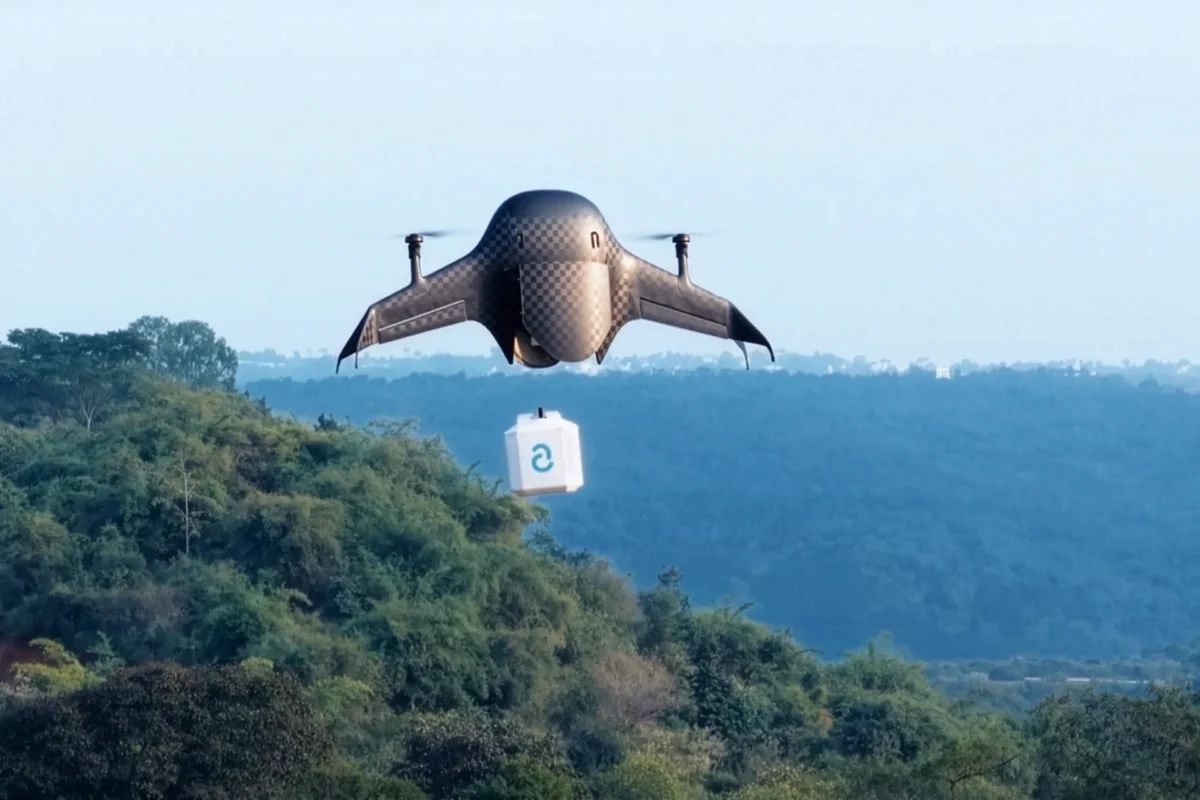
Airbound, an innovative Indian startup at the forefront of autonomous drone technology, has successfully closed a Series A funding round, raising $37 million in fresh capital. This significant investment propels the company closer to its ambitious goal: transforming the logistics landscape by making aerial goods movement as economical as traditional road transportation. The round was spearheaded by prominent venture capital firm Greenoaks, with substantial participation from key players including DoorDash, Lachy Groom, Lightspeed, and Humba Ventures. This latest influx of capital brings the three-year-old company’s total funding to nearly $50 million, building on an $8.65 million seed round secured less than a year prior.
The burgeoning sector of drone delivery is predicated on the promise of unparalleled speed and efficiency for specific cargo types, challenging the established dominance of ground vehicles. While successful pilot programs and niche deployments have demonstrated the viability of drone logistics, the industry still grapples with scaling operations to match the vast reach and versatility of conventional trucking networks. Airbound is strategically positioned to bridge this gap, focusing on fundamental aircraft redesign to achieve competitive cost parity with existing ground-based alternatives.
Rethinking Aerial Logistics: The Airbound Design Philosophy
At the core of Airbound’s strategy is a radical reimagining of drone architecture. Traditional aircraft often expend a considerable portion of their energy simply supporting their own weight rather than maximizing payload capacity, rendering flight inherently expensive, particularly for smaller loads. Naman Pushp, founder and CEO of Airbound, articulated the company’s solution: developing vertical-flight drones meticulously engineered to weigh less than the cargo they are designed to transport. This inverted weight ratio is a critical differentiator, aiming to dramatically reduce operational costs and enhance fuel efficiency.
The company’s current operational drone, designated TRT, exemplifies this design philosophy. It weighs approximately 3.3 pounds (1.5 kg) and is capable of carrying a payload of around 2.2 pounds (1 kg). Looking ahead, Airbound is actively developing its next-generation aircraft, which is projected to weigh approximately 6.6 pounds (3 kg) while boasting a significantly increased payload capacity of up to 11 pounds (5 kg). This continuous evolution in design underscores Airbound’s commitment to optimizing the payload-to-weight ratio, a key metric for economic viability in logistics.
Airbound drones feature a distinctive rocket-like, tail-sitter configuration. This innovative design enables the aircraft to execute vertical takeoffs and landings in an upright position, subsequently transitioning seamlessly into horizontal flight. Pushp emphasized the strategic importance of retaining Vertical Takeoff and Landing (VTOL) capabilities, even as the company scales up to larger aircraft designs. This independence from conventional runways is a significant advantage, allowing for greater operational flexibility and the establishment of delivery points in diverse, often challenging, geographical locations. "We want to build towards a world where everything has cost parity with trucking," Pushp stated, encapsulating the company’s ambitious long-term vision.
Operational Milestones and Real-World Impact
Since its inception in 2023, Airbound has achieved impressive operational milestones, completing over 13,000 autonomous flights across the southern Indian cities of Bengaluru and Guntur. A cornerstone of their early success has been a transformative partnership with Narayana Health, a prominent Indian hospital network. This collaboration has seen Airbound drones conduct more than 1,000 flights, primarily transporting critical diagnostic samples between various healthcare facilities.
The efficiency gains demonstrated through this partnership are profound. A single active Airbound drone on the Narayana route can transport diagnostic samples approximately 2.5 miles (4 km) in a mere seven minutes. In stark contrast, the same transportation task, if reliant on road transport, could take between three to five hours. This extended duration is not solely due to traffic congestion but also includes the considerable time spent waiting for a sufficient volume of samples to accumulate before they can be bundled for a cost-effective road journey. The immediate availability and rapid transit offered by drones translate directly into faster diagnoses and potentially life-saving treatment decisions.
The success of this pilot program is leading to an expansion of the partnership. Narayana Health’s new Banashankari hospital in Bengaluru has been deliberately designed without an on-site diagnostic laboratory or blood bank. Instead, it will strategically rely on Airbound’s drone network to seamlessly connect with centralized facilities, representing a pioneering model for integrated healthcare logistics that prioritizes efficiency and centralized resource management. This innovative approach highlights the potential for drone technology to fundamentally alter infrastructure planning in critical sectors.
Forging a Multi-City Drone Network in Andhra Pradesh
Airbound’s strategic vision extends far beyond individual hospital routes. The company has articulated a far grander ambition: to establish a comprehensive drone delivery network spanning three key cities within the state of Andhra Pradesh. This ambitious undertaking is underpinned by an agreement with the state government, outlining an eventual target of 10,000 daily flights dedicated to retail, e-commerce, and healthcare deliveries. Achieving this daily flight volume would necessitate a fleet ranging from 250 to 1,000 aircraft, depending on the varying route lengths, though Pushp anticipates the requirement to be closer to 250.
Crucially, this agreement with the Andhra Pradesh government does not entail a direct government contract or subsidy. Instead, the state government is actively collaborating with Airbound to develop the necessary regulatory framework to enable the large-scale operation of such a network. This partnership signifies a proactive approach by state authorities to foster innovation and facilitate the integration of advanced technologies into public infrastructure. Airbound’s business model in this context is predicated on generating revenue from commercial entities that will utilize its network for their delivery needs, positioning the company as a foundational logistics provider rather than merely an operator.
The "Boeing Role": A Platform for Aerial Logistics
The Indian drone sector is experiencing a period of rapid growth, with several startups like Skye Air Mobility and TSAW Drones actively building aerial logistics businesses. Additionally, established Indian drone manufacturers such as Garuda Aerospace have explored various delivery use cases. Within this competitive landscape, Airbound distinguishes itself with a unique strategic focus. Naman Pushp articulated this differentiation by stating that Airbound aims to build the fundamental aircraft infrastructure that other logistics networks could ultimately adopt and rely upon, rather than striving to become the largest direct delivery operator itself.
"That’s the Boeing role — the aircraft airlines everywhere rely on, not the airline itself," Pushp elaborated. This analogy underscores Airbound’s ambition to be a foundational technology provider, creating robust, scalable, and cost-effective drone platforms that can power a myriad of aerial logistics operations across various industries and service providers. This strategic positioning could allow Airbound to capture a significant share of the burgeoning drone market by becoming an indispensable supplier of aerial vehicles, similar to how major aircraft manufacturers serve the global airline industry.
Manufacturing and the Regulatory Bottleneck
Airbound maintains a robust in-house design and manufacturing capability within its expansive 43,000-square-foot facility located in Bengaluru. This facility is responsible for the production of airframes and other core drone systems, ensuring tight control over quality, innovation, and intellectual property. While Pushp refrained from disclosing specific production capacities or the exact number of aircraft manufactured to date, he expressed confidence that manufacturing capabilities would not impede Airbound’s scaling efforts. The company’s integrated approach to design and production is designed to ensure that as demand grows, their ability to produce drones will keep pace.
However, Pushp identified a more significant impediment to large-scale deployment: regulation. Specifically, securing approvals for Beyond Visual Line of Sight (BVLOS) operations remains the primary bottleneck. BVLOS certification is critical for drone delivery networks to operate at scale, enabling drones to fly autonomously beyond the direct visual sight of an operator, often over long distances and varied terrains. While India has made strides in drone policy, the complexities and rigorous requirements for BVLOS approvals can be time-consuming and challenging for operators. The lack of ubiquitous BVLOS permissions across the country restricts Airbound’s ability to fully commercialize its extensive flight operations and generate substantial revenue.
Despite the company’s impressive technological advancements, operational milestones, and a team exceeding 150 employees, Airbound remains broadly pre-revenue. This reflects the early stage of the drone delivery market and the capital-intensive nature of developing and deploying advanced autonomous systems, particularly within a nascent regulatory environment. Pushp acknowledged this, stating, "The goal is to be a giant in a few decades, not to make revenue as soon as we can." This long-term perspective emphasizes a commitment to foundational development and market creation over immediate profitability, a common strategy for disruptive deep-tech startups.
Broader Implications and Future Outlook
Airbound’s successful funding round and strategic direction hold significant implications for the future of logistics, healthcare, and the broader Indian startup ecosystem. For logistics, the prospect of cost-effective aerial transport could revolutionize supply chains, particularly for urgent, high-value, or time-sensitive goods. Industries ranging from pharmaceuticals to e-commerce stand to benefit from faster delivery times and enhanced reach, especially in geographically challenging or underserved regions.
In healthcare, the Narayana Health partnership serves as a powerful testament to the transformative potential of drone technology. By enabling rapid transport of medical samples, drones can significantly reduce diagnostic turnaround times, leading to quicker patient care and improved health outcomes. The model of designing hospitals to leverage centralized diagnostic facilities via drone transport could become a blueprint for future healthcare infrastructure development, particularly in developing nations seeking to optimize resource allocation.
For India, Airbound’s success signals the growing maturity and ambition of its deep-tech and hardware startup ecosystem. The substantial investment from international and domestic venture capital firms underscores a strong belief in India’s capacity to innovate in cutting-edge technologies. This could inspire further investment and foster a vibrant environment for engineering talent, contributing to job creation and economic growth. Furthermore, India’s proactive approach to developing regulatory frameworks, even if challenging, positions it as a potential leader in shaping the global standards for drone operations.
As the world grapples with increasing urbanization, supply chain complexities, and demands for faster service, the integration of autonomous drones into the logistics fabric is becoming an inevitability. Airbound, with its innovative design philosophy, proven operational capabilities, and strategic long-term vision, is poised to play a pivotal role in defining this future, aspiring to lay the groundwork for a new era of aerial commerce and essential service delivery. The path ahead involves navigating regulatory complexities and continuing technological refinement, but the potential rewards – a world where critical goods move with unprecedented speed and efficiency – are immense.