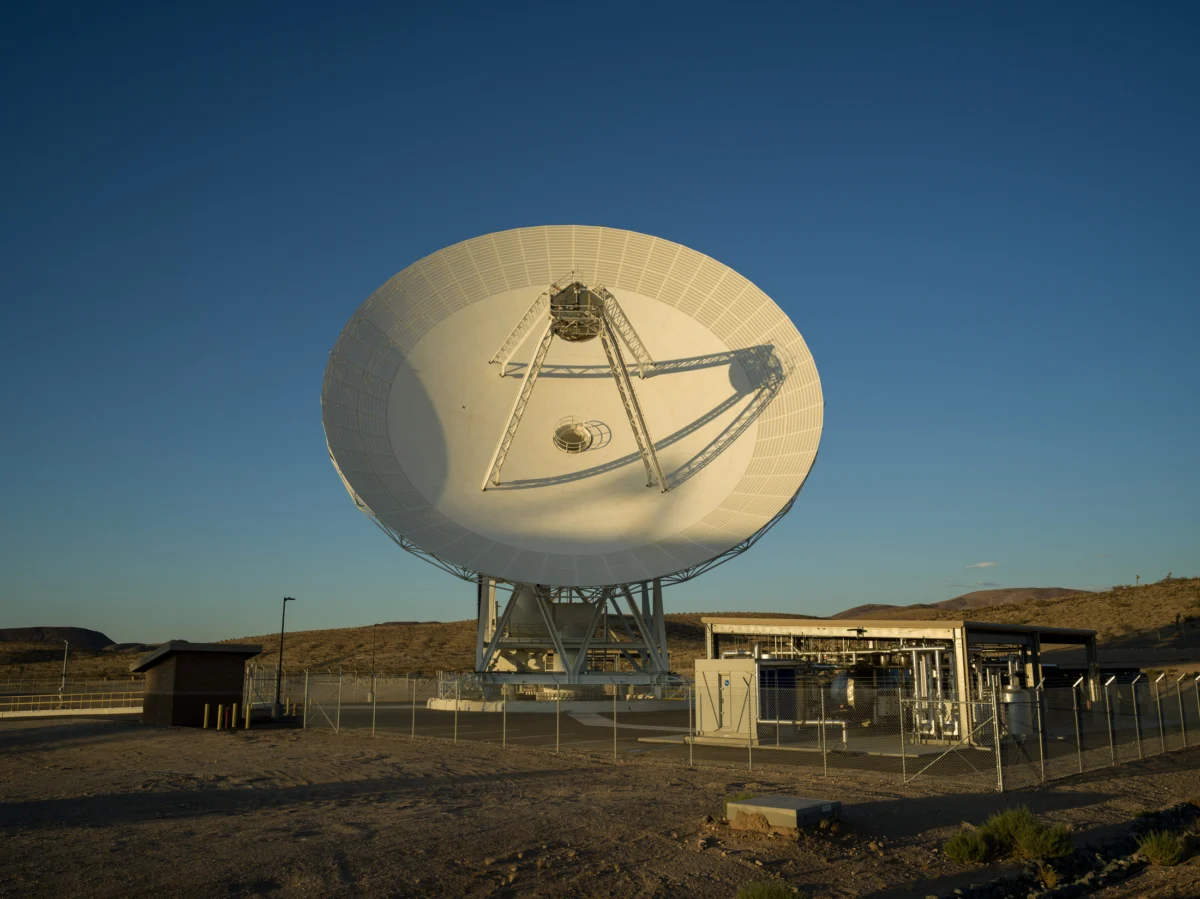
The National Aeronautics and Space Administration (NASA) has officially inaugurated a pivotal addition to its global deep space communications infrastructure, marking a significant milestone in humanity’s ongoing quest to explore the cosmos. The new 34-meter-wide (114-foot-wide) radio frequency antenna, designated Deep Space Station 23 (DSS-23), has been seamlessly integrated into the agency’s Deep Space Network (DSN) at the Goldstone Deep Space Communications Complex, situated near Barstow in Southern California. This state-of-the-art instrument represents a substantial upgrade to the network, which employs giant dish antennas strategically positioned across three global facilities to maintain vital communication links with more than 40 spacecraft currently traversing the solar system and venturing into interstellar space. The formal ribbon-cutting ceremony, attended by NASA leadership, dedicated personnel, and distinguished dignitaries, celebrated the completion of DSS-23, which is the latest component to come online as part of the Deep Space Network’s ambitious Aperture Enhancement Project. This long-running initiative, launched in 2009, is systematically expanding and modernizing the network through the addition of six advanced 34-meter multifrequency beam-waveguide antennas, each designed for enhanced versatility and operational efficiency across a broad spectrum of radio frequencies essential for diverse mission profiles.
The Deep Space Network: A Global Lifeline for Cosmic Exploration
At its core, the Deep Space Network (DSN) serves as the indispensable backbone of NASA’s robotic and human space exploration endeavors, providing the critical two-way radio communication links that enable scientists and engineers on Earth to command spacecraft, receive invaluable scientific data, and track mission trajectories across astronomical distances. Established in 1958, the DSN is managed by NASA’s Jet Propulsion Laboratory (JPL) in Southern California, which is operated by Caltech for the agency. Its unique global configuration, comprising complexes in Goldstone, California; Madrid, Spain; and Canberra, Australia, ensures continuous communication with missions as the Earth rotates, offering uninterrupted coverage for spacecraft beyond low Earth orbit. Each complex is equipped with multiple high-gain antennas, ranging from the venerable 70-meter (230-foot) dishes capable of detecting faint signals from the farthest reaches of the solar system, to numerous 34-meter antennas that provide robust communication for a multitude of missions. This intricate network is a testament to decades of engineering ingenuity and operational excellence, supporting everything from Mars rovers and orbital observatories to interstellar probes like the Voyagers, which have now journeyed beyond the heliosphere. The DSN’s capacity to communicate across billions of miles, accurately tracking and receiving data at incredibly low signal-to-noise ratios, is fundamental to the success of missions that push the boundaries of human knowledge.
DSS-23: A New Era of Enhanced Communication Capabilities
The integration of DSS-23 is a direct response to the increasing demands of a rapidly expanding fleet of sophisticated spacecraft and the ambitious scope of future missions. As the fifth antenna to be added under the Aperture Enhancement Project, DSS-23 brings with it advanced multifrequency beam-waveguide technology. This innovative design allows the sensitive electronic receiving and transmitting equipment to be housed in a stable, climate-controlled underground room, rather than on the moving antenna dish itself. This architectural choice offers several distinct advantages: it simplifies maintenance and upgrades, as technicians can access the equipment without having to physically climb the antenna structure; it improves signal quality by reducing noise and interference associated with equipment mounted directly on the dish; and it enhances the antenna’s versatility, allowing it to communicate across multiple radio frequency bands (such as X-band and Ka-band) with greater efficiency. This versatility is crucial for supporting a diverse array of missions, each with specific communication requirements and data rates. The project’s goal of adding six such antennas underscores NASA’s strategic investment in future-proofing its deep space communication infrastructure, ensuring that the DSN remains capable of handling the ever-growing volume of data and the increasingly complex communication needs of tomorrow’s scientific and exploratory endeavors.
A Detailed Timeline of Construction and Commissioning
The journey of DSS-23 from conception to operational readiness involved a meticulous multi-year process, highlighting the significant engineering and logistical challenges inherent in constructing such a precise instrument. The groundbreaking ceremony for DSS-23 took place in February 2020, marking the official commencement of civil engineering works and foundation laying. Over the subsequent months, a dedicated team of engineers, technicians, and construction workers toiled to erect the massive structure. A pivotal moment in the construction phase occurred in December 2022, when the colossal 133-ton metal reflector framework was carefully hoisted and securely bolted atop the antenna’s central pedestal. This intricate operation required pinpoint precision and coordination. Following the placement of the framework, engineers meticulously installed the numerous individual panels that collectively form the antenna’s parabolic dish. These panels are critical for accurately reflecting radio frequency signals transmitted to and received from distant spacecraft. The final and arguably most critical phase involved the painstaking calibration of the antenna. This process, which can take months, ensures that DSS-23 operates with extraordinary precision and can seamlessly integrate and work in concert with the existing antennas within the Deep Space Network, precisely aligning its focus to capture faint signals from billions of miles away or transmit commands with utmost accuracy.
Following its physical completion and initial calibration, DSS-23 underwent an intensive testing campaign from May through July of the current year. This rigorous evaluation period was designed to thoroughly demonstrate the antenna’s capabilities across various operational scenarios, ensuring its readiness for mission-critical tasks. These tests involved transmitting and receiving signals, tracking simulated spacecraft, and verifying its performance against established benchmarks. Upon successful completion of this comprehensive testing, DSS-23 officially commenced operations on August 3. Its inaugural tracking assignment was with NASA’s Chandra X-ray Observatory, a flagship mission that has been providing invaluable insights into the X-ray universe since its launch in 1999. Since then, DSS-23 has rapidly integrated into the DSN’s operational rhythm, establishing vital communication links with a multitude of active deep space missions. These include the Mars Reconnaissance Orbiter, which has been studying Mars from orbit since 2006; the Psyche mission, currently en route to a metal-rich asteroid; the Juno spacecraft, diligently exploring Jupiter; and the iconic Voyager 1, humanity’s farthest-flung emissary in interstellar space. The swift transition from testing to active mission support underscores the antenna’s immediate impact and the efficiency of the teams involved.
Official Reactions and Strategic Implications
The inauguration of DSS-23 has been met with significant enthusiasm within NASA and the broader space community, with leadership emphasizing its strategic importance for the agency’s future endeavors. James Kenyon, associate administrator of the Research and Technology Mission Directorate at NASA Headquarters in Washington, articulated the profound significance of this expansion: “By expanding the Deep Space Network, we are strengthening the communications foundation NASA needs for the bold missions ahead — from exploring more of the Moon than ever before to peering deeper into the solar system. This new antenna will help us deliver on our national goals for space exploration and push beyond the limits of what once seemed impossible.” This statement highlights the integral role of the DSN in enabling ambitious projects like the Artemis program, which aims to return humans to the Moon and establish a sustained lunar presence, as well as future robotic missions designed to explore the outer planets and beyond. The ability to maintain robust, high-bandwidth communication with these increasingly complex missions is paramount for their success, allowing for real-time decision-making and the transmission of vast quantities of scientific data.
Dave Gallagher, director of JPL, echoed this sentiment, underscoring the modernization efforts and the network’s enduring legacy. “The addition of this next-generation antenna brings us closer to a completely modernized network that embraces advanced technology to ensure NASA’s leadership in deep space communications,” Gallagher stated. He further added, “After over 60 years of continuous operations supporting consequential missions, these upgrades prime the network for a new era of exploration. The teams that designed, planned, and built DSS-23 should be proud.” This perspective acknowledges the DSN’s rich history of supporting groundbreaking missions, from the early Mariner and Voyager programs to the current generation of Mars rovers and interstellar probes. The ongoing modernization, exemplified by DSS-23, ensures that NASA’s communication capabilities evolve in parallel with its scientific ambitions, maintaining its position at the forefront of space exploration. The complexity of this evolution was further highlighted by Germaine Aziz, manager of the Deep Space Network Aperture Enhancement Project at JPL, who noted, “The biggest challenge wasn’t actually constructing the antenna. It was transforming a complex collection of mechanical, electrical, software, radio frequency, and infrastructure systems into a single, mission-ready asset. Every subsystem must be integrated, calibrated, and verified to operate with extraordinary precision and reliability before it can support NASA’s deep space missions.” This emphasizes the intricate systems engineering required to bring such a sophisticated instrument online and integrate it into a global network.
The Broader Network Landscape and Future Enhancements
DSS-23 is now the fifth operational antenna at the Goldstone complex, complementing three other 34-meter antennas and one colossal 70-meter antenna that have long served as the workhorses of deep space communication. Its addition not only increases the overall capacity of the Goldstone facility but also enhances the resilience of the entire DSN. The Aperture Enhancement Project is a strategic initiative that looks beyond simply adding capacity; it also addresses the long-term sustainability of the network. The DSN’s venerable 70-meter antennas, while incredibly powerful, have been in near-continuous operation for over 50 years. As with any aging infrastructure, their maintenance and repair costs are progressively increasing. The project’s long-term vision includes the ability to "array" the newer 34-meter antennas – combining and operating several of them together to achieve a communications capability equivalent to a single 70-meter dish. This innovative approach provides a crucial communications backup for each facility’s single 70-meter antenna, ensuring that NASA’s most demanding missions can always maintain robust contact, even as the older antennas eventually transition out of primary service or undergo extensive overhauls. This strategy ensures redundancy and operational continuity, safeguarding against potential single points of failure.
The Aperture Enhancement Project is slated for completion with the upcoming addition of a sixth enhancement-project antenna, Deep Space Station 33 (DSS-33), which is currently under construction at the Canberra facility in Australia. DSS-33 is projected to come online in 2029. Once completed, this will bring the total number of 34-meter antennas across the entire Deep Space Network to thirteen, significantly bolstering the network’s capacity, flexibility, and redundancy. This comprehensive upgrade represents a forward-thinking approach to managing the escalating demands of deep space exploration, acknowledging that future missions will require even greater data throughput, faster communication speeds, and unparalleled reliability.
Management, Oversight, and Interconnectedness
The intricate operation and ongoing development of the Deep Space Network are overseen by NASA’s Space Communications and Navigation (SCaN) Program, which falls under the Research and Technology Mission Directorate at NASA Headquarters. JPL, with its profound expertise in deep space missions, manages the day-to-day operations of the DSN, ensuring its continuous readiness and optimal performance. The DSN’s critical role extends far beyond robotic planetary exploration. In collaboration with the Near Space Network, which provides communication services for missions closer to Earth, the DSN supports over 100 NASA and non-NASA missions. These encompass a broad spectrum of objectives, including maintaining vital links with astronauts aboard the International Space Station, supporting the ambitious Artemis missions aimed at returning humans to the Moon and establishing a lunar presence, continuously monitoring Earth’s climate and environment, and enabling the exploration of the solar system and beyond. The seamless integration of communication infrastructure, from near-Earth to interstellar distances, is a testament to NASA’s holistic approach to space operations, ensuring that every endeavor, from protecting our home planet to unraveling the mysteries of the universe, is supported by a robust and reliable communications lifeline. The successful integration of DSS-23 is a vivid demonstration of this commitment, paving the way for the next generation of scientific discoveries and human exploration.
For more information about the Deep Space Network, please visit: https://www.nasa.gov/communicating-with-missions/dsn