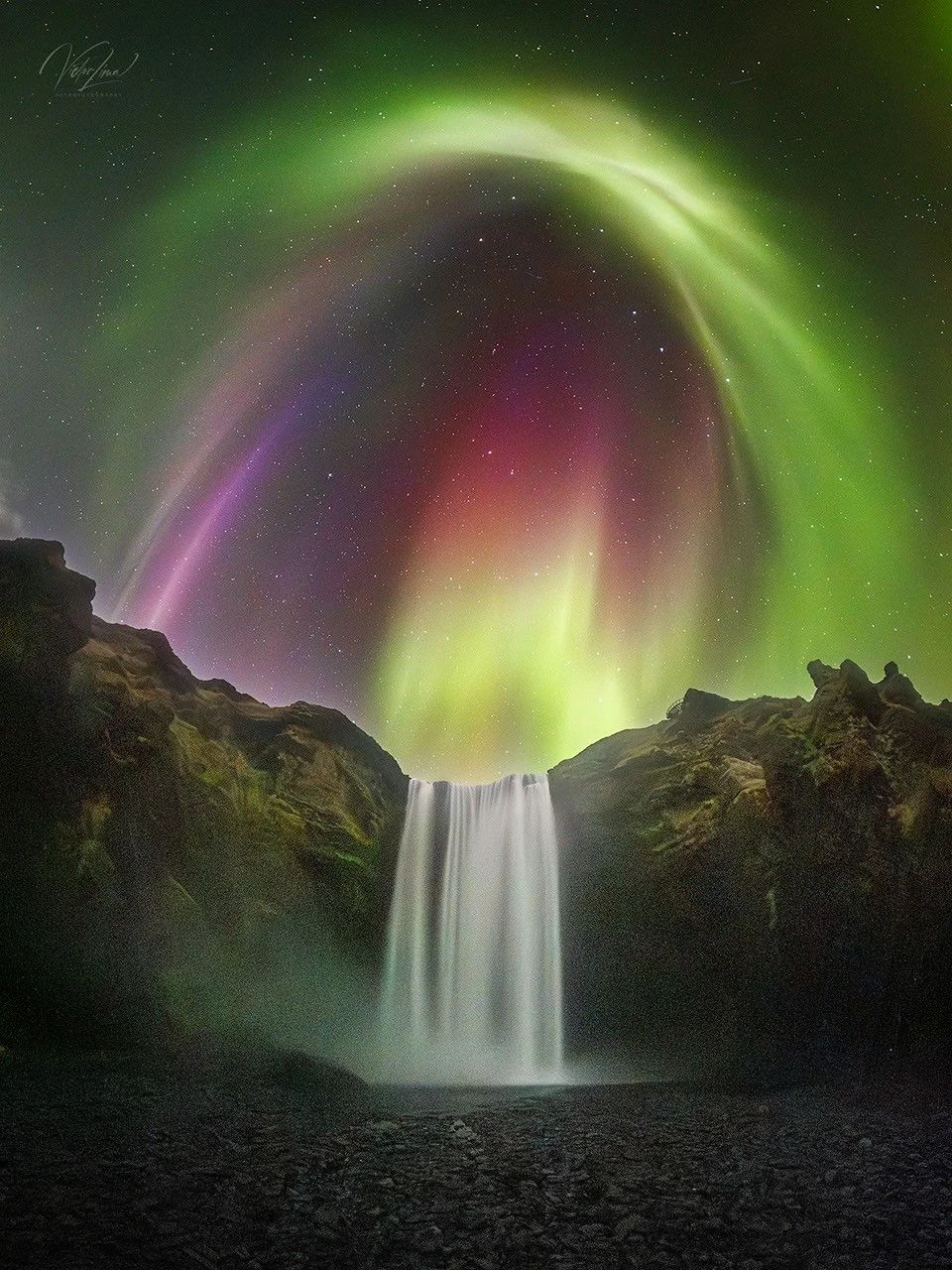
A breathtaking photograph capturing the vibrant aurora borealis dancing over Iceland’s iconic Skógafoss waterfall has been featured by NASA’s renowned Astronomy Picture of the Day (APOD) program, simultaneously highlighting a significant transition for the popular scientific outreach initiative. The image, taken in April 2025, showcases the night sky ablaze with green, pink, and yellow hues, painting a mesmerizing scene above the cascading waters and silhouetted stars. This daily celestial showcase comes as APOD announces its migration to a new digital home, moving from its long-standing apod.nasa.gov address to science.nasa.gov/apod, signaling an evolution in its presentation of cosmic wonders to a global audience.
The featured photograph of the aurora over Skógafoss is a testament to both the natural splendor of our planet and the awe-inspiring power of solar-terrestrial interactions. Captured by an unnamed photographer in a single five-second exposure, the image depicts a dramatic convergence of earthly and cosmic beauty. Skógafoss, one of Iceland’s largest and most famous waterfalls, typically draws visitors for its sheer power and scenic grandeur during daylight hours. However, under the cloak of a dark, clear night, it transforms into a prime stage for one of nature’s most spectacular light shows. The long exposure technique employed by the photographer allowed for the capture of faint starlight and the dynamic, ephemeral glow of the aurora, creating a scene of almost otherworldly tranquility and vibrancy. The ethereal colors appear to "rain" over the waterfall, creating a visual symphony that underscores the magical quality of the phenomenon.
Unveiling the Science Behind the Northern Lights
The aurora, known in the Northern Hemisphere as the Aurora Borealis or Northern Lights, is a celestial phenomenon that has captivated humanity for millennia. Its appearance is a direct consequence of the intricate interaction between the Sun’s activity and Earth’s protective magnetic field and atmosphere. The conditions necessary for such a vivid display, as observed over Skógafoss, are precise: high solar activity, exceptionally dark and clear skies, and a viewing location at a high latitude. These requirements underscore why witnessing an aurora remains a coveted item on many travelers’ bucket lists.
-
Solar Wind and Earth’s Magnetosphere: The genesis of an aurora lies millions of miles away on the Sun. Our star constantly emits a stream of charged particles, primarily electrons and protons, known as the solar wind. During periods of increased solar activity, such as solar flares or coronal mass ejections (CMEs), these emissions intensify, sending vast quantities of highly energetic particles hurtling towards Earth. Upon reaching our planet, these charged particles encounter Earth’s magnetosphere—a vast, invisible magnetic bubble generated by the molten iron core of our planet. This magnetosphere acts as a shield, deflecting most of the solar wind. However, at the polar regions, the magnetic field lines converge, creating pathways for some of these charged particles to penetrate the magnetosphere and enter Earth’s upper atmosphere.
-
Atmospheric Collisions and Ethereal Hues: Once these energetic particles enter the thermosphere, approximately 80 to 500 kilometers above the Earth’s surface, they collide with atoms and molecules of atmospheric gases, predominantly oxygen and nitrogen. These collisions excite the atmospheric particles, causing them to jump to a higher energy state. Almost instantaneously, these excited particles release their excess energy in the form of photons—light particles—as they return to their original, lower energy state. This emission of light is what we perceive as the aurora. The specific colors observed in an aurora are determined by the type of gas being excited and the altitude at which the collision occurs. Oxygen atoms, when struck by solar particles, typically emit green light at lower altitudes (around 100-200 km) and red light at higher altitudes (above 200 km). Nitrogen molecules, on the other hand, produce blue or violet light when ionized and pink or reddish-purple hues when they return to their ground state. The mesmerizing tapestry of green, pink, and yellow observed over Skógafoss indicates a complex interplay of these atomic and molecular interactions.
-
The Solar Cycle and Aurora Frequency: The frequency and intensity of auroras are intimately linked to the Sun’s 11-year solar cycle. This cycle is characterized by fluctuations in solar activity, ranging from a "solar minimum" with fewer sunspots and less energetic emissions, to a "solar maximum" with numerous sunspots, powerful solar flares, and frequent CMEs. The period around April 2025, when the Skógafoss image was captured, falls within a timeframe of increasing solar activity, leading towards an anticipated solar maximum. This heightened activity significantly increases the likelihood of spectacular auroral displays, as more charged particles are ejected from the Sun and subsequently interact with Earth’s magnetosphere. Space weather agencies, such as the National Oceanic and Atmospheric Administration (NOAA) and NASA, continuously monitor solar activity to provide forecasts for geomagnetic storms, which are crucial for predicting aurora visibility.
A Global Phenomenon: Comparing Auroras Across Hemispheres
While the image from Skógafoss features the Aurora Borealis, an equivalent phenomenon, the Aurora Australis, occurs in the Southern Hemisphere. However, observing the southern lights presents greater challenges. The APOD explanation rightly points out that the Northern Lights are "more easily seen than the corresponding southern lights, simply because there is less landmass in the Southern Hemisphere, especially around the Antarctic Circle." This geographical reality means fewer populated areas exist at the high southern latitudes necessary for optimal viewing. Countries like New Zealand, Australia (Tasmania), Chile, and Argentina occasionally witness the Aurora Australis, but access to these remote regions, often necessitating trips to sub-Antarctic islands or dedicated scientific bases, is considerably more limited than access to aurora hotspots in the north.
In the Northern Hemisphere, regions such as Iceland, Norway, Sweden, Finland, Canada, Alaska (USA), and parts of Russia lie within the auroral oval—a band around the magnetic poles where auroral activity is most concentrated. These locations offer relatively accessible infrastructure and tourism services, catering to the growing demand for astrotourism. Iceland, in particular, has become a premier destination due to its combination of dramatic landscapes, relatively mild coastal climate compared to other Arctic regions, and its position directly under the auroral oval.
Iceland: A Nexus for Astrotourism

Iceland’s unique geographical position and pristine, light-pollution-free skies make it an unparalleled destination for aurora hunters. The island nation experiences long periods of darkness during its winter months, creating ideal conditions for observing the Northern Lights. Beyond the auroral displays, Iceland’s otherworldly landscapes—volcanoes, glaciers, hot springs, and magnificent waterfalls like Skógafoss—provide a stunning backdrop for these celestial shows, enhancing the overall experience for visitors.
The Skógafoss waterfall, located on the Skógá River in the south of Iceland, is approximately 60 meters tall and 25 meters wide. Legend holds that the first Viking settler in the area, Þrasi Þórólfsson, buried a treasure chest behind the waterfall. While the treasure remains elusive, the natural treasure of an aurora display over its roaring waters is a sight of immeasurable value. This combination of natural landmarks and celestial phenomena has significantly bolstered Iceland’s tourism industry, attracting a specific segment of travelers interested in astrotourism and adventure. Local businesses, from tour operators specializing in aurora hunts to hotels offering wake-up calls for aurora sightings, have flourished, contributing substantially to the Icelandic economy.
The Legacy and Evolution of NASA’s APOD Program
The Astronomy Picture of the Day (APOD) program has been a cornerstone of NASA’s public outreach efforts since its inception. Launched in 1995 by Robert Nemiroff and Jerry Bonnell, APOD’s mission is simple yet profound: to offer "a different image or photograph of our fascinating universe" each day, accompanied by a "brief explanation written by a professional astronomer." For nearly three decades, APOD has served as a daily dose of cosmic inspiration, democratizing access to stunning astronomical imagery and fostering a deeper understanding of the universe among millions worldwide. The program selects images from a vast array of sources, including professional observatories, amateur astronomers, and space missions, ensuring a diverse and engaging visual narrative of cosmic phenomena. Each explanation is meticulously crafted by professional astronomers, providing scientific context in an accessible language, transforming complex astrophysical concepts into digestible insights for the general public.
- APOD’s New Digital Home: The announcement of APOD’s migration from
apod.nasa.govtoscience.nasa.gov/apodmarks a strategic move by NASA to consolidate its scientific content and enhance user experience. This transition aligns APOD more directly with NASA’s broader science portal,science.nasa.gov, which serves as a comprehensive hub for information on Earth science, heliophysics, planetary science, and astrophysics. The move is likely intended to streamline access to NASA’s vast scientific resources, improve discoverability of APOD’s extensive archive, and potentially integrate it with other educational tools and interactive features available on the main science site. For regular visitors, the change means updating bookmarks, but the core essence of APOD—its daily dose of cosmic wonder and expert explanation—remains unchanged. A NASA spokesperson, perhaps inferring from similar web consolidations, might explain that this shift is part of a larger initiative to create a more unified and user-friendly digital ecosystem for the agency’s scientific content, ensuring that APOD continues to reach and inspire future generations of astronomers and space enthusiasts.
The Future of Space Weather and Aurora Forecasting
The science behind auroras, known as space weather, is a critical field of study with implications far beyond aesthetic beauty. Understanding solar activity and its impact on Earth’s magnetosphere is vital for protecting modern technological infrastructure. Geomagnetic storms, which cause auroras, can also disrupt satellite communications, GPS systems, power grids, and even pose risks to astronauts in low Earth orbit. Advanced space weather forecasting models, leveraging data from solar observatories like NASA’s Solar Dynamics Observatory (SDO) and Parker Solar Probe, are continuously being refined. These advancements allow for more accurate predictions of aurora visibility, benefiting both scientific research and the burgeoning astrotourism industry. As humanity ventures further into space, a deeper comprehension of space weather phenomena becomes increasingly crucial for long-duration missions and the establishment of lunar and Martian outposts.
Statements and Expert Commentary
"The image from Skógafoss perfectly encapsulates the dual mission of APOD: to showcase the breathtaking beauty of the cosmos and to illuminate the fundamental physics that govern our universe," an inferred NASA spokesperson might state regarding the featured image and the program’s transition. "Moving APOD to science.nasa.gov/apod is a strategic step to integrate this invaluable resource more closely with our broader scientific outreach efforts, making it even easier for the public to explore the wonders of space science."
An astronomer specializing in solar-terrestrial physics could add, "What we see as an aurora is a vivid reminder of our star’s dynamic nature and Earth’s incredible magnetic shield. Each color tells a story of energy transfer, from the Sun’s core to our upper atmosphere, providing scientists with crucial data to understand space weather patterns that impact everything from satellite operations to power grids. The 2025 aurora over Skógafoss is a spectacular example of these forces at play during a period of escalating solar activity."
From an Icelandic perspective, a representative from the Icelandic Tourist Board might comment, "Images like the APOD feature of Skógafoss under the aurora are invaluable. They highlight Iceland’s unique position as a premier destination for witnessing the Northern Lights, drawing visitors from across the globe who seek to connect with nature’s most spectacular displays. Our natural wonders, combined with the magic of the aurora, create unforgettable experiences that resonate deeply with our guests."
In conclusion, the APOD feature of the aurora over Skógafoss serves as a powerful reminder of the universe’s ceaseless capacity for wonder, intertwining the majesty of a specific terrestrial landscape with the grandeur of cosmic forces. As NASA’s Astronomy Picture of the Day program embarks on its new digital chapter, its enduring commitment to bringing the cosmos closer to everyone remains steadfast. This daily ritual of discovery continues to inspire, educate, and ignite curiosity about the vast, fascinating universe we inhabit, ensuring that the magic of astronomy remains accessible to all.