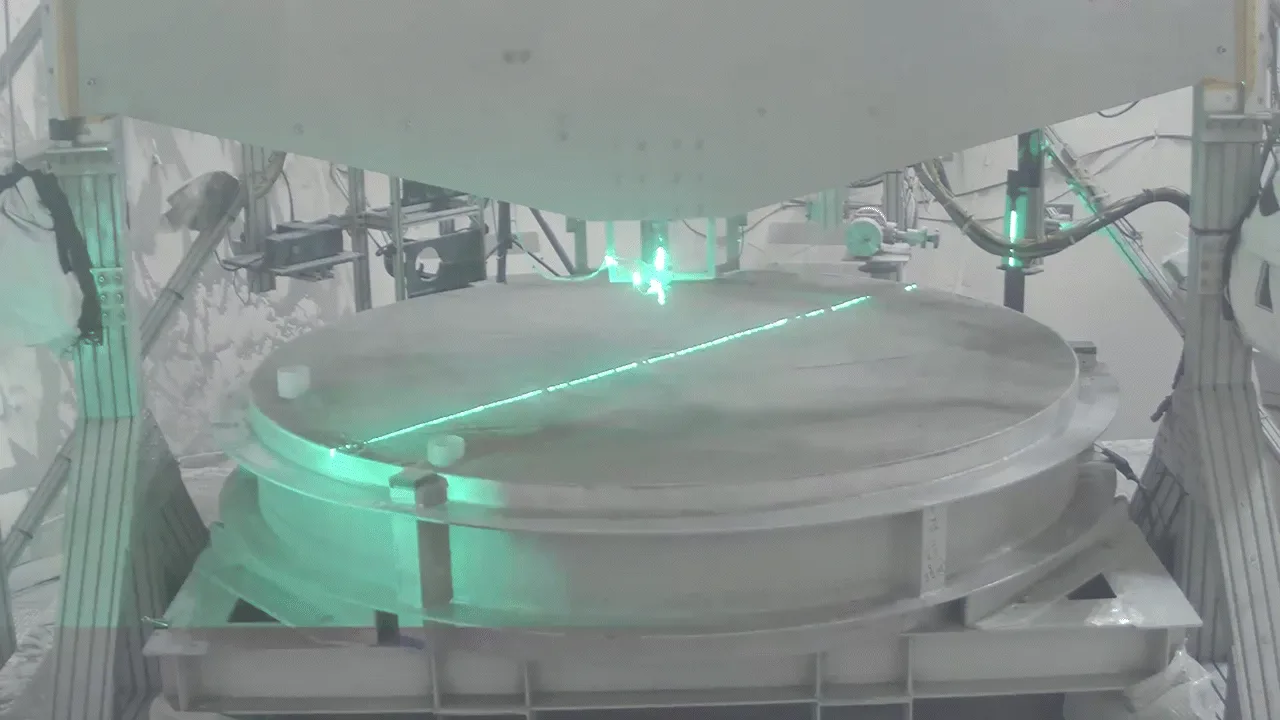
In a critical stride toward ensuring the safety and success of future lunar missions, a dedicated team at NASA’s Langley Research Center in Hampton, Virginia, has embarked on an ambitious series of plume-surface interaction (PSI) tests within a colossal 60-foot spherical vacuum chamber. These pioneering experiments, which began in December and were significantly updated on August 26, 2026, with new data and visual assets, are designed to unravel the complex science behind lunar landings, specifically addressing the formidable hazards posed by lander engine plumes interacting with the Moon’s abrasive dust, soil, and rocks. As NASA prepares to return humans to the lunar surface with Artemis IV in 2028 and establish a permanent Moon Base, the invaluable data gleaned from these tests will be instrumental in refining predictive models, optimizing spacecraft designs, and ultimately safeguarding both astronauts and vital equipment.
The Lunar Dust Dilemma: A Historical and Future Challenge
The interaction between a spacecraft’s exhaust plume and the lunar surface, known as Plume-Surface Interaction (PSI), presents one of the most persistent and dangerous challenges for lunar landings. When a rocket engine fires near the Moon’s surface, its high-velocity exhaust gases disturb and accelerate the lunar regolith – a layer of loose, unconsolidated dust, soil, and broken rock. This phenomenon creates a high-speed "ejecta curtain" of particles that can pose significant threats:
- Abrasion and Erosion: High-velocity dust particles can act like sandpaper, eroding landing pads, sensitive instruments, optical components, and even astronaut suits.
- Contamination: Fine lunar dust can adhere to nearly everything due to its electrostatic properties, contaminating scientific payloads, solar panels, and life support systems.
- Visibility Impairment: The cloud of ejected dust can severely reduce visibility for astronauts and autonomous landing systems during the critical final descent phase, potentially leading to unsafe landing conditions.
- Crater Formation: The exhaust plume can carve out craters beneath the lander, creating unstable terrain or burying scientific equipment.
The Apollo missions offered early, albeit limited, insights into the PSI phenomenon. Astronauts reported obscured vision during final descent and observed significant dust deposition on their spacecraft. However, with the Artemis program aiming for longer-duration stays, the establishment of a lunar base, and the involvement of more complex hardware and commercial partners, a deeper, more predictive understanding of PSI is paramount. The Moon’s regolith itself is uniquely problematic; unlike terrestrial dust, lunar dust is extremely fine, angular, and abrasive due, in part, to billions of years of micrometeorite bombardment in a vacuum. It also carries an electrostatic charge, causing it to cling stubbornly to surfaces and travel further than expected in the Moon’s low gravity.
Artemis Program’s Ambitious Goals and the Imperative for Research
The ongoing tests at NASA Langley are directly linked to the ambitious objectives of the Artemis program, which envisions a sustained human presence on the Moon. The program’s foundational phase involves a series of increasingly complex missions, culminating in Artemis IV in 2028, which will see astronauts return to the lunar surface. Beyond these initial landings, NASA and its international and commercial partners plan to construct the Artemis Base Camp – a permanent outpost near the Moon’s South Pole. This base will necessitate multiple landings and takeoffs, making the understanding and mitigation of PSI hazards absolutely critical for long-term operational success, infrastructure longevity, and astronaut well-being.
"This plume-surface interaction ground test is the most complex test of its kind to be undertaken in a vacuum chamber," stated Ashley Korzun, testing lead at NASA Langley. Her comments underscore the unprecedented scale and sophistication of the current efforts. "If I’m in a spacecraft and I’m going to move all that regolith while landing, some of that’s going to hit my lander. Some of it’s going to go out toward other things – payloads, science experiments, eventually rovers and other assets. Understanding those physics is pivotal to ensuring crew safety and mission success." The stakes are higher than ever, given the multi-billion dollar investment in Artemis and the lives of the astronauts involved. The data from these tests will directly inform the design of Human Landing Systems (HLS), rovers, habitats, and other critical infrastructure, ensuring they can withstand the harsh lunar environment.
Inside the Vacuum Chamber: Simulating the Lunar Environment with Unprecedented Fidelity
To accurately simulate the conditions of a lunar landing, NASA Langley utilizes its formidable 60-foot diameter spherical vacuum chamber – one of the largest and most capable facilities of its kind globally. This massive chamber can replicate the near-perfect vacuum of space, a crucial factor as the absence of an atmosphere profoundly influences how exhaust plumes expand and interact with surfaces. In a vacuum, plumes expand much more rapidly and widely than in an atmosphere, creating a broader area of influence for ejected regolith.
Within this controlled environment, a precisely engineered bin, approximately six-and-a-half feet in diameter and one foot deep, holds a specialized lunar regolith simulant. This simulant, known as Black Point-1 (BP-1), is meticulously chosen for its fidelity to actual lunar soil. Sourced from volcanic ash deposits, BP-1 possesses the jagged, cohesive, and abrasive properties characteristic of genuine lunar regolith. Its particle size distribution, mineralogical composition, and geotechnical behavior are carefully matched to samples returned by the Apollo missions, providing a high-fidelity testbed for plume interaction studies. The use of such a high-quality simulant is vital; subtle differences in particle shape and electrostatic properties can dramatically alter the dynamics of plume-surface interaction.
Dual Propulsion Systems: A Spectrum of Testing for Diverse Spacecraft
The testing campaign at NASA Langley is designed for maximum versatility, employing two distinct types of propulsion systems to simulate a wide range of lander configurations and engine types:
-
Ethane Plume Simulation System: The initial phase of testing utilizes an ethane plume simulation system. This system, designed by NASA’s Stennis Space Center near Bay St. Louis, Mississippi, and expertly built and operated by Purdue University, generates a maximum of approximately 100 pounds of thrust. While this is significantly less than the thousands of pounds of thrust produced by full-scale lunar lander engines (such as those for the SpaceX Starship Human Landing System or Blue Origin’s Blue Moon lander), it provides a scalable representation of exhaust dynamics. The ethane system is unique in that it heats up to simulate exhaust temperatures but does not involve combustion, allowing for precise control and characterization of the plume’s physical properties without the added complexity of chemical reactions. This system has recently begun firing into the BP-1 simulant, allowing researchers to observe and measure the immediate effects. The 100-pound thrust level is particularly relevant for smaller, robotic lunar landers or for simulating the throttled-down descent phase of larger vehicles.
-
Hybrid Rocket Motor System: Slated for testing later this year, the second propulsion system is a 14-inch, 3D-printed hybrid rocket motor. Developed at Utah State University in Logan, Utah, and previously tested at NASA’s Marshall Space Flight Center in Huntsville, Alabama, this motor produces around 35 pounds of thrust. Unlike the ethane system, the hybrid motor ignites both solid propellant and a stream of gaseous oxygen, creating a hot, powerful stream of rocket exhaust that more closely simulates the chemical combustion of a real rocket engine. This provides a crucial comparison point, allowing researchers to understand how the thermal and chemical properties of a burning plume affect regolith ejection and cratering, in addition to purely kinetic effects. The ability to test both non-combusting and combusting plumes offers a comprehensive dataset, covering a broader spectrum of propulsion technologies being considered for lunar and Martian missions.
Both propulsion systems will be tested at various heights above the regolith bin, mimicking different stages of a lander’s descent and hover profiles. "It gives us a huge range of test conditions," Korzun explained, "to be able to talk about spacecraft of all different kinds going to the Moon, and for us to understand what they’re going to do as they land or try to take back off from the surface." This methodical approach ensures that the data collected is broadly applicable to diverse lander architectures, from small robotic probes to large human-rated vehicles.
Precision Measurement: Unlocking the Secrets of Ejecta Dynamics
The short, intense six-second test runs are captured by an array of sophisticated instruments designed to collect an unprecedented volume of data. Key among these is a version of the Stereo Cameras for Lunar Plume Surface Studies (SCLPSS) system. This advanced stereoscopic imaging system gained prominence after successfully capturing the first-of-its-kind moon landing footage of plume-surface interaction during Firefly Aerospace’s Blue Ghost Mission-1 in 2025. SCLPSS provides high-resolution, three-dimensional data on the trajectory and velocity of ejected particles.
Beyond SCLPSS, the vacuum chamber is instrumented with a suite of sensors to meticulously measure various parameters:
- Crater Formation: High-speed cameras and laser profilometers track the depth, diameter, and morphology of the craters formed by the plume, providing insights into soil mechanics under extreme stress.
- Ejecta Sheet Dynamics: Instruments measure the angle, height, and evolution of the "ejecta sheet" – the curtain of dust and debris blasted upwards and outwards.
- Spatial Distribution of Solid Ejecta: Particle counters and deposition sensors map where and how much regolith is deposited, crucial for understanding contamination risks to nearby assets.
- Speed of Regolith Particles: Laser velocimeters precisely measure the speed of individual regolith particles as they are blasted out of the bin, providing critical data for modeling particle impacts.
- Plume Characteristics: Pressure sensors, temperature probes, and mass spectrometers characterize the plume itself, ensuring accurate correlation between engine performance and surface effects.
This rich dataset will be used to validate and improve computational fluid dynamics (CFD) models, which are mathematical simulations that predict how fluids (like rocket exhaust) interact with surfaces. Current models often struggle with the complexities of granular material behavior in a vacuum, and the Langley tests provide the empirical data needed to make these models far more accurate and reliable.
Collaboration: A Multi-Institutional Endeavor
The scale and complexity of this test campaign necessitate broad collaboration, showcasing the interconnected nature of space exploration research. This effort brings together expertise from:
- NASA Centers: Langley (facility and testing lead), Stennis (ethane system design), Marshall (hybrid motor testing and Human Landing Systems expertise).
- Academic Institutions: Purdue University (ethane system operation), Utah State University (hybrid motor development).
- Commercial Entities: Both small and large commercial partners are involved, reflecting NASA’s strategy to foster a robust commercial space economy. These partnerships are crucial, as commercial providers are developing many of the landers and infrastructure for Artemis.
This multi-faceted collaboration ensures a diverse range of perspectives and technical capabilities, accelerating the pace of discovery and ensuring the results are applicable across the broader space industry.
From Moon to Mars: A Vision for Future Exploration
The foresight in the design of NASA Langley’s plume-surface interaction testbed extends far beyond lunar missions. The entire operation is built with modularity in mind, allowing it to adapt seamlessly for future missions to Mars. This adaptability is critical for NASA’s long-term exploration goals:
- Mars Simulant: The lunar regolith simulant can be easily replaced with various Mars simulants, which are typically more akin to sand and have different mineralogical and physical properties.
- Hardware Adaptability: Pieces of hardware and instrumentation can be unbolted and replaced to represent future Mars landers, which will have different engine types and landing profiles.
- Atmospheric Simulation: Rather than taking the vacuum sphere down to the extremely low pressure of the Moon, its pressure can be adjusted to simulate the thin, carbon dioxide-rich atmosphere on the Red Planet. This is a crucial distinction, as a Martian atmosphere, however tenuous, will significantly alter plume expansion and dust dynamics compared to a vacuum.
"Mars has always been in our road maps," Korzun affirmed, highlighting NASA’s integrated approach to space exploration. This forward-thinking design ensures that the investment in the Langley testbed will yield dividends for decades to come, supporting not only Artemis but also the eventual human journey to Mars.
Ensuring Mission Success and Astronaut Safety: Official Perspectives
The strategic importance of these tests resonates deeply within NASA. Daniel Stubbs, an engineer with the Human Landing Systems plume and aero environments team at NASA Marshall, emphasized the significance: "This test campaign is one of the most flight-relevant and highly instrumented plume-surface interaction test series NASA has ever conducted. The data from these tests at NASA Langley will be critical in developing and validating models to predict the effects of plume-surface interaction for landing on the Moon and even Mars, ensuring mission success for the human landing systems and the safety of our astronauts."
This direct link to "flight-relevance" underscores that the data is not merely academic; it will directly influence engineering decisions on real flight hardware. By refining predictive models, engineers can design landers with optimized landing gear, improved shielding for sensitive components, and potentially innovative thrust vectoring or multi-nozzle configurations to mitigate dust ejection. The ultimate goal is to provide astronauts with the safest possible landing environment and to protect the invaluable scientific and technological assets deployed on the lunar surface.
The Broader Implications: Paving the Way for a Sustainable Space Future
While the immediate focus is on the Moon, the implications of NASA Langley’s PSI tests extend across the entire spectrum of space exploration:
- Commercial Space Advancement: The validated models and insights gained will be made available to commercial partners, reducing their development risks and costs. This fosters innovation and accelerates the growth of a robust lunar economy.
- Enhanced Scientific Returns: By understanding and mitigating plume effects, scientists can ensure that delicate instruments and samples remain pristine, leading to more accurate and impactful scientific discoveries. It also allows for the placement of scientific payloads closer to landing sites without fear of contamination or damage.
- Foundation for Sustainable Presence: The ability to predict and manage regolith movement is fundamental for constructing and maintaining long-term infrastructure like habitats, power systems, and communication arrays on the Moon and Mars. It’s about building a durable foundation for humanity’s expansion into the solar system.
- Risk Reduction and Cost Efficiency: Ground testing in controlled environments is significantly less expensive and less risky than in-space testing. By thoroughly understanding PSI on Earth, NASA can reduce the need for costly on-orbit experiments and minimize the potential for mission failures.
Through the Artemis program, NASA is not merely returning to the Moon; it is building a bridge to the future of human space exploration. The meticulous work being conducted at NASA Langley is a cornerstone of this endeavor, providing the critical scientific understanding needed to overcome one of the most persistent and hazardous challenges of landing on other celestial bodies. For now, the Moon looms large, but the lessons learned in Hampton, Virginia, will undoubtedly light the way for humanity’s eventual journey to the Red Planet and beyond.
For more information about Artemis, visit: https://www.nasa.gov/artemis