For the better part of the last decade, Nvidia’s narrative in the artificial intelligence (AI) sector was singularly focused on its Graphics Processing Units (GPUs). These powerful processors became the undisputed engine of the AI revolution, propelling the company’s market valuation to unprecedented heights. However, a significant paradigm shift is now unfolding, revealing that Nvidia’s enduring competitive advantage extends far beyond its silicon prowess to encompass the intricate orchestration of entire AI data centers operating at a colossal scale.
The Evolution of Nvidia’s Market Narrative
The prevailing story about Nvidia, particularly during the initial years of the AI boom, highlighted its near-monopoly on state-of-the-art GPUs. As AI models grew exponentially in complexity and adoption, the demand for these specialized accelerators skyrocketed, turning Nvidia into an immensely profitable entity. This period saw Nvidia’s market capitalization surge an astounding tenfold between early 2023 and mid-2025, reflecting investor confidence in its indispensable role. However, this trajectory began to moderate over the past year, largely fueled by burgeoning concerns about increasing competition in the GPU market.
This concern was not unfounded. Major hyperscale cloud providers—such as Amazon, Google, and Microsoft—began to heavily invest in developing their own custom AI chips. Amazon introduced its Inferentia and Trainium chips designed for inference and training, respectively. Google pioneered its Tensor Processing Units (TPUs), now in their fifth generation, specifically optimized for its AI workloads. Microsoft followed suit with its Maia AI accelerator and Athena CPUs, aiming for greater control over performance, cost, and supply chain. These internal initiatives signaled a clear intent from some of Nvidia’s largest customers to reduce their reliance on a single vendor, leading many industry analysts and investors to question the long-term durability of Nvidia’s GPU-centric advantage. The narrative shifted to one of impending commoditization, where GPUs might eventually become just another component in a diverse hardware landscape.
Beyond the Silicon: The Emergence of System Orchestration
However, a new and compelling narrative has taken shape since Nvidia’s recent earnings report on Wednesday, illuminating a deeper, more resilient foundation for its market leadership. Investors are increasingly recognizing that Nvidia’s strategic moat extends significantly beyond the individual GPU. As AI compute demands escalate to the gigawatt scale—a testament to the enormous energy consumption and processing power required by modern large language models (LLMs) and complex AI applications—the challenge of efficiently orchestrating these massive computational ecosystems has become extraordinarily complex.
Operating a megascale data center at peak efficiency is an engineering feat of immense proportions. It involves far more than simply plugging in powerful GPUs. It requires seamless coordination between processors, memory, high-speed networking, and storage, all managed by sophisticated software layers. As AI deployments grow larger and faster, the inherent challenges in achieving this optimal balance only intensify. Nvidia, through years of anticipating these infrastructure needs, has quietly built much of the state-of-the-art hardware and software required to handle this intricate orchestration. This comprehensive approach grants the company a substantial advantage in the entire system surrounding the GPU, even as direct competition in the GPU market itself intensifies.
The Vera Rubin Architecture: A Holistic Approach
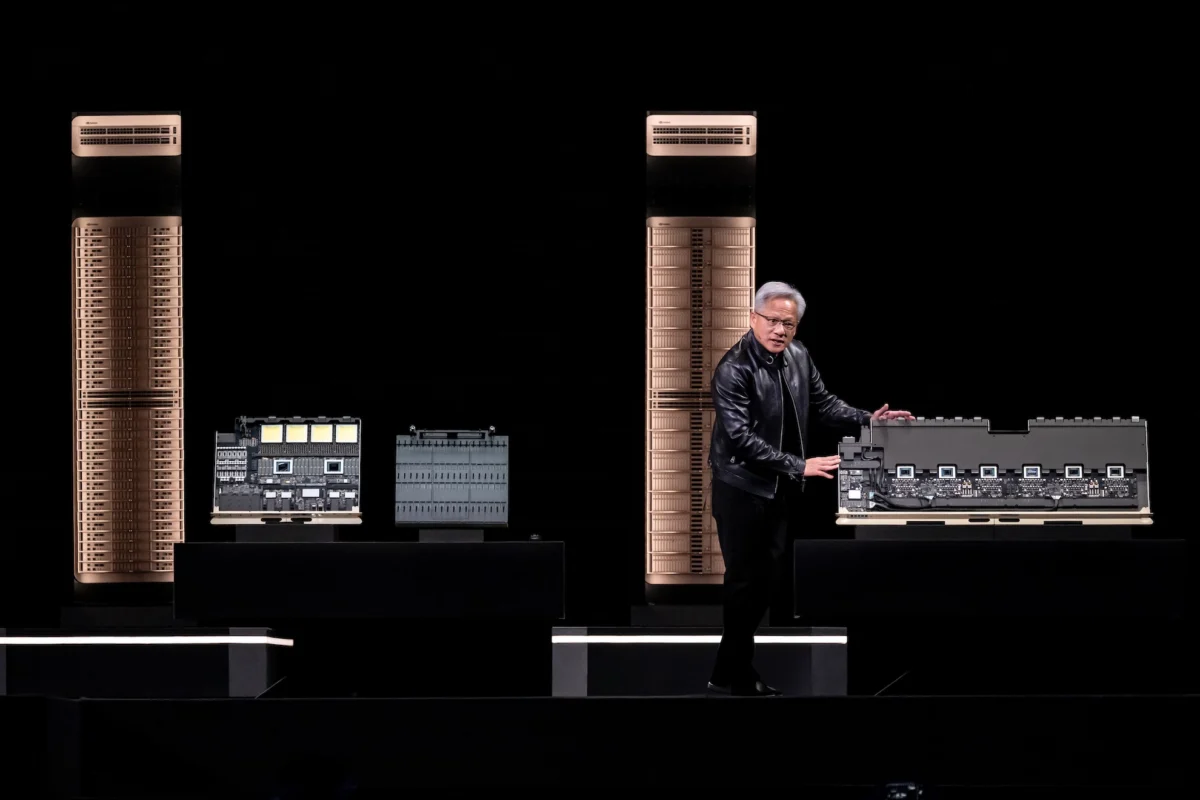
A closer examination of Nvidia’s latest offerings, particularly its Vera Rubin architecture, provides concrete evidence of this strategic pivot. The Rubin platform is not merely a new GPU; it is a meticulously designed, integrated system. It pairs the flagship Rubin GPU with a collection of complementary units, including the Vera CPU, specialized inference accelerators (distinct from third-party offerings like Groq), and purpose-built racks for high-performance storage and networking. This represents a significant evolution from simply selling individual chips to delivering full-stack, optimized solutions.
Industry discussions with Nvidia representatives shed light on the profound implications of these integrated systems. Unlike the Rubin GPU, which is engineered to churn through vast quantities of AI tokens, the accompanying components are designed to ensure that everything outside the GPU operates with maximum efficiency. If the GPU is metaphorically the engine of the AI car, then the Vera CPU, networking fabric, and storage solutions represent the sophisticated chassis, transmission, and fuel delivery system—all working in concert to unlock the engine’s full potential.
The Critical Role of the Vera CPU and Data Orchestration
The Vera CPU, in particular, addresses the fundamental problem of data orchestration. Jason Hardy, Nvidia’s VP of storage technology, emphasized its importance: “Vera is important because there’s only so much memory that you can put in a single server or any sort of compute platform.” This statement underscores a critical bottleneck in modern AI. While computing power has scaled dramatically, memory capacity within individual servers has also grown, leading to a surge in demand for high-bandwidth memory (HBM) and other advanced memory solutions. This surge has, in turn, enriched companies like Micron, which have become key players in the "second wave" of the AI infrastructure boom.
However, the challenge is not just about having sufficient memory; it’s about efficiently delivering the right data to the GPU at precisely the right moment. As companies relentlessly pursue lower tokens-per-watt metrics—a key measure of AI efficiency—the importance of intelligent data traffic direction becomes paramount. Inefficient data movement can bottleneck even the most powerful GPUs, wasting valuable processing cycles and energy.
Hardy highlighted the tangible benefits of this integrated approach: “We saw upwards of 3x improvement in these operations, where the Vera CPU is allowing for acceleration. So now we can use our flash to its fullest potential, because we can get all that performance out of it without bottlenecking.” This significant performance gain illustrates how a well-orchestrated system can dramatically enhance the overall efficiency and throughput of AI workloads, transforming raw hardware power into actual computational advantage.
Alternative Strategies: Minimizing Data Movement
Nvidia is not alone in recognizing the critical nature of data movement. Other prominent AI players are tackling this challenge through different architectural philosophies. OpenAI, for instance, developed its custom Jalapeño chip with a primary focus on minimizing the amount of data that needs to be moved around in the first place.
In a recent blog post, OpenAI detailed its design philosophy: “We designed Jalapeño to minimize data movement and communication delays. Its large domain allows the entire workload to remain within one connected system, minimizing data movement and helping the complete request stay fast and efficient from beginning to end.” This approach aims to avoid the problem altogether by conducting an entire workload within a single, highly integrated chip, thereby sidestepping the complexities and latencies associated with moving data between discrete components.
While OpenAI’s strategy represents a different architectural choice—integrating more functionality onto a single chip to reduce inter-component data transfer—the underlying logic remains consistent: boosting efficiency through smarter data management and traffic control, rather than simply relying on ever-increasing processor cycles. This shared recognition of data orchestration’s importance highlights a new, critical layer of infrastructure where companies are now fiercely competing for innovation and dominance.
Broader Market Implications and the New Battleground
This strategic pivot by Nvidia carries significant implications for the broader AI hardware and software ecosystem. The focus has moved from a singular race for the fastest GPU to a more comprehensive contest for the most efficient, integrated, and manageable AI computing platform.
For rival chipmakers, the challenge is no longer just about developing a GPU that can match Nvidia’s performance. It now requires building an entire ecosystem of complementary hardware and software that can seamlessly integrate and operate at scale. This raises the barrier to entry considerably, as it demands expertise across CPUs, networking, storage, and system software—areas where Nvidia has been investing heavily for years. Hyperscalers, with their vertical integration capabilities, are uniquely positioned to compete in this new arena, leveraging their own custom silicon and optimized infrastructure.
The shift also has profound implications for other hardware vendors. Memory manufacturers, network switch providers, and storage solution companies will find themselves increasingly needing to integrate more tightly with platform providers or develop their own orchestration capabilities. The value proposition is no longer just about standalone component performance but how well those components contribute to the overall system efficiency.
At least in these nascent stages of the system orchestration era, Nvidia appears to hold a commanding lead. Its long-standing investments in its CUDA software platform, which provides a unified programming model across its GPUs and increasingly its other hardware, coupled with its holistic approach to hardware design, offers a powerful, integrated solution. This vertical integration, from the bare metal GPU to the highest levels of system software, creates a "full-stack" advantage that is difficult for competitors to replicate quickly.
The future of AI infrastructure competition will likely be defined by the ability to optimize data flow, minimize latency, and maximize energy efficiency across vast, interconnected systems. Nvidia’s strategic move to address this complex challenge head-on, by extending its dominance beyond individual chips to the entire AI data center stack, positions it strongly for the next phase of the AI revolution, transforming what was once seen as a potential vulnerability into a reinforced fortress of innovation and integration.