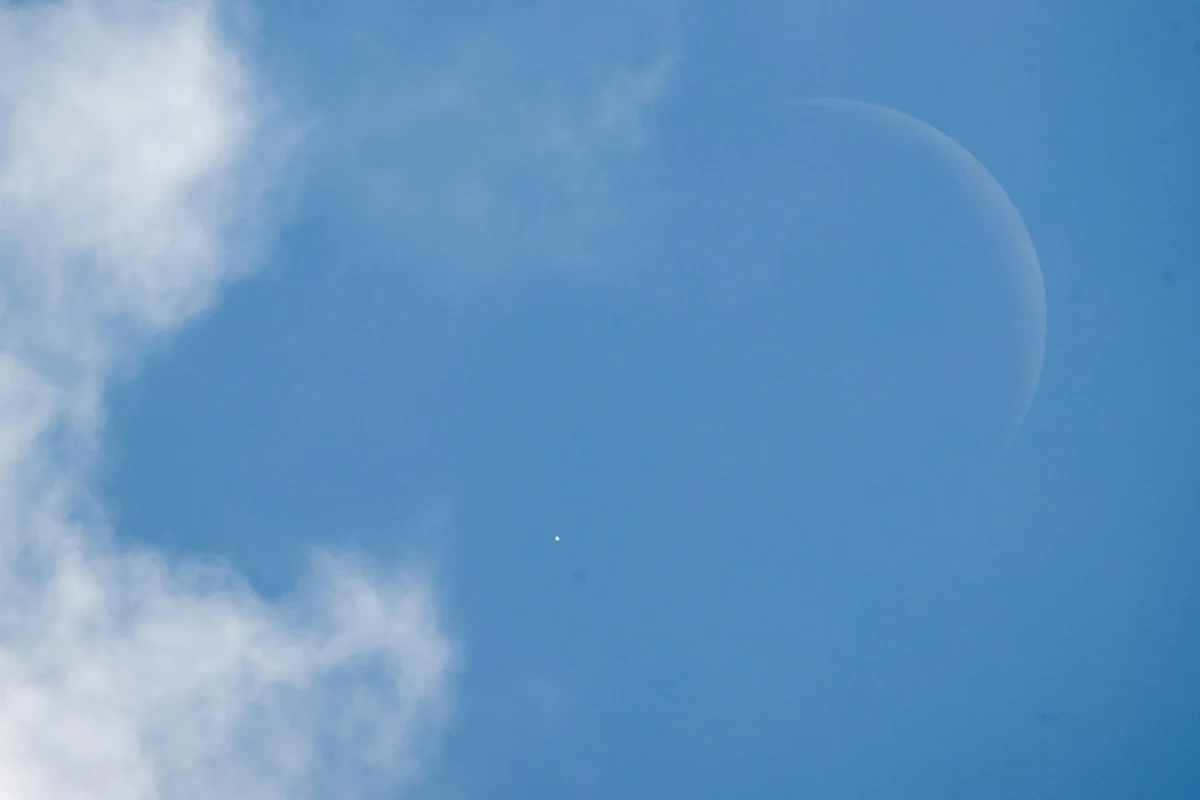
On Wednesday, June 17, skywatchers across the United States and parts of Canada were treated to a captivating celestial phenomenon: a daytime lunar occultation of Venus. This rare event, where the Moon passed directly in front of Venus from Earth’s perspective, briefly obscuring the brilliant planet, offered a profound visual demonstration of celestial mechanics to millions. The daytime visibility added an extra layer of challenge and excitement for observers, making it a particularly memorable astronomical highlight of the year. This specific alignment marked the first of three such occultations involving Venus scheduled to occur, with subsequent events anticipated in 2026 across different global regions, promising continued opportunities for astronomical observation and public engagement.
Understanding Celestial Occultations
A lunar occultation is a specific type of astronomical event that occurs when a celestial body, in this case, the Moon, passes in front of another, more distant celestial object, blocking its light from reaching an observer on Earth. The term "occultation" is derived from the Latin word "occultare," meaning "to hide." This phenomenon is distinct from a transit, where a smaller object passes in front of a larger one (like Mercury or Venus transiting the Sun), or an eclipse, where one celestial body blocks the light from another, typically referring to the Moon blocking the Sun (solar eclipse) or the Earth blocking the Sun’s light from reaching the Moon (lunar eclipse).
Lunar occultations are relatively common, with the Moon regularly passing in front of stars. However, occultations of planets are far less frequent due to their specific orbital paths and the comparatively smaller apparent size of planets relative to the Moon. When a planet like Venus, Jupiter, Saturn, or Mars is occulted, it becomes a notable event for astronomers and the public alike. The Moon’s orbit is slightly inclined to the ecliptic, the plane in which Earth orbits the Sun, and planets generally lie close to this plane. An occultation occurs when these orbital paths align precisely from our vantage point on Earth, creating a narrow band of visibility across the planet’s surface.
The Planet Venus: Earth’s ‘Sister’ and Luminary
Venus, often dubbed Earth’s "sister planet" due to its similar size and mass, holds a unique place in our solar system and in the night sky. With an average diameter of approximately 12,104 kilometers, it is only slightly smaller than Earth. Venus orbits the Sun once every 225 Earth days and rotates very slowly in the opposite direction to most planets, with one rotation taking 243 Earth days. Its dense atmosphere, composed primarily of carbon dioxide with thick clouds of sulfuric acid, makes it the hottest planet in our solar system, with surface temperatures exceeding 460 degrees Celsius.
Despite its inhospitable surface, Venus is renowned for its incredible brightness in our sky. It is the second-brightest natural object in the night sky after the Moon, reaching a visual magnitude of up to -4.9. This extreme luminosity is primarily due to its highly reflective cloud cover, which bounces about 70% of the sunlight it receives back into space. This exceptional brightness is what made the daytime occultation of Venus on June 17 possible and observable, even against the scattered light of Earth’s atmosphere. Under optimal conditions, Venus can sometimes be spotted in a clear sky even during broad daylight, especially when it is near its greatest elongation from the Sun, making it a prime candidate for daytime occultations.
The Mechanics of a Daytime Disappearance
The June 17 event was particularly remarkable because it occurred during daylight hours for observers across North America. Observing celestial events during the day presents unique challenges due to the bright scattering of sunlight in Earth’s atmosphere, which tends to wash out fainter objects. However, Venus’s extraordinary brilliance allowed it to cut through the daytime glare, albeit requiring clear skies and often the aid of binoculars or a small telescope for optimal viewing.
For the occultation to be visible, two primary conditions must be met: the Moon and Venus must be angularly close in the sky, and their alignment must fall within the viewing path from Earth. On June 17, as the Moon, then in its waxing crescent phase, traversed its orbit, it precisely aligned to pass directly in front of Venus. From Earth, the apparent diameter of the Moon is approximately 0.5 degrees, while Venus’s apparent diameter varies, but is significantly smaller, typically ranging from 10 to 60 arcseconds depending on its position relative to Earth. During the occultation, the leading limb of the Moon gradually obscured Venus, which then disappeared behind the lunar disc, only to re-emerge hours later from the Moon’s trailing limb. The exact timings of ingress (disappearance) and egress (reappearance) varied slightly depending on the observer’s precise geographical location within the visibility path.
The path of visibility for the June 17 occultation stretched across a broad swath of North America. From the western regions, observers witnessed the event earlier in the morning, while those in the eastern United States and Canada saw it later in the day. For instance, in parts of California, the occultation might have begun around 9:00 AM Pacific Daylight Time, with Venus reappearing around 10:30 AM. Moving eastward, observers in Texas or Florida might have seen ingress closer to 11:00 AM Central or Eastern Daylight Time, with egress in the early afternoon. This dynamic progression across the continent highlighted the interplay of Earth’s rotation and the Moon’s orbital motion.
Public Engagement and Astronomical Outreach
The daytime lunar occultation of Venus generated significant public interest, drawing attention from both seasoned astronomers and casual skywatchers. Observatories, planetariums, and amateur astronomy clubs across the United States and Canada organized special viewing events, often providing telescopes equipped with appropriate filters and expert guidance. Social media platforms buzzed with activity, as individuals shared images, videos, and personal accounts of their observations. Hashtags related to the event trended, demonstrating the widespread fascination with celestial phenomena.
Astronomers from leading institutions emphasized the educational value of such events. Dr. Elena Petrova, an astrophysicist at the California Institute of Technology, remarked, "These celestial ballets offer a tangible way for the public to connect with the cosmos. Seeing a bright planet like Venus disappear behind the Moon in broad daylight is a vivid reminder of the precise and predictable clockwork of our solar system. It sparks curiosity and encourages people to look up, to question, and perhaps even to pursue science." Similarly, a spokesperson for NASA’s Jet Propulsion Laboratory stated, "Events like the Venus occultation serve as powerful outreach tools. They help demystify astronomy and inspire a new generation of scientists and explorers by showcasing the beauty and complexity of our universe in an accessible way."
Many amateur astronomers took the opportunity to test their observational skills and equipment. Using small telescopes or even high-powered binoculars, viewers could discern the crescent phase of Venus just before its disappearance, a detail often overlooked by the naked eye. The contrast between Venus’s brilliant disc and the subtle, sunlit crescent of the Moon created stunning visual effects, which were widely captured through astrophotography. These shared experiences fostered a sense of community among astronomy enthusiasts, bridging geographical distances through a shared wonder of the cosmos.
Historical Context and Scientific Significance
While lunar occultations of planets are not typically used for groundbreaking scientific discoveries in the era of space telescopes and planetary probes, they have historically played a crucial role in astronomy. In the past, precise timings of occultations were used to refine our understanding of lunar orbital mechanics, to accurately map the Moon’s limb profile, and to determine the exact positions of planets. Early astronomers also used these events to calculate distances and verify orbital models. For instance, observing the precise moment a star or planet disappeared behind the Moon’s edge could provide clues about the observer’s longitude, a vital piece of information for navigation before the advent of accurate chronometers.
Today, such events serve more as educational and public outreach opportunities. They offer a direct, visual confirmation of concepts like orbital mechanics, apparent size, and the relative distances of celestial bodies. The Moon’s close proximity to Earth (an average distance of 384,400 kilometers) makes its movement across the sky noticeable, while Venus, at its closest approach to Earth, is still tens of millions of kilometers away. The occultation vividly illustrates the concept of parallax and how our perspective changes depending on our location on Earth. Furthermore, these events provide valuable data points for calibrating astronomical software and confirming ephemeris calculations, ensuring the accuracy of future predictions.
Future Spectacles: Venus Occultations in 2026
The June 17 event was described as the first of three occultations involving Venus scheduled to occur within a relatively short period, highlighting a unique series of alignments. While the North American event was a highlight, the subsequent two occultations in 2026 promise equally spectacular views for different parts of the world.
The second lunar occultation of Venus is predicted for September 14, 2026. This event will be visible from a broad swath of the Eastern Hemisphere, encompassing parts of Asia, Africa, Europe, and western Russia. Observers in these regions will have the opportunity to witness Venus disappear behind the Moon, again potentially during daytime or twilight hours, depending on their precise location and local timing. The specific geometry of this alignment means that the viewing path will sweep across vast landmasses, offering millions of people a chance to witness the phenomenon. Astronomers and public outreach organizations in these regions are expected to begin preparations well in advance, providing guidance on optimal viewing times and equipment.
Following this, the third and final occultation in this series for Venus will occur on November 7, 2026. This particular event will be visible primarily from southern South America. Countries like Argentina, Chile, and Uruguay, along with parts of Brazil, will be in the prime viewing zone. The late 2026 event will conclude a remarkable sequence of Venus occultations, each visible from a distinct geographical region due to the ever-changing alignment of the Moon’s and Venus’s orbits relative to Earth’s rotational position. The occurrence of three such planetary occultations by the Moon within a relatively short span is a testament to the dynamic and complex choreography of our solar system. Each event, while similar in nature, offers a unique perspective and timing, underscoring the universal appeal of astronomy.
Broader Impact and Continued Exploration
The widespread observation of the June 17 daytime occultation of Venus serves as a powerful reminder of humanity’s enduring fascination with the cosmos. These events transcend cultural and national boundaries, uniting people in a shared moment of wonder and scientific curiosity. They reinforce the importance of observational astronomy, encouraging both amateur and professional astronomers to engage with the night (and day) sky.
Beyond immediate observation, such events contribute to a broader appreciation for space science and exploration. They complement the grander missions undertaken by space agencies, such as sending probes to Venus to study its extreme atmosphere, or telescopes like the James Webb Space Telescope that peer into the deepest reaches of the universe. By connecting these large-scale scientific endeavors with visible, accessible celestial events, the public gains a more holistic understanding of humanity’s quest to understand its place in the universe. As we look forward to the future occultations of Venus in 2026, the scientific community and skywatchers worldwide will undoubtedly continue to prepare, observe, and celebrate these captivating celestial performances, further cementing astronomy’s role as a bridge between scientific inquiry and public imagination.