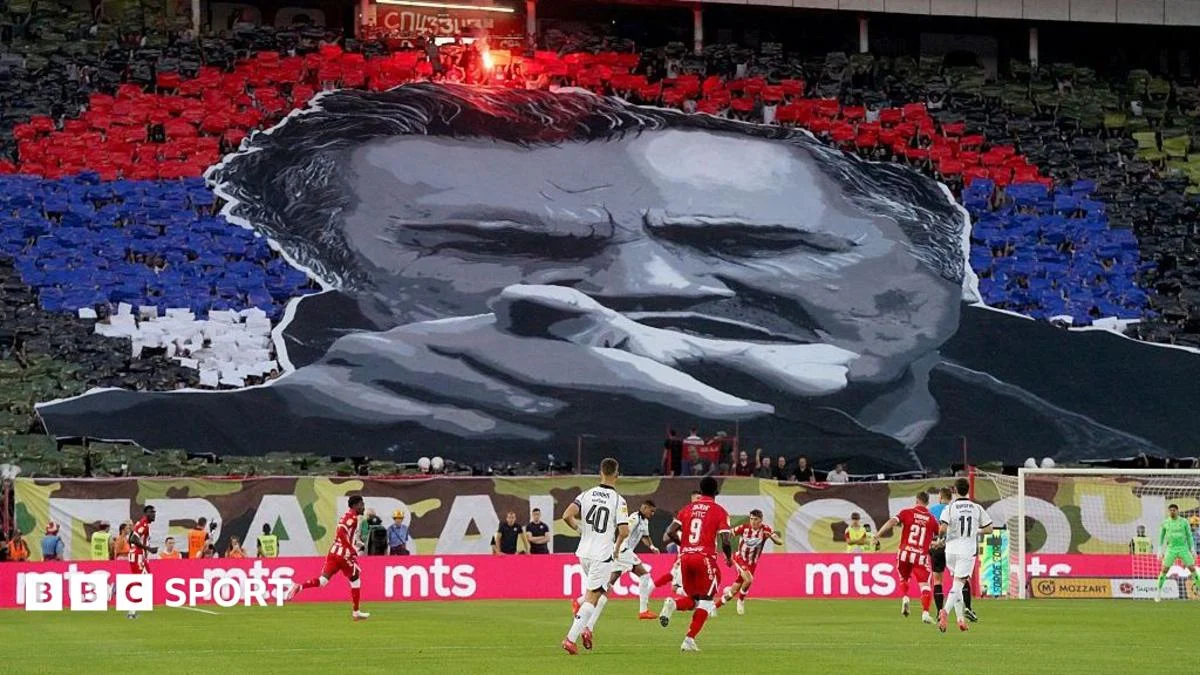
The highly anticipated Belgrade derby between Red Star Belgrade and Partizan Belgrade on Sunday night was marred by a deeply controversial display from Red Star fans, who unveiled a tifo honoring Ratko Mladic, a convicted war criminal responsible for horrific atrocities during the Bosnian War. The visual tribute, displayed prominently in the stadium, has ignited widespread condemnation and raised serious questions about the normalization of figures associated with genocide and crimes against humanity within certain segments of Serbian society and football fan culture.
Mladic, who died in August while imprisoned by the United Nations International Residual Mechanism for Criminal Tribunals (MICT), was handed a life sentence in 2017 for genocide, war crimes, and crimes against humanity. His conviction stemmed from his leadership role in the Bosnian Serb Army during the brutal wars in the former Yugoslavia between 1992 and 1995. The UN tribunal found him responsible for orchestrating the systematic killing of non-Serb populations, most notably overseeing the massacre of over 8,000 Bosniak men and boys in Srebrenica in July 1995, an act widely recognized as the worst atrocity in Europe since World War II. He was also found guilty of orchestrating the devastating 44-month siege of Sarajevo, which resulted in the deaths of more than 10,000 civilians, including countless children, through sniper fire and shelling.
This is not the first time Red Star’s fanbase has displayed support for Mladic. Earlier this season, in a Europa League play-off match against Czech side FC Viktoria Plzen last month, fans unfurled a banner commemorating the convicted war criminal. This act led to disciplinary action from UEFA, the governing body of European football, which imposed a fine of 90,000 euros (approximately £77,000) on Red Star Belgrade. The club’s social media accounts, in a move that has further amplified the controversy, published a video showcasing the tifo and the subsequent minute’s silence observed for Mladic, which was accompanied by a saluting emoji. This digital endorsement has been met with strong disapproval, including an explicit obscenity posted in reply by the official X account of Bosnia-Herzegovina’s national team, highlighting the profound pain and anger such displays evoke in the affected nations.
The legacy of Ratko Mladic remains deeply divisive. While internationally condemned and convicted by a UN tribunal, he continues to be revered by some within Serbia, where he is viewed by certain nationalist factions as a hero who defended Serb interests. This sentiment was starkly illustrated by the large gathering of thousands of people at a church in Belgrade for his funeral just a day after the derby incident, underscoring the continued polarization surrounding his figure. Mladic’s post-war life was characterized by a prolonged period on the run, lasting over a decade, during which he evaded capture despite extensive manhunt efforts. He was eventually apprehended in 2011 at the residence of a relative in the Serbian village of Lazarevo, having lived in hiding. His initial period of impunity was reportedly facilitated by the protection of then-Serbian President Slobodan Milošević, who himself later faced trial for genocide and war crimes before dying in detention.
Historical Context and the Bosnian War
The Bosnian War (1992-1995) was a complex and devastating conflict that erupted following the breakup of Yugoslavia. The war was primarily fought between the three main ethnic groups: Bosniaks (Bosnian Muslims), Serbs, and Croats. Ratko Mladic, as commander of the Main Staff of the Army of Republika Srpska (VRS), played a pivotal role in the military operations undertaken by Bosnian Serb forces. His command was characterized by a brutal campaign aimed at achieving territorial objectives and ethnic cleansing.
The Srebrenica massacre, the largest mass killing in Europe since World War II, stands as a horrific testament to Mladic’s actions. In July 1995, after the fall of the UN "safe area" of Srebrenica to VRS forces, thousands of Bosniak men and boys were systematically separated from women, children, and the elderly. They were then executed by Bosnian Serb soldiers. The International Court of Justice (ICJ) and the ICTY have both ruled that the events in Srebrenica constituted genocide.
The siege of Sarajevo, which began in April 1992 and lasted until February 1996, was another defining tragedy of the war. Under Mladic’s military command, Serb forces surrounded the capital and subjected its residents to relentless shelling and sniper fire. This prolonged period of terror inflicted immense suffering on the civilian population, leading to widespread destruction of infrastructure and a severe humanitarian crisis.
Red Star Belgrade’s Fan Culture and Previous Incidents
Red Star Belgrade, one of Serbia’s most prominent football clubs, boasts a passionate and often fervent fanbase. However, this passion has, on several occasions, crossed into controversial and politically charged territory. The club has a history of its supporters engaging in displays that have been criticized for their nationalist or offensive nature.
The UEFA fine of 90,000 euros, imposed after the banner commemorating Mladic in the Europa League match against Viktoria Plzen, demonstrates a pattern of behavior that is drawing increased scrutiny from international sporting bodies. This suggests that the club’s fan base, or at least a significant segment thereof, continues to express support for figures associated with war crimes, despite the legal ramifications and international condemnation. The club’s social media engagement with the tifo, including the use of a saluting emoji, further implies an endorsement or at least a tacit acceptance of such displays by elements within the club’s communication channels.
International Reactions and Implications
The unveiling of the Mladic tifo has provoked strong reactions from various international parties. The official response from Bosnia-Herzegovina’s national team, using an obscenity, reflects the deep-seated anger and revulsion felt by victims of the Bosnian War and their families. Such displays are seen not just as a disrespect to the victims but also as an attempt to rewrite history and glorify perpetrators of mass atrocities.
The incident also raises concerns about the potential for football stadiums to become platforms for the propagation of extremist ideologies. While football clubs often encourage fan engagement and passion, there is a clear line between sporting rivalry and the glorification of war criminals. The normalization of such figures within fan culture can have far-reaching implications, potentially fueling ethnic tensions and hindering reconciliation efforts in post-conflict regions.
Analysis of Broader Impact
The continued public veneration of Ratko Mladic by a segment of Red Star Belgrade’s fanbase, and the club’s own social media engagement with the incident, carries significant weight. It suggests a persistent disconnect between the international legal framework that has condemned Mladic and the prevailing sentiments within certain circles in Serbia.
For the victims and survivors of the Bosnian War, these displays are a profound source of pain and re-traumatization. They serve as a stark reminder of the atrocities they endured and the fact that the architects of their suffering are still, in some quarters, celebrated. This can impede the fragile process of reconciliation between communities in the former Yugoslavia.
From a sporting governance perspective, this incident puts UEFA and FIFA under pressure to take more decisive action. While fines have been levied, the recurring nature of these displays may necessitate more stringent penalties, potentially including stadium bans, points deductions, or even exclusion from international competitions if clubs cannot adequately control the conduct of their supporters. The challenge lies in balancing the autonomy of fan groups with the responsibility of clubs to uphold ethical standards and prevent the misuse of their platforms for political or ideological extremism.
The fact that thousands gathered for Mladic’s funeral in Belgrade on the day after the derby underscores the deep societal divisions that persist in Serbia regarding the legacy of the wars. While some view him as a national hero, the international community, and particularly the affected nations of Bosnia-Herzegovina, see him as a symbol of genocide and immense human suffering. The Red Star Belgrade tifo, therefore, is not merely a sporting incident but a potent symbol of these ongoing historical and societal cleavages, reflecting a struggle over memory, justice, and the very definition of heroism in the context of the Yugoslav Wars. The club and its supporters face a critical juncture, where their actions have consequences far beyond the football pitch, impacting international relations and the ongoing quest for justice and accountability.