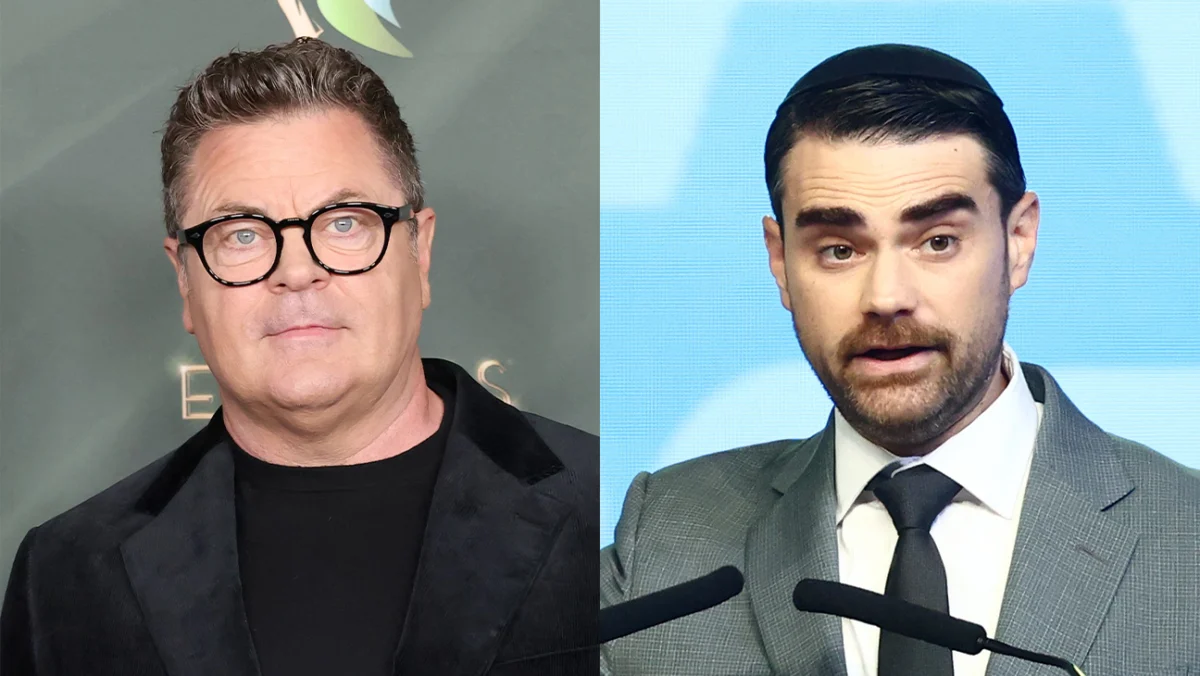
Actor Nick Offerman has publicly condemned conservative commentator Ben Shapiro, accusing him of "rampant homophobia" following Shapiro’s critical remarks regarding Offerman’s portrayal of a gay character in the critically acclaimed HBO series The Last of Us. The exchange highlights a broader cultural divide and the ongoing discourse surrounding LGBTQ+ representation in mainstream media, particularly within the context of popular, genre-defining television.
Offerman’s Condemnation and Shapiro’s Critique
The controversy ignited during an appearance by Nick Offerman on the Talk Easy With Sam Fragoso podcast. During the interview, host Sam Fragoso played a clip of Ben Shapiro from The Ben Shapiro Show, in which the political commentator attempted to summarize the plot of The Last of Us‘s third episode, titled "Long, Long Time." Shapiro’s recap, however, was not only factually inaccurate in several key aspects but also infused with a dismissive and, according to Offerman, homophobic tone.
Shapiro’s commentary fixated on Offerman’s character, Bill, a reclusive and paranoid survivalist who develops a deep romantic relationship with another man, Frank, portrayed by Murray Bartlett. Shapiro’s interpretation, delivered with a noticeable lack of empathy, framed the episode’s narrative as a departure from the show’s central zombie apocalypse theme, characterizing it as a simplistic story about "two gay dudes who meet and have a relationship." He notably referred to Bill as a "gay Ron Swanson," drawing a direct parallel to Offerman’s iconic role in the NBC sitcom Parks and Recreation.
"So the entire plot of the episode is that Nick Offerman, but he actually plays Ron Swanson, but Ron Swanson who likes to nail dudes," Shapiro stated. He continued to describe Bill’s isolated existence, his preparedness for the apocalypse, and the subsequent development of his relationship with Frank. Shapiro’s summary significantly misrepresented the episode’s emotional depth and thematic complexity, reducing the poignant 20-year romance to a superficial encounter.
Shapiro’s critique further elaborated on the tragic arc of Bill and Frank’s relationship, noting Frank’s eventual death from cancer and Bill’s subsequent decision to end his own life. Shapiro framed this decision as a derivative imitation of Romeo and Juliet, albeit with a homosexual pairing. "One dies; he gets cancer and he decides to essentially euthanize himself and gay Ron Swanson decides that he is also going to commit suicide at the same time because of Romeo and Juliet, or Romeo and Romeo in this particular case," Shapiro said. This characterization, while factually recounting the deaths, glossed over the profound bond and mutual devotion that defined Bill and Frank’s love story.
Offerman’s Reaction and Analysis
Upon hearing Shapiro’s remarks, Offerman expressed palpable shock and dismay. "Holy shit… that’s crazy," he responded on the podcast. He then launched into a scathing critique of Shapiro’s commentary, deeming it "insane" and highlighting its inaccuracy.
"That’s the most Ben Shapiro I’ve ever seen, and there’s a very good reason for that. I mean, I don’t know what to say. I’m embarrassed for his reading comprehension," Offerman stated. He pointed out that Shapiro had gotten "eight things wrong" in his recap, in addition to what Offerman perceived as his "rampant homophobia."
Offerman further elaborated on the potential impact of Shapiro’s platform and his audience’s reception of such commentary. He likened the situation to content that might be found on platforms like The Joe Rogan Experience, implying that the simplistic and often factually questionable nature of the critique could resonate with a significant portion of the audience. "That’s like a Joe Rogan clip or something that’s just so dumb and so wrong. But then it’s really upsetting to understand how powerful that probably is and how many people it’s reached and would be in agreement with it. They’d be like, ‘Oh no, not Ron Swanson,’ or whatever agreement they would have," Offerman said.
The actor’s concern stemmed from the possibility that Shapiro’s mischaracterizations, delivered with his characteristic assertive style, could influence public perception of the episode and, by extension, LGBTQ+ relationships depicted in media. Offerman’s defense underscored the importance of nuanced storytelling and accurate representation, particularly when dealing with sensitive themes.
Context of "Long, Long Time" and its Reception
The third episode of The Last of Us, which aired in January 2023, was a significant departure from the show’s main narrative arc, focusing instead on the 20-year love story of Bill and Frank. This deviation was widely praised by critics and audiences alike for its emotional depth, poignant storytelling, and powerful performances. The episode explored themes of love, resilience, and finding meaning in a post-apocalyptic world, showcasing a tender and enduring relationship that provided a stark contrast to the pervasive violence and despair of the series.
The episode’s success was underscored by its critical reception. It garnered widespread acclaim, with many critics highlighting it as a standout episode of the season, and indeed, of recent television. The narrative of Bill and Frank’s relationship was lauded for its humanism and its ability to explore profound emotional territory within the confines of a zombie apocalypse.
Nick Offerman’s performance in "Long, Long Time" was particularly lauded, earning him significant critical attention and accolades. His portrayal of the gruff, isolated survivalist who finds profound love and connection was widely considered a career highlight. This critical success culminated in Offerman winning the Primetime Emmy Award for Outstanding Guest Actor in a Drama Series for his role in the episode, further solidifying the episode’s artistic merit and the impact of his performance.
Ben Shapiro’s Platform and the "Culture War"
Ben Shapiro is a prominent figure in conservative media, known for his role as co-founder of The Daily Wire and his widely syndicated commentary. His platform often engages with contemporary social and cultural issues, frequently taking stances that are in opposition to progressive viewpoints. His critiques of media, particularly those involving LGBTQ+ themes or perceived liberal ideologies, are a recurring feature of his content.
Shapiro’s comments on The Last of Us episode fit into a broader pattern of engagement with what is often termed the "culture war," a term used to describe ideological conflicts between conservative and progressive factions within society. For commentators like Shapiro, the inclusion of LGBTQ+ characters and storylines in popular media can be a focal point for criticism, often framed as an imposition of a particular agenda or a departure from traditional values.
The "gay Ron Swanson" framing, while intended by Shapiro to be a point of critique, inadvertently highlights the potential for misinterpretation and the reduction of complex characters and relationships to simplistic, often pejorative, labels. The deliberate comparison to a character known for his staunch individualism and libertarian ideals, and then juxtaposing it with a homosexual identity, appears to be an attempt to create a sense of incongruity or to suggest a deviation from the perceived "essence" of the original character.
Implications and Broader Context
The exchange between Offerman and Shapiro brings to light several significant implications for the media landscape and public discourse:
- The Power of Narrative and Representation: The strong positive reception of "Long, Long Time" demonstrates the public’s appetite for diverse and emotionally resonant storytelling. The episode offered a powerful example of how LGBTQ+ relationships can be integrated into mainstream narratives in a way that is authentic, moving, and universally relatable. Shapiro’s critique, conversely, suggests a resistance to such representation from certain segments of the audience, potentially fueled by ideological opposition.
- The Role of Media Personalities in Shaping Opinion: Figures like Ben Shapiro wield considerable influence over their audiences. Their interpretations and criticisms of cultural products can significantly shape how these products are perceived. Offerman’s concern about the "power" of Shapiro’s message underscores the responsibility that comes with such platforms and the potential for misinformation or prejudice to spread.
- The Nuances of Interpretation: The vast difference between Shapiro’s reductive and critical summary and the widespread critical acclaim for the episode highlights the subjective nature of interpretation, but also the potential for deliberate misrepresentation. Offerman’s frustration stems from Shapiro’s apparent disregard for the episode’s artistic merit and its emotional impact, opting instead for a critical lens that seems pre-determined by his ideological stance.
- The Ongoing Debate on LGBTQ+ Visibility: The controversy is a microcosm of the larger, ongoing debate about LGBTQ+ visibility and acceptance in media. While progress has been made in terms of representation, such incidents demonstrate that there are still significant challenges and resistance to overcome. The fact that a critically lauded and artistically significant portrayal of a gay relationship can still be met with such dismissive criticism underscores the persistent nature of homophobia and prejudice.
- The Impact on Artistic Integrity: For creators and actors, such critiques can be disheartening. Offerman’s strong response indicates a commitment to the integrity of the work and a desire to defend the artistic choices made by the showrunners and the cast. The success of "Long, Long Time" and Offerman’s Emmy win serve as powerful counterpoints to Shapiro’s dismissive commentary, affirming the value and artistic merit of the narrative.
The dialogue between Nick Offerman and Ben Shapiro serves as a stark reminder of the ongoing cultural conversations surrounding representation, interpretation, and the impact of influential voices in shaping public perception. While Shapiro’s critique was met with Offerman’s sharp rebuttal, the underlying issues of prejudice and the power of narrative continue to be significant forces in the media landscape. The episode’s success and Offerman’s subsequent accolades stand as a testament to the enduring power of authentic and inclusive storytelling.