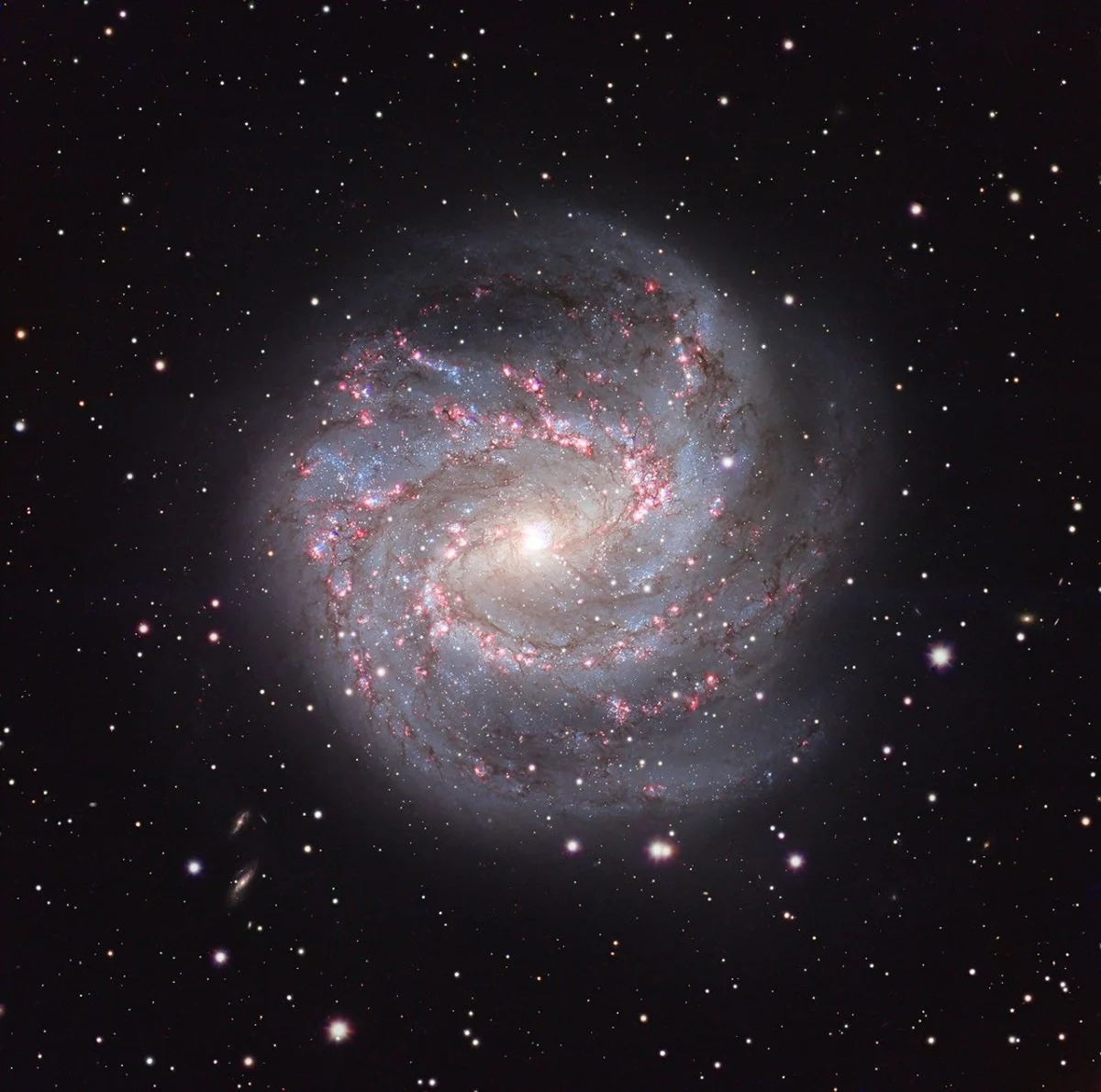
The venerable Astronomy Picture of the Day (APOD) program, a daily staple for cosmic enthusiasts worldwide, today featured a stunning ground-based telescopic view of Messier 83 (M83), commonly known as the Southern Pinwheel Galaxy. This captivating image arrives amidst a significant digital transition for APOD, as its primary NASA portal migrates to a new, consolidated platform under science.nasa.gov/apod. The move, effective for users accessing the site, underscores NASA’s ongoing efforts to streamline its vast online resources and enhance public accessibility to scientific discoveries and educational content.
M83: A Jewel in the Southern Sky
Located approximately twelve million light-years from Earth, near the southeastern tip of the sprawling constellation Hydra, M83 is a magnificent grand-design spiral galaxy. Its intricate structure is beautifully rendered in today’s featured photograph, revealing prominent spiral arms defined by dark lanes of cosmic dust and vibrant clusters of young, blue stars. These features contribute to its evocative popular moniker, the Southern Pinwheel. Further enhancing its visual appeal are numerous reddish regions of intense star formation, which have earned it another fitting nickname: the "Thousand-Ruby Galaxy."
M83 is notably smaller than our own Milky Way galaxy, spanning a diameter of approximately 40,000 light-years. Despite its relatively modest size, it is a powerhouse of activity, exhibiting a high rate of star formation, particularly evident in its luminous spiral arms. This characteristic classifies M83 as a starburst galaxy, a type of galaxy undergoing an exceptionally high rate of new star creation compared to the average galaxy. Such bursts of star formation are often triggered by galactic interactions or internal gravitational instabilities, though the precise mechanism driving M83’s continuous activity remains a subject of ongoing astrophysical research.
The galaxy was first discovered by French astronomer Nicolas Louis de Lacaille in 1751 during his expedition to the Cape of Good Hope. His meticulous observations from the southern hemisphere allowed him to catalog numerous celestial objects previously unknown to European astronomers. M83 holds a significant place in astronomical history, being one of the first spiral galaxies to be recognized and extensively studied. Its favorable orientation from Earth, allowing for a near face-on view, has made it a prime target for both professional observatories and amateur astronomers alike, providing invaluable insights into the dynamics and evolution of spiral galaxies. Over the centuries, M83 has been the host of at least six recorded supernovae, making it one of the most prolific supernova-producing galaxies observed, further testifying to its active stellar life cycle.
Unveiling M83’s Energetic Core and Starburst Activity
Beyond its visible splendor, M83 exhibits remarkable activity at higher energy wavelengths. Observations from X-ray telescopes have revealed that the core of M83 is exceptionally bright in X-ray energies. This intense emission is attributed to a high concentration of neutron stars and black holes, remnants of massive stars that exploded as supernovae during an intense, prolonged burst of star formation within the galaxy’s central regions. These compact objects, often found in binary systems with companion stars, accrete matter that heats to extreme temperatures, emitting copious amounts of X-rays.
The presence of such a dense population of high-energy sources in the galactic core provides crucial evidence for the galaxy’s vigorous star-forming past and present. Astrophysicists utilize data from observatories like NASA’s Chandra X-ray Observatory to map these X-ray sources, gaining a deeper understanding of the processes that govern the birth, life, and death of massive stars, and their subsequent evolution into exotic compact objects. The interplay between these energetic phenomena and the broader galactic environment offers a complex picture of M83’s dynamic evolution, providing a natural laboratory for studying galactic astrophysics on a grand scale. The sharp detail of today’s ground-based image, combined with data from space-based telescopes, allows astronomers to piece together a multi-wavelength understanding of this fascinating cosmic entity.
The Enduring Legacy of Astronomy Picture of the Day (APOD)

Since its inception on June 16, 1995, APOD has served as a cornerstone of public astronomical outreach. Conceived and maintained by astrophysicists Robert Nemiroff (Michigan Technological University) and Jerry Bonnell (NASA Goddard Space Flight Center), APOD’s mission has been to make the wonders of the universe accessible to a global audience. Each day, the program presents a different image or photograph of our fascinating universe, accompanied by a concise and informative explanation written by a professional astronomer. This blend of stunning visuals and expert commentary has cultivated a vast following, transcending geographical and linguistic barriers.
APOD has been instrumental in democratizing astronomy, transforming complex scientific concepts into digestible and inspiring narratives for millions. Its archive, a treasure trove of celestial imagery and explanations, represents one of the most comprehensive public resources for astronomical education available online. The program’s success lies in its consistent delivery of high-quality content, ranging from breathtaking nebulae and distant galaxies to planetary close-ups and phenomena within our solar system, all curated with scientific rigor and an eye for aesthetic appeal. Over the decades, APOD has received numerous accolades for its contributions to science communication and education, solidifying its status as a premier online destination for space enthusiasts, educators, and researchers alike. Its impact extends beyond mere information dissemination; it fosters a sense of wonder and encourages scientific literacy, inspiring new generations to look up at the night sky with curiosity and understanding.
NASA’s Strategic Digital Migration: A New Era for APOD
The current migration of APOD’s main NASA site from its long-standing apod.nasa.gov address to science.nasa.gov/apod is part of a broader strategic initiative by the agency to consolidate and modernize its digital presence. This move is designed to integrate APOD more seamlessly into NASA’s overarching Science Mission Directorate portal, aiming to provide a more unified and user-friendly experience for the public. By centralizing its diverse scientific content, NASA intends to improve navigation, enhance search capabilities, and ensure greater consistency across its various educational and informational platforms.
Officials within NASA have indicated that this digital consolidation is driven by a commitment to maximizing the impact and reach of the agency’s scientific endeavors. Integrating APOD into the science.nasa.gov domain ensures that it benefits from the latest web infrastructure, security protocols, and accessibility standards, while also placing it directly alongside other premier NASA science offerings, such as mission updates, research findings, and educational resources. This strategic alignment is expected to foster greater cross-pollination of interest, potentially exposing new audiences to APOD and conversely, guiding APOD’s dedicated followers to other fascinating aspects of NASA’s scientific portfolio. The transition is managed to ensure minimal disruption to the daily delivery of the APOD experience, maintaining its uninterrupted legacy of cosmic exploration. Users are automatically redirected to the new URL, ensuring continuous access to the daily feature and the extensive archives. This forward-looking approach reflects NASA’s dedication to evolving with digital trends while preserving the integrity and accessibility of its most cherished public engagement programs.
M83 in the Cosmic Neighborhood: The Centaurus A Group
M83 is not an isolated galactic entity; it is a prominent member of a group of galaxies known as the Centaurus A/M83 Group, or sometimes the M83 Group. This galactic association highlights the interconnectedness of structures in the universe, where galaxies often cluster together under mutual gravitational influence. The group’s most famous member, besides M83 itself, is the active galaxy Centaurus A (NGC 5128). Centaurus A is a peculiar elliptical galaxy renowned for its powerful radio emissions, indicative of an active supermassive black hole at its core, which is actively accreting matter and ejecting relativistic jets of plasma.
The dynamics within such galaxy groups are crucial for understanding galactic evolution. Gravitational interactions, including close encounters and mergers, can trigger intense bursts of star formation, reshape galactic morphologies, and influence the activity of central supermassive black holes. Studying galaxies like M83 within their group context provides astronomers with vital clues about how galaxies evolve over cosmic timescales, how their star formation rates are regulated, and how they interact with their surrounding environment. The relative proximity of the Centaurus A/M83 Group, at around 10-15 million light-years, makes it an excellent laboratory for such investigations, allowing for detailed observations of individual member galaxies and their collective behavior.
The Daily Glimpse into the Universe: What to Expect Next
As APOD continues its daily mission from its new digital home, it promises to maintain its tradition of bringing the universe’s most compelling imagery to public view. Following today’s spectacular depiction of M83, tomorrow’s feature is teased as a "lunar sun catcher." This intriguing title hints at a potentially captivating image or phenomenon related to the Moon and its interaction with sunlight, perhaps a striking optical effect, a unique lunar landscape illuminated by the Sun, or even an artistic representation of such an event. The anticipation for each new APOD image reflects the program’s enduring success in fostering curiosity and engagement with astronomy. Through its consistent delivery of scientifically accurate and visually stunning content, APOD remains a vital bridge between cutting-edge astronomical research and the global public, inspiring countless individuals to embark on their own journeys of cosmic discovery. The integration into NASA’s broader science portal ensures that this cherished resource will continue to illuminate the cosmos for many years to come, strengthening NASA’s commitment to public education and scientific exploration.