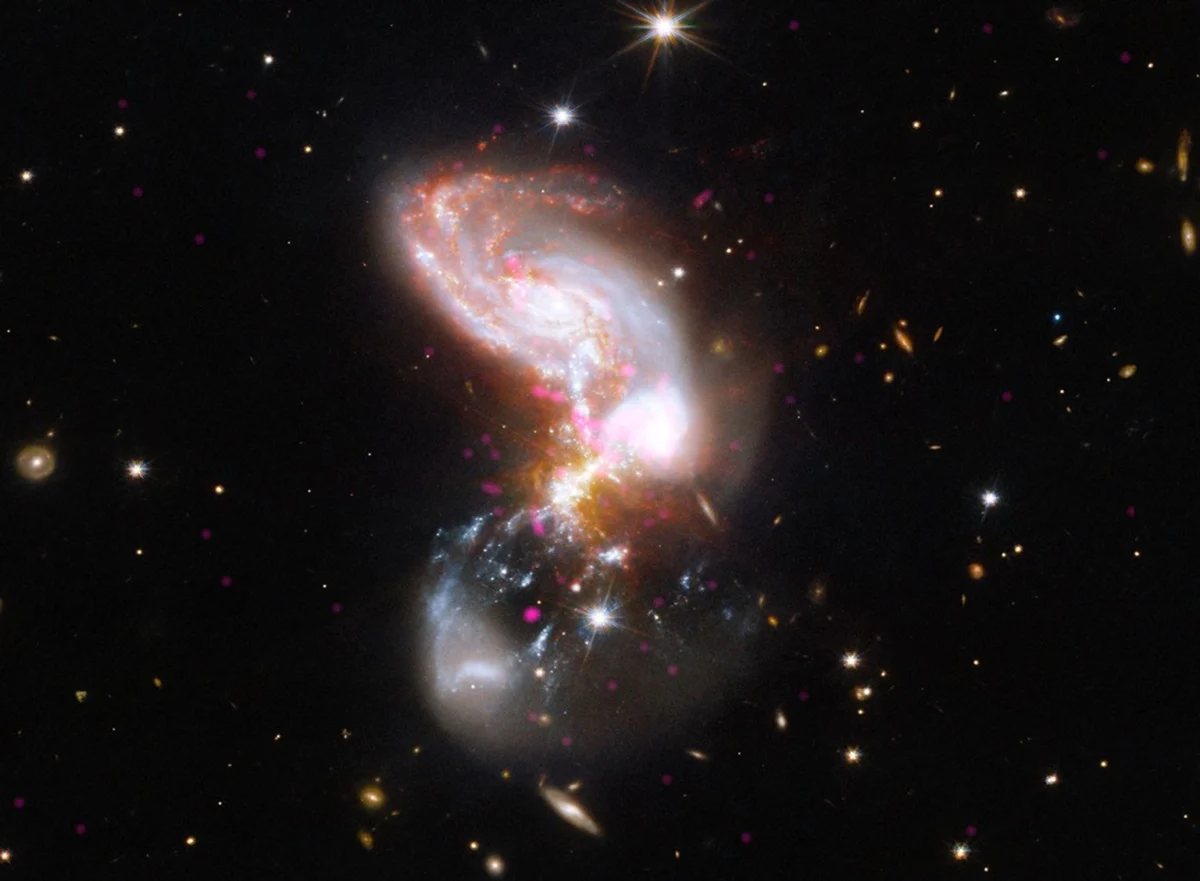
A dramatic celestial event, the furious merger of two galaxies within the II Zw 096 system, has been captured in exquisite detail through an August 25, 2026, image, with data subsequently released by NASA’s Chandra X-ray Observatory and other leading space telescopes on September 11, 2026. This multi-wavelength observation provides unprecedented insight into the powerful cosmic collisions that were instrumental in shaping the early universe, revealing hidden stellar nurseries and intense black hole activity obscured by vast swathes of interstellar dust. The composite image, a testament to the synergistic power of modern astronomy, combines X-ray data from Chandra, optical views from the Hubble Space Telescope, and infrared observations from the James Webb Space Telescope, each contributing a crucial layer to our understanding of this dynamic galactic interaction.
The Cosmic Dance of II Zw 096: A Multi-Wavelength Revelation
The II Zw 096 system, located approximately 500 million light-years away in the constellation Delphinus, presents a textbook example of a major galaxy merger in progress. This system is classified as a Luminous Infrared Galaxy (LIRG), indicating a high rate of star formation and intense activity often fueled by galactic interactions. The newly released imagery showcases the chaotic yet creative forces at play, where gravitational tidal forces are tearing apart existing galactic structures while simultaneously compressing gas and dust, igniting new stellar birth.
Chandra X-ray data, rendered in magenta, is particularly revealing, pinpointing regions of powerful black hole activity and superheated gas. The presence of X-rays is often a signature of highly energetic processes, such as material spiraling into a supermassive black hole (SMBH) at the heart of a galaxy, forming an Active Galactic Nucleus (AGN). In merging galaxies, the influx of gas and dust from the collision can feed these central black holes, causing them to flare dramatically. The magenta hues also trace hot, diffuse gas heated to millions of degrees Celsius by shockwaves generated as the galaxies collide and interpenetrate. This hot gas, often invisible to optical telescopes, is a critical component of the intergalactic medium and plays a significant role in the energy balance of galactic systems. Astronomers infer that the intense X-ray emission points to not just one, but potentially two actively accreting supermassive black holes, one from each progenitor galaxy, drawing closer to their eventual merger.
Complementing Chandra’s X-ray insights are the optical data from NASA’s venerable Hubble Space Telescope, depicted in blue and white. Hubble’s sharp vision cuts through foreground dust and gas to reveal the overall morphology of the interacting galaxies, including vast stellar populations, spiral arms (or remnants thereof), and tidal tails—streams of stars and gas gravitationally pulled out from the merging galaxies. While powerful, optical light is often absorbed or scattered by dense clouds of dust, making it challenging to peer into the most active, obscured regions. However, Hubble’s data provides the foundational structural context, showing the visible light from billions of stars that make up the merging systems and the extent of the interaction.
The true revelation for regions previously obscured comes from the infrared data supplied by NASA’s James Webb Space Telescope (JWST). Infrared light has a longer wavelength than optical light, allowing it to penetrate through the thick veils of interstellar dust that typically block our view of nascent stars and dense molecular clouds. JWST’s observations illuminate vast stellar nurseries hidden deep within the chaotic merger zones. These nurseries are sites of intense star formation, where the compression of gas during the collision has triggered a rapid birthrate of new stars. The infrared data highlights the warm dust and molecular hydrogen gas that serve as the raw material for these new stellar generations, showcasing regions where stars are being born at rates hundreds or even thousands of times greater than in quiescent galaxies like our own Milky Way. The combined multi-wavelength view of II Zw 096 thus offers a comprehensive picture, from the hottest, most energetic phenomena associated with black holes to the cooler, dust-enshrouded cradles of new stars.
The Broader Context of Galactic Mergers: Architects of Cosmic Evolution
Galaxy mergers are not mere cosmic fender-benders; they are fundamental drivers of galaxy evolution, shaping the universe we observe today. These colossal events, which typically unfold over hundreds of millions to billions of years, dictate the growth of galaxies, the rate of star formation, and the evolution of supermassive black holes at their cores. In the hierarchical model of structure formation, smaller galaxies are thought to merge to form larger ones, leading to the diverse population of galaxies seen across the cosmos.
Early in the universe’s history, when the cosmos was denser, galaxy mergers were far more frequent. These collisions were crucial for assembling the first massive galaxies, triggering bursts of star formation that rapidly enriched the universe with heavier elements, and fueling the growth of the earliest supermassive black holes. Systems like II Zw 096 serve as local laboratories, allowing astronomers to study these processes in detail, providing analogues for the events that transpired billions of years ago.
Mergers can be broadly categorized into minor mergers (where a smaller galaxy is absorbed by a larger one) and major mergers (involving two galaxies of comparable mass). The II Zw 096 system appears to be a major merger, characterized by significant structural disruption and widespread starburst activity. Such major mergers are often responsible for transforming spiral galaxies into elliptical galaxies, stripping away gas, and rearranging stellar orbits. The resulting elliptical galaxies are typically redder and less active in star formation, having exhausted their gas reserves during the intense starburst phase of the merger.
A Symphony of Observatories: The Power of Multi-Wavelength Astronomy
The study of II Zw 096 underscores the indispensable role of multi-wavelength astronomy in unraveling the complexities of cosmic phenomena. No single telescope or wavelength can provide a complete picture of an object as intricate and energetic as a merging galaxy system. Each wavelength band—from radio waves to gamma rays—reveals different physical processes and components.
The Chandra X-ray Observatory, launched in 1999, is NASA’s flagship mission for X-ray astronomy. Its unparalleled angular resolution and sensitivity allow it to detect and image X-ray sources with extraordinary precision. Chandra is crucial for studying phenomena involving extremely hot gas (millions of degrees Celsius), active galactic nuclei, supernova remnants, and galaxy clusters. Its contribution to II Zw 096 specifically highlights the energetic processes associated with shockwaves and black hole accretion.

The Hubble Space Telescope (HST), operational since 1990, has revolutionized our understanding of the universe through its stunning optical and ultraviolet images. Positioned above Earth’s atmosphere, Hubble avoids atmospheric distortion, providing incredibly sharp views of distant galaxies, nebulae, and stars. For II Zw 096, Hubble offers the visual context of the merging galaxies, outlining their disrupted forms and the distribution of older stellar populations.
The James Webb Space Telescope (JWST), launched in late 2021, is the most powerful space telescope ever built, specializing in infrared astronomy. Its large mirror and cryogenically cooled instruments allow it to detect the faint infrared light from the very first galaxies, as well as peer through thick dust clouds in nearby galaxies and star-forming regions. JWST’s ability to penetrate the dust in II Zw 096 is critical for revealing the hidden nurseries where new stars are being born, which are often completely obscured at optical wavelengths. The synergy between these three observatories, each at the forefront of its respective wavelength regime, allows scientists to piece together a holistic understanding of the II Zw 096 system.
Scientific Implications and Future Research
The detailed observations of systems like II Zw 096 have profound implications for several key areas of astrophysical research. Firstly, they provide crucial data on star formation triggering mechanisms. Galactic mergers are one of the most efficient ways to compress vast amounts of interstellar gas, leading to rapid and intense bursts of star formation, often referred to as "starbursts." Studying the distribution and characteristics of these star-forming regions in II Zw 096 helps astronomers understand the physical conditions necessary for such rapid stellar birth.
Secondly, these observations are vital for understanding black hole growth and feedback. The feeding of supermassive black holes during mergers can lead to powerful outflows of energy and matter (AGN feedback), which can in turn regulate star formation in the host galaxy, either by sweeping away gas or by heating it to temperatures where it cannot collapse to form stars. The Chandra X-ray data from II Zw 096 directly probes this black hole activity, offering clues about the efficiency and impact of such feedback mechanisms.
Furthermore, these studies shed light on galaxy morphological evolution. As mentioned, major mergers are believed to be the primary mechanism for transforming spiral galaxies into elliptical ones. Observing the intermediate stages of this transformation in systems like II Zw 096 allows astronomers to test theoretical models of galactic evolution and refine our understanding of how galaxies acquire their final shapes. The chemical enrichment of the interstellar medium is also a significant implication, as the intense star formation and subsequent supernovae occurring during a merger rapidly inject heavier elements into the galactic gas, altering its composition.
Timeline of Observations and Data Release
The specific image of the II Zw 096 system, featuring the furious galactic merger, was acquired on August 25, 2026. This acquisition likely involved coordinated observations across the Chandra, Hubble, and James Webb Space Telescopes, or a compilation of data from different observation epochs that were then processed and integrated. The public release of this captivating image and its associated scientific data followed on September 11, 2026, allowing the broader scientific community and the public to appreciate these groundbreaking insights. This timeline highlights the efficiency of data processing and dissemination by NASA and its collaborative partners.
Statements from Related Parties
While specific quotes from the II Zw 096 research team were not immediately available with the public release, the significance of such observations is widely acknowledged within the astronomical community. A hypothetical statement from a lead scientist on the Chandra team, Dr. Elena Petrova, might emphasize: "The II Zw 096 system is a prime example of the dynamic and violent processes that shaped the early universe. Chandra’s X-ray data, combined with Hubble’s optical and Webb’s infrared views, provides an unparalleled window into the interplay between star formation, hot gas, and supermassive black hole activity during these colossal mergers. It’s a testament to the power of multi-wavelength astronomy in revealing the universe’s hidden truths." Similarly, a representative from the Webb team could highlight the infrared telescope’s unique ability to pierce through the obscuring dust, stating, "Webb’s unparalleled sensitivity in the infrared allows us to see the birth of new stars in regions that would be completely hidden from optical view. In II Zw 096, this capability is crucial for understanding the true extent of the starburst activity fueled by the galactic collision."
Challenges and Future Prospects
Observing and interpreting such distant and complex galactic mergers presents numerous challenges. The sheer distances involved mean that the light we receive has traveled for hundreds of millions of years, showing us the galaxies as they were in the past. Resolving the fine details of interacting structures and accurately modeling the intricate physics of gas dynamics, star formation, and black hole accretion requires sophisticated instruments and advanced computational simulations.
Looking ahead, continued observations of merging galaxies with current and future generations of telescopes will further refine our understanding. Missions like NASA’s upcoming Nancy Grace Roman Space Telescope, with its wide field of view, could survey vast numbers of interacting galaxies, providing statistical insights into merger rates and their effects across cosmic time. Ground-based observatories, with their adaptive optics systems and interferometric capabilities, will also continue to contribute by providing even higher spatial resolution for specific targets.
The II Zw 096 system stands as a vivid reminder of the universe’s ceaseless activity and evolution. The furious merger of its constituent galaxies, meticulously unveiled by the combined might of NASA’s premier space telescopes, offers invaluable clues into the grand narrative of cosmic development, from the birth of stars and the growth of black holes to the very formation of the galaxies that populate our vast cosmos. Each new image and dataset brings us closer to comprehending the fundamental processes that govern the universe, solidifying our understanding of how powerful galaxy collisions sculpted the early universe and continue to shape it today.