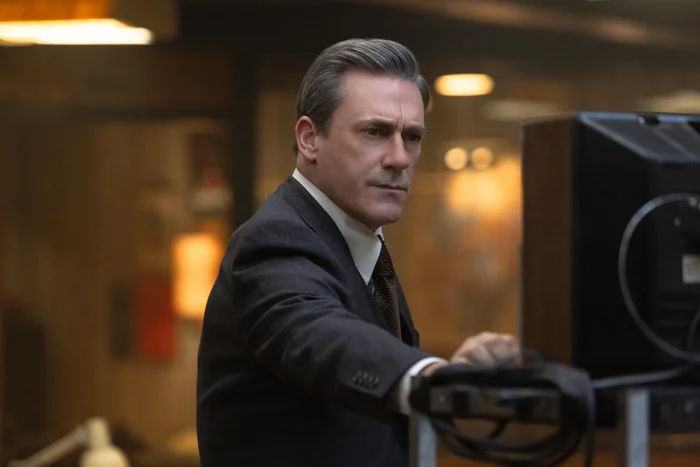
Jon Hamm steps into the spotlight once again, this time not as a charismatic ad executive or a larger-than-life figure, but as a local news broadcaster thrust into the heart of a harrowing real-life drama in the new series American Hostage. The upcoming MGM+ production, slated for a September 20th premiere, delves into a chilling 1977 true crime event that, despite its decades-old origins, resonates with uncanny relevance in today’s fractured socio-political landscape. Hamm, who also lent his voice to a narrative podcast of the same name, portrays a seasoned journalist who finds himself in an untenable position when a desperate individual takes a mortgage broker hostage, demanding a platform to air his grievances.
The series, co-created by Shawn Ryan and Eileen Myers, is described by Sony Pictures Television as a "psychological thriller that tells the harrowing true story of Fred Heckman, a beloved Indianapolis radio reporter who is thrust into the middle of a life-or-death crisis when hostage-taker, Tony Kiritsis, demands to be interviewed on his popular radio news program." This compelling narrative, rooted in fact, explores not only the immediate tension of a hostage situation but also the broader societal undercurrents that contributed to such a desperate act.
Echoes of Discontent: The Enduring Resonance of "American Hostage"
Speaking at The Hollywood Reporter‘s Studio at 1 Hotel during TIFF, presented by sponsor Canada Goose, Jon Hamm articulated his conviction that the 1977 event offers potent thematic parallels to contemporary society. "I think that there’s some thematic devices that resonate in the culture politically now," Hamm stated. He elaborated on the idea of segments of the population feeling "overlooked, or feeling under-addressed, in their wants and needs and desires." The title, American Hostage, was a deliberate choice, Hamm explained, highlighting the dual nature of the crisis: the literal taking of a hostage and the potential existential predicament of the perpetrator. "This man obviously takes a person hostage, but is he in fact hostage to his American Dream?" Hamm mused, underscoring the psychological depth the series aims to explore.
The Emmy Award-winning actor emphasized the enduring power of the story, noting, "There’s a lot of resonance to the title. I think that’s why the story, for whatever reason, feels—even though it’s a 50-year-old true story—it feels very relevant, given the current political climate." This sentiment is amplified by the fact that the narrative originated from a significant media event, one that captured national attention and reflected a burgeoning era of live, local news breaking into the broader public consciousness.
Background of the 1977 Incident: The Tony Kiritsis Hostage Crisis
The events that inspired American Hostage unfolded in Indianapolis in 1977. Tony Kiritsis, a Greek immigrant and struggling businessman, became increasingly embittered by financial difficulties and what he perceived as systemic injustices. His frustration culminated on February 5, 1977, when he took Richard Hall, a mortgage broker at Indianapolis Mortgage Company, hostage at gunpoint. Kiritsis’s demands were not for ransom in the traditional sense, but rather for a platform to voice his grievances and expose what he believed to be corrupt practices within the financial system.
He famously appeared on local television, armed and holding Hall captive, demanding to be interviewed on Fred Heckman’s popular radio news program. Heckman, a respected and established journalist with WIFE radio, found himself at the epicenter of a rapidly escalating crisis. The situation was broadcast live, drawing immense public attention and unfolding over a tense 63-hour period. Kiritsis sought to use the media as his stage to publicize his story and seek what he felt was justice. The standoff was a stark illustration of how individual desperation, amplified by media access, could create a national spectacle.
A Shifting Media Landscape: From Local Spectacle to National Obsession
The 1977 Kiritsis incident was a watershed moment in media history, demonstrating the growing power of local news to captivate a national audience. Jon Hamm drew a parallel to a more widely recognized media event: the O.J. Simpson police chase in June 1994. "I think probably most people’s first experience of any of that was the O.J. situation because it happened in the middle of a huge sporting event," Hamm recalled. "It was national. Most of us live in L.A., and L.A. had a car chase kind of every day, but it was very local. That became a very daily kind of thing in the ’90s. Some helicopter would chase some car going somewhere. The original one was most likely the O.J. situation."
However, Hamm pointed out the pioneering nature of the 1977 event. "If you go back in time, this [1977 Tony Kiritsis case] is one of the first times we kind of see a local story explode nationally," he stated. He also referenced the Patty Hearst situation as another early instance of a local event gaining national traction, particularly during the raid on her hideout in South Central Los Angeles. "It was the beginning of where we are now," Hamm observed, "where everything is maximized for the salaciousness of its content." This points to a broader societal shift, amplified by media, where dramatic events are increasingly commodified for public consumption.
The series also examines the stark contrast in audience trust towards news organizations then and now. In 1977, local news figures like Fred Heckman were often seen as credible sources, trusted to deliver accurate information. This stands in sharp relief to the current media environment, where trust in news organizations has reached historic lows, as evidenced by data from Gallup.
The Erosion of Trust: Journalistic Integrity in a Fractured World
Shawn Ryan, co-creator of American Hostage, underscored the "journalistic aspect to the show" as being "very pertinent today." He lamented the current state of media consumption, stating, "Right now, we live in a very fractured journalist world. You can kind of choose your news more than the news really informing you these days." Ryan fondly recalled a time when journalists held a different status. "Back then, I’m old enough to remember what it was like for journalists to be trusted and for the news to be something that was sacred."
This historical context imbues Hamm’s character with added complexity. Ryan elaborated on the precarious position of Fred Heckman within the narrative: "He’s stuck in a very precarious position because he’s a journalist who has invested decades into building his reputation as telling the truth… and now he’s also expected to be a hostage negotiator and to try to save two lives." This multifaceted role highlights the evolving expectations placed upon journalists, particularly during times of crisis, and the blurring lines between reporting, mediating, and intervening.
Analysis of Implications: The Perennial Struggle for the American Dream
American Hostage delves into the core of the American Dream, a concept that has long been a cornerstone of national identity. Tony Kiritsis’s actions, while extreme and illegal, stemmed from a profound sense of disillusionment with a system he felt had failed him. His perceived inability to achieve financial security and his belief in systemic corruption resonate with ongoing debates about economic inequality, social mobility, and the efficacy of governmental and financial institutions.
The series can be interpreted as a microcosm of broader societal anxieties. The feeling of being "overlooked" that Hamm described is a sentiment that has been amplified in recent years, contributing to political polarization and social unrest. The hostage crisis, in this context, becomes a metaphor for a nation grappling with its own internal divisions and the unmet promises of prosperity and opportunity.
Furthermore, the series’ exploration of the media’s role in such events offers a critical lens on the evolution of news coverage. The transition from a more centralized, trusted media landscape to one characterized by fragmentation and the pursuit of sensationalism raises important questions about journalistic ethics, the public’s right to information, and the responsibility of media outlets in shaping public discourse. The 1977 incident, as a precursor to the hyper-mediated crises of today, serves as a powerful reminder of the media’s influence and the delicate balance required in reporting on life-or-death situations.
Broader Impact and Future Considerations
The premiere of American Hostage arrives at a time when discussions about economic disparity, media trust, and the psychological toll of societal pressures are more pertinent than ever. The series has the potential to spark conversations about:
- Economic Disenfranchisement: The story of Tony Kiritsis offers a stark portrayal of the consequences of financial hardship and the desperation it can breed. This remains a critical issue in contemporary society, with ongoing debates about economic policies and their impact on various demographic groups.
- Media’s Evolving Role: By examining the 1977 event, the series prompts reflection on how media coverage of crises has transformed. The shift from a more restrained, authoritative news delivery to the 24/7, often sensationalized, news cycle of today presents both opportunities and challenges for informing the public and maintaining journalistic integrity.
- The Nature of the "American Dream": The title itself invites a critical examination of what the American Dream signifies today. Is it still attainable for all? What happens when individuals feel that promise has been broken? The series offers a dramatic exploration of these complex questions.
- Psychological Impact of Crisis: The inherent tension of a hostage situation, coupled with the personal stakes for the individuals involved, highlights the profound psychological impact of such events. The series is likely to delve into the mental fortitude of both the hostage-taker and the hostage-taker, as well as the journalist caught in the middle.
As American Hostage prepares to debut on MGM+, audiences can anticipate a gripping narrative that transcends its historical setting, offering a timely and thought-provoking commentary on enduring societal issues and the ever-evolving landscape of media and public trust. The series promises to be more than just a recounting of a historical event; it aims to be a mirror reflecting the anxieties and complexities of modern American life.