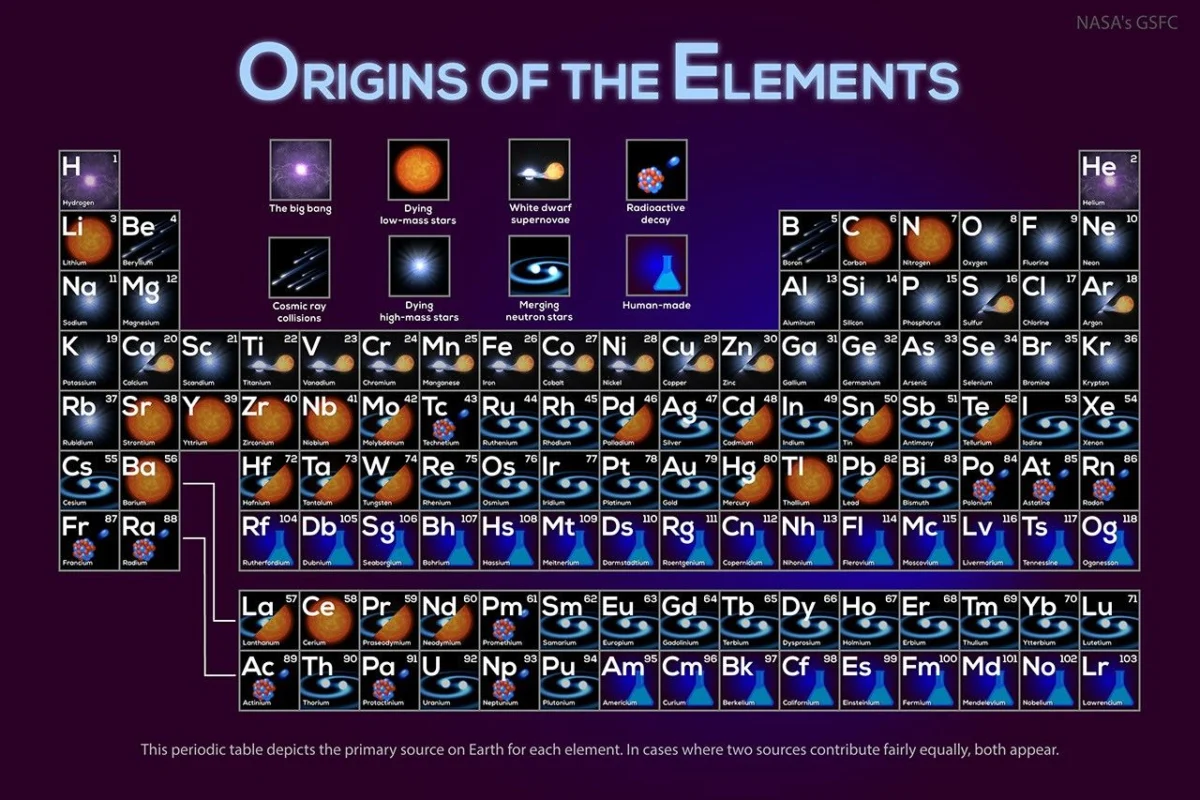
On September 14, 2026, NASA’s Astronomy Picture of the Day (APOD) presented a profound visualization that connects the farthest reaches of the cosmos to the very building blocks of life on Earth. The featured image, a color-coded periodic table, serves as a dynamic map illustrating humanity’s current understanding of where each known element originated across the universe’s vast timeline and extreme astrophysical events. This daily feature, renowned for its captivating astronomical imagery and expert explanations, highlights the intricate journey of matter from the Big Bang to the complex chemistry that constitutes our planet and ourselves.
The Primordial Soup: Genesis in the Big Bang
The narrative of element formation begins approximately 13.8 billion years ago with the Big Bang. In the immediate aftermath of this cosmic genesis, the universe was an incredibly hot and dense plasma. As it rapidly expanded and cooled, a process known as Big Bang Nucleosynthesis (BBN) occurred within the first few minutes. During this brief but crucial period, the universe was cool enough for protons and neutrons to fuse, but only for a short time before further expansion prevented significant formation of heavier nuclei. The primary products of BBN were the lightest elements: hydrogen (about 75% of the baryonic mass) and helium (about 25%), with trace amounts of lithium and beryllium.
The APOD explanation specifically notes that "The hydrogen in your body and present in every molecule of water came from the Big Bang. There are no other appreciable sources of hydrogen in the universe." This statement underscores hydrogen’s foundational role, not just in astrophysics as the fuel for stars, but also in biology as an indispensable component of water and organic molecules. Without this primordial element, the subsequent stellar evolution and the eventual emergence of life would be impossible. The constraints on BBN meant that elements heavier than lithium could not form in significant quantities, leaving the vast majority of the periodic table yet to be created.
Stellar Factories: Forging Elements in the Hearts of Stars
The next major chapter in the cosmic narrative of element formation unfolds within stars. After billions of years, gravity drew together vast clouds of hydrogen and helium gas, leading to the birth of the first stars. These stellar giants acted as the universe’s first nuclear furnaces, initiating the process of stellar nucleosynthesis.
In the cores of main-sequence stars like our Sun, hydrogen atoms fuse to form helium through the proton-proton chain reaction. As stars exhaust their hydrogen fuel, their internal dynamics change dramatically. More massive stars, in particular, evolve into red giants, where core temperatures and pressures increase sufficiently to ignite helium fusion, producing carbon and oxygen through the triple-alpha process. The APOD article states, "The carbon in your body was made by nuclear fusion in the interior of stars, as was the oxygen." These two elements are fundamental to organic chemistry and the respiration processes of life.
For stars significantly more massive than the Sun (typically eight times the Sun’s mass or more), this nucleosynthetic process continues in concentric shells within their cores. Progressively heavier elements are synthesized, moving up the periodic table: carbon fuses into neon, neon into oxygen, oxygen into silicon, and silicon into iron. Each stage requires increasingly higher temperatures and pressures. This layered fusion process generates a stellar "onion" structure, with iron accumulating in the innermost core. Iron is a critical turning point because its fusion consumes energy rather than releasing it, marking the end of sustainable energy production for the star.
Cosmic Cataclysms: Supernovae and the Distribution of Elements
The accumulation of an iron core in a massive star leads to an inevitable and spectacular demise: a supernova. When the iron core reaches a critical mass (the Chandrasekhar limit), it can no longer support itself against gravitational collapse. The core implodes rapidly, rebounding off the super-dense stellar remnant (a neutron star or black hole), and sending a powerful shockwave outward through the star’s outer layers. This catastrophic explosion, one of the most luminous events in the universe, disperses the newly forged elements into the interstellar medium.
Crucially, supernovae are not just dispersal mechanisms; they are also sites of further nucleosynthesis. The immense energy released during the explosion drives endothermic reactions and facilitates rapid neutron capture processes (the r-process) in the neutron-rich environment. This allows for the creation of elements heavier than iron, such as nickel, zinc, and many others, up to about half the elements on the periodic table. As the APOD explanation details, "Much of the iron in your body was made during supernovas of stars that occurred long ago and far away." Supernovae are therefore essential for enriching the galaxy with the diverse array of elements necessary for the formation of new stars, planets, and ultimately, life.
Exotic Collisions: Neutron Star Mergers and the Heaviest Elements
For the very heaviest elements, beyond iron and many of those formed in supernovae, astronomers have identified an even more exotic and energetic origin: the merger of neutron stars. Neutron stars are the incredibly dense remnants of massive stars that have undergone supernova explosions, packing the mass of our Sun into a sphere only about 20 kilometers in diameter. When two such incredibly dense objects in a binary system spiral inward and collide, the event is cataclysmic.
These mergers create an environment rich in free neutrons and extreme conditions, perfect for the rapid neutron capture process (r-process) to occur. In this scenario, atomic nuclei quickly absorb multiple neutrons before they have a chance to decay, building up very heavy isotopes that then undergo beta decay to form stable, super-heavy elements. The APOD article specifically highlights this, stating, "The gold in your jewelry was likely made from neutron stars during collisions that may have been visible as short-duration gamma-ray bursts or gravitational wave events."
The groundbreaking detection of gravitational waves from a binary neutron star merger (GW170817) by the LIGO and Virgo collaborations in 2017 provided direct observational evidence for this theory. Subsequent observations across the electromagnetic spectrum (a "kilonova") confirmed the presence of freshly synthesized heavy elements, including gold, platinum, and uranium. This event was a watershed moment in astrophysics, confirming a long-theorized cosmic forge and demonstrating the power of multi-messenger astronomy.
The Human Element: We Are Stardust
The APOD feature serves as a poignant reminder of the profound connection between the universe’s grandest phenomena and our own existence. The phrase "we are stardust," popularized by Carl Sagan, gains scientific weight through such analyses. Every atom in our bodies, save for the primordial hydrogen, has been processed through stars, supernovae, or neutron star mergers across billions of years and unimaginable distances.
For instance, oxygen, making up about 65% of the human body by mass, and carbon, about 18%, are predominantly products of stellar fusion. Iron, crucial for hemoglobin and oxygen transport, traces its lineage to supernovae. Even the trace elements, though small in quantity, are indispensable. As the article notes, "Elements like phosphorus and copper are present in our bodies in only small amounts but are essential to the functioning of all known life." Phosphorus is vital for DNA, RNA, and ATP, while copper is a cofactor for numerous enzymes.
This cosmic pedigree highlights not only the remarkable journey of matter but also the universality of physical laws. The same processes that govern the lives and deaths of stars are responsible for the intricate chemistry that allows life to flourish on a small blue planet.
Unanswered Questions and the Frontier of Discovery
While humanity has made immense strides in understanding nucleosynthesis, the color-coded periodic table featured in APOD also subtly points to areas where our knowledge remains incomplete. The explanation explicitly states that "The sites of nuclear creation of some elements, such as copper, are not really well known and are continuing topics of observational and computational research."
The precise astrophysical sites and mechanisms for the formation of several intermediate-mass elements (those between iron and the heaviest r-process elements) are still subjects of active investigation. For example, while massive stars and supernovae contribute, the relative importance of different stellar mass ranges, explosion mechanisms, and the influence of stellar rotation and magnetic fields are continually being refined through advanced simulations and increasingly sensitive astronomical observations. The slow neutron capture process (s-process), which occurs in asymptotic giant branch (AGB) stars, also contributes significantly to a range of elements, and its precise yields are still being modeled.
Future missions and observatories, including advanced gravitational wave detectors, next-generation X-ray and gamma-ray telescopes, and even neutrino observatories, will play a crucial role in unraveling these remaining mysteries. By observing the universe across different wavelengths and messengers, scientists aim to pinpoint the elusive cosmic nurseries for all elements, thus completing the comprehensive picture of our chemical origins.
The Enduring Legacy of APOD and NASA’s Outreach
The Astronomy Picture of the Day (APOD) has served as a cornerstone of public astronomical outreach since its inception in 1995. Curated by astrophysicists Robert Nemiroff and Jerry Bonnell, with recent contributions from Cecilia Chirenti and Keighley Rockcliffe, APOD consistently delivers stunning imagery and accessible scientific explanations to a global audience. It embodies NASA’s commitment to public education and engagement in science, making complex astrophysical concepts understandable and inspiring for millions.
The article details the organizational backing for APOD, noting it is "A service of ASD at NASA / GSFC, NASA Science Activation & Michigan Tech. U." This collaborative effort ensures the high scientific quality and broad dissemination of the content. The imminent migration of APOD’s main NASA site from apod.nasa.gov to science.nasa.gov/apod signifies an integration into a broader science communication platform, ensuring continued access to this invaluable resource for years to come.
This particular APOD, dated September 14, 2026, perfectly encapsulates APOD’s mission: to visually communicate cutting-edge astronomical understanding in an engaging way. By presenting the periodic table as a cosmic map of creation, it not only educates but also encourages reflection on our place in the universe, emphasizing that our very existence is a testament to the dynamic and violent processes that continually sculpt the cosmos. The ongoing research into element origins underscores that even with our vast knowledge, the universe still holds countless secrets, waiting to be revealed by dedicated scientists and shared with an eager public through platforms like APOD.