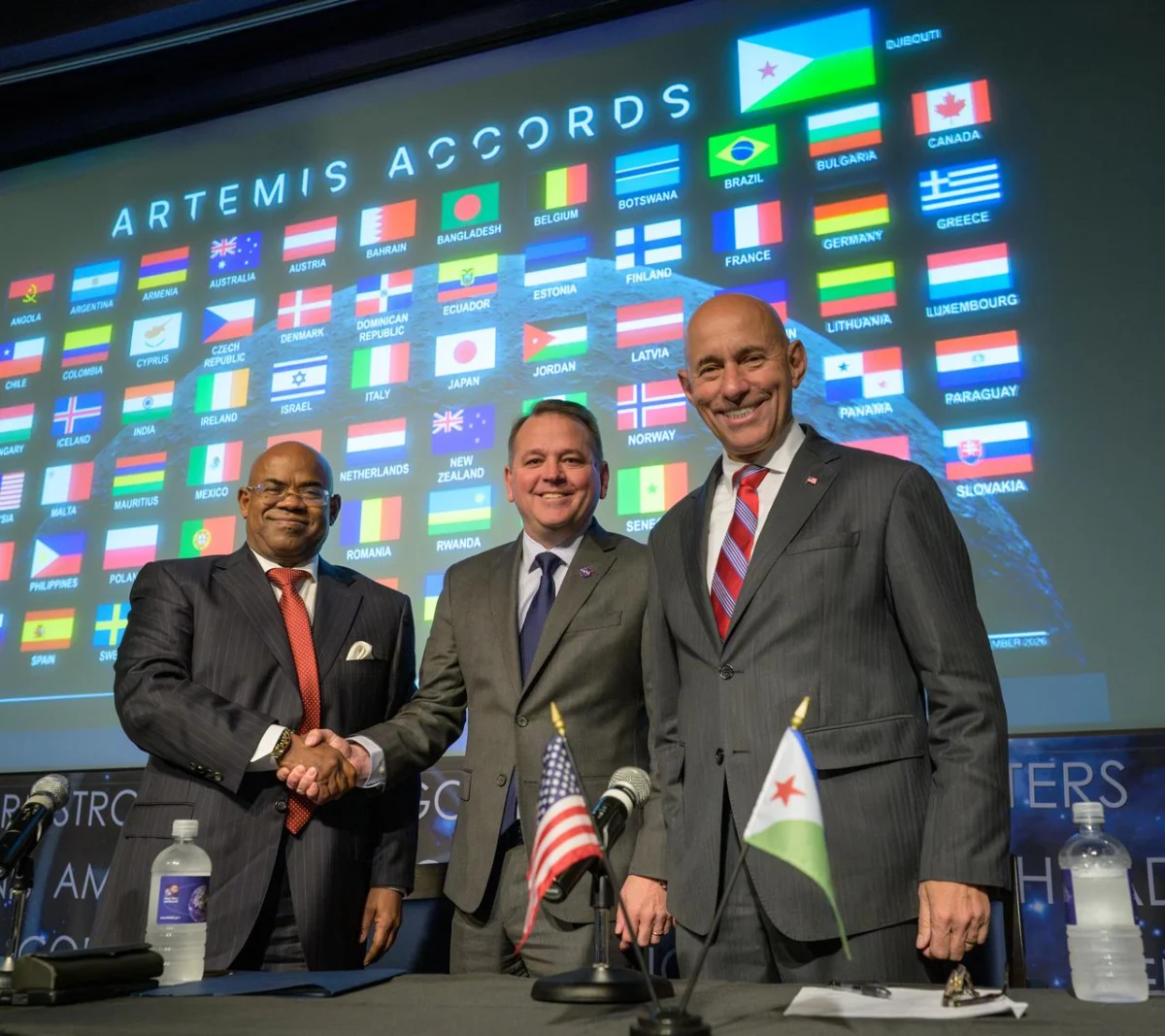
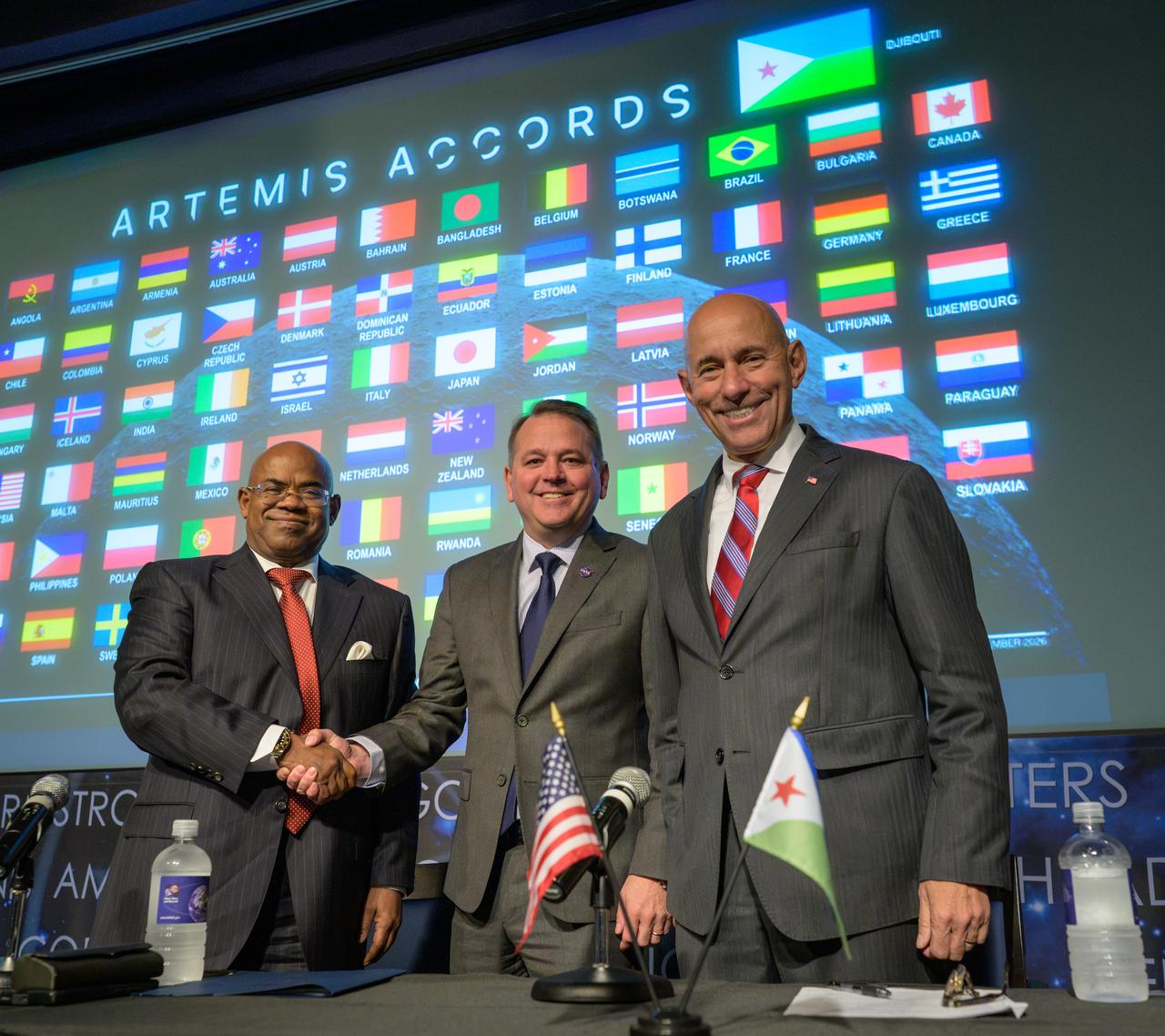
The Republic of Djibouti officially became the 72nd nation and the eighth African country to endorse the Artemis Accords, a landmark set of non-binding principles designed to enhance transparency, safety, and coordination among nations engaged in lunar, Martian, and broader deep-space exploration. The signing ceremony, held on Monday, September 14, 2026, at NASA Headquarters in Washington, D.C., marked a significant step for the East African nation’s burgeoning space program and underscored the growing international consensus around responsible space activities.
The event saw Ambassador Mohamed Siad Douale sign the Accords on behalf of Djibouti, affirming his nation’s commitment to the principles of peaceful and sustainable space exploration. Hosting the ceremony was NASA Deputy Administrator Matt Anderson, who emphasized the strategic importance of Djibouti’s entry into the coalition. U.S. State Department Assistant Secretary for African Affairs Frank Garcia also participated, highlighting the diplomatic and geopolitical dimensions of the agreement.
The Artemis Accords: A Framework for Future Space Governance
The Artemis Accords, established in 2020 by NASA and the U.S. Department of State alongside seven other founding nations—Australia, Canada, Italy, Japan, Luxembourg, the United Kingdom, and the United Arab Emirates—represent a crucial effort to extend the principles of the 1967 Outer Space Treaty into a new era of lunar and deep-space activities. With a renewed focus on returning humans to the Moon through the Artemis program, and eventually establishing a sustained human presence there as a stepping stone to Mars, the need for a clear framework for international cooperation and responsible conduct has become paramount.
The Accords are built upon a foundation of eight key principles, designed to ensure a safe, peaceful, and prosperous future in space. These include:
- Peaceful Purposes: All activities conducted under the Artemis program must be exclusively for peaceful purposes, in line with the Outer Space Treaty.
- Transparency: Signatories are expected to be transparent about their policies and plans, sharing information to minimize misunderstandings and promote trust.
- Interoperability: Nations commit to developing systems that are interoperable, allowing for the sharing of resources and reducing technical barriers to collaboration.
- Emergency Assistance: The Accords reinforce the obligation to render assistance to personnel in distress in outer space, as required by the Outer Space Treaty.
- Registration of Space Objects: Signatories are to comply with the Convention on Registration of Objects Launched into Outer Space, maintaining a public record of their space activities.
- Release of Scientific Data: Scientific data resulting from Artemis activities should be publicly shared in a timely manner, benefiting the global scientific community.
- Protection of Heritage: Nations agree to preserve sites and artifacts of historic human activity on the Moon and other celestial bodies.
- Space Resources: The Accords affirm that the extraction and utilization of space resources should be conducted in a manner that is safe, sustainable, and transparent, consistent with international law. This principle, in particular, has been a significant point of discussion, aiming to provide a legal and practical framework for future resource utilization.
- Deconfliction of Activities: Signatories commit to preventing harmful interference and ensuring the safety of operations through coordination and information sharing regarding their activities.
- Orbital Debris Mitigation: Nations pledge to mitigate orbital debris and safely dispose of spacecraft at the end of their missions, contributing to the long-term sustainability of the space environment.
These principles aim to prevent conflict, foster collaboration, and ensure that the benefits of space exploration are shared broadly, moving beyond the traditional bilateral agreements to establish a multilateral, norm-setting framework for the 21st century’s space race.
Djibouti’s Ascent in Space: A Chronology of Ambition
Djibouti’s decision to join the Artemis Accords is the culmination of a deliberate and strategic expansion of its national space program, which commenced in 2020. Managed by the Centre for Studies and Research of Djibouti (CERD) within the Ministry of Higher Education and Research, the program has rapidly developed its technical capabilities and infrastructure.
- 2020: The Republic of Djibouti officially launches its national space program, signaling its intent to become a participant in the global space economy and scientific community. This initiative was driven by a recognition of space technology’s potential to address national development challenges in areas like resource management, climate monitoring, and connectivity.
- 2023: Djibouti achieves a significant milestone with the successful launch of its first satellite, Djibouti 1A. The satellite, designed for Earth observation and data collection, reached orbit aboard an American Falcon 9 rocket launched from Vandenberg Space Force Base in California. This event marked Djibouti’s entry into the exclusive club of nations with independent satellite capabilities.
- 2024: Building on its initial success, Djibouti launches its second satellite, Djibouti 1B, also on a Falcon 9 rocket from Vandenberg. This follow-up launch further solidified the nation’s technical expertise and commitment to building a robust space infrastructure. Both Djibouti 1A and 1B are examples of how the U.S. has supported Djibouti’s emerging capabilities in space, fostering a relationship that now extends to the Artemis Accords.
- September 14, 2026: Djibouti formally signs the Artemis Accords, becoming the 72nd signatory nation and the eighth from the African continent. This act solidifies its place within a growing global coalition committed to peaceful and responsible space exploration.
Ambassador Douale underscored the nation’s motivations for joining the Accords, stating, "By joining the Artemis Accords, Djibouti seeks to deepen its partnership with the United States and with the growing community of nations committed to peaceful space cooperation. We look forward to building partnerships in scientific research, satellite applications, education, and technical training, while creating new opportunities for Djibouti students, researchers, engineers, and entrepreneurs." His remarks reflect a clear vision for leveraging space to drive national development and create future-oriented opportunities for its citizens.
Strategic Implications and Broader Impact
Djibouti’s accession to the Artemis Accords carries multi-faceted implications, both for the small East African nation and for the broader landscape of international space governance.
For Djibouti:
- Enhanced International Collaboration: The Accords open direct avenues for collaboration with NASA and other signatory nations on future lunar missions, scientific research, and technological development. This could translate into opportunities for Djiboutian scientists and engineers to participate in cutting-edge space projects.
- Technological Advancement and Capacity Building: The focus on interoperability and technical training within the Accords aligns perfectly with Djibouti’s goals of expanding its indigenous space capabilities. Access to advanced technologies, expertise, and best practices from leading spacefaring nations can accelerate its program’s growth.
- Economic Diversification: A thriving space sector can spur economic growth, creating high-tech jobs, fostering innovation, and attracting foreign investment. Djibouti’s strategic location at the confluence of major shipping lanes and its stable political environment could potentially position it as a regional hub for space-related services, such as ground stations or data processing.
- Educational and Entrepreneurial Opportunities: As Ambassador Douale highlighted, the Accords promise to create new pathways for students, researchers, engineers, and entrepreneurs. This includes scholarships, joint research projects, and the development of a local space industry ecosystem.
- Geopolitical Standing: Joining a U.S.-led initiative like the Artemis Accords elevates Djibouti’s international profile and strengthens its diplomatic ties, particularly with the United States and other Western allies. It signals Djibouti’s commitment to international norms and responsible global citizenship.
For the Artemis Accords and Global Space Governance:
- Increased Legitimacy and Global Reach: With 72 signatories, the Accords are rapidly gaining traction as the primary framework for responsible conduct in lunar and deep-space exploration. Djibouti’s signing further broadens its geographic and cultural representation, demonstrating its appeal beyond traditional space powers.
- Strengthening Norms: Each new signatory reinforces the principles embedded in the Accords, helping to solidify international norms for activities like resource utilization, debris mitigation, and transparency in an environment where a comprehensive international space treaty remains elusive.
- African Representation: As the eighth African nation, Djibouti’s participation strengthens the voice of the African continent in shaping the future of space. This is crucial as African nations increasingly recognize the importance of space for their development goals and seek to avoid being left behind in the new era of space exploration. Other African signatories include Rwanda, Nigeria, Angola, South Africa, Kenya, Ethiopia, and Zambia, indicating a growing pan-African interest in space.
- U.S. Leadership: The continued expansion of the Artemis Accords coalition underscores the U.S.’s success in building a broad international consensus around its vision for space exploration. NASA Deputy Administrator Matt Anderson’s remarks, "NASA will lead, but we will not do it alone. We are creating opportunities for Artemis Accords nations to contribute hardware, scientific payloads, technology demonstrations, CubeSats, and other capabilities to future missions," encapsulate this collaborative leadership model.
The Future of Space Exploration and Djibouti’s Role
The Artemis program, spearheaded by NASA, aims to land the first woman and first person of color on the Moon, establish a sustainable lunar presence, and pave the way for human missions to Mars. This ambitious endeavor relies heavily on international partnerships, and the Artemis Accords serve as the diplomatic bedrock for these collaborations. Nations signing the Accords are not just endorsing principles; they are opening doors to concrete opportunities for participation, ranging from providing scientific instruments and technology demonstrations to potentially contributing to habitat development or resource extraction infrastructure.
For Djibouti, its journey from launching its first satellite in 2023 to becoming a signatory of the Artemis Accords in 2026 demonstrates a clear strategic trajectory. Its early success in satellite deployment, facilitated by American launch services, exemplifies the kind of practical cooperation that can blossom into deeper partnerships under the Accords. The nation’s focus on satellite applications is particularly relevant, as Earth observation and telecommunications are vital for monitoring environmental changes, managing natural resources, and fostering economic development in the region.
The global space landscape is undergoing a profound transformation, with increasing involvement from commercial entities and a growing number of nations, both large and small, recognizing the strategic and economic value of space. In this evolving context, frameworks like the Artemis Accords are essential for ensuring that humanity’s expansion into the cosmos is conducted responsibly, peacefully, and for the benefit of all. Djibouti’s decision to join this coalition is a testament to its forward-looking vision and its commitment to being an active, responsible participant in the "Golden Age of space exploration and innovation."
As the world looks towards returning to the Moon and venturing further into the solar system, the collective commitment of nations like Djibouti through the Artemis Accords will be crucial in shaping the future of humanity’s endeavors beyond Earth.
Learn more about the Artemis Accords at: https://www.nasa.gov/artemis-accords