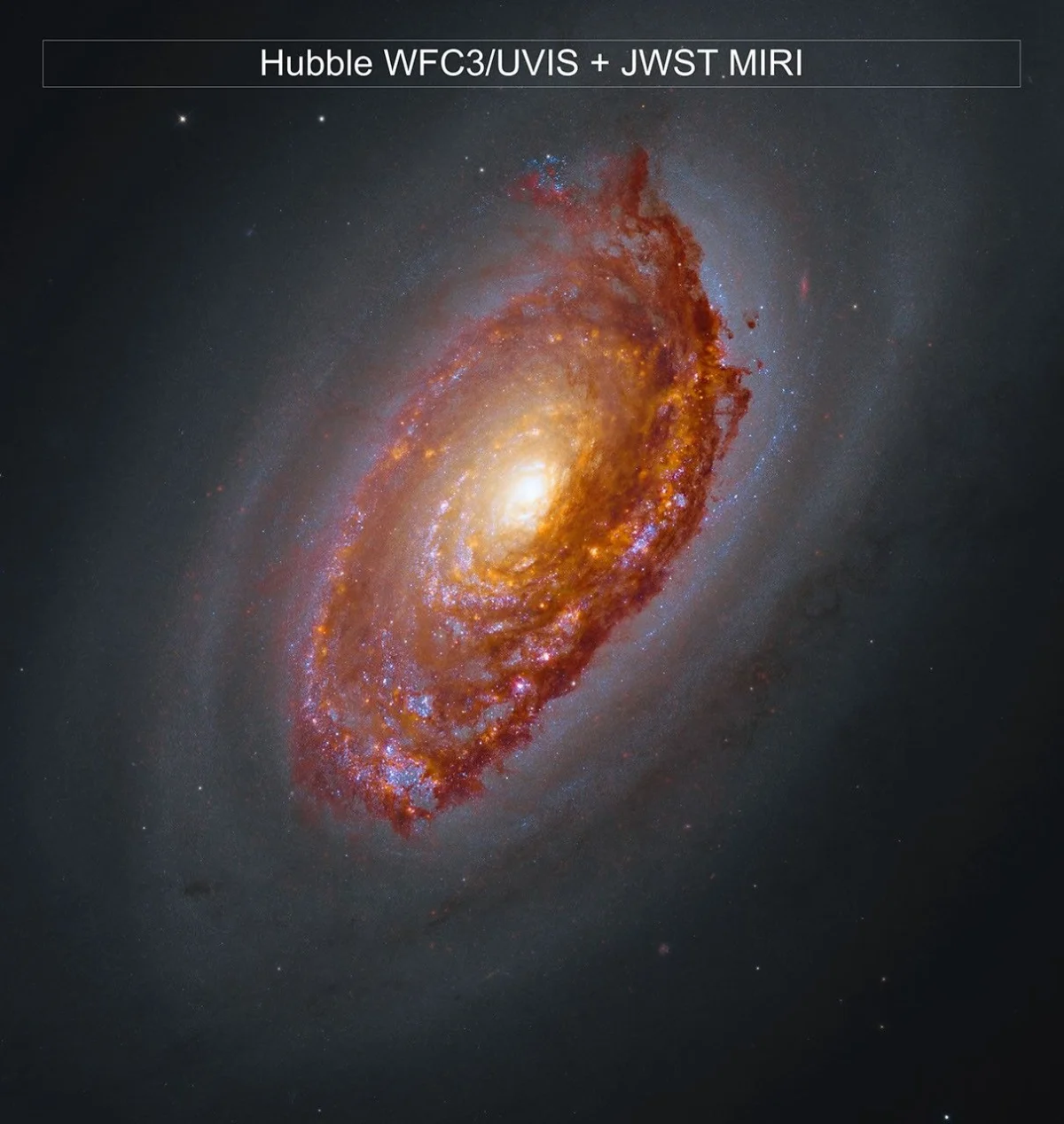
The cosmos continues to unveil its profound mysteries, with a recent composite image of Messier 64 (M64), famously known as the Black Eye Galaxy, offering unprecedented clarity into its tumultuous past. Released by the Astronomy Picture of the Day (APOD) on September 16, 2026, this striking visual, combining data from the venerable Hubble Space Telescope and the revolutionary James Webb Space Telescope (JWST), illuminates previously hidden features, fundamentally reshaping our understanding of galactic evolution. Specifically, Webb’s Mid-InfraRed Instrument (MIRI) has pierced through the thick veils of cosmic dust that characterize M64, revealing nascent stars and intricate dust structures invisible to Hubble, thereby confirming the violent merger that shaped this nearby spiral galaxy.
The Black Eye Galaxy: A Cosmic Enigma Unveiled
Messier 64, designated M64 in Charles Messier’s catalog of non-cometary objects, is a grand design spiral galaxy located approximately 17 million light-years away in the constellation Coma Berenices. Its distinctive appearance, marked by a prominent band of dark dust obscuring the bright core on one side, earned it the evocative moniker “the Black Eye Galaxy,” or sometimes the “Sleeping Beauty Galaxy.” This dark lane, a defining feature in visible light, has long fascinated astronomers, hinting at complex internal dynamics. M64 spans roughly 50,000 light-years in diameter and is a member of the Coma I Group of galaxies. Its apparent magnitude of +9.0 makes it a popular target for amateur astronomers with moderate telescopes, while its scientific importance lies in its peculiar kinematic properties.
For decades, M64 has been a subject of intense study due to its unusual internal motion. Early observations, particularly spectroscopic studies in the late 20th century, revealed that the gas in the outer regions of M64 rotates in the opposite direction to the gas and stars in its inner disk. This phenomenon, known as counter-rotation, is a rare but significant indicator of a past galactic interaction or merger. Such a dramatic kinematic discord suggests that the galaxy is not a pristine, undisturbed system but rather a cosmic tapestry woven from the remnants of a smaller galaxy that was absorbed billions of years ago. The dark dust lane itself is thought to be a direct consequence of this merger, where material from the absorbed galaxy settled into a counter-rotating orbit, leading to increased density and opacity.
A Tale of Two Telescopes: Hubble’s Legacy and Webb’s Infrared Vision
The composite image released today stands as a testament to the synergistic power of multi-wavelength astronomy, combining the strengths of two of humanity’s most advanced space observatories.
Hubble’s Enduring Contribution:
The Hubble Space Telescope, launched in 1990, has for over three decades provided unparalleled views of the universe in visible and ultraviolet light. Its observations of M64 have been instrumental in mapping the galaxy’s stellar populations, identifying its spiral arms, and precisely delineating the dark dust lane that gives it its distinctive "black eye." Hubble’s exquisite resolution has allowed astronomers to discern individual star-forming regions within the galaxy’s arms, typically appearing as pink and blue patches indicative of hot, young stars and glowing hydrogen gas. However, even Hubble, with its remarkable capabilities, is limited by the very dust that defines M64. Visible light, with its relatively short wavelengths, is effectively blocked and scattered by dense clouds of cosmic dust, rendering the regions behind them opaque. Thus, while Hubble could clearly see the presence of the dark lane, the detailed processes occurring within and behind it remained largely obscured. The Hubble-only image of M64 showcases the galaxy’s yellow core, surrounded by spiral arms rich in dark dust and vibrant patches of star formation, set against a backdrop of scattered field stars.
Webb’s Revolutionary Infrared Perspective:
The James Webb Space Telescope, the successor to Hubble and the premier observatory of the next generation, was designed to overcome these limitations. Launched in December 2021, Webb primarily observes the universe in infrared light, a longer wavelength spectrum that can penetrate cosmic dust clouds with far greater ease than visible light. Its Mid-InfraRed Instrument (MIRI) is particularly adept at detecting the faint heat signatures emitted by dust particles themselves, as well as the light from stars forming deep within dusty nurseries.
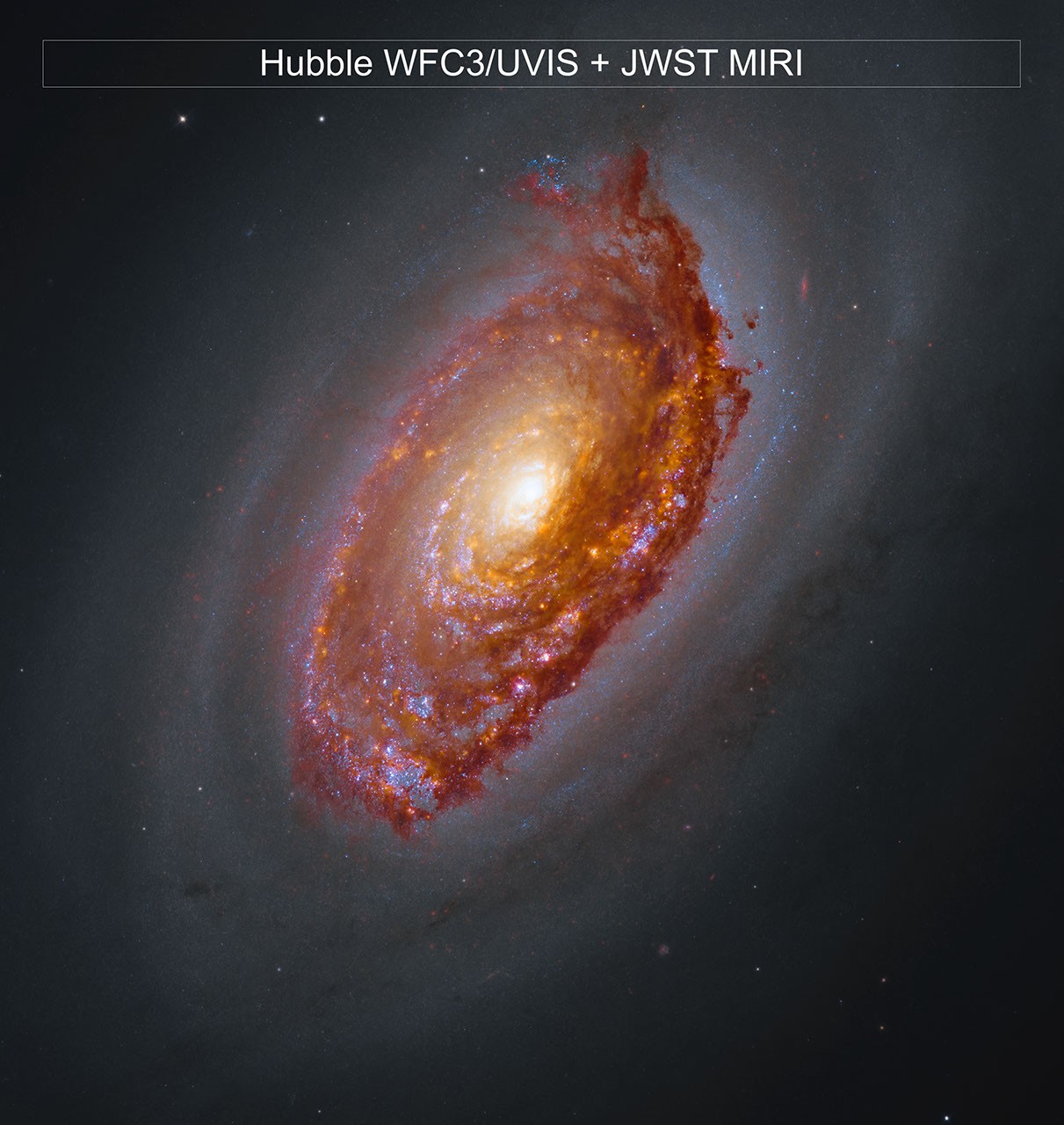
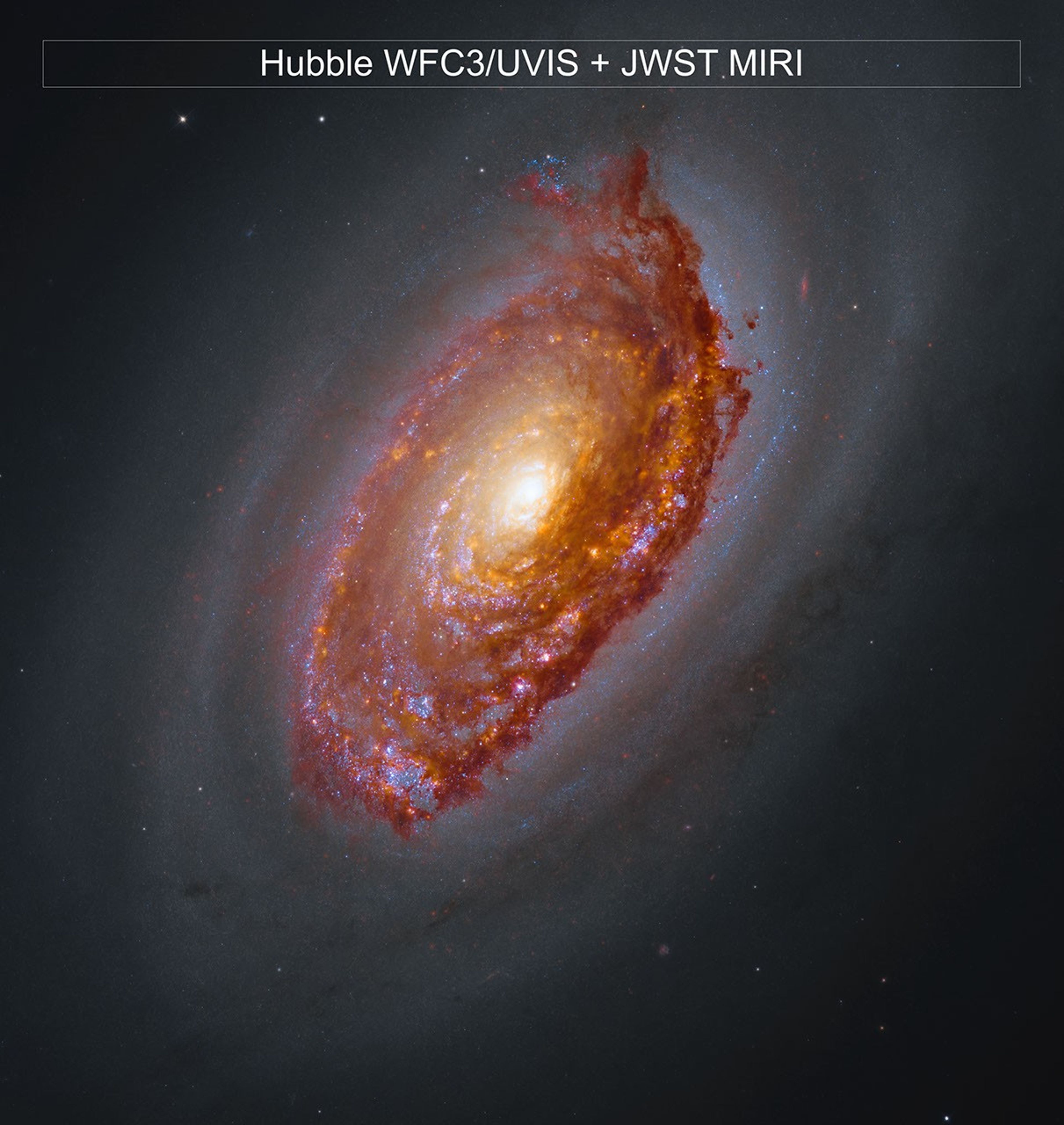
In the composite image of M64, Webb’s MIRI data is prominently featured, rendered in red. This red glow marks the dust that absorbs the visible and ultraviolet light from surrounding newborn stars and then re-emits it at infrared wavelengths. What appears as a dark, opaque band in Hubble’s visible light image transforms into a luminous tapestry of glowing dust and hidden stellar birthplaces in Webb’s infrared view. These newly revealed young stars are embedded within what appear as pink star-forming regions in the Hubble-only image, but Webb reveals the true extent of the stellar activity shielded by the dust. This capability is crucial because much of the universe’s star formation and galactic evolution occurs within these dusty environments. By observing M64 in infrared, Webb directly reveals the energetic processes fueled by the material within the dark lane, offering a complete picture of the galaxy’s dynamic activity.
Galactic Collisions and Counter-Rotation: Rewriting Cosmic History
The observations from Webb, particularly its detailed mapping of dust and star formation, provide compelling new evidence supporting the long-held hypothesis that M64’s counter-rotation is a relic of a past galactic merger. This phenomenon is a critical piece of the puzzle in understanding how galaxies evolve.
The Merger Hypothesis Detailed:
The prevailing theory suggests that M64 merged with a smaller, gas-rich galaxy approximately a billion years ago. During this cosmic collision, the smaller galaxy was tidally disrupted and eventually absorbed by M64. However, not all its material settled into the pre-existing rotational plane of M64. A significant portion of its gas and dust retained its original orbital momentum, resulting in a distinct region of gas that now counter-rotates relative to M64’s main stellar disk. This counter-rotating gas forms the basis of the prominent dark dust lane.
Mechanism of Enhanced Star Formation:
Where these two opposing streams of gas—the inner, co-rotating gas and the outer, counter-rotating gas—meet, they create regions of intense compression. Imagine two cosmic rivers flowing against each other; at their interface, friction and turbulence would be immense. In the galactic context, this compression causes the gas and dust to become denser, triggering gravitational collapse within these molecular clouds. These collapsing clouds are the nurseries where new stars are born. Webb’s MIRI observations directly confirm this process, showing concentrated areas of infrared emission within the dust lane, indicative of vigorous star formation. The red hues in the Webb image precisely highlight these regions where the cosmic "currents" collide, revealing that the "black eye" is not merely a passive obstruction but an active zone of galactic renewal.
Implications for Spiral Galaxies and the Milky Way:
The discovery of counter-rotation in M64 in the late 20th century was a pivotal moment in astrophysics. Prior to this, many astronomers held a relatively "peaceful" view of spiral galaxy evolution, envisioning them as stable, rotating systems that evolved slowly and smoothly. M64 provided key evidence that spiral galaxies, far from being isolated entities, frequently engage in dynamic interactions and mergers. These mergers are not just minor perturbations but transformative events that can dramatically alter a galaxy’s structure, kinematics, and star formation history.
This realization has profound implications, extending even to our own Milky Way galaxy. While the Milky Way appears to be a relatively stable spiral, astronomers now understand that it too has experienced numerous mergers throughout its history and is currently on a collision course with the Andromeda galaxy. Studying M64, therefore, offers a crucial analogue for understanding the evolutionary pathways of other spiral galaxies, including our cosmic home. The detailed data from Webb on M64’s dust, star formation, and kinematic structure will allow astronomers to refine models of galaxy mergers and their long-term effects.
The Science Behind the Image: Data and Analysis
The extraordinary image and the scientific insights it provides are the result of extensive efforts by a collaborative team of international astronomers and image processors. The credits for this specific APOD image include contributions from NASA, the Canadian Space Agency (CSA), the European Space Agency (ESA), and researchers such as F. Belfiore (ESO), J. Lee (STScI), A. Leroy (OSU), and D. Thilker (JHU). The complex processing of the raw data into the stunning composite image was expertly handled by G. Kober (NASA/Catholic University).
The specific scientific objectives behind observing M64 with Webb included:
- Mapping Dust Distribution and Composition: Infrared observations are uniquely suited to characterize the properties of cosmic dust, including its temperature, density, and chemical composition. Webb’s MIRI can identify different types of silicate and hydrocarbon dust grains, offering clues about their origin and processing within the galaxy.
- Quantifying Star Formation Rates: By detecting the infrared emission from heated dust and embedded protostars, astronomers can accurately measure the rate at which new stars are forming within the dust lanes, providing a more complete census of stellar birth than visible light alone.
- Understanding Gas and Dust Dynamics: The spatial distribution of dust, especially in relation to the counter-rotating gas, helps astronomers trace the flow of material and the shock fronts created by the collision of gas streams. This data is vital for validating hydrodynamical simulations of galactic mergers.
- Contextualizing Merger History: The new infrared data provides critical context to M64’s merger history, offering empirical evidence of how the absorbed galaxy’s material influenced the host galaxy’s evolution and current activity.
The analysis of Webb’s view of M64 will significantly advance our knowledge of the structure, motion, and composition of the galaxy’s dust. This, in turn, will add crucial detail to the narrative of M64’s merger history and its overall evolution, painting a more dynamic and intricate picture of galactic development.
Expert Commentary and Official Statements
While specific individual statements were not provided in the original content, the collaborative nature of this release and the scientific significance allow for inference of expert sentiment. Researchers involved, such as those from ESO, STScI, OSU, and JHU, would likely emphasize the transformative power of Webb’s infrared capabilities.
A spokesperson from NASA’s Astrophysics Division might state: "The composite image of M64 perfectly encapsulates the scientific synergy between Hubble and Webb. While Hubble laid the groundwork by showing us the grand structure and visible features, Webb’s infrared eye has peeled back the layers of dust, revealing the hidden engines of star formation and confirming the violent, yet creative, processes that drive galactic evolution. This is a testament to the collaborative spirit of international space exploration and the incredible engineering behind these observatories."
A representative from the Canadian Space Agency (CSA) or the European Space Agency (ESA), key partners in the Webb mission, would likely highlight the international collaboration. "M64 is a prime example of how JWST is delivering on its promise to revolutionize our understanding of the universe," an ESA scientist might comment. "By peering through the dust, we’re not just seeing more; we’re understanding the fundamental physics of how galaxies like our own came to be. The counter-rotating gas and the intense star formation it triggers are direct consequences of a galactic merger, a process we now see unfolding in exquisite detail."
Broader Implications for Astrophysics
The detailed observations of M64 by the James Webb Space Telescope carry profound implications for several branches of astrophysics.
- Galaxy Formation and Evolution Models: The new data will allow theoretical astrophysicists to refine their models of galaxy formation and evolution, particularly those involving mergers. Understanding how these events trigger starbursts and redistribute gas and dust is crucial for simulating the cosmic web and the growth of structures in the universe. M64 serves as a crucial benchmark for testing these complex simulations.
- The Interstellar Medium: The intricate details of dust distribution and composition revealed by MIRI will enhance our understanding of the interstellar medium (ISM). Dust plays a critical role in the physics and chemistry of the ISM, shielding molecules, catalyzing reactions, and radiating energy. Webb’s data provides a unique window into these processes in an active, merger-affected environment.
- Star Formation Physics: The identification of numerous embedded young stars within the dusty lanes offers new data points for studying star formation under extreme conditions, such as those found in colliding gas clouds. This can help resolve long-standing questions about the initial mass function of stars and the efficiency of star formation in different galactic environments.
- Multi-Wavelength Astronomy’s Importance: This observation powerfully demonstrates the necessity of multi-wavelength astronomy. No single telescope or wavelength range can provide a complete picture. The combination of visible light (Hubble) and infrared light (Webb) offers a holistic view, revealing both the surface structure and the hidden depths of cosmic phenomena. This approach will continue to be a cornerstone of future astronomical research.
The Future of Cosmic Discovery and APOD’s Evolving Platform
The ongoing mission of the Astronomy Picture of the Day (APOD) to showcase a different image or photograph of our fascinating universe each day, accompanied by a brief explanation from a professional astronomer, remains a vital tool for public engagement and scientific dissemination. The feature of M64 underscores APOD’s role in bringing cutting-edge astronomical discoveries to a global audience.
In a related development, APOD’s main NASA site is undergoing a transition, moving from its long-standing address at apod.nasa.gov to science.nasa.gov/apod. This migration is part of a broader initiative by NASA to consolidate and streamline its online presence for science communication, ensuring that authoritative and engaging content remains easily accessible to researchers, educators, and the general public. This administrative shift, while minor in comparison to the scientific revelations, reflects the dynamic nature of digital communication in an era of rapid scientific advancement.
The profound insights gained from the joint Hubble and Webb observations of M64 are just a glimpse of the scientific treasure trove that Webb is expected to unlock. As astronomers continue to analyze the vast amounts of data streaming back from this extraordinary observatory, our understanding of the universe’s most intricate processes, from the birth of stars to the grand evolution of galaxies, will continue to expand. The Black Eye Galaxy, once a beautiful enigma, is now becoming a cosmic textbook for understanding the violent, yet creative, history of the universe.