The Dawn of a New Era in Spaceflight: A Bicentennial Unveiling
On Constitution Day, 1976, at Rockwell International’s assembly facility in Palmdale, California, a crowd of thousands, including dignitaries, aerospace engineers, and a unique assembly of pop culture icons, gathered to witness the rollout of a revolutionary vehicle. This was no ordinary aircraft; it was the Space Shuttle Enterprise, a craft designed not for orbital flight itself, but to prove the fundamental aerodynamic and landing characteristics of a reusable spaceplane concept that promised to transform human access to space. The event transcended a mere technical presentation; it was a powerful symbol of American innovation, resilience, and an enduring fascination with the cosmos, perfectly timed during the nation’s 200th anniversary celebrations. The bicentennial year itself was marked by a wave of national pride and a reflection on America’s historical achievements, and the Enterprise’s debut seamlessly wove itself into this narrative, projecting a future as grand as the nation’s past.
The Genesis of the Space Shuttle Program: A Vision for Reusability
The unveiling of the Enterprise was the culmination of years of intense research, development, and political debate following the Apollo era. After successfully landing humans on the Moon, NASA faced the challenge of defining its next grand objective. The vision for the Space Shuttle program, officially approved by President Richard Nixon in 1972, was ambitious: to create a reusable spacecraft system that could dramatically reduce the cost and increase the frequency of access to low-Earth orbit. This was a radical departure from the "expendable" rockets and capsules of Mercury, Gemini, and Apollo. The shuttle was envisioned as a "space truck," capable of deploying satellites, conducting scientific experiments, servicing space stations, and returning to Earth to be refurbished and flown again, much like a commercial airliner.
The concept called for an orbiter, external tank, and two solid rocket boosters. The orbiter itself was a delta-winged spacecraft designed to re-enter the atmosphere and glide to a conventional runway landing. This reusability was the cornerstone of the program’s economic and operational promise. Rockwell International, a titan in aerospace manufacturing with a rich history of producing iconic aircraft like the B-1 Lancer bomber and playing a significant role in the Apollo program, was awarded the contract to build the orbiters. Their Palmdale facility became the crucible where these complex machines were forged, bringing together thousands of engineers, technicians, and scientists in a unified effort to push the boundaries of aerospace engineering.
A Name Forged by Fans: The USS Enterprise Connection
Initially, NASA had intended to name the first orbiter "Constitution," a fitting tribute given its unveiling on Constitution Day during the bicentennial year. However, this plan was dramatically altered by an unprecedented public groundswell. A passionate, organized, and overwhelmingly successful letter-writing campaign spearheaded by fans of the wildly popular science fiction television series Star Trek inundated the White House. Nearly 100,000 letters poured in, urging that the shuttle be named after the fictional starship USS Enterprise, the iconic vessel commanded by Captain James T. Kirk.
The Star Trek series, which had aired from 1966 to 1969 but enjoyed immense popularity in syndication, had captivated audiences worldwide with its optimistic vision of a future where humanity explored the stars, embracing diversity and scientific discovery. The USS Enterprise represented exploration, courage, and the peaceful pursuit of knowledge – ideals that resonated deeply with the public’s perception of NASA. The sheer volume and fervor of the fan campaign demonstrated the profound cultural impact of Star Trek and its ability to mobilize a dedicated fanbase.
President Gerald Ford, recognizing the cultural significance and public relations value of such a connection, weighed in. In a memo, he directed NASA to christen the shuttle Enterprise, reportedly stating he was "partial to the name." This decision was a rare instance of popular culture directly influencing a major governmental scientific endeavor, a testament to the power of public engagement and the enduring appeal of the Star Trek universe. The name Enterprise itself carried a rich legacy in U.S. naval history, having been bestowed upon numerous distinguished vessels, including the first nuclear-powered aircraft carrier, a decorated World War II carrier, and even an American vessel from the Revolutionary War, thereby linking the nation’s pioneering spirit across centuries and into the future of space.
The Unveiling Ceremony: A Confluence of Worlds
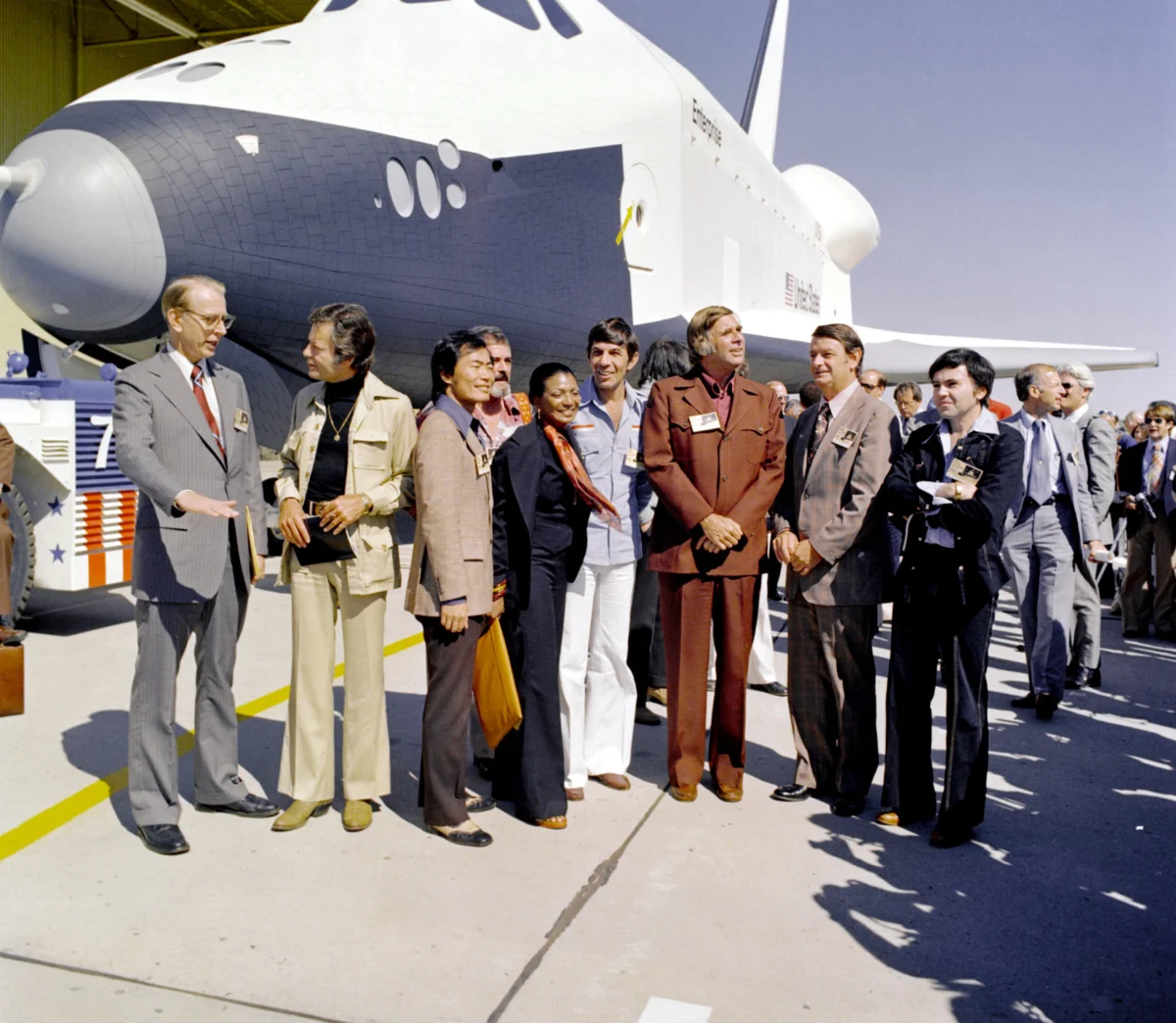
The rollout ceremony on September 17, 1976, was a spectacle that blended the gravitas of scientific achievement with the excitement of popular culture. Hundreds of invited guests filled the Rockwell facility, their anticipation palpable. Dignitaries included NASA Administrator James C. Fletcher and U.S. Rep. Don Fuqua (D-Fla), a key congressional advocate for the space program. However, the most celebrated guests, drawing immense media attention, were the creators and cast members of Star Trek.
Gene Roddenberry, the visionary creator of Star Trek, stood proudly alongside several of his show’s beloved actors: DeForest Kelley (Dr. "Bones" McCoy), George Takei (Mr. Sulu), James Doohan (Chief Engineer Montgomery "Scotty" Scott), Nichelle Nichols (Lt. Uhura), Leonard Nimoy (Mr. Spock), and Walter Koenig (Ensign Chekov). Their presence underscored the unique connection between the fictional starship and its real-world counterpart. The sight of these actors, who had inspired millions with their on-screen journeys, standing before the actual Space Shuttle Enterprise, symbolized a bridge between aspiration and reality, between science fiction and scientific fact. It was a powerful moment for public outreach, demonstrating NASA’s willingness to embrace popular enthusiasm for space.

The atmosphere was electric. As the colossal white orbiter, bearing the distinctive NASA "worm" logo and its new name, was towed into view, cheers erupted. The Enterprise, though a test vehicle, looked every bit the futuristic spacecraft, its sleek lines promising a new era of exploration. For the Star Trek cast, it was a moment of profound pride and emotional resonance, seeing their fictional universe manifest in such a tangible and significant way. Nichelle Nichols, who played Lt. Uhura, reportedly shed tears of joy, recognizing the monumental impact of their show. This public display served not only as a technical milestone but also as a powerful public relations coup, generating widespread enthusiasm for the nascent Space Shuttle program.
Beyond the Rollout: Enterprise’s Critical Mission
While the Enterprise was a marvel to behold, it was distinct from its operational brethren that would follow. Designated OV-101 (Orbiter Vehicle-101), it was purpose-built as a testbed and was not equipped for spaceflight. It lacked functional main engines, a comprehensive thermal protection system (heat shield tiles), and many of the sophisticated life support and orbital maneuvering systems necessary for missions in space. Instead, its primary mission was to perform the crucial atmospheric test flights that would validate the shuttle’s aerodynamic design, flight controls, and landing procedures.
This rigorous testing phase, known as the Approach and Landing Test (ALT) program, commenced in early 1977. The Enterprise was mated to a modified Boeing 747 Shuttle Carrier Aircraft (SCA) at NASA’s Dryden Flight Research Center (now Armstrong Flight Research Center) at Edwards Air Force Base in California. The ALT program consisted of several phases:
- Captive-Carry Flights: Initially, the Enterprise remained attached to the SCA for a series of flights to test the combined aircraft’s aerodynamics and structural integrity. These flights allowed engineers to gather data on how the massive orbiter affected the 747’s performance and handling.
- Crewed Captive-Carry Flights: Astronauts Fred Haise (veteran of Apollo 13) and Gordon Fullerton, and later Joe Engle and Richard Truly, were aboard the Enterprise during some of these captive flights, practicing emergency procedures and familiarizing themselves with the vehicle’s systems.
- Free-Flight Tests: The most critical phase involved the Enterprise being released from the SCA at high altitude, allowing it to glide unpowered to a runway landing. Between August and October 1977, five successful free-flight tests were conducted. These flights were instrumental in gathering invaluable data on the orbiter’s subsonic flight characteristics, stability, control, and its ability to perform a precise landing approach.
These tests were not without their challenges. Engineers and test pilots meticulously analyzed every aspect of the Enterprise’s performance, identifying and resolving issues before the operational orbiters would face the unforgiving environment of space. The data collected from the ALT program directly informed the final design and operational procedures for Columbia, the first Space Shuttle orbiter to fly into space.
Paving the Way to Orbit: Enterprise’s Enduring Impact
The Enterprise’s contributions were foundational. Its successful completion of the ALT program provided the critical proof-of-concept for the Space Shuttle design, demonstrating that a large, delta-winged spacecraft could indeed fly and land like an aircraft after re-entry. This validation was essential for proceeding with the construction and eventual launch of the operational fleet. Without the Enterprise’s pioneering atmospheric flights, the entire Space Shuttle program would have faced significantly higher risks and delays.
The lessons learned from Enterprise’s tests were applied directly to the subsequent orbiters: Columbia (OV-102), Challenger (OV-099), Discovery (OV-103), Atlantis (OV-104), and Endeavour (OV-105). These orbiters would go on to conduct 135 missions over 30 years, launching satellites, deploying the Hubble Space Telescope, building the International Space Station, and serving as a platform for countless scientific experiments.
The Space Shuttle program, enabled by the foundational work of the Enterprise, redefined human spaceflight for a generation. It facilitated unprecedented access to space for a diverse range of payloads and human endeavors, expanding our understanding of Earth, the solar system, and the universe. It also fostered international collaboration, particularly with the construction and operation of the International Space Station.
The Shuttle Program’s Legacy and Enterprise’s Enduring Symbolism
After its pivotal role in the ALT program, the Space Shuttle Enterprise served as a ground vibration test article, further contributing to the structural understanding of the orbiter design. It never flew in space, but its legacy is undeniably orbital. Today, the Space Shuttle Enterprise holds a place of honor at the Intrepid Sea, Air & Space Museum in New York City, housed in a custom-built pavilion on the deck of the historic aircraft carrier USS Intrepid. This final resting place is particularly poignant, as it connects the real Enterprise with its naval namesakes and the spirit of exploration across different frontiers.
The Enterprise stands as a powerful symbol of the convergence of human ingenuity, scientific ambition, and popular culture. It represents the audacious dream of making space travel routine, a dream that, while not fully realized by the shuttle program in its initial economic promises, nevertheless pushed the boundaries of what was thought possible. The connection to Star Trek continues to resonate, inspiring new generations to pursue careers in science, technology, engineering, and mathematics (STEM). The story of its naming is a unique anecdote in aerospace history, highlighting how public passion can intersect with national endeavor.
In an era where private companies are once again pushing the frontiers of reusable rocket technology and space tourism, the Space Shuttle Enterprise serves as a powerful reminder of the challenges and triumphs inherent in such ambitious undertakings. It was the first step in a bold experiment, a testament to the idea that with vision, dedication, and perhaps a little help from popular culture, humanity can indeed reach for the stars. The Enterprise, the non-flying space shuttle, forever holds its place as the trailblazer that proved the wings of a spaceplane could truly fly. Its 50th anniversary marks not just a historical date, but a moment to reflect on the enduring spirit of exploration it embodies and the profound impact it had on shaping the future of space travel.