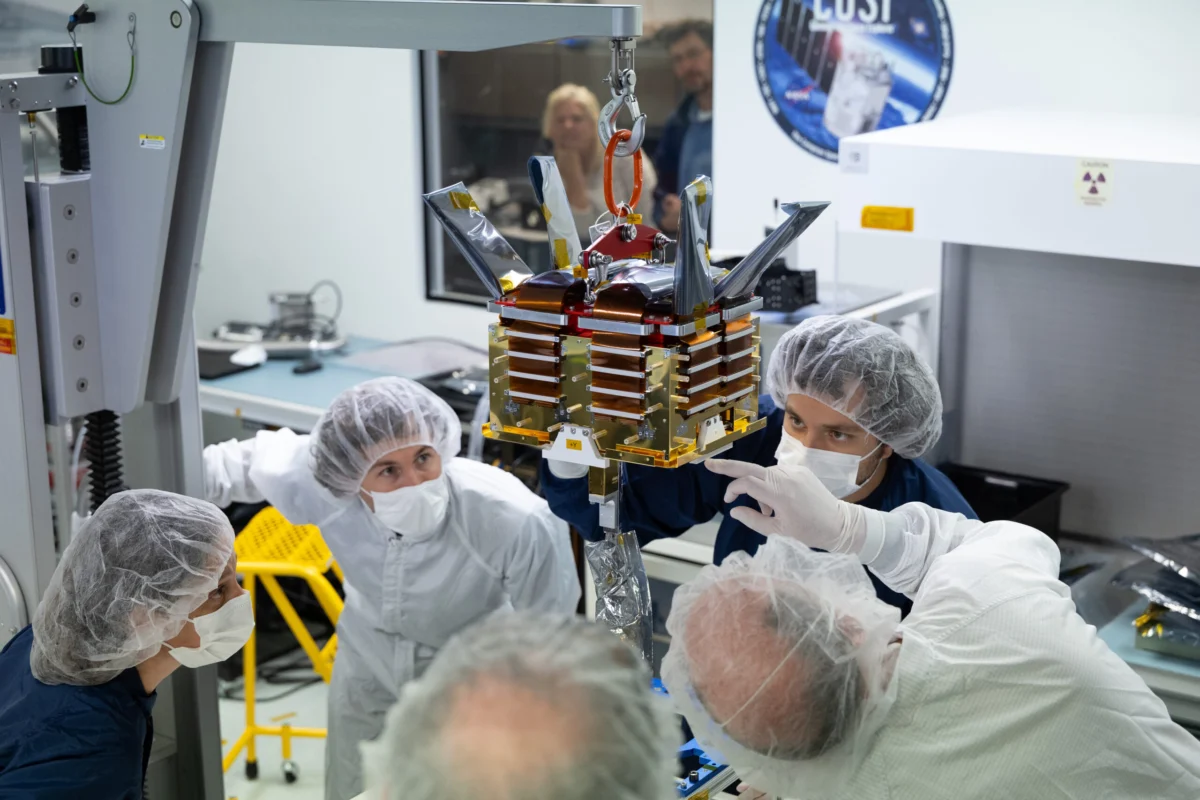
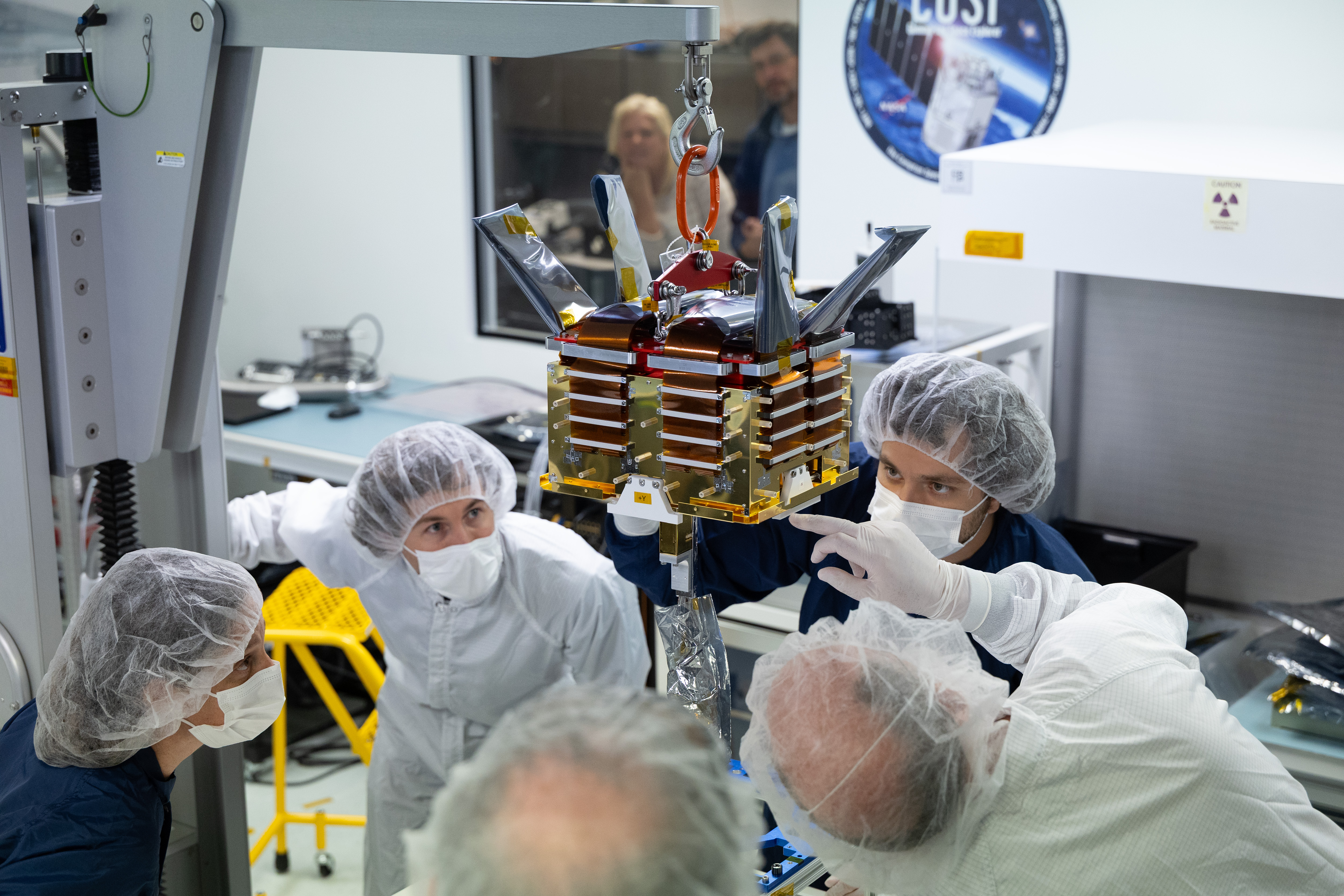
In a pivotal moment for astrophysics and space exploration, engineers and managers at the University of California, Berkeley, oversaw the meticulous raising of the Compton Spectrometer and Imager (COSI) detector assembly on July 8, 2026. The intricate operation, captured in a photograph, involved slowly lifting the sophisticated instrument from a work table, signaling a significant step forward in the mission’s integration phase. This milestone brings the wide-field gamma-ray telescope closer to its ultimate goal of unlocking some of the universe’s most energetic secrets, from the violent deaths of stars to the mysterious interplay of matter and antimatter in our galaxy and beyond.
The image prominently features the four pieces of silver material adorning the top of the detector box, which serve a critical function: covering the flex circuits. These flexible printed circuits are essential conduits, responsible for carrying delicate electrical signals from the detectors to the readout electronics, where they are processed and prepared for scientific analysis. The precision required for such an operation underscores the complex engineering involved in constructing instruments designed to detect elusive high-energy gamma rays.
The Scientific Imperative: Unveiling the Energetic Universe
COSI is not merely another telescope; it represents a new generation of gamma-ray observatories designed to push the boundaries of our understanding of the cosmos. Gamma rays, the most energetic form of light, are produced in some of the universe’s most extreme environments, including supernovae, active galactic nuclei, pulsars, and the annihilation of matter and antimatter. Unlike optical or radio waves, gamma rays cannot be focused by traditional mirrors and lenses, requiring innovative detection techniques like those employed by COSI.
The mission’s primary scientific objectives are ambitious and far-reaching:
- Mapping Galactic Nucleosynthesis: By observing gamma rays produced during the decay of radioactive isotopes synthesized in stellar explosions (supernovae), COSI will create detailed maps of where and how heavy elements, crucial for life, are forged in the Milky Way. Specifically, it targets the 1.157 MeV gamma-ray line from the decay of Titanium-44 and other nucleosynthetic products.
- Probing Matter-Antimatter Annihilation: COSI will investigate the origins and distribution of positron-electron annihilation radiation (at 511 keV) within the galactic center and disk. This phenomenon provides unique insights into dark matter candidates, pulsars, and other high-energy sources that produce positrons.
- Characterizing Gamma-Ray Bursts (GRBs) and Transient Phenomena: As a wide-field instrument, COSI is uniquely positioned to detect and localize transient events like GRBs, providing crucial data on their prompt emission and evolution. Its ability to measure polarization will offer unprecedented insights into the emission mechanisms of these cosmic cataclysms.
- Exploring Compact Objects and Particle Acceleration: The mission will study gamma-ray emission from extreme environments such as black holes, neutron stars, and pulsar wind nebulae, shedding light on the mechanisms by which particles are accelerated to relativistic speeds.
- Searching for Dark Matter Signatures: While not its primary focus, COSI’s sensitivity to continuum gamma-ray emission could potentially detect indirect signatures of dark matter annihilation or decay, particularly in regions of high dark matter density.
Operating in the crucial MeV energy range (from approximately 0.2 to 5 MeV), COSI fills a vital gap between lower-energy X-ray telescopes and higher-energy GeV gamma-ray observatories like NASA’s Fermi Gamma-ray Space Telescope. This range is particularly rich in astrophysical phenomena, making COSI a critical tool for multi-messenger astronomy.
A Legacy of Gamma-Ray Astronomy and Technological Advancement
The development of COSI builds upon a rich history of gamma-ray astronomy. Early missions like NASA’s Compton Gamma-Ray Observatory (CGRO), launched in 1991, revolutionized the field with instruments like EGRET (Energetic Gamma Ray Experiment Telescope) and COMPTEL (Compton Telescope). COMPTEL, in particular, pioneered the use of the Compton scattering technique, which COSI refines and significantly advances. Subsequent missions, such as the European Space Agency’s INTEGRAL (International Gamma-Ray Astrophysics Laboratory), launched in 2002, and Fermi-LAT (Large Area Telescope), launched in 2008, have continued to expand our gamma-ray vision.
COSI represents the next evolutionary step for Compton telescopes. Unlike traditional telescopes that use mirrors or lenses, Compton telescopes detect gamma rays by observing a two-step process: first, the gamma ray scatters off an electron (Compton scattering), and then the scattered gamma ray is absorbed by another detector. By measuring the energy and position of both interactions, the direction and energy of the original gamma ray can be reconstructed. COSI employs a stack of high-purity germanium (HPGe) detectors, cooled to cryogenic temperatures, which offer superior energy resolution and detection efficiency compared to previous technologies. This allows for more precise measurement of gamma-ray energies and improved background rejection, leading to higher sensitivity.
Chronology of a Complex Mission
The journey to the July 8, 2026, assembly milestone has been a long and arduous one, characteristic of major space missions. COSI was selected by NASA in 2021 as a Small Explorer (SMEX) mission, a category designed for focused scientific investigations with smaller budgets and shorter development times compared to flagship missions.
- 2021: Mission concept proposed and selected by NASA’s Astrophysics Explorers Program. Initial funding secured for Phase A studies, focusing on mission design and feasibility.
- 2022: Phase B commenced, involving preliminary design, detailed instrument specifications, and selection of key suppliers. Detector fabrication began at partner institutions.
- 2023: Critical Design Review (CDR) successfully passed, green-lighting the full-scale fabrication and assembly of the flight hardware. Component manufacturing accelerated across the collaborative network.
- 2024: Delivery of individual detector modules to UC Berkeley’s Space Sciences Laboratory (SSL) began. Testing of individual detector performance and electronics initiated.
- 2025: Integration of detector modules into the main detector array. Development and testing of the cryogenic cooling system, essential for the HPGe detectors’ operation.
- Early 2026: Final assembly of the detector box, including the intricate routing of flex circuits and connection to readout electronics. Extensive ground testing commenced to verify electrical, thermal, and mechanical performance.
- July 8, 2026: The successful raising of the complete COSI detector assembly, as depicted, marks the culmination of years of design, fabrication, and initial integration efforts. This event signifies that the detector is largely complete and ready for further integration into the spacecraft bus and subsequent environmental testing.
Looking ahead, the next phases for COSI will involve integrating the detector assembly with the spacecraft bus, which provides power, communication, attitude control, and propulsion. This will be followed by a rigorous series of environmental tests, including thermal vacuum testing to simulate space conditions, vibration testing to ensure survivability during launch, and electromagnetic compatibility testing. The current timeline projects a launch window in late 2027 or early 2028, with the mission expected to have a nominal operational lifetime of at least two years, with the potential for extension.
The Power of Global Collaboration
COSI is a testament to the power of international scientific and engineering collaboration. The mission is led by the University of California, Berkeley’s Space Sciences Laboratory (SSL), which serves as the scientific lead and is responsible for the overall instrument development and project management.
"This moment is incredibly rewarding for everyone involved," stated Dr. Julia Chen, COSI Project Manager at UC Berkeley SSL, in an inferred statement following the assembly. "Seeing the detector assembly, the heart of our mission, reach this stage is a testament to the relentless dedication and ingenuity of our engineers and scientists. It’s a complex dance of precision mechanics, cutting-edge electronics, and cryogenic systems, all working in harmony."
Key partners include:
- University of California, San Diego (UCSD): Contributes significantly to detector development and characterization, leveraging their expertise in semiconductor technologies.
- Naval Research Laboratory (NRL): Provides crucial support in instrumentation, flight software development, and space qualification processes, drawing on their extensive experience with space-based observatories.
- NASA’s Goddard Space Flight Center (GSFC): Offers project management oversight, mission assurance, and contributes to instrument development and data processing infrastructure. "COSI represents a strategic investment by NASA in advancing our understanding of the high-energy universe," commented Dr. Marcus Thorne, NASA Program Scientist for Astrophysics Explorers, in a hypothetical statement. "The science it promises to deliver—from understanding element formation to probing dark matter—is transformative. We are thrilled to see the hardware coming together so successfully."
- Northrop Grumman: Likely responsible for the spacecraft bus and its integration with the COSI instrument, providing the platform that will carry the telescope into orbit.
- Space Dynamics Laboratory (SDL): Contributes expertise in spacecraft and instrument testing, ensuring the robustness and reliability of the COSI flight hardware under extreme space conditions.
- Italian Space Agency (ASI): A vital international partner, providing additional scientific expertise, hardware contributions, or ground segment support, underscoring the global nature of modern astrophysics.
- Other Research Institutions: A broader network of universities and research centers contribute specialized knowledge in areas such as data analysis algorithms, theoretical modeling, and astrophysics research.
This multi-institutional and international collaboration pools diverse expertise and resources, enabling the development of an instrument far more sophisticated and capable than any single entity could achieve alone.
Engineering Marvel: The Detector Assembly
The COSI detector assembly is an engineering marvel. At its core are multiple layers of high-purity germanium (HPGe) strip detectors. HPGe detectors are semiconductor devices that, when cooled to extremely low temperatures (typically around 80-90 Kelvin, or -193 to -183 degrees Celsius), become incredibly efficient at converting the energy of incoming gamma rays into electrical signals. Their excellent energy resolution allows scientists to precisely measure the energy of gamma rays, which is crucial for identifying specific isotopes and understanding emission processes.
The "flex circuits" mentioned in the article are miniature marvels themselves. These are thin, flexible electronic circuits, often made of polyimide film with conductive traces, that connect the individual HPGe detector strips to the front-end readout electronics. Their flexibility allows for complex routing in confined spaces without the rigidity of traditional circuit boards, minimizing weight and maximizing the active detection area. The silver material covering them likely serves as a protective layer against environmental factors or as a thermal shield.
The entire detector assembly is housed within a cryostat, a vacuum-insulated container designed to maintain the extremely low temperatures required for the HPGe detectors to function. A robust active cooling system, likely a cryocooler, continuously chills the detectors. This precise thermal management is critical, as even slight temperature fluctuations can degrade detector performance. The detector box also incorporates shielding to minimize background radiation from cosmic rays and the spacecraft itself, ensuring that only astrophysical gamma rays are detected and measured accurately.
Broader Implications for Astrophysics and Beyond
The successful development and eventual launch of COSI will have profound implications for astrophysics and fundamental physics.
- Unlocking New Discoveries: By providing unprecedented sensitivity and angular resolution in the MeV band, COSI is poised to discover new gamma-ray sources and shed light on previously unresolved emissions. This could include faint, diffuse emissions from dark matter annihilation or previously unknown populations of compact objects.
- Advancing Multi-Messenger Astronomy: COSI’s observations will complement data from gravitational wave detectors (like LIGO/Virgo), neutrino observatories (like IceCube), and other electromagnetic telescopes across the spectrum. For instance, simultaneous observations of a neutron star merger by gravitational wave detectors and COSI could provide crucial insights into the production of heavy elements and the physics of extreme matter.
- Refining Cosmological Models: By mapping nucleosynthesis across the galaxy, COSI will provide critical data to refine models of stellar evolution and the chemical enrichment of the universe, offering a clearer picture of how our solar system and life itself came to be.
- Technological Spin-offs: The advanced detector technologies, cryogenic systems, and data processing techniques developed for COSI could find applications in other fields, such as medical imaging, national security, or industrial inspection.
- Inspiring the Next Generation: Successful missions like COSI inspire future generations of scientists and engineers, demonstrating the power of human ingenuity to explore the cosmos and answer fundamental questions about our existence.
The raising of the COSI detector assembly is far more than a simple engineering maneuver; it is a symbolic lifting of humanity’s gaze toward the most violent and enigmatic corners of the universe. With each successful integration step, the promise of new discoveries in gamma-ray astronomy grows brighter, bringing us closer to understanding the fundamental forces and processes that shape our cosmos.