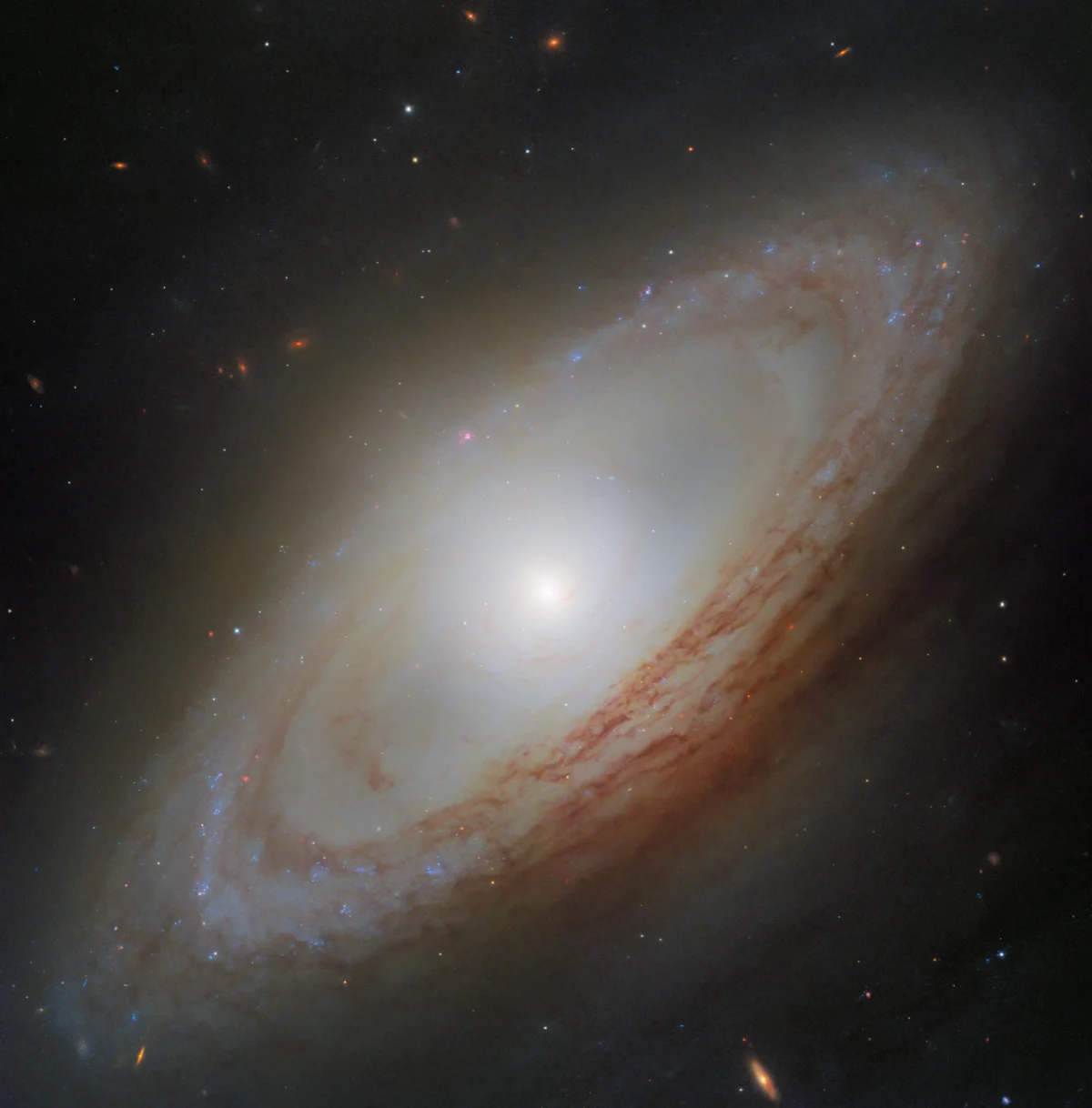
A new image from the NASA/ESA Hubble Space Telescope has unveiled NGC 4698, a spiral galaxy located approximately 55 million light-years away in the constellation Virgo, which, despite its serene appearance, harbors a chaotic and profoundly unusual internal structure. This discovery, announced on September 18, 2026, by Elizabeth Tammi, sheds new light on the complex processes that shape galaxies and challenges conventional models of galactic evolution. NGC 4698 is one of over a thousand galaxies comprising the Virgo Cluster, the nearest large gravitationally bound collection of galaxies to our own Local Group.
The Enigmatic Structure of NGC 4698
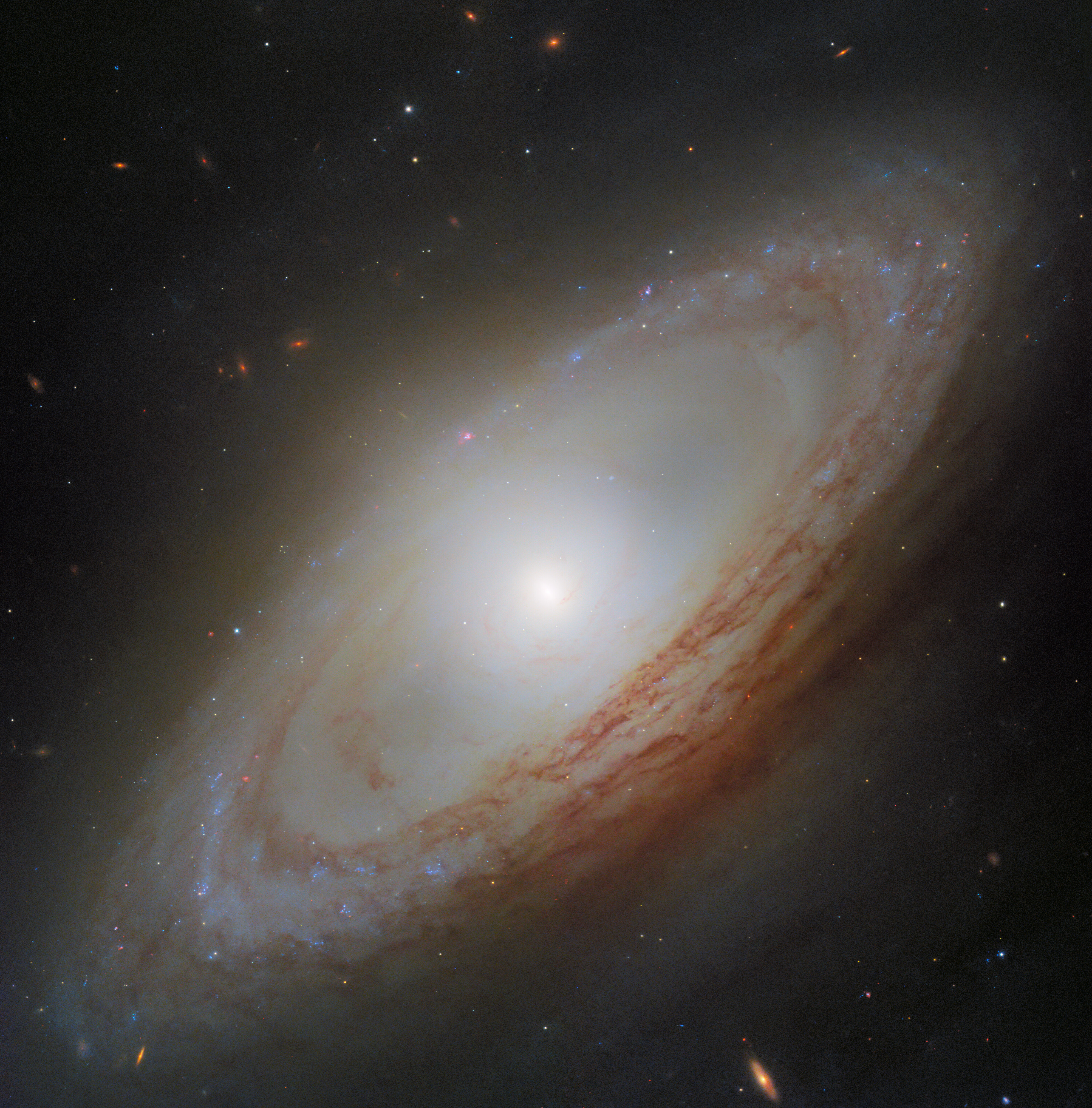
Like the Milky Way, NGC 4698 is classified as a spiral galaxy, characterized by its distinct spiral arms coiling within a thin disk of stars, gas, and dust. These arms are punctuated by opaque clumps of brown dust and dotted with bright, young blue stars, indicative of ongoing star formation. However, NGC 4698 deviates significantly from the typical spiral morphology. Unlike many of its counterparts, where spiral arms gracefully extend down to the galactic core, NGC 4698’s delicate arms recede from its glowing center, instead forming a ring-like structure around the galaxy’s periphery. This unique configuration immediately sets it apart from more commonly observed spiral galaxies, such as the one recently photographed by Hubble with its prominent, centrally winding arms.
The central region of NGC 4698 is dominated by an elongated galactic bulge, which radiates a diffuse off-white glow. This glow originates from a dense concentration of stars that are generally smaller, older, and cooler than the massive blue stars found in the galaxy’s outer disk. These tightly packed stars orbit a supermassive black hole, an object estimated to contain millions of times the mass of our Sun. Crucially, scientific observations suggest that this central black hole is actively accreting matter, drawing gas inward with its immense gravitational pull, a process that can significantly influence the dynamics and evolution of its host galaxy.
Unraveling the Anomaly: Perpendicular Dynamics
What truly distinguishes NGC 4698 from the vast majority of known spiral galaxies is its extraordinary internal kinematic structure. While it outwardly resembles a typical spiral galaxy with its flat, starry disk and glowing center, closer inspection reveals a profound anomaly: NGC 4698 is one of the rare spiral galaxies known to possess a bulge that extends perpendicularly from its main disk. The subtle elongation is discernible in the Hubble image, where the ghostly glow of the starry bulge can be seen peeking both above and below the dusty galactic plane. Even more remarkably, the stars and gas located nearest to the galaxy’s center rotate on an axis perpendicular to the rotation of the rest of the disk. This "out of sync" motion represents a significant departure from the standard model of galactic rotation, where all components typically align with the primary disk.
This perpendicular rotation is not merely an observational curiosity; it presents a substantial challenge to existing theories of galaxy formation and evolution. In most spiral galaxies, the stars, gas, and dust within the disk rotate coherently around the galactic center. A perpendicular component suggests a powerful disruptive event or a highly unusual formation mechanism. Astronomers have been working to understand the forces capable of such a dramatic reorientation of stellar and gaseous components within a galaxy.
The Merger Hypothesis: An External Culprit
The most compelling explanation for NGC 4698’s bizarre perpendicular dynamics points to an external influence: a minor galactic merger event. The prevailing hypothesis posits that if NGC 4698 funneled in gas from an outside source – likely from a smaller, satellite galaxy that it absorbed – this newly acquired gas could have settled into a distinct disk in the galaxy’s center, but at an angle relative to the pre-existing main disk. Over cosmic timescales, the stars that subsequently formed from this misaligned gas would inherit this perpendicular rotation.
Evidence supporting this merger scenario comes from additional observations that have identified a short, faint "tail" of hydrogen gas streaming from one side of NGC 4698. Such tidal tails are often tell-tale signatures of ongoing or recent galactic interactions and mergers, where gravitational forces strip material from one or both interacting galaxies. This hydrogen tail acts as a cosmic breadcrumb, tracing the path of a past encounter that could have introduced the misaligned material. While the original article does not specify the exact timeline of such a merger, typical minor mergers can span hundreds of millions of years, with the remnants and dynamical effects persisting for billions of years.
Galactic mergers are a fundamental process in the hierarchical model of galaxy formation, where larger galaxies grow by accreting smaller ones. However, the specific outcome observed in NGC 4698—a perpendicular central disk—is relatively rare, making it a crucial case study for understanding the diverse ways mergers can reshape galactic structures.
Hubble’s Enduring Legacy in Galactic Astronomy
The data that enabled this remarkable insight into NGC 4698 were collected by the NASA/ESA Hubble Space Telescope, a cornerstone of astronomical research for over three decades. Launched in 1990, Hubble has revolutionized our understanding of the universe, providing unparalleled high-resolution images across a wide range of wavelengths. Its location above Earth’s atmosphere allows it to capture incredibly sharp views, free from atmospheric distortion, making it uniquely suited for resolving the intricate details of distant galaxies like NGC 4698.
Hubble’s observations of NGC 4698 are part of a broader observing program specifically focusing on galaxies within the Virgo Cluster. This initiative leverages Hubble’s exquisite capabilities to zoom in on the finer details of these relatively nearby galaxies, enabling researchers to study individual star clusters, nebulae, and the distribution of gas and dust with unprecedented clarity. The ultimate goal of this extensive program is twofold: to gain a granular understanding of individual galactic components and, simultaneously, to paint a larger picture of how a galaxy’s journey through a dense cluster environment affects its overall evolution and its capacity to form new stars. The Virgo Cluster, being the nearest large galaxy cluster, offers a unique laboratory for studying environmental effects on galaxy evolution, such as ram-pressure stripping, where a galaxy’s gas is "swept away" as it moves through the hot intergalactic medium.
The Broader Implications for Galaxy Evolution Models
The discovery of NGC 4698’s perpendicular core has significant implications for refining our models of galaxy formation and evolution. Traditional models often assume a relatively ordered process of disk formation, where gas cools and settles into a rotating plane. However, galaxies like NGC 4698 demonstrate that external events, such as mergers, can introduce substantial chaos and lead to highly complex, multi-component kinematic structures.
This observation encourages astronomers to consider a wider range of merger scenarios and their potential outcomes. It suggests that even minor mergers, which might not dramatically alter a galaxy’s overall appearance, can profoundly impact its internal dynamics and the distribution of its stellar and gaseous components. Furthermore, the active supermassive black hole at NGC 4698’s center adds another layer of complexity. The infall of gas, whether from internal processes or external mergers, fuels the black hole’s growth, which in turn can drive powerful outflows that affect star formation across the galaxy. The interplay between mergers, gas infall, and black hole activity is a crucial area of ongoing research, and NGC 4698 provides a compelling real-world example of these processes in action.
The study of NGC 4698 is not an isolated event but part of a continuous effort by the scientific community, led by institutions like NASA and ESA, to map and understand the universe. Findings like these are instrumental in validating or challenging theoretical predictions, pushing the boundaries of our cosmological understanding. Claire Andreoli, a Media Contact at NASA’s Goddard Space Flight Center, underscores the importance of such discoveries in communicating the cutting-edge research conducted by space telescopes like Hubble.
The Future of Galactic Exploration
As astronomers continue to analyze data from Hubble and prepare for future observatories like the James Webb Space Telescope (JWST) and upcoming ground-based telescopes, the insights gleaned from peculiar galaxies like NGC 4698 will prove invaluable. While Hubble excels in visible and ultraviolet light, JWST’s infrared capabilities will allow scientists to peer through the dust and gas that obscure parts of NGC 4698, potentially revealing more about the distribution of its older stellar populations and the nature of the gas inflow feeding its central black hole. Future observatories with even greater sensitivity and resolution will undoubtedly uncover more such anomalies, further enriching our understanding of the diverse and dynamic universe.
The ongoing research program targeting the Virgo Cluster will continue to yield data that illuminates how a galaxy’s environment influences its journey through cosmic time. By studying the details of these relatively nearby galaxies, scientists aim to piece together the larger evolutionary puzzle, understanding how the intricate dance of gravity, gas dynamics, and stellar processes shapes the magnificent cosmic structures we observe today. NGC 4698 stands as a testament to the universe’s capacity for unexpected complexity, a reminder that even in seemingly serene cosmic vistas, profound secrets await discovery.