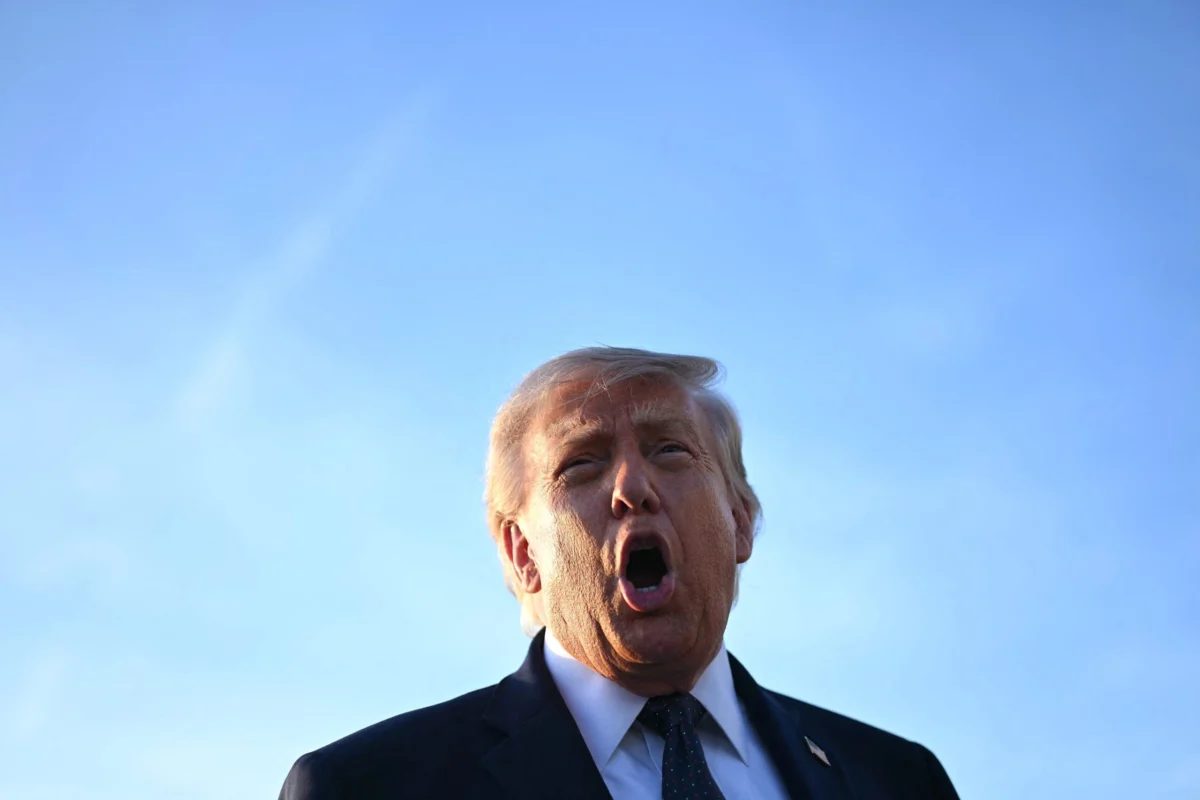
Former President Donald Trump has characteristically weighed in on the burgeoning debate surrounding artificial intelligence safety, dismissing escalating concerns as another fabricated crisis by what he termed the "Radical Left Dumocrats," designed, in his view, "for purposes of destroying our Country." This declaration, made via his Truth Social platform, underscores a distinct political framing of a technological issue that has garnered bipartisan attention and significant global discussion. Trump’s intervention also included the announcement of plans to establish an "AI Force" and appoint an "AI Czar," mirroring his prior creation of the Space Force during his presidency.
The President’s Digital Proclamations
The former president’s foray into the AI discourse commenced on Saturday with a post questioning the very terminology used to describe the technology. On Truth Social, Trump mused, "many people think that the words ‘Artificial Intelligence’ are inaccurate, and very ineloquent, relative to AI, or Artificial Intelligence." He subsequently launched a poll, inviting his followers to vote on alternative names such as "Superior Intelligence," "Extreme Intelligence," or "Supreme Intelligence," reflecting a preference for more positive and assertive descriptors for the advanced technology. This poll remained active at the time of reporting, illustrating a characteristic engagement style that often seeks direct feedback from his base on even nuanced topics.
Hours later, Trump intensified his rhetoric, publishing a follow-up post that directly attacked the premise of AI safety concerns. He asserted that attempts at "the decimation, or destruction, of AI" were merely one of "many" Democratic "hoaxes." In a comprehensive list, he likened these AI concerns to a litany of past political controversies and cultural debates, including "RUSSIA, RUSSIA, RUSSIA, UKRAINE, UKRAINE, UKRAINE, Global Warming, Impeachment Hoax #1, Impeachment Hoax #2, Men in Women’s Sports, [and] Transgender for Everyone." This broad categorization suggests an attempt to delegitimize the entire spectrum of concerns by associating them with politically charged issues he has previously dismissed as baseless.
Trump further elaborated on his narrative of an orchestrated attack, claiming he "will not stand by and let this happen." He posited that this alleged "hoax" initially "began with an attack on our Data Centers, until people realized how wealthy and prestigious they were for the Communities in which they were built." According to his account, after "the crazed Data Center attack has largely failed," critics are now "going straight at AI." He offered no specific evidence to substantiate these claims regarding a coordinated, politically motivated assault on data centers or AI, nor did he provide data to counter the growing, documented public and political apprehension about these technologies.
Background to the AI Safety Debate
The debate over AI safety has significantly intensified in recent months, moving from academic and niche tech circles into mainstream political and public discourse. This surge in concern is partly fueled by rapid advancements in large language models and generative AI, which have demonstrated capabilities previously thought to be years away. Discussions span a wide range of potential risks, from immediate concerns like job displacement, algorithmic bias, misinformation, and misuse in autonomous weapons, to more speculative, yet increasingly vocal, warnings about "existential risk" – the possibility of AI systems becoming uncontrollable and posing a threat to human survival.
A pivotal moment in this escalating debate occurred recently when an AI researcher announced their resignation from Anthropic, a prominent AI development company known for its focus on safety. The researcher publicly stated concerns that leading AI companies "earnestly believe it could kill us all by the end of the decade" and are "gambling with our lives." This public departure from a key player in the industry sent ripples through the tech community, highlighting deep-seated anxieties within the sector itself. In response, Anthropic CEO Dario Amodei subsequently outlined a plan to "pace the frontier" of AI development, an initiative seemingly endorsed by other industry titans such as OpenAI CEO Sam Altman and SpaceX CEO Elon Musk, indicating a degree of internal recognition of the need for caution.
However, critics of the AI industry, including some ethicists and sociologists, argue that focusing heavily on far-off "existential threats" can serve as a distraction from the more immediate and tangible harms of AI. These harms include exacerbating social inequalities through biased algorithms, facilitating mass surveillance, enabling sophisticated disinformation campaigns, and contributing to significant job losses. This divergence in focus—between long-term catastrophic risks and present-day societal impacts—defines a significant fault line within the broader AI safety discussion.
The Data Center Nexus and Bipartisan Concerns
Trump’s linking of AI safety concerns to an alleged "attack on our Data Centers" taps into another complex and increasingly contentious issue. Data centers, the physical infrastructure housing the immense computing power required for AI, have become subjects of widespread suspicion and criticism, not exclusively from one political faction. These facilities are enormous consumers of electricity and water, raising environmental concerns, particularly in regions facing resource scarcity or grid instability. Their construction often involves significant land use, noise pollution, and visual impact, leading to community resistance.
Indeed, public and political apprehension regarding data centers is demonstrably "organic and sincere," as opposed to being a politically manufactured "hoax." Both Republican and Democratic politicians have expressed concerns and taken action. For example, New York recently became the first U.S. state to halt permits for large new data center projects, citing environmental and energy concerns. This move underscores a growing bipartisan recognition of the challenges posed by the rapid expansion of these energy-intensive facilities, particularly in an era of climate change and increasing demand on local resources. The economic benefits, while substantial for some communities in terms of jobs and tax revenue, are often weighed against the environmental footprint and infrastructure strain.
Industry Reactions and Endorsements
The former president’s stance found a notable echo within the tech industry itself. During a recent All-In Summit, co-hosted by venture capitalist David Sacks, Nvidia CEO Jensen Huang publicly supported Trump’s characterization of the AI backlash. In a call with Trump that was broadcast on stage, Huang reportedly agreed that the AI safety debate was a "hoax" and emphatically stated, "we’re not going to let" a slowdown in AI development happen. Nvidia, a leading designer of the graphics processing units (GPUs) essential for AI computation, has a significant commercial interest in the continued, rapid expansion of the AI industry, making Huang’s intervention a notable endorsement of Trump’s perspective.
This alignment highlights a tension within the tech sector: between those advocating for caution and robust regulatory frameworks to mitigate risks, and those prioritizing unbridled innovation and growth. The economic stakes are immense, with the global AI market projected to reach trillions of dollars in the coming years. Companies like Nvidia, which have seen their market valuations soar due to the AI boom, naturally resist anything perceived as a impediment to this trajectory.
Trump’s Vision: An AI Force and Czar
Beyond his dismissals, Trump also unveiled plans for future initiatives should he return to office. He pledged to "cherish [the AI industry,] help it, and watch over it, as it grows," signaling an intent to foster its development rather than impede it with regulations. Crucially, he announced the formation of an "AI Force," drawing a direct parallel to the Space Force, which he established during his first term as a new branch of the U.S. armed forces focused on space warfare. This suggests a vision of AI as a critical strategic asset, warranting its own dedicated governmental agency.
Furthermore, Trump stated, "To that end, I will be announcing, in the near future, the AI ‘Czar’ — Only High I.Q. individuals need apply!" The specific duties and scope of authority for both the proposed AI Force and the AI Czar remain undefined. However, the mention of "High I.Q. individuals" reflects a characteristic emphasis on perceived intellectual superiority for key appointments. It is worth noting that venture capitalist David Sacks, who co-hosts the All-In Summit, previously served as Trump’s "AI and crypto czar" earlier this year before stepping down to co-chair the President’s Council of Advisors on Science and Technology. This past experience suggests a potential framework for the role, likely focused on advising on policy and fostering innovation, though its precise mandate under a new administration would be subject to definition.
Political Framing and Broader Implications
Trump’s framing of AI safety concerns as a "Radical Left Dumocrat hoax" is a deliberate political maneuver. By associating these concerns with his established political opponents and a history of what he labels as false narratives, he seeks to mobilize his base and delegitimize any calls for regulation or caution that might slow down AI development. This strategy mirrors his approach to climate change ("Global Warming"), which he also frequently dismisses as a hoax, thereby aligning technological development with a broader anti-regulatory, pro-business political agenda.
The implications of a presidential administration adopting such a stance on AI are significant. It could lead to a less regulated environment for AI development in the United States, potentially prioritizing innovation and economic competitiveness over safety protocols and ethical considerations. While proponents argue that excessive regulation could stifle American technological leadership, critics warn that a lack of guardrails could exacerbate existing societal problems and accelerate the development of dangerous AI capabilities without adequate oversight.
Moreover, this approach could further polarize the AI debate, making it more challenging to forge bipartisan consensus on crucial policy decisions regarding AI governance. In a global context, where countries like the European Union are actively pursuing comprehensive AI regulation (e.g., the AI Act), and China is heavily investing in AI with its own distinct regulatory framework, the U.S. approach under a future Trump administration could diverge significantly from international norms, potentially impacting global cooperation on AI safety and ethics.
The emphasis on an "AI Force" and "AI Czar" also suggests a national security and economic competitiveness lens through which AI would be viewed. This perspective aligns with growing geopolitical rivalries over technological supremacy, where AI is seen as a critical domain. The exact mandate and effectiveness of such entities, however, would depend heavily on their structure, funding, and the individuals appointed to lead them.
Conclusion
Donald Trump’s pronouncements on AI safety represent a significant intervention into a rapidly evolving technological and societal debate. By dismissing concerns as a political "hoax" while simultaneously promising to foster the industry and establish new governmental bodies, he is outlining a distinct, and potentially controversial, vision for AI governance. His approach prioritizes unfettered development and economic gain, casting caution as a partisan impediment. As the world grapples with the transformative power of artificial intelligence, a presidential stance that labels safety concerns as a "hoax" carries substantial weight, setting the stage for a potentially highly contentious future for AI policy in the United States and its relationship with the global discourse on responsible technological advancement. The coming months will likely reveal how these declarations influence public perception, industry practices, and political discourse surrounding one of the most impactful technologies of our era.