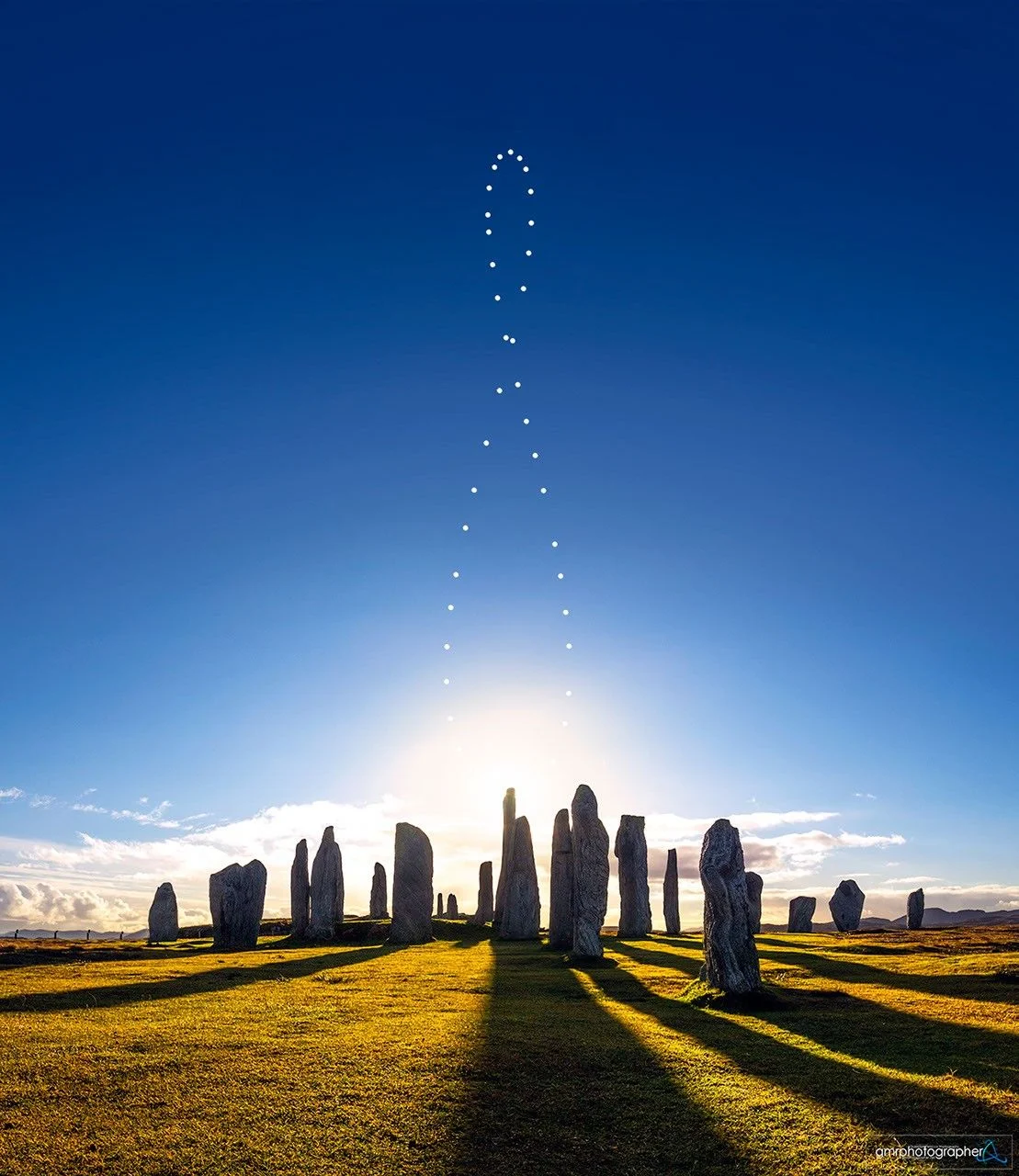
The Astronomy Picture of the Day (APOD) program, a daily initiative by NASA and Michigan Technological University, has once again captivated the global public with a stunning celestial phenomenon, featuring a meticulously captured analemma image against the backdrop of the prehistoric Callanish Stones in Scotland’s Outer Hebrides. Published on September 20, 2026, the composite photograph, credited to Giuseppe Petricca, showcases the Sun’s unique figure-eight path across the sky over the course of a year, coinciding with the anticipation of the autumnal equinox just two days later. This celestial display serves as a potent reminder of Earth’s intricate orbital mechanics and its profound influence on both ancient civilizations and modern scientific understanding.
Unpacking the Analemma Phenomenon
An analemma is a captivating visual representation of the Sun’s apparent movement across the sky when observed from a fixed location at the same time each day over an entire year. Far from tracing a simple straight line, the Sun’s position forms a distinctive figure-eight pattern. This remarkable shape is not an illusion but a direct consequence of two fundamental astronomical principles: the Earth’s axial tilt and the ellipticity of its orbit around the Sun.
The Earth’s axis is tilted at approximately 23.5 degrees relative to its orbital plane. This tilt is responsible for the seasons, causing the Sun to appear higher in the sky during summer and lower during winter. As the Earth progresses through its orbit, the Sun’s declination (its angular distance north or south of the celestial equator) changes, contributing to the vertical elongation of the analemma. The solstices mark the extreme points of this vertical motion: the summer solstice corresponds to the highest point of the Sun’s apparent path (northern hemisphere), and the winter solstice to the lowest. The featured image, having been taken near the December solstice, shows the Sun at the lower portion of its analemma path.
Compounding this effect is the Earth’s elliptical orbit. Unlike a perfect circle, the Earth’s orbit is an ellipse, meaning its distance from the Sun varies throughout the year. The Earth is closest to the Sun (perihelion) in early January and farthest (aphelion) in early July. According to Kepler’s laws of planetary motion, the Earth moves faster when it is closer to the Sun and slower when it is farther away. This variation in orbital speed causes the Sun’s apparent position to drift slightly east or west relative to its mean position, creating the horizontal component of the analemma. The combination of these two effects—the changing declination due to axial tilt and the varying orbital speed due to ellipticity—results in the characteristic figure-eight shape. The slight asymmetry often observed in analemmas, with one loop being larger than the other, is due to the specific timing of perihelion and aphelion relative to the solstices. This complex interplay of cosmic forces is encapsulated in what astronomers refer to as the "Equation of Time," which quantifies the difference between apparent solar time (as measured by a sundial) and mean solar time (as measured by a clock).
The Callanish Stones: A Window to Ancient Observatories
The backdrop for this modern astronomical marvel is the ancient Callanish Stones, a majestic megalithic complex located on the Isle of Lewis in the Outer Hebrides of Scotland. Erected around 2700 BCE during humanity’s Bronze Age, these standing stones predate Stonehenge by several centuries and represent a profound testament to the sophisticated understanding and observational skills of early human civilizations. Comprising a central stone circle surrounded by avenues of smaller stones, the site is constructed from local Lewisian gneiss, a remarkably durable and ancient rock.
The primary purpose of the Callanish Stones remains a subject of ongoing archaeological and archaeoastronomical debate. While their exact function is not definitively known, prevailing theories suggest they served as a ceremonial center, a burial ground, or, significantly, an astronomical observatory. Many researchers believe that the alignment of the stones may have been deliberately chosen to mark significant celestial events, such as the solstices, equinoxes, and the lunar standstills. For instance, the main axis of the stone circle is oriented towards the path of the Sun and Moon. On the summer solstice, the Sun sets directly behind the largest stone in the west, while at the winter solstice, the Moon appears to "dance" along the tops of the stones.
The fact that Giuseppe Petricca chose the Callanish Stones as the foreground for his analemma photograph is particularly poignant. It creates a visual dialogue between humanity’s earliest attempts to track celestial movements and our contemporary scientific methods. Although the precise astronomical significance of the Callanish Stones is still being unravelled, their very existence speaks to an enduring human fascination with the cosmos—a fascination that APOD continues to foster today.
The 2026 Analemma: A Specific Observation
Giuseppe Petricca’s featured analemma is a painstaking photographic achievement. Composed from images taken every few days at noon near Callanish, the project required meticulous planning, consistent execution, and an entire year of dedicated observation. The final composite image, a testament to modern astrophotography techniques, captures the subtle yet predictable shifts in the Sun’s position throughout the year. The choice of noon as the consistent observation time simplifies the analemma, as it eliminates the variations in altitude and azimuth that would occur if the images were taken at different times of day.
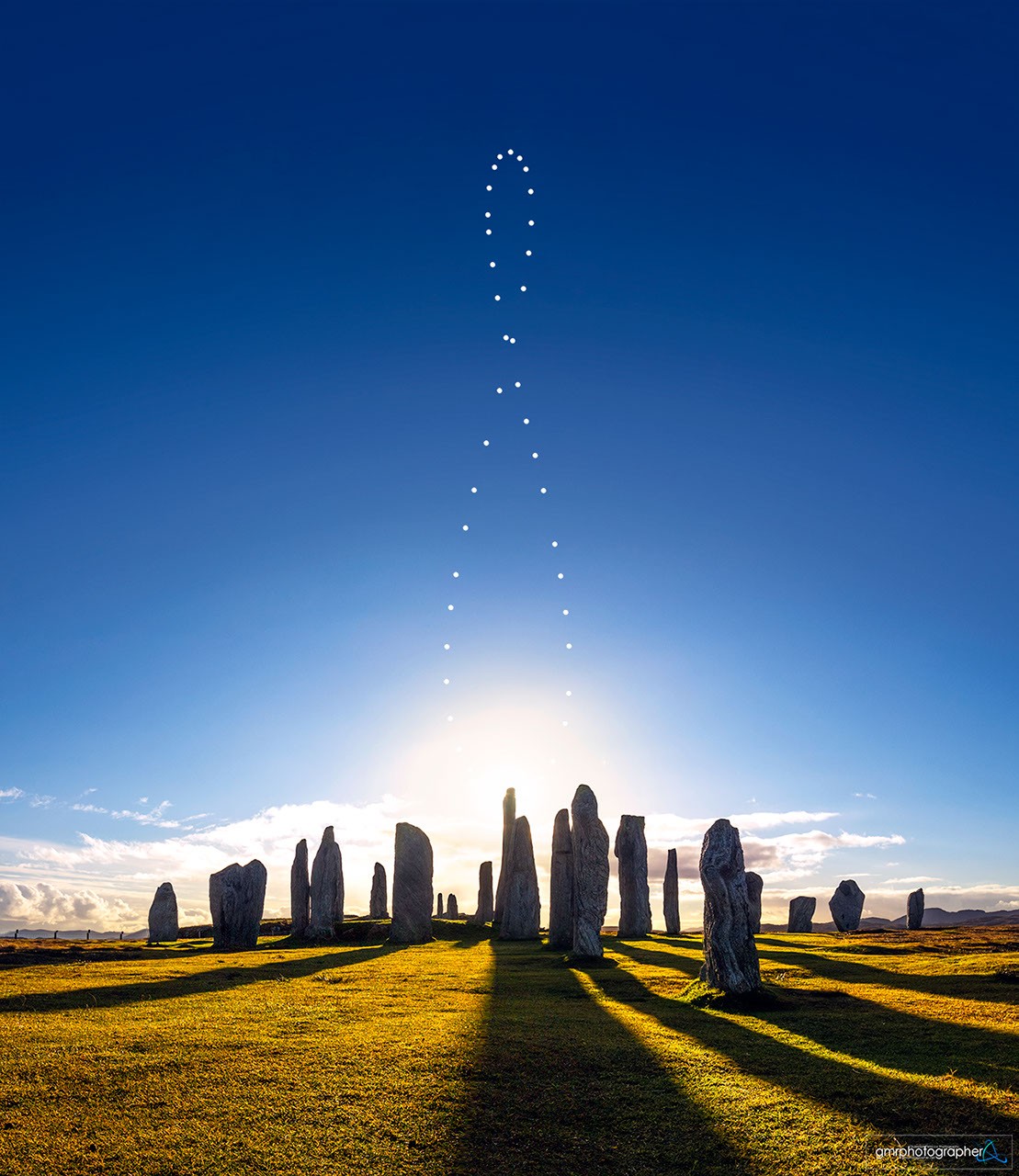
The timing of this particular APOD feature, near the December solstice, is crucial for understanding the depicted analemma. The Sun’s position near the bottom of the figure-eight clearly indicates that the images contributing to that specific point were captured when the Sun was at its lowest annual declination, signifying the onset of winter in the Northern Hemisphere. This detailed observation reinforces the scientific explanation of the analemma, providing tangible evidence of Earth’s orbital mechanics. Petricca’s work not only illustrates a complex scientific principle but also grounds it in a visually striking and historically rich context, making it accessible and engaging for a broad audience.
The Approaching Equinox: A Celestial Milestone
Adding another layer of astronomical significance to the APOD feature is the imminent autumnal equinox, slated to occur just two days after the article’s publication on September 22, 2026. The term "equinox" derives from Latin, meaning "equal night," and it describes the two points in Earth’s orbit when the Sun crosses the celestial equator. At these moments, the Earth’s tilt is neither towards nor away from the Sun, resulting in approximately equal durations of day and night across nearly all latitudes of the planet.
For the Northern Hemisphere, the September equinox marks the astronomical beginning of autumn, while for the Southern Hemisphere, it signals the start of spring (the vernal equinox). Astronomically, an equinox corresponds to the middle points of an analemma, where the Sun’s apparent path crosses itself, though not necessarily the intersection point of the figure-eight itself, which occurs due to the interaction of both orbital and axial effects. The upcoming September 22nd equinox signifies a moment of balance in the solar year, a pivot point between the extremes of summer and winter.
Culturally, equinoxes have been celebrated by diverse civilizations throughout history, often associated with harvest festivals, rituals of balance, and transitions in agricultural cycles. For instance, in many East Asian cultures, the Mid-Autumn Festival (or Moon Festival) is celebrated around the autumnal equinox, symbolizing family reunion and harvest. In ancient Mayan civilization, the equinoxes were marked by specific alignments at Chichen Itza, where the shadow of a serpent appears to descend the steps of the El Castillo pyramid. These traditions underscore humanity’s ancient and profound connection to the rhythm of the cosmos, highlighting how celestial events have shaped cultural practices and spiritual beliefs across millennia.
NASA’s APOD Initiative: Bridging Science and Public Engagement
The Astronomy Picture of the Day (APOD) program, a collaborative effort between NASA and Michigan Technological University, has been a cornerstone of public science communication since its inception in 1995. Its mission is straightforward yet impactful: to present a different image or photograph of the universe each day, accompanied by a concise and informative explanation written by a professional astronomer. This daily dose of cosmic wonder has cultivated a global following, inspiring countless individuals to explore the vastness of space and delve deeper into scientific inquiry.
APOD’s success lies in its ability to demystify complex astronomical phenomena, making them accessible to lay audiences without compromising scientific accuracy. The program’s team of authors and editors, including renowned astronomers Robert Nemiroff and Jerry Bonnell, meticulously curate images and craft explanations that resonate with both casual enthusiasts and seasoned scholars. The featured analemma is a prime example of APOD’s pedagogical approach, transforming an abstract concept into a visually compelling narrative.
In a significant operational update, APOD has announced a migration of its primary NASA site from apod.nasa.gov to science.nasa.gov/apod. This transition is part of NASA’s broader effort to consolidate its online presence, enhance user experience, and ensure the long-term sustainability and accessibility of its vast repository of scientific information. While the core mission and daily content will remain unchanged, the new domain aims to integrate APOD more seamlessly within NASA’s overarching science communication framework, potentially offering improved infrastructure and expanded functionalities for its global audience. This move reflects NASA’s ongoing commitment to leveraging digital platforms to engage the public with cutting-edge scientific discoveries and timeless celestial beauty.
Broader Implications and Future Observations
The intersection of ancient monuments and modern astronomical observations, as exemplified by the Callanish analemma, underscores the enduring human quest to understand our place in the universe. From the megalith builders who sought to chart the heavens with stone, to contemporary astrophotographers who capture intricate celestial mechanics, the pursuit of cosmic knowledge spans millennia. The APOD feature not only celebrates a specific scientific phenomenon but also fosters an appreciation for the historical continuity of astronomical inquiry.
The continued publication of images like the analemma encourages scientific literacy and inspires new generations of astronomers, scientists, and curious minds. By presenting complex topics in an engaging and accessible format, APOD plays a vital role in bridging the gap between specialized scientific research and public understanding. As technology advances, the ability to capture such detailed and aesthetically pleasing astronomical images only grows, promising an even richer tapestry of cosmic revelations in the years to come. The analemma, a humble figure-eight in the sky, thus becomes a powerful symbol of scientific precision, historical depth, and the boundless wonder of the universe that continues to unfold before our eyes.