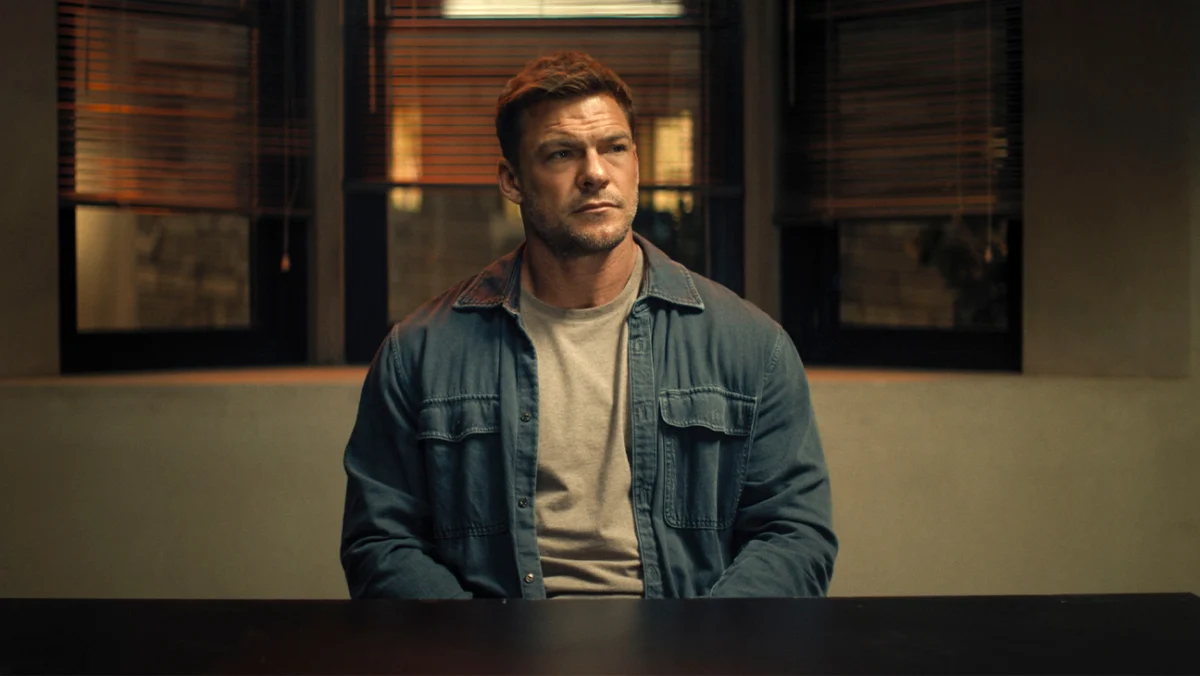
Alan Ritchson, the acclaimed star and executive producer of the hit Prime Video series Reacher, has offered a compelling explanation for why his personal favorite novel from Lee Child’s expansive Jack Reacher bibliography, Die Trying, has yet to be adapted for the screen. The revelation came in response to a dedicated fan’s expression of disappointment on the social media platform Threads, highlighting a perceived avoidance of earlier novels in the series by the show’s producers.
The fan’s message, which Ritchson directly addressed, articulated a common sentiment among viewers who appreciate the standalone nature of most Reacher installments. "Every season of Reacher so far has been great, and I understand that they may be avoiding the earlier novels due to their slightly less standalone nature, but every year I’m sad to learn that next season won’t be the book where he kills his way through a white supremacist militia camp," the fan wrote, specifically referencing the plot of Die Trying.
Ritchson’s candid reply shed light on a complex situation, suggesting that a significant hurdle existed beyond purely narrative or production considerations. "My favorite book. Fun fact: I had it approved until someone got re-elected," he stated, alluding to a political shift that purportedly derailed the adaptation plans.
The Unseen Influence: Political Climate and Creative Control
While Ritchson deliberately refrained from naming the specific individual whose re-election he referenced, his public and consistent criticism of former President Donald Trump provides a strong contextual inference. Ritchson has been an outspoken critic of Trump, frequently voicing his disapproval of the former president’s policies and rhetoric. This history of public commentary suggests that the "someone" to whom Ritchson referred is likely Trump.
The adaptation of Die Trying reportedly received official approval at one stage, only to be halted due to the political landscape that emerged following a particular election cycle. This implies that the thematic elements or the portrayal of a white supremacist militia within the novel may have become too politically sensitive or controversial to proceed with during a specific administration. The novel, published in 1998, is the second in Lee Child’s Jack Reacher series and features Reacher becoming embroiled in a dangerous situation where he must protect a politician’s daughter from a radical militia group intent on establishing a white-only state. The subject matter, particularly the depiction of a violent extremist group and their ideology, could have been perceived as too incendiary or potentially misconstrued in a politically charged environment.
Ritchson’s previous public statements offer further insight into his concerns about political figures and societal issues. In July, he publicly condemned Donald Trump in relation to the unsealed documents pertaining to Jeffrey Epstein. During an appearance on the Happy Sad Confused podcast, Ritchson expressed his strong opinions on what he described as "abuses that are happening," urging for accountability. He questioned the lack of transparency surrounding the Epstein files, stating, "Don’t you want to see what’s in there so that we can hold people accountable? These fucking rapists. We’re just cool with it." His impassioned remarks at the time also touched upon broader societal issues and the perceived failures of leadership.
Background on Die Trying and its Thematic Resonance
Lee Child’s Die Trying, published in 1998, presents a narrative that dives deep into themes of extremism, political secession, and the moral complexities of confronting violent ideologies. The plot centers on Jack Reacher and the daughter of a U.S. Congressman who are abducted by a radical militia. This group, driven by an extreme separatist agenda, aims to carve out their own territory within the United States, explicitly for individuals of white descent. Reacher’s involvement is not merely coincidental; he is drawn into the heart of this dangerous conflict, tasked with protecting the politician’s daughter and thwarting the militia’s violent secessionist plot.
The novel’s exploration of a domestic extremist group with secessionist aims, and their explicit ideology, is a potent and potentially challenging subject matter for contemporary adaptation. The presence of a "white supremacist militia camp" as described by the fan, and Reacher’s role in "killing his way through" it, signifies a direct confrontation with extreme political and social ideologies. Such themes, while central to the book’s dramatic tension and Reacher’s character as a force for justice, can become fraught with political implications, especially in an era of heightened awareness and debate surrounding extremism and political polarization.
The Reacher Series: A Production Timeline and Future Prospects
The Reacher series on Prime Video has achieved significant critical and commercial success since its debut. The show’s ability to capture the essence of Lee Child’s beloved character and his pulpy, action-packed narratives has resonated with a broad audience. Each season has adapted a different Reacher novel, with the producers aiming to maintain a balance between fan-favorite stories and those that translate effectively to the screen.
The first season, released in February 2022, was based on the first Reacher novel, Killing Floor. The second season, which premiered in December 2023, adapted The Enemy, the eighth novel in the series. This indicates a deliberate choice by the production team to not strictly adhere to chronological order, potentially allowing for flexibility in selecting stories that offer compelling storylines and character development.
Interestingly, the article notes that Reacher has already secured an early renewal for a fifth season. This fifth season is slated to be an adaptation of Make Me, the twelfth book in Lee Child’s series. This upcoming adaptation further underscores the producers’ strategic approach to selecting novels, possibly prioritizing those with broader appeal or more straightforward narrative arcs for television. The decision to adapt Make Me before exploring earlier novels like Die Trying suggests that other factors, beyond Ritchson’s personal preference or even fan demand, are influencing the production schedule.
The fact that Die Trying was reportedly "approved" at one point suggests that significant creative and financial resources may have been allocated towards its potential development. Ritchson’s statement implies that this approval was rescinded or put on indefinite hold due to external political pressures. This highlights the intricate relationship between creative endeavors and the prevailing socio-political climate, where even established literary works can become subject to scrutiny and potential censorship based on the prevailing political winds.
Broader Implications and Industry Context
Ritchson’s revelation offers a candid glimpse into the often-unseen political considerations that can influence Hollywood productions. The entertainment industry, while often seen as a platform for artistic expression, is also a business susceptible to market forces, public opinion, and, as this instance suggests, the broader political environment. The decision to greenlight or shelve projects can be influenced by a complex interplay of factors, including potential backlash, brand sensitivity, and the perceived alignment with current political discourse.
The Reacher series, with its massive global audience and the star power of Alan Ritchson, carries significant weight. Any decision to adapt a novel that touches upon sensitive themes like white supremacy and political extremism would undoubtedly be subject to intense scrutiny. Ritchson’s statement suggests that the potential for controversy, possibly amplified by the political climate at the time of a specific election cycle, was deemed too high a risk for Die Trying‘s adaptation.
This situation is not unique to Reacher. Across the entertainment landscape, numerous productions have faced challenges or delays due to evolving social and political sensitivities. The increasing polarization of political discourse can create an environment where certain narratives are perceived as more controversial or divisive than they might have been in a different era. For producers and studios, navigating these sensitivities requires a delicate balance between artistic integrity and commercial viability.
Prime Video has been contacted for comment regarding Ritchson’s statement and the status of the Die Trying adaptation. Their official response, or lack thereof, will likely provide further context on the studio’s perspective on the matter. Until then, Ritchson’s candid admission offers a compelling, albeit indirect, explanation for why one of the most fan-favorite Jack Reacher stories remains on the shelf, seemingly a casualty of political currents rather than creative limitations. The resilience of the Reacher series, evidenced by its early renewal for a fifth season, suggests that while Die Trying may be on hold, the franchise is far from dormant, continuing to explore Lee Child’s vast literary universe one novel at a time.