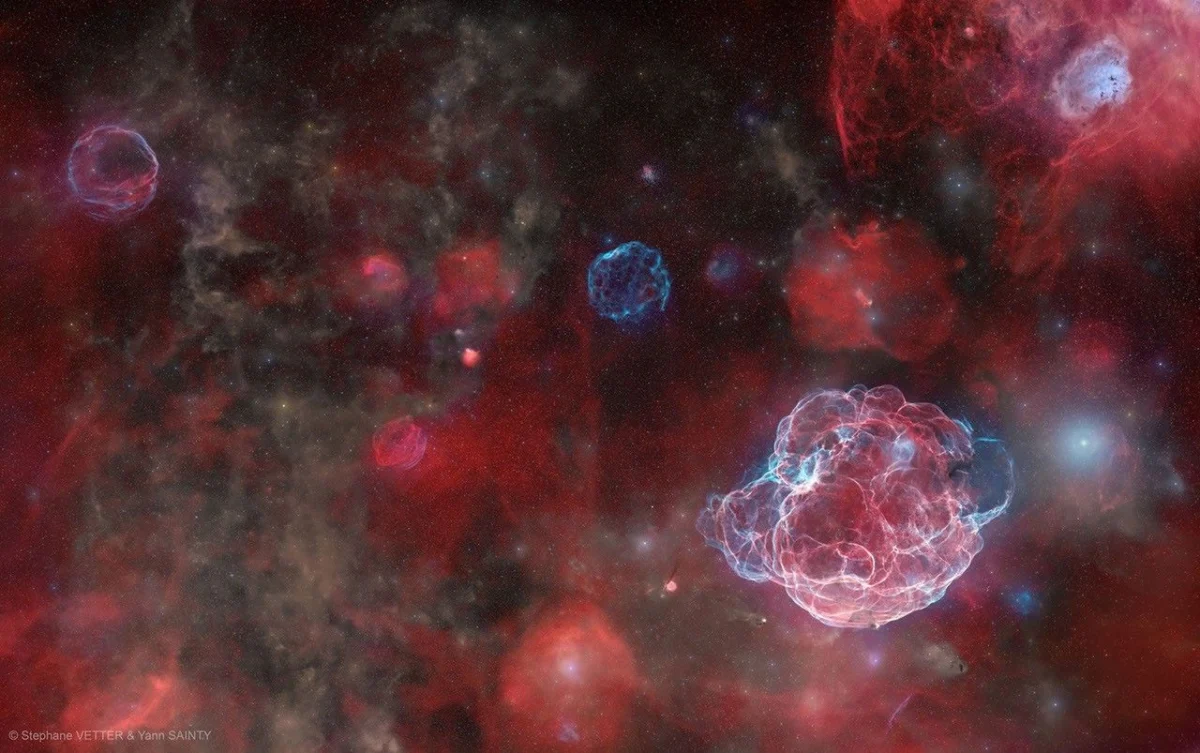
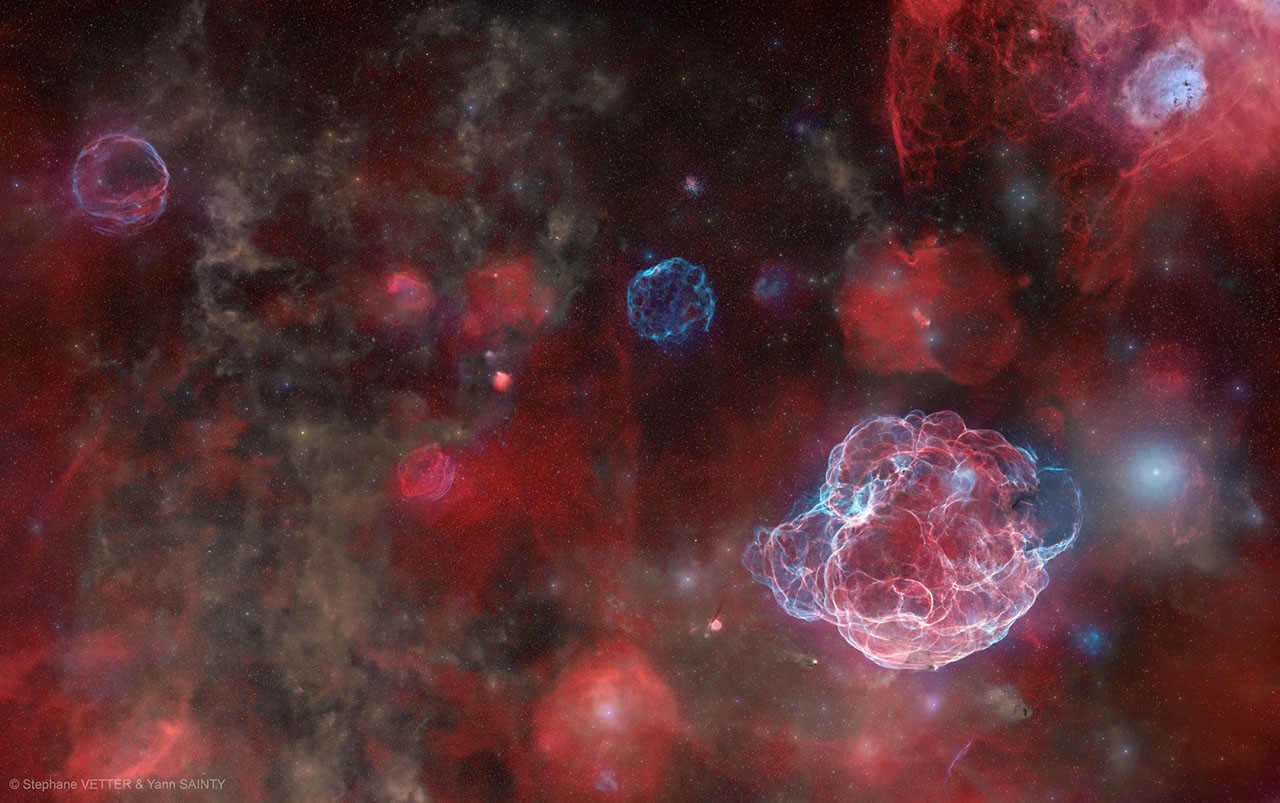
The latest Astronomy Picture of the Day (APOD) from NASA presents a breathtaking and scientifically significant composite image, revealing the ethereal remnants of five ancient stellar explosions across a vast stretch of the constellation Auriga, the Charioteer. This extraordinary visual tapestry, meticulously captured over approximately 200 hours of observation from the Oukaïmeden Observatory in Morocco, offers an unprecedented glimpse into the violent yet creatively destructive processes that shape our galaxy. The image, which spans an area equivalent to a thousand full moons tiled together, serves as a powerful testament to the ongoing cycle of stellar life and death, and the remarkable advancements in astrophotography that bring these distant phenomena into sharp focus for public and scientific appreciation.
The Astronomical Canvas: Auriga’s Fiery Ghosts
The featured image, a composite of immense depth and detail, centers on a region within Auriga, a prominent constellation in the northern celestial hemisphere. Auriga is easily recognizable by its bright star Capella, one of the brightest stars in the night sky. While often associated with open star clusters like M36, M37, and M38, this particular APOD focuses on a less commonly depicted, yet equally dramatic, aspect of the constellation: its collection of supernova remnants (SNRs). From left to right across the panoramic field of view, the image meticulously maps out G181.1+9.5, G182.4+4.3, G179.0+2.6, G180.0−1.7 (also known as Sh2-240 or the Spaghetti Nebula), and G178.2−4.2. These designations, derived from their galactic coordinates, hint at their precise locations within the Milky Way’s intricate structure. Additionally, the annotated version of the image highlights the well-known open cluster M37 and the intriguing Tadpole Nebula, providing further context to the rich stellar environment of Auriga. Each remnant represents a catastrophic event from the distant past, the explosive death of a massive star, whose echoes continue to ripple through the interstellar medium, influencing subsequent generations of stars and planets.
The Explosive Origins of Supernova Remnants
Supernovae are among the most energetic events in the universe, marking the dramatic end-of-life stages for certain types of stars. There are broadly two primary mechanisms that lead to a supernova. Type Ia supernovae occur in binary star systems where a white dwarf accretes matter from a companion star, eventually exceeding the Chandrasekhar limit (about 1.4 solar masses) and triggering a runaway nuclear fusion reaction that completely obliterates the star. These are often used as "standard candles" for measuring cosmic distances due to their consistent peak luminosity.
The supernovae responsible for the remnants observed in Auriga are more likely Type II supernovae. These occur when massive stars, typically those with initial masses greater than eight times that of our Sun, exhaust their nuclear fuel. Once the star’s core fusion ceases, the core collapses under its own immense gravity, forming an incredibly dense neutron star or, for the most massive progenitors, a black hole. This collapse then triggers a rebound effect, sending a powerful shockwave outwards through the star’s outer layers, expelling them into space at tremendous velocities. This expulsion is what we observe as a supernova.
The ejected material, rich in heavy elements forged during the star’s life and the explosion itself, expands outwards, sweeping up and heating the surrounding interstellar gas and dust. This expanding shell of shocked gas and delicate filamentary structures is what constitutes a supernova remnant. The characteristic red hues in the image are typically indicative of hydrogen emission (H-alpha), excited by the shock front, while the blue tones often signify emission from doubly ionized oxygen (OIII), another common spectral signature of these energetic environments. Supernova remnants can span tens to hundreds of light-years across and persist for tens to hundreds of thousands of years before eventually dissipating into the general interstellar medium.
A Quintet of Cosmic Ghosts: Unveiling Scientific Mysteries
The presence of five distinct supernova remnants within a relatively confined region of the sky, as depicted in the APOD image, presents a unique opportunity for astronomers. While these explosions happened independently and are situated at varying distances up to several thousands of light-years from Earth, their collective visualization offers insights into the dynamic history of star formation and death in our galactic neighborhood. Their estimated ages, ranging up to tens of thousands of years, mean that these colossal events unfolded long after humanity’s ancestors walked the Earth, and perhaps some of the brighter events were even witnessed by early humans as "new stars" that gradually faded over weeks or months, leaving behind no immediate visual trace beyond their initial brilliance.
One of the more prominent remnants in the image is G180.0−1.7, famously known as the Spaghetti Nebula or Sh2-240. This particular remnant is characterized by its intricate, wispy filaments that indeed resemble strands of spaghetti, formed by the interaction of the expanding shockwave with the uneven interstellar medium. Studies of Sh2-240 and its counterparts provide crucial data on the physics of shock waves, the acceleration of cosmic rays, and the chemical enrichment of the galaxy. Supernovae are the primary cosmic factories for many heavy elements, including iron, nickel, gold, and uranium, which are essential building blocks for planets and life. By dispersing these elements into space, supernovae seed the next generation of stars and planetary systems.
The individual characteristics of each remnant—their size, expansion velocity, emission spectra, and interaction with their local environment—offer distinct clues to their progenitor stars, the nature of the supernova explosion, and the density of the interstellar medium through which they propagate. For instance, differences in the observed hydrogen and oxygen emission ratios can indicate variations in the temperature, density, and ionization state of the gas within different parts of the remnants. Observing multiple remnants in various stages of evolution allows astronomers to build a more comprehensive model of how these structures evolve over time.
The Oukaïmeden Observatory’s Contribution to Deep-Sky Imaging
The remarkable clarity and depth of the APOD image are a testament to the dedication of the astrophotographers and the quality of the observing site. The image was acquired at the Oukaïmeden Observatory, located high in the Atlas Mountains of Morocco. Situated at an altitude of approximately 2,750 meters (9,000 feet), Oukaïmeden benefits from exceptionally dark skies, minimal light pollution, and often stable atmospheric conditions, making it an ideal location for deep-sky astronomical observations. The clean, dry air at such elevations reduces atmospheric extinction and turbulence, allowing for sharper images and the collection of fainter light.
The reported 200 hours of observation time is indicative of a sophisticated and painstaking astrophotography process. Capturing such faint and extended objects requires numerous long-exposure images taken through various narrowband filters—specifically hydrogen-alpha (Hα) and oxygen III (OIII) in this case—which isolate the light emitted by specific excited elements within the nebulae. These individual exposures are then meticulously calibrated, aligned, and stacked to reduce noise and enhance the subtle details and faint structures. The final composite image is a result of advanced image processing techniques that combine the data from different filters into a stunning full-color representation, revealing structures invisible to the naked eye or even short-exposure photography. This level of dedication by amateur and professional astrophotographers alike plays a crucial role in bringing the wonders of the universe to a broader audience and contributes to scientific data collection.
APOD: A Window to the Universe and its Broader Impact
NASA’s Astronomy Picture of the Day program, initiated in 1995, has become a cornerstone of public astronomical outreach and education. Curated by Robert Nemiroff and Jerry Bonnell, APOD features a different image or photograph of the universe each day, accompanied by a concise explanation written by a professional astronomer. The program’s mission is to "discover the cosmos" for millions worldwide, fostering curiosity and scientific literacy. This daily dose of cosmic wonder has garnered a massive following, illustrating how accessible and engaging scientific discovery can be.

The selection of images like the Auriga supernova remnants highlights APOD’s commitment to showcasing not just visually stunning phenomena, but also images with significant scientific narrative. Such images bridge the gap between complex astrophysical concepts and public understanding, allowing viewers to appreciate the beauty and the underlying physics of the universe simultaneously. The inclusion of an annotated version further enhances its educational value, guiding viewers to identify specific objects and understand their context.
The program’s reach and impact are substantial. By providing a curated collection of high-quality astronomical images and explanations, APOD serves as a valuable resource for students, educators, amateur astronomers, and anyone with an interest in space. It inspires new generations to pursue careers in science and technology and reminds the public of the vast, unexplored frontiers beyond Earth. The upcoming migration of APOD’s main NASA site from apod.nasa.gov to science.nasa.gov/apod signifies NASA’s continued investment in and commitment to the program, ensuring its accessibility and longevity within its broader science communication ecosystem.
Broader Scientific Implications and Future of Cosmic Exploration
The study of supernova remnants like those in Auriga carries profound implications for our understanding of galactic evolution, star formation, and high-energy astrophysics. These cosmic structures are not merely static monuments to past stellar deaths; they are active laboratories where fundamental processes unfold. The shockwaves from supernovae can compress existing molecular clouds, potentially triggering the collapse of gas and dust to form new stars. This feedback loop between stellar death and birth is a crucial mechanism driving the ongoing evolution of galaxies.
Furthermore, SNRs are known sources of cosmic rays—high-energy particles that travel through space at nearly the speed of light. Understanding how these particles are accelerated within the turbulent environments of supernova remnants is a key area of research in astrophysics. The study of their X-ray and radio emissions, often complementary to the visible light captured in images like the APOD feature, provides insights into the extreme physics at play, including magnetic field amplification and particle acceleration mechanisms.
The continued dedication of observatories like Oukaïmeden, coupled with the global reach of platforms like APOD, underscores the collaborative nature of modern astronomy. It showcases how ground-based observations, often requiring immense patience and technological skill, complement data from space-based telescopes, collectively painting a more complete picture of the universe. As technology advances, allowing for even deeper and more sensitive observations, our understanding of these "ghosts of supernovas" and their profound influence on the cosmos will only continue to grow, pushing the boundaries of human knowledge and inspiring countless individuals to look up and wonder. The daily presentation of such awe-inspiring imagery ensures that the universe remains an open book for all to read and explore.