The United States began their quest for an eleventh consecutive Presidents Cup victory by establishing a 3-2 advantage over the International team following Thursday’s fourball matches at the prestigious Medinah Country Club in Illinois. This opening session set a familiar tone for the biennial team competition, where the American contingent has historically dominated, but the International squad demonstrated flashes of resilience, signaling their intent to challenge the established order.
Dominant American Performances Fuel Early Advantage
The American squad, captained by Brandt Snedeker, wasted no time in asserting their presence on the course. The first point was secured by the formidable pairing of Justin Thomas and rookie Jackson Koivun, who delivered a commanding 4&3 victory over Canada’s Corey Conners and Colombia’s Nico Echavarria. This decisive win provided an immediate morale boost for the home team, showcasing the potent combination of seasoned experience and youthful exuberance. Thomas, a Ryder Cup veteran, provided steady leadership, while Koivun, making his Presidents Cup debut, showcased an impressive composure and skill set that belied his inexperience. Their aggressive play and seamless synergy from the outset established a significant lead that their opponents were unable to overcome.
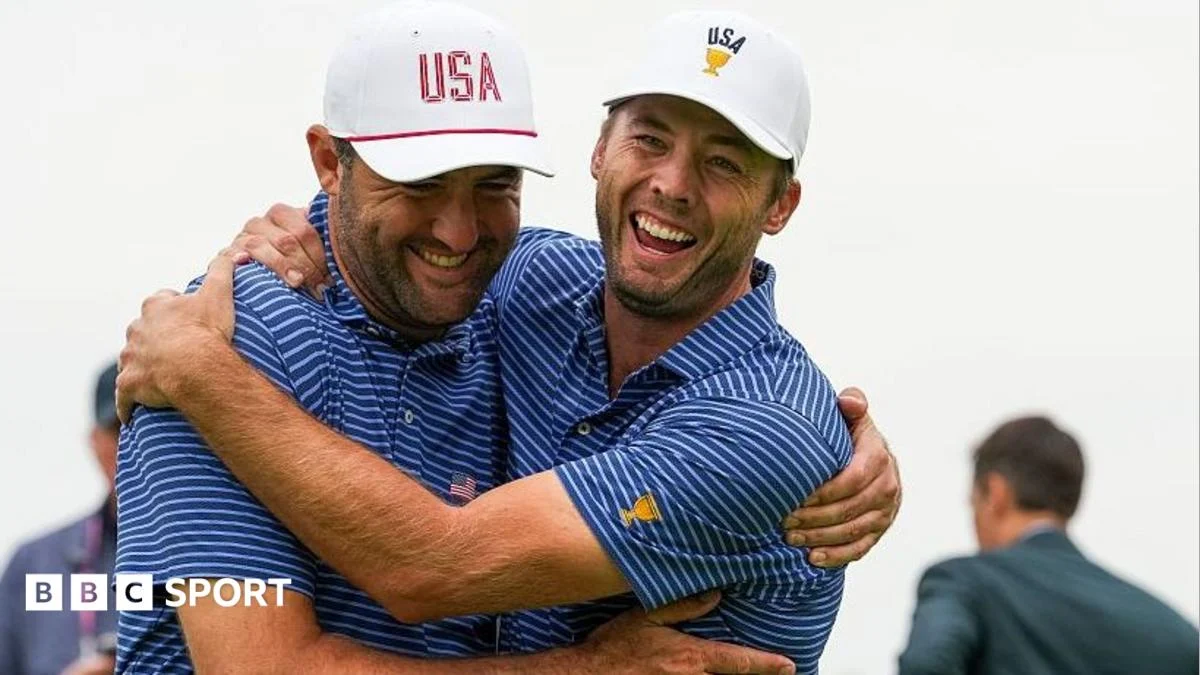
The world’s top-ranked golfer, Scottie Scheffler, partnered with his long-time friend Sam Burns, added another crucial point to the American tally. In a tightly contested match, Scheffler’s clutch play on the 17th hole proved to be the decisive factor, securing their victory. Their opponents, Australia’s Min Woo Lee and South Korea’s Sungjae Im, were left to lament several missed opportunities on the greens in the closing stages of the match, a recurring theme for the International team in this session. Scheffler’s reputation as a tenacious competitor was on full display, as he consistently delivered under pressure, demonstrating why he holds the top spot in the Official World Golf Ranking. Burns, meanwhile, provided solid support, contributing key putts and strategic play that complemented Scheffler’s brilliance.
The American advantage was further solidified by two-time major champions Wyndham Clark and Collin Morikawa. This powerhouse duo led from the opening hole against Australia’s Adam Scott, a veteran of numerous Presidents Cup campaigns, and the reigning Open Champion Ryan Fox of New Zealand. Clark and Morikawa maintained their dominant performance throughout the match, ultimately closing out their 3&2 success with two holes still to play. Their aggressive approach and unwavering confidence from the tee to the green proved too much for their International counterparts, ensuring the United States would carry a lead into Friday’s alternate-shot format. Morikawa’s precision with his irons and Clark’s prodigious driving distance created a formidable pairing that consistently put their opponents under pressure.
International Team Fights Back, Shows Glimmers of Hope
Despite the early American dominance, the International team, led by Geoff Ogilvy, demonstrated their fighting spirit and highlighted their potential to remain competitive. The five foursome matches scheduled for Friday present a different strategic challenge, one where the International side will be looking to leverage their strengths in alternate-shot play. The biennial contest, which pits American golfers against a team representing the rest of the world (excluding Europe), has seen only one International victory in its history – a memorable triumph in 1998, now 28 years ago. This historical context underscores the magnitude of the task facing Ogilvy’s squad, but their resilience in this opening session suggests they are determined to rewrite that narrative.
The International team secured two vital points to keep them within striking distance. The Japanese duo of Hideki Matsuyama, a multiple PGA Tour winner, and debutant Ryo Hisatsune delivered a strong performance, earning a 3&1 victory over the American pairing of Cameron Young and Xander Schauffele. Matsuyama’s experience and steady play, combined with Hisatsune’s enthusiastic debut, proved to be a potent combination. Their ability to control the momentum of the match and execute crucial shots in critical moments was a testament to their preparation and skill.
Adding to the International team’s success, the dynamic South Korean pairing of Kim Si-woo and Tom Kim consistently looked in control of their match. They secured a comfortable 3&2 win against Chris Gotterup and Patrick Cantlay. The Kim duo’s aggressive style and confident putting allowed them to build and maintain a lead throughout their encounter, demonstrating the depth of talent within the International squad and their ability to generate points. Their synergy on the course, characterized by energetic celebrations and clear communication, added an exciting element to the session.
A Look Ahead: Foursomes and the Path to Victory
The focus now shifts to Friday’s five foursome matches, a format where teams alternate hitting shots with the same ball. This highly strategic and often nerve-wracking format demands exceptional teamwork, precision, and mental fortitude. The United States will be looking to extend their lead, while the International team will be aiming to equalize or even take the lead, setting the stage for a dramatic weekend of golf.
Following Friday’s foursomes, Saturday will feature two more sessions: a morning of fourball matches, where each player plays their own ball and the lowest score counts, followed by an afternoon of foursomes. The Presidents Cup culminates on Sunday with all twelve players from each team competing in singles matches. A total of 15.5 points are required to secure overall victory in the competition.
Historical Context and Significance of the Presidents Cup
The Presidents Cup, established in 1994, serves as a prestigious international team golf competition, mirroring the format and rivalry of the Ryder Cup but featuring a United States team against a global team comprised of players from outside Europe. The event has been characterized by a strong sense of sportsmanship and camaraderie, alongside fierce competition. Medinah Country Club, a historic venue with a rich championship pedigree, provides a fitting stage for this latest chapter in the Presidents Cup saga. The course has previously hosted three U.S. Opens and two Ryder Cups, adding to the weight of tradition and expectation for both teams.
The American team’s pursuit of an eleventh consecutive victory is a testament to their consistent strength and depth in talent over the years. However, the International team’s performance in this opening session, particularly the resilience shown by Matsuyama, Hisatsune, Kim Si-woo, and Tom Kim, indicates that this year’s contest could be more closely fought than some predictions might suggest. The International team’s singular victory in 1998, achieved at the Royal Melbourne Golf Club in Australia, remains a beacon of hope and a reminder that an upset is not out of the question. That victory was spearheaded by a team that included such notable players as Greg Norman, Ernie Els, and Vijay Singh.
Analyzing the Early Dynamics
The 3-2 lead for the United States after the fourball session is a narrow but significant advantage. In team match play, momentum is a critical factor, and the Americans have seized it in the opening exchanges. The three American pairings that secured points – Thomas/Koivun, Scheffler/Burns, and Clark/Morikawa – showcased a blend of experience and emerging talent that proved difficult for the International team to counter consistently. The International team’s two points, secured by Matsuyama/Hisatsune and Kim Si-woo/Tom Kim, highlight their potential to win matches when their pairings click and their players execute.
The missed putts by the International players in the Scheffler/Burns match, and the early deficit faced by Scott/Fox, are areas that Ogilvy will undoubtedly address with his team. The foursomes format on Friday often amplifies pressure, as players are acutely aware of their partner’s shots and the collective responsibility for each hole. This session will be crucial in determining whether the United States can build a commanding lead or if the International team can claw their way back into contention. The strategic decisions made by both captains regarding pairings and player rotation will be under intense scrutiny.
The Presidents Cup, with its unique blend of team dynamics and individual brilliance, promises to deliver another compelling chapter of international golf rivalry. As the competition progresses, the psychological battle, the execution of strategic game plans, and the sheer determination of the players will all play a pivotal role in deciding whether the United States can continue their dominant streak or if the International team can finally etch another historic victory onto the Presidents Cup ledger. The atmosphere at Medinah is charged with anticipation, and the coming days are set to provide a captivating display of elite golf.