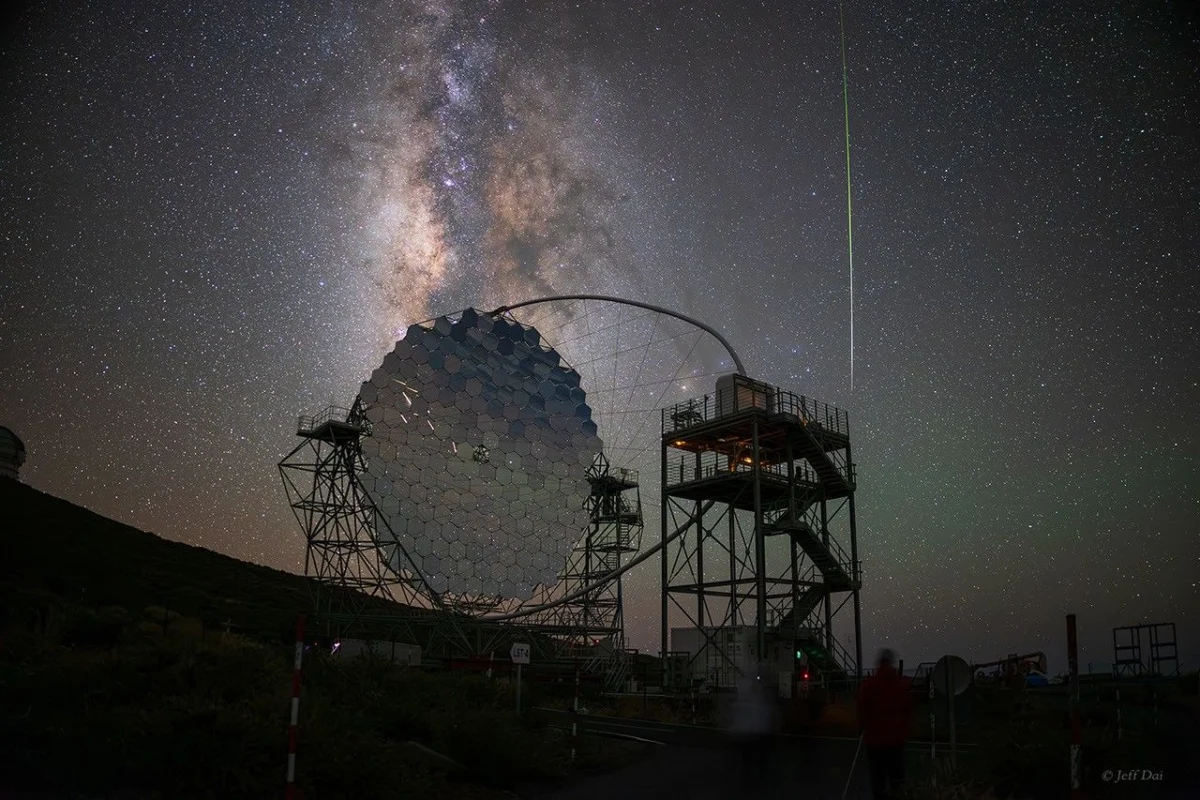
On the night of August 15, a vibrant Perseid meteor dramatically traversed the celestial expanse above the Observatorio del Roque de los Muchachos, situated on La Palma in Spain’s Canary Islands, creating a breathtaking tableau captured by astrophotographers and later highlighted by NASA’s Astronomy Picture of the Day (APOD). This striking astronomical event not only showcased the annual spectacle of the Perseid meteor shower but also illuminated the groundbreaking 23-meter diameter mirror of the prototype Large-Sized Telescope (LST-1), a critical component of the nascent Cherenkov Telescope Array Observatory (CTAO). The image presented to the public depicts the colorful meteor’s trail etched against the backdrop of the central Milky Way, its luminous stellar lanes and dark interstellar dust clouds arcing majestically above the rugged horizon of the volcanic island.
The Celestial Spectacle: A Perseid Meteor’s Fiery Descent
The Perseid meteor shower is one of the most anticipated annual astronomical events, renowned for its consistent activity and often bright, fast meteors. Originating from the debris trail left by Comet 109P/Swift-Tuttle, these meteors occur as Earth passes through the comet’s dusty wake each summer. As these particles, ranging from the size of a grain of sand to a pea, plunge into Earth’s atmosphere at speeds reaching up to 59 kilometers per second (approximately 132,000 miles per hour), they ionize the air molecules along their path. This process generates the characteristic luminous streaks of light visible from the ground, often accompanied by vibrant colors depending on the chemical composition of the meteoroid and the atmospheric gases it excites. The bright and colorful nature of the August 15 Perseid suggests a substantial piece of debris, rich in elements like magnesium (green-blue), calcium (violet), or sodium (orange-yellow), undergoing intense ablation in the upper atmosphere. The peak activity for the Perseids typically falls around mid-August, making the August 15 sighting perfectly aligned with the shower’s zenith. Observers in the northern hemisphere, particularly those under dark skies away from light pollution, are afforded the best views, making the high-altitude, pristine environment of La Palma an ideal vantage point.
La Palma: A Sanctuary for Stargazers and Scientists
The Observatorio del Roque de los Muchachos, perched at an altitude of over 2,400 meters (7,900 feet) on the rim of an ancient volcanic caldera, is globally recognized as one of the premier astronomical observing sites. Its geographical location, far from continental light pollution, combined with stable atmospheric conditions and frequent cloud inversions that trap lower-lying moisture, provides exceptional "seeing" conditions—the clarity and steadiness of the atmosphere for astronomical observations. These unique attributes attract an array of cutting-edge telescopes and scientific instruments from across the globe, forming a formidable hub for astronomical research. Among these facilities are the Gran Telescopio Canarias (GTC), one of the largest optical-infrared telescopes in the world, and other high-energy astrophysics observatories such as the MAGIC (Major Atmospheric Gamma-ray Imaging Cherenkov) telescopes, which predate the CTAO’s full deployment. The image featuring the Perseid meteor beautifully encapsulates the synergy between natural celestial phenomena and advanced human endeavor in exploring the cosmos, with the LST-1 mirroring the very flashes it is designed to detect from far more energetic cosmic events.
The Large-Sized Telescope (LST-1) and the Cherenkov Telescope Array Observatory (CTAO)
The foreground of the mesmerizing celestial photograph is dominated by the colossal 23-meter diameter mirror of the LST-1, the inaugural Large-Sized Telescope prototype for the northern hemisphere site of the Cherenkov Telescope Array Observatory. The LST-1 is not merely a passive observer of meteors; it is a sophisticated instrument designed to probe the most extreme phenomena in the universe through the detection of very high-energy gamma rays. These gamma rays, the most energetic form of light, are produced in some of the universe’s most violent events, such as supernova explosions, interactions around supermassive black holes in active galactic nuclei (AGN), and gamma-ray bursts (GRBs)—the most powerful explosions in the cosmos.
The Cherenkov Detection Principle: Unlike optical telescopes that capture direct light from celestial objects, Cherenkov telescopes like LST-1 employ an indirect method. When a very high-energy gamma ray (or a high-energy cosmic ray) strikes Earth’s upper atmosphere, it initiates a cascade of secondary particles, forming an "air shower." These relativistic particles travel faster than the speed of light in the atmosphere (though still slower than the speed of light in a vacuum). This phenomenon generates a faint, bluish flash of light known as Cherenkov radiation, analogous to a sonic boom produced by an object breaking the sound barrier. These flashes are extremely brief, lasting only about a billionth of a second, and are highly directional, pointing back to the original gamma-ray source.

LST-1’s Advanced Design: To capture these fleeting flashes, LST-1 features a massive primary mirror composed of 198 precisely aligned hexagonal mirror segments. This segmented design allows for a vast light-collecting area while maintaining structural integrity. The collected light is then focused onto a large, high-efficiency, pixelized camera, which can record these rapid light pulses with exquisite temporal and spatial resolution. The sheer size of the mirror is crucial for collecting enough Cherenkov light from distant and faint sources, allowing LST-1 to detect gamma rays in the lower end of the very high-energy spectrum (typically from a few tens of GeV to several TeV). This energy range is particularly important for studying extended and less energetic gamma-ray sources, complementing the capabilities of the smaller Medium-Sized and Small-Sized Telescopes within the CTAO, which are designed for higher energies.
The Cherenkov Telescope Array Observatory (CTAO): A Global Endeavor: The LST-1 at La Palma is a cornerstone of the broader CTAO project, an international initiative involving over 1,500 scientists and engineers from more than 30 countries. The CTAO is envisioned as the next-generation ground-based observatory for very high-energy gamma-ray astronomy, comprising dozens of telescopes across two sites: a northern hemisphere array at La Palma (primarily LSTs and MSTs) and a southern hemisphere array near Paranal, Chile (MSTs and SSTs). This dual-site approach ensures full sky coverage and optimizes observation conditions for different types of gamma-ray sources. The scientific objectives of CTAO are ambitious, ranging from understanding the origin of cosmic rays and the nature of dark matter to exploring the environments around supermassive black holes and searching for new physics beyond the Standard Model. The successful operation of LST-1 is a crucial step towards realizing the full scientific potential of this global observatory. The reflection of the Perseid meteor on LST-1’s mirror segments on August 15 served as a serendipitous, yet poignant, reminder of the atmospheric phenomena these instruments are designed to observe, albeit on a vastly different energy scale.
Broader Implications and Future Discoveries
The capture of the Perseid meteor against the backdrop of LST-1 underscores the intertwined nature of natural astronomical phenomena and human scientific exploration. It visually connects the accessible wonder of a meteor shower with the profound mysteries that advanced observatories like CTAO are designed to unravel. The scientific data gathered by LST-1 and the full CTAO will provide unprecedented insights into the universe’s most extreme processes. For instance, detecting very high-energy gamma rays from distant active galaxies can help scientists understand the mechanisms by which these cosmic behemoths accelerate particles to near-light speeds. Similarly, observations of gamma-ray bursts could shed light on the collapse of massive stars and the birth of black holes. The search for gamma-ray signals from dark matter annihilation or decay offers a unique avenue to probe this elusive component of our universe.
The international collaboration behind CTAO signifies a global commitment to pushing the boundaries of astrophysical knowledge. Statements from CTAO leadership consistently emphasize the transformative potential of the observatory, predicting a new era in gamma-ray astronomy comparable to the impact of gravitational wave observatories or the James Webb Space Telescope in their respective fields. The construction and commissioning of LST-1, with its complex mirror system and high-performance camera, represent a significant engineering triumph and a testament to human ingenuity.
NASA’s Astronomy Picture of the Day: Bridging Science and Public Engagement
The image’s feature on NASA’s Astronomy Picture of the Day (APOD) highlights APOD’s enduring role as a vital platform for public science communication and education. Since its inception in 1995, APOD has captivated millions worldwide by presenting a different image or photograph of the universe each day, accompanied by a concise, professional explanation written by astronomers. This daily dose of cosmic wonder serves to democratize astronomy, making complex scientific concepts accessible and inspiring curiosity about the universe. The inclusion of the Perseid meteor over LST-1 not only showcases a beautiful astronomical event but also subtly introduces the public to cutting-edge research infrastructure like the CTAO, fostering a greater appreciation for the scientific endeavors that deepen our understanding of space.
In an administrative update, APOD has announced changes to its email for image submissions, advising contributors to consult the updated guidelines on its website for future submissions. Furthermore, APOD’s main NASA site is undergoing a migration, transitioning from its long-standing address at apod.nasa.gov to science.nasa.gov/apod. These operational adjustments aim to streamline processes and integrate APOD more closely within NASA’s broader science communication framework, ensuring its continued accessibility and relevance for a global audience eager to discover the cosmos. As the scientific community looks ahead, the promise of discoveries from facilities like LST-1, brilliantly juxtaposed with the ephemeral beauty of a Perseid meteor, continues to fuel our collective quest for knowledge.