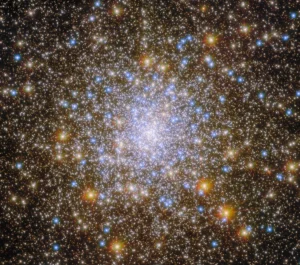



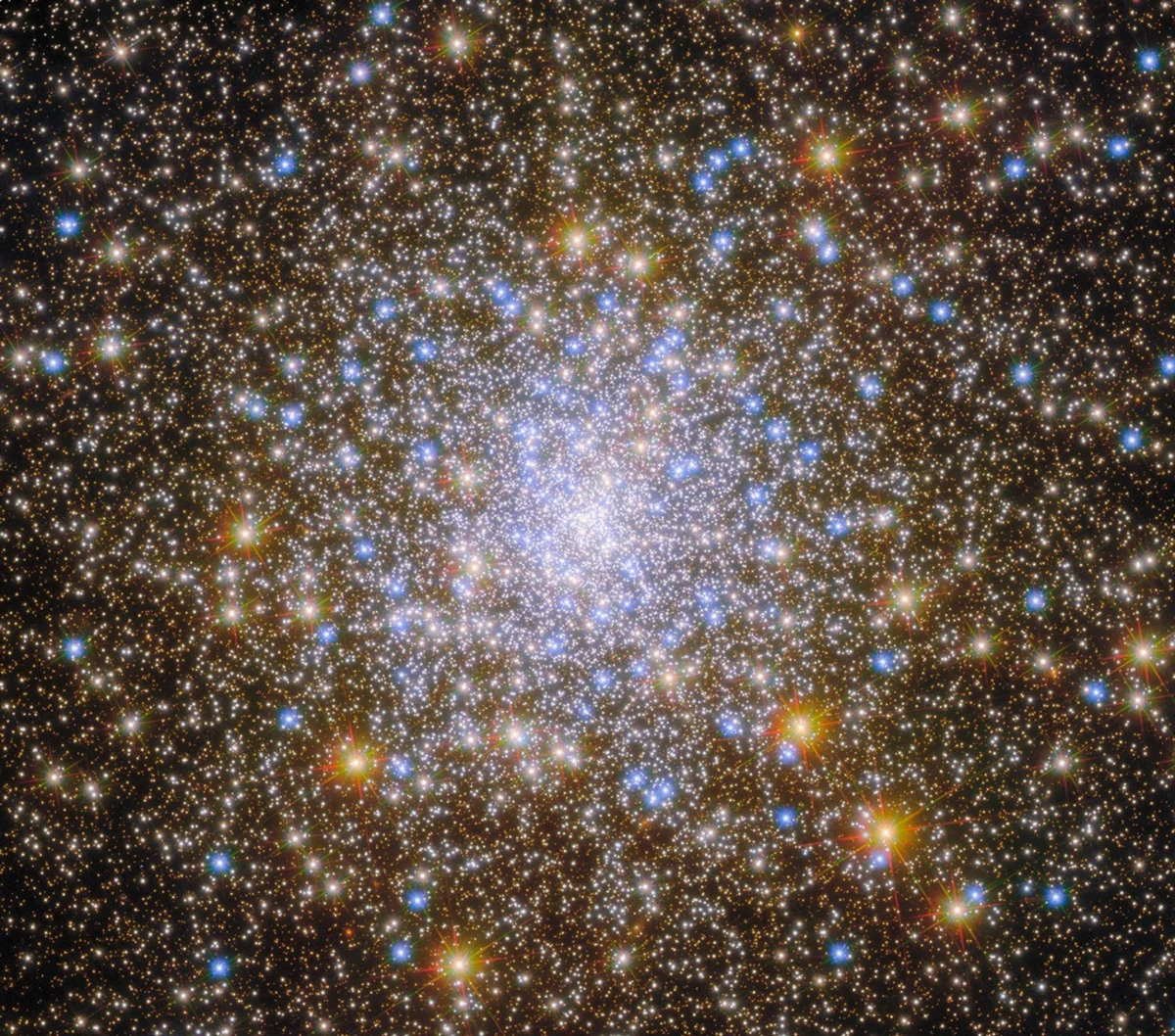
The NASA/ESA Hubble Space Telescope, on November 5, 2026, released a captivating image of Messier 30 (M30), a dazzling globular cluster located approximately 27,500 light-years from Earth in the constellation Capricornus. This latest celestial portrait serves as a profound lesson in galactic history, offering astronomers an invaluable window into the ancient past of our universe. The intricate tapestry of stars within M30 presents a striking visual dichotomy: thousands of stars filling the view, clearly divided between vibrant blue ones concentrated towards the cluster’s bright core and scattered around its outskirts, and a majority of yellow stars predominantly populating the regions outside the dense core. A few prominent orange stars, appearing noticeably larger, suggest a closer proximity to the observer. This diverse stellar composition is not merely aesthetically pleasing; it holds critical clues about stellar evolution, stellar dynamics, and the formation processes that shaped galaxies like our own.
The Cosmic Time Capsule: Unveiling Messier 30
Messier 30 is not just any star cluster; it is a globular cluster, one of the oldest and most densely packed stellar groupings known. These ancient relics are typically found in the halo of galaxies, containing hundreds of thousands to millions of stars gravitationally bound into a spherical shape. M30, like many of its counterparts, is believed to be over 12 billion years old, making its stars nearly as old as the universe itself. Studying M30 allows astronomers to peer back in time, observing stellar populations that formed in the early epochs of galactic assembly. Its extreme age means that most of its original, massive, short-lived stars have long since exhausted their nuclear fuel and evolved into white dwarfs, neutron stars, or black holes. The stars we observe today are predominantly those with lower masses, which have much longer lifespans, alongside a fascinating subset of rejuvenated stars.
Globular clusters are often considered "living fossils" of the early universe because their stars formed in a relatively rapid burst, retaining a pristine chemical composition compared to the younger, metal-rich stars found in galactic disks. M30, with its specific stellar populations and dynamic characteristics, offers a prime laboratory for understanding these primordial environments. The observed differentiation between blue and yellow stars in the Hubble image is a key aspect of this historical record, pointing towards complex evolutionary pathways within the cluster.
A Glimpse into Stellar Demographics: M30’s Vibrant Populations
The striking color variations within M30, meticulously captured by Hubble, are central to its scientific value. The presence of numerous blue stars, especially towards the core, within an ancient cluster like M30 is particularly intriguing. In standard stellar evolution models, blue stars are typically massive, hot, and young, burning through their fuel rapidly. Their existence in a cluster predominantly composed of ancient, low-mass stars suggests alternative evolutionary paths. These blue stars are often identified as "blue stragglers" – stars that appear younger and bluer than their co-eval counterparts.
Blue stragglers are thought to form through stellar interactions, such as the collision and merger of two stars, or the mass transfer between binary star companions. In the extremely dense environment of a globular cluster’s core, stellar encounters are far more frequent than in the sparsely populated galactic disk. When two stars merge, or one siphons material from another, the resulting star can be rejuvenated, appearing bluer and hotter, essentially "straggling" behind the evolutionary sequence of its peers. The observation of blue stars concentrated in M30’s core provides strong evidence for these dynamic processes at play, continually reshaping the cluster’s stellar population even billions of years after its formation.
Conversely, the abundance of yellow stars, particularly outside the dense core, likely represents the more typical, older stellar populations of M30. These would include stars evolving off the main sequence into the subgiant and red giant phases, which are cooler and emit light predominantly in the yellow to orange spectrum. The presence of a few noticeably larger orange stars closer to our perspective further supports this, indicating giant or supergiant stars that have expanded significantly in their later evolutionary stages. By analyzing the distribution, luminosity, and color of these different stellar types, astronomers can construct detailed Hertzsprung-Russell diagrams for M30, which graphically plot stars’ luminosities against their temperatures (or colors). Such diagrams allow scientists to precisely date the cluster, understand its internal dynamics, and model the various evolutionary paths taken by its constituent stars.
The Legacy of Charles Messier: Cataloging the Cosmos
The designation "Messier 30" pays homage to the pioneering French astronomer Charles Messier, who meticulously cataloged M30 and 109 other diffuse celestial objects in the late 18th century. Born in 1730, Messier was an ardent comet hunter. His primary motivation for creating the catalog, published between 1771 and 1781, was to distinguish these fixed, nebulous objects from the transient comets he so eagerly sought. In the era of rudimentary telescopes, many deep-sky objects appeared as faint, fuzzy smudges, easily mistaken for the tails of nascent comets. Messier’s catalog provided an invaluable guide for astronomers, ensuring they wouldn’t waste precious observing time on objects that were, in fact, permanent fixtures of the night sky.
Messier first observed and documented M30 on September 3, 1764, describing it as a "nebula without stars, round and bright, center brilliant, gradually fading." His observation, made with the limited technology of his time, speaks volumes about the cluster’s inherent brightness and distinctiveness. While Messier himself could not resolve the individual stars, his catalog entry laid the groundwork for future generations of astronomers, equipped with more powerful instruments, to fully appreciate the stellar majesty of objects like M30. Today, the Messier Catalog remains one of the most popular and enduring lists of deep-sky objects for both professional astronomers and amateur stargazers alike, a testament to Messier’s diligent work and the fundamental importance of systematic observation in astronomy.
Hubble’s Enduring Vision: A Quarter-Century of Discovery
The image of M30, released in 2026, underscores the extraordinary longevity and continued scientific prowess of the Hubble Space Telescope. Launched on April 24, 1990, Hubble has revolutionized our understanding of the cosmos for over three decades, far exceeding its initial projected lifespan. Positioned above Earth’s atmosphere, Hubble avoids the blurring and absorption of light that plague ground-based telescopes, providing unparalleled clarity and detail in its observations across ultraviolet, visible, and near-infrared wavelengths.
Hubble’s Wide Field Camera 3 (WFC3) and Advanced Camera for Surveys (ACS) are instrumental in capturing such high-resolution, multi-color images of stellar clusters. These instruments allow astronomers to resolve individual stars even in the crowded cores of globular clusters, enabling precise photometric measurements that reveal their colors, luminosities, and ultimately, their evolutionary stages. Over its operational history, Hubble has observed countless globular clusters, mapping their stellar populations, searching for exotic objects like pulsars and black holes, and studying their internal dynamics. Its observations have been critical in establishing the age of the universe, refining the cosmic distance ladder, and revealing the processes of galaxy formation and evolution. The 2026 release of M30 data highlights Hubble’s ongoing contribution to astrophysics, demonstrating its continued capability to deliver groundbreaking scientific insights even as newer observatories come online.
M30’s Unique Characteristics: A Core-Collapsed Mystery
Beyond its general classification as a globular cluster, Messier 30 possesses a distinct and scientifically significant characteristic: it is a "core-collapsed" cluster. This means that M30 has undergone a process where its central region has become incredibly dense due to gravitational interactions between its stars, leading to a much higher concentration of stars in its core compared to non-core-collapsed globular clusters.
The process of core collapse is a natural consequence of stellar dynamics within a dense cluster over billions of years. Stars in the core exchange energy through gravitational encounters, with heavier stars tending to sink towards the center while lighter stars are ejected to the outskirts or even out of the cluster entirely. This process can lead to a runaway effect, where the core becomes progressively denser, increasing the frequency of stellar interactions.
In M30’s core, the stellar density is so extreme that stars are packed together with remarkable proximity, significantly enhancing the probability of close encounters, binary star formation, and even direct stellar collisions. These interactions are precisely what are thought to give rise to the blue stragglers observed in the Hubble image. Moreover, core-collapsed clusters are prime hunting grounds for exotic compact objects such as millisecond pulsars, X-ray binaries, and intermediate-mass black holes, which are thought to form or accumulate in these ultra-dense environments.
Supporting data for M30 reveals its immense scale and unique properties. With an estimated mass of several hundred thousand solar masses, it spans approximately 90 light-years in diameter. Its relatively low metallicity (a measure of elements heavier than hydrogen and helium) confirms its ancient origins, as these elements were far less abundant in the early universe. The study of M30’s core-collapsed nature provides a natural laboratory for understanding stellar dynamics in extreme environments, offering insights into the physics of gravitational encounters and the formation of high-energy astrophysical phenomena that are otherwise difficult to observe.
The Scientific Resonance: Insights into Galactic Formation and Evolution
The ongoing study of globular clusters like M30 through instruments such as the Hubble Space Telescope holds profound implications for our understanding of galactic formation and evolution. Globular clusters are considered the earliest structures to form in galaxies, preceding the main stellar disk and spiral arms. By analyzing their ages, chemical compositions, and orbital paths, astronomers can reconstruct the early history of the Milky Way. For instance, the fact that M30 resides in the halo of our galaxy and is extremely old suggests it might be a remnant of a dwarf galaxy that was accreted by the Milky Way in its early stages, or it could be one of the original building blocks that coalesced to form the Milky Way itself.
The distinct stellar populations within M30 – particularly the evidence for multiple stellar generations or rejuvenation processes indicated by the blue stragglers – challenge simplistic models of globular cluster formation. It suggests that these clusters are not merely static collections of stars born at the same time, but rather dynamic environments where stellar interactions continue to play a significant role over cosmic timescales. Such findings refine our theoretical models of stellar evolution and gravitational dynamics. Furthermore, the analysis of M30’s integrated light and individual stellar spectra helps constrain parameters for models of chemical evolution in the early universe, providing benchmarks for understanding how the first generations of stars enriched the cosmos with heavier elements.
Statements from the Astronomical Community
The release of such images invariably generates excitement within the astronomical community. Dr. Maria Libralato, a co-investigator on the project, commented, "M30 is a phenomenal example of a globular cluster that continues to surprise us. The exquisite resolution provided by Hubble allows us to dissect its stellar populations with unprecedented detail, offering crucial insights into the complex stellar interactions that shape these ancient systems. The clear distinction between the blue and yellow stars, especially, tells a vivid story of stellar rejuvenation and evolution in an incredibly dense environment."
Dr. Giampaolo Piotto, another leading researcher involved in the M30 analysis, added, "Every observation of M30 deepens our understanding of core-collapsed clusters. It’s not just a collection of old stars; it’s a dynamic laboratory where we can witness stellar collisions and mass transfer in action. The data from Hubble is essential for validating our theoretical models of stellar dynamics and the formation of exotic compact objects within these clusters."
A spokesperson for NASA’s Hubble mission office emphasized the telescope’s enduring legacy: "Hubble continues to be a cornerstone of astronomical research, even decades after its launch. Images like this M30 portrait are not just beautiful; they are rich scientific datasets that fuel new discoveries and refine our understanding of the universe’s history. It’s a testament to the dedication of the teams at NASA and ESA that Hubble remains a vital asset in exploring the cosmos."
Looking Ahead: The Future of Globular Cluster Research
While Hubble continues to provide invaluable data, the future of globular cluster research will undoubtedly be shaped by complementary observations from next-generation telescopes. The James Webb Space Telescope (JWST), with its unparalleled infrared capabilities, can peer through the dust and gas that might obscure parts of these clusters, revealing even fainter or more embedded objects, including very low-mass stars, brown dwarfs, and potentially primordial black holes. JWST’s spectroscopic instruments will also allow for more detailed chemical analyses of individual stars, offering a more precise understanding of their origins and evolutionary paths.
Future ground-based observatories, such as the Extremely Large Telescope (ELT) and the Giant Magellan Telescope (GMT), with their massive mirrors, will provide unprecedented spatial resolution and light-gathering power, enabling astronomers to study the faintest stars and the most crowded regions of globular clusters with even greater detail. The synergy between space-based observatories like Hubble and JWST, and these colossal ground-based facilities, promises to unlock further secrets of M30 and other globular clusters, ultimately refining our models of stellar evolution, galactic assembly, and the early universe. M30, as revealed by Hubble, remains a pivotal object in this grand cosmic exploration, a sparkling collection of stars that continues to teach us profound lessons about our galactic past.