


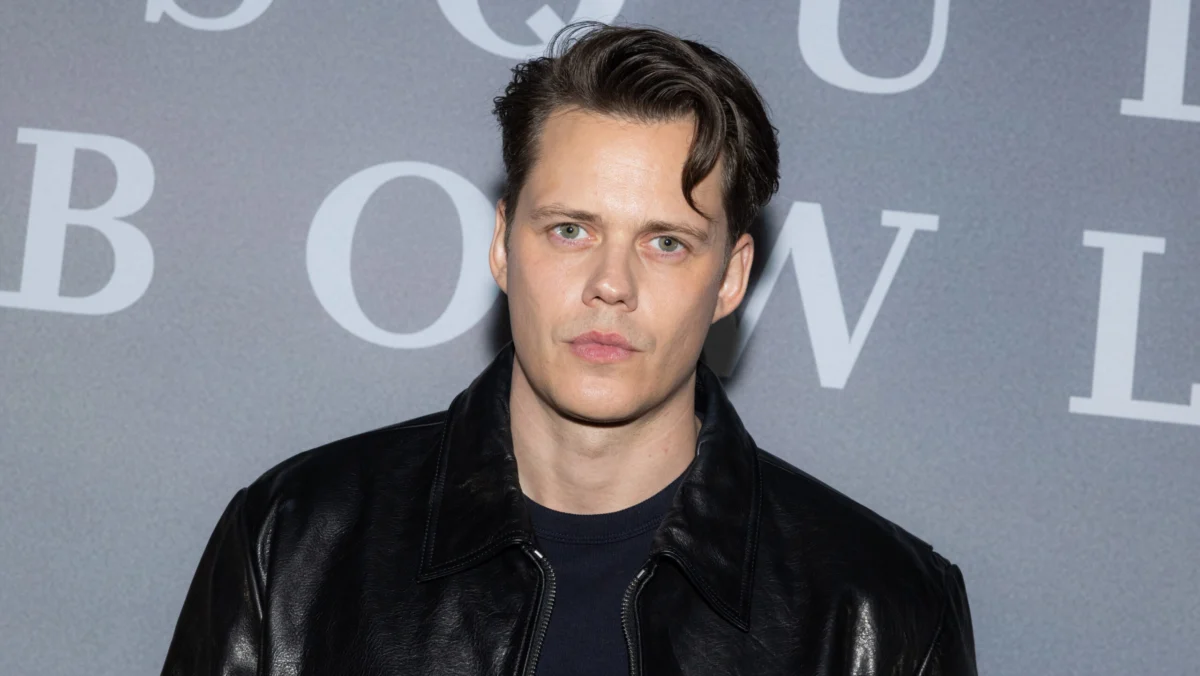
Bill Skarsgard, the actor currently captivating audiences with his chilling portrayal of Count Orlok in Robert Eggers’ critically acclaimed reimagining of Nosferatu, has candidly revealed a growing sense of depletion when it comes to inhabiting the personas of cinematic antagonists. In a recent, wide-ranging interview on Josh Horowitz’s popular podcast, Happy Sad Confused, the 36-year-old Swedish performer, whose career has been punctuated by memorably dark and complex characters, articulated a desire for more nuanced roles, even as the fervent speculation surrounding the next actor to don the iconic tuxedo of James Bond continues to swirl.
Skarsgard, who has left an indelible mark on the horror genre with his terrifying performance as Pennywise the Dancing Clown in the It film series and has further cemented his reputation with roles such as Eric Draven in The Crow and the formidable Marquis Vincent Bisset de Gramont in John Wick: Chapter 4, stated that the well of villainous archetypes is beginning to feel somewhat dry. "For a villain, it would have to be something that felt original to me, that was something that I hadn’t done before," Skarsgard explained. "I feel, kind of, spent with those things. But there’s villains [that] could be really fun in different ways and if it’s the right kind." This sentiment suggests a shift in his artistic priorities, moving beyond the sheer allure of darkness to seek roles that offer greater creative challenge and originality.
The conversation on Happy Sad Confused naturally gravitated towards Skarsgard’s long-expressed admiration for the James Bond franchise, a sentiment previously highlighted in other interviews. However, Skarsgard was quick to clarify his current position on the possibility of joining the iconic spy series. When host Josh Horowitz broached the subject, Skarsgard quipped, "Yeah! Well, because they didn’t call me about James Bond. I don’t know what that was about. Maybe they were like, ‘We can’t do a Swede for this guy.’ I wasn’t even thrown into the mix." This lighthearted dismissal underscores that, despite his interest in the Bond universe, no formal discussions or overtures have been made to him for the coveted role of 007.
The Evolving Landscape of the James Bond Franchise
The search for the next James Bond has become a subject of intense public and industry interest since Daniel Craig’s departure from the role following his final outing in No Time to Die (2021). The producers, Barbara Broccoli and Michael G. Wilson, have consistently stated their intention to reimagine the character for a new era, indicating a potential shift in the franchise’s direction. This has led to a prolonged casting process, with numerous actors being rumored, discussed, and, in some cases, confirmed to have undergone screen tests.
Early reports from The Hollywood Reporter had indicated that actors such as Callum Turner, Jack Lowden, and Josh O’Connor were among those who had participated in screen tests for the role. More recently, the publication also reported on Robert Pattinson’s involvement in screen tests, a development that generated significant buzz within the entertainment sphere. Nicholas Hoult’s name has also surfaced as a prominent contender in these ongoing discussions. The protracted nature of this casting decision speaks to the significance of the role and the producers’ commitment to finding the right fit for a character who has been a global cinematic icon for over six decades.
Skarsgard’s Perspective on Villainous Roles and Franchise Engagement
Skarsgard elaborated on his ideal involvement within a franchise like James Bond. He expressed a reluctance to commit to a long-term, multi-film commitment that would span a decade or more, a common trajectory for the actor who eventually takes on the mantle of Bond. Instead, he voiced a preference for a more contained, impactful role, specifically a one-off villain performance. This strategic approach aligns with his current artistic sensibilities and his desire to avoid feeling "spent" on recurring character types.
He drew parallels to acclaimed actors who have delivered memorable villainous turns in the Bond series, such as Mads Mikkelsen in Casino Royale (2006) and Javier Bardem in Skyfall (2012). These actors, while not the titular spy, played pivotal roles that significantly enhanced the narrative and provided compelling foils for Bond. Skarsgard’s hypothetical interest would likely lean towards a similarly impactful, self-contained antagonist performance, allowing him to explore the darker facets of character without the long-term burden of carrying an entire franchise.
Supporting Data and Industry Context
The enduring appeal of the James Bond franchise is undeniable, with its films consistently ranking among the highest-grossing in cinematic history. No Time to Die, Daniel Craig’s final appearance, grossed over $774 million worldwide, demonstrating the continued commercial viability of the series. The franchise’s ability to reinvent itself while maintaining its core elements—sophisticated espionage, exotic locales, thrilling action sequences, and, of course, a charismatic lead—is a testament to its robust storytelling framework and dedicated fanbase.
The casting of a new Bond is not merely a matter of selecting an actor; it is a cultural event that shapes the future of a significant cinematic property. The decision impacts not only the immediate films but also the broader narrative direction, thematic exploration, and marketing strategies for years to come. The producers’ careful consideration reflects the weight of this responsibility.
Broader Implications and Analysis
Skarsgard’s candid remarks offer insight into the evolving career strategies of prominent actors in the current entertainment landscape. The era of the multi-picture franchise has undeniably reshaped Hollywood, with studios increasingly relying on established intellectual properties to drive box office success. For actors, this presents both opportunities and challenges. While lucrative long-term contracts can provide financial security and a platform for global recognition, they can also limit artistic flexibility and lead to the type of creative exhaustion Skarsgard describes.
His expressed desire for "original" and "different" villain roles suggests a broader trend among performers to seek out projects that offer unique storytelling and character development. This is particularly relevant in the genre space, where audiences have become increasingly sophisticated and appreciative of nuanced performances, even within traditional archetypes. The success of Nosferatu, for instance, hinges on Skarsgard’s ability to imbue the iconic vampire with a fresh, unsettling quality, moving beyond a mere caricature.
The James Bond franchise, in its quest for a new 007, is navigating this complex terrain. The producers must balance the legacy and expectations associated with the character with the need for a contemporary interpretation that resonates with a new generation of viewers. Whether this involves casting a relatively unknown actor to grow with the role or selecting a more established star to bring a fresh perspective, the decision will undoubtedly be closely scrutinized.
Skarsgard’s Current Endeavors
Beyond the Bond speculation, Bill Skarsgard is actively engaged in other significant projects. He stars in Peter Berg’s war film The Mosquito Bowl, which has seen a theatrical release and is slated for a Netflix debut on November 25th. This project further showcases his versatility, moving from supernatural horror and action-thrillers to the realm of historical war drama. The film, which reportedly delves into the intense rivalries and psychological toll of an intense football game played by Marines during the Vietnam War, offers Skarsgard another opportunity to explore complex human emotions and challenging circumstances.
The ongoing discourse surrounding Bill Skarsgard’s career choices and his thoughts on major franchise roles highlights a dynamic period in Hollywood. As the James Bond casting saga continues to unfold, Skarsgard’s measured approach and artistic discernment position him as a compelling figure whose future performances will likely continue to captivate audiences, regardless of the genre or the specific nature of the characters he chooses to embody. His current creative trajectory suggests a commitment to depth and originality, qualities that are increasingly valued in an entertainment industry often driven by spectacle and established formulas. The possibility of him gracing the Bond universe in a villainous capacity, though not currently on the table, remains an intriguing prospect for fans who appreciate his transformative abilities.