


The automotive landscape has witnessed a significant revival as Honda prepares to reintroduce the Prelude nameplate, a move that effectively fills a long-standing void in the manufacturer’s lineup for a front-wheel-drive hybrid coupe. This return comes approximately 16 years after the launch of the Honda CR-Z, a vehicle now widely regarded as the spiritual predecessor to the upcoming Prelude. While both vehicles share a foundational philosophy of blending efficiency with driver engagement, they bookend a transformative era in gasoline-electric propulsion technology. The transition from the CR-Z’s experimental nature to the new Prelude’s refined performance highlights a broader industry shift toward electrification as a primary driver of automotive dynamics rather than a mere secondary fuel-saving measure.
A New Era for Petrol-Electric Performance
When the Honda CR-Z debuted in 2010, the concept of a performance-oriented hybrid was largely unproven and met with skepticism by enthusiasts. At that time, the automotive industry was on the cusp of a revolution but had not yet reached the milestone of the so-called "holy trinity" of hybrid hypercars: the Ferrari LaFerrari, the McLaren P1, and the Porsche 918 Spyder. These multi-million-dollar machines would eventually prove that electric assistance could enhance track performance, but in 2010, that reality was years away.
During the CR-Z’s tenure, the market for performance hybrids was remarkably sparse. Aside from niche offerings like the Fisker Karma or the Lexus GS 450h sports saloon, the hybrid badge was synonymous with the utilitarian efficiency of the Toyota Prius. Honda’s attempt to inject "fun" into the hybrid segment with the CR-Z was a bold, albeit early, move. The company sought to prove that petrol-electric synergy could be offered at an accessible price point, even before the technology had been perfected at the highest levels of motorsport or luxury engineering.
Technical Specifications: Comparing Two Generations of Innovation
The new Honda Prelude utilizes a sophisticated series-hybrid powertrain, often referred to as a range-extender style system. In this configuration, a high-output electric motor handles the majority of propulsion duties. It is supported by a 2.0-litre Atkinson-cycle four-cylinder petrol engine. Under most driving conditions, the engine acts as a generator to provide power to the electric motor. However, during high-constant-load scenarios, such as highway cruising, the engine can connect directly to the driven wheels via a planetary gearing system, operating in a parallel-hybrid mode.
While Honda has not officially released a combined system torque figure for the Prelude, industry analysts and early test sessions suggest the output exceeds 250 lb-ft. This provides a level of responsiveness that, while not reaching the aggressive heights of a dedicated hot hatchback like the Civic Type R, offers sufficient torque to navigate demanding, undulating terrain with confidence.
In contrast, the CR-Z was built upon the Integrated Motor Assist (IMA) architecture. It featured a 1.5-litre i-VTEC petrol engine paired with a relatively modest electric motor. In its initial iteration, the electric motor produced only 14 brake horsepower (bhp) and 58 lb-ft of torque. Despite these humble figures, the CR-Z was unique for its inclusion of a six-speed manual transmission—a rarity in the hybrid world then and now. The electric motor served to bolster the torque curve at lower engine speeds, allowing the car to pull through higher gears more assertively than a standard 1.5-litre atmospheric engine would allow, while still permitting the engine to rev freely to its redline.
A Chronology of the Honda Sport Coupe
To understand the significance of the Prelude’s return, one must look at the timeline of Honda’s development of compact, driver-focused vehicles:
- 1978–2001: The Original Prelude Era: Spanning five generations, the Prelude was Honda’s flagship for showcasing new technology, including four-wheel steering and the Active Torque Transfer System (ATTS). It was discontinued in 2001 as consumer interest shifted toward SUVs and the Integra.
- 2010–2016: The CR-Z Experiment: Launched as a spiritual successor to the CR-X, the CR-Z was the world’s first hybrid sports coupe with a manual transmission. It faced criticism for being neither fast enough to be a true sports car nor efficient enough to beat dedicated hybrids.
- 2023: The Prelude Concept Reveal: Honda surprised the industry at the Japan Mobility Show by unveiling the Prelude Concept, a sleek, production-ready design that signaled the return of the nameplate.
- 2025–2026: Market Launch: The production version is expected to hit global markets, positioned as a sophisticated, electrified grand tourer.
Performance Analysis and Driving Dynamics
The driving experience of the new Prelude represents a significant departure from the CR-Z. The CR-Z, often described as a "son of Insight," was lightweight and simple, yet it lacked the purposeful suspension tuning required to compete with contemporary sports cars. Its charm lay in its manual gearbox and the novelty of its hybrid assistance, which felt like a "boost" button for a small-displacement engine.
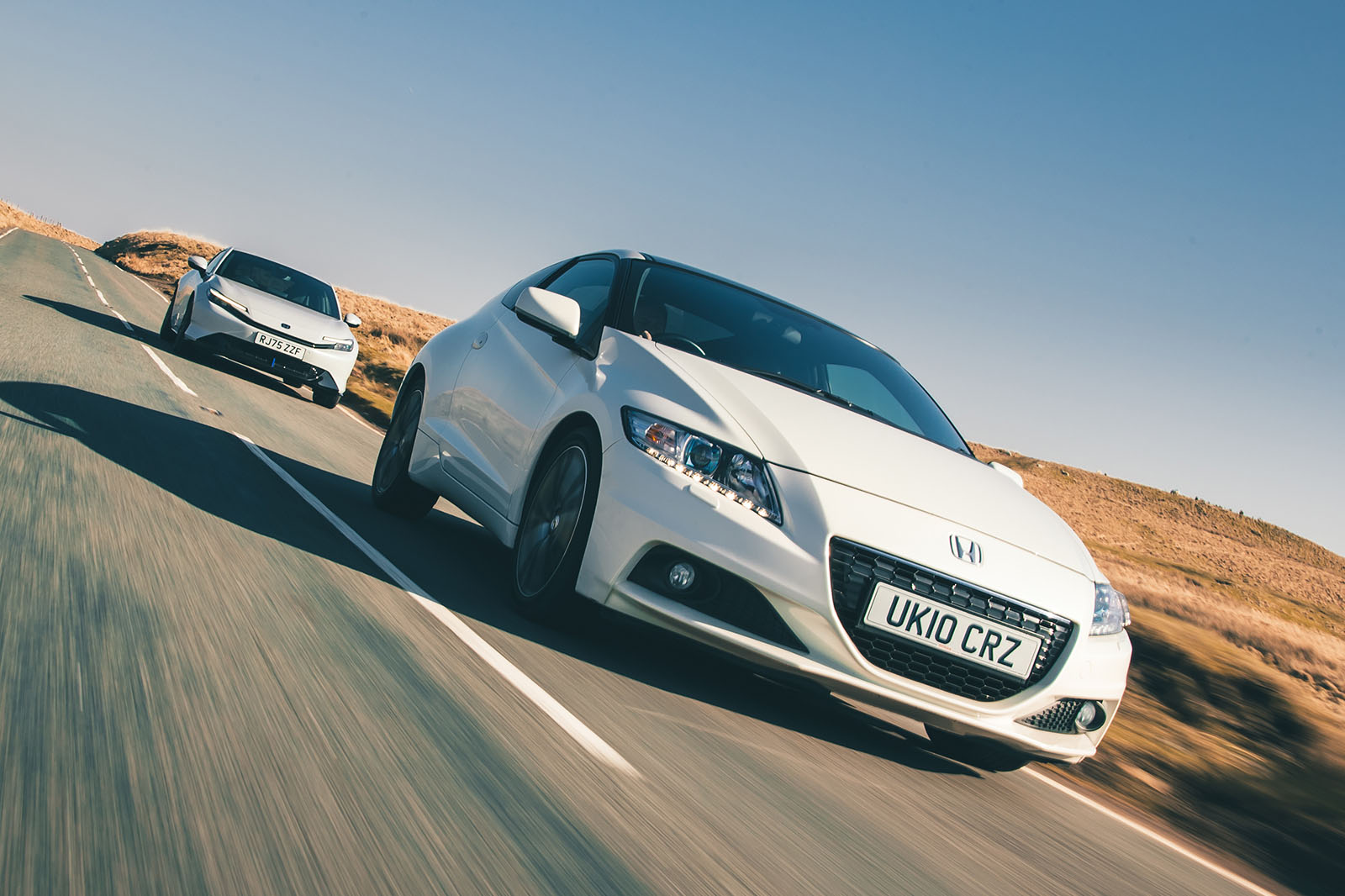
The modern Prelude, however, benefits from nearly two decades of hybrid refinement. Its e:HEV system provides seamless transitions between electric and gasoline power, prioritizing the instant torque of the electric motor. This results in a "brisk" sensation that is more aligned with modern premium coupes. While the CR-Z felt somewhat pedestrian in its power delivery, the Prelude utilizes its electric reserves to ensure that power is available across the entire operating range, making it a much more capable tool for spirited driving on technical roads.
Official Responses and Strategic Positioning
Honda executives have positioned the Prelude not as a direct competitor to high-performance track cars, but as a "joy of driving" ambassador for the electrified age. During the concept’s unveiling, Honda CEO Toshihiro Mibe emphasized that the Prelude is intended to showcase Honda’s "unalterable sports mindset" even as the company moves toward its goal of 100% electric and fuel-cell vehicle sales by 2040.
Honda UK, maintaining its heritage fleet, has allowed for direct comparisons between the CR-Z GT and the new Prelude prototypes. Spokespeople from the brand suggest that the Prelude is designed to appeal to mature drivers who value aesthetic elegance and efficient performance over raw horsepower. This strategic positioning places the Prelude in a unique niche, bridging the gap between the utilitarian Civic Hybrid and the high-performance Type R models.
Broader Impact on the Automotive Market
The reintroduction of the Prelude comes at a critical juncture for the automotive industry. As many manufacturers move toward fully electric lineups, there remains a significant segment of the market that is not yet ready to transition away from internal combustion entirely, yet desires the benefits of electrification.
The Prelude serves several functions within this context:
- Technological Bridge: It demonstrates that hybrid technology can be used to enhance the "fun to drive" factor without the range anxiety associated with battery-electric vehicles (BEVs).
- Brand Heritage: By reviving a beloved nameplate, Honda taps into nostalgia while modernizing its image.
- Market Differentiation: While competitors like Toyota and Subaru continue to offer pure-combustion coupes (the GR86 and BRZ), Honda is carving out a space for the "premium hybrid coupe," a segment that has been largely ignored since the discontinuation of the BMW i8.
Future Implications
The Prelude’s success will likely dictate Honda’s future strategy regarding electrified sports cars. If the market embraces a hybrid coupe that prioritizes refinement and torque over top-end speed, it may pave the way for a hybrid or fully electric successor to the NSX or even an electrified S2000.
Furthermore, the Prelude’s powertrain—a refinement of the e:HEV system found in the Civic and Accord—suggests that Honda is finding ways to make its high-efficiency systems more engaging for enthusiasts. The use of simulated gear shifts and linear tuning in the Prelude’s software aims to mimic the feel of a traditional powertrain, addressing one of the primary complaints directed at early hybrids like the CR-Z.
As the Prelude nears its official production release, it stands as a testament to how far hybrid technology has progressed. From the experimental and somewhat compromised CR-Z to the confident and technologically advanced Prelude, Honda has spent sixteen years refining the formula for the petrol-electric coupe. The result is a vehicle that no longer needs to apologize for its hybrid nature but rather uses it as its greatest strength.