


A new study utilizing extensive data from NASA’s venerable Hubble Space Telescope has uncovered a profound and sustained decline in star formation within the nearby Andromeda galaxy, our largest galactic neighbor. The research indicates a steady decrease over the past 500 million years, culminating in an even more dramatic drop over the last 40 million years. This revelation provides astronomers with an invaluable "fossil record" of galactic evolution, offering critical insights into the processes that shape large spiral galaxies, including our own Milky Way.
The findings, published on Monday in the esteemed Astrophysical Journal, leverage the unparalleled observational capabilities of the Hubble Space Telescope, which has for decades served as humanity’s premier eye on the universe. By meticulously examining hundreds of millions of individual stars across Andromeda’s vast disk, scientists have pieced together a detailed chronological account of its stellar birthrate, revealing a galaxy that, after a period of robust activity, appears to be settling into a quieter phase of its cosmic life.
The Grand Neighbor: Andromeda’s Significance in Galactic Studies
The Andromeda galaxy (Messier 31) holds a unique and privileged position in astronomical research. Located approximately 2.5 million light-years from Earth, it is effectively in our cosmic backyard, close enough to be observed with the unaided eye from dark-sky locations. As a spiral galaxy comparable in size and morphology to our own Milky Way, Andromeda serves as an indispensable laboratory for understanding galactic dynamics, evolution, and star formation processes that are difficult to study in our own galaxy due to our internal perspective. Its proximity allows astronomers to resolve individual stars, a feat typically impossible for more distant galaxies, thereby providing an unprecedented level of detail crucial for reconstructing its past.
Andromeda is not merely a neighbor but also a harbinger of our galactic future. Both the Milky Way and Andromeda are the dominant members of the Local Group of galaxies, and they are on a collision course, predicted to merge in about 4.5 billion years. Understanding Andromeda’s current state and evolutionary history, including its star formation activity, is therefore vital for predicting the outcome of this colossal cosmic encounter and the formation of the eventual "Milkomeda" elliptical galaxy. The ongoing decline in star formation in Andromeda adds another layer to this complex cosmic narrative, suggesting that the merging galaxies might be less active at the time of their grand union than previously thought, potentially influencing the subsequent burst of star formation often associated with major mergers.
Hubble’s Unprecedented View: Unraveling Stellar Histories
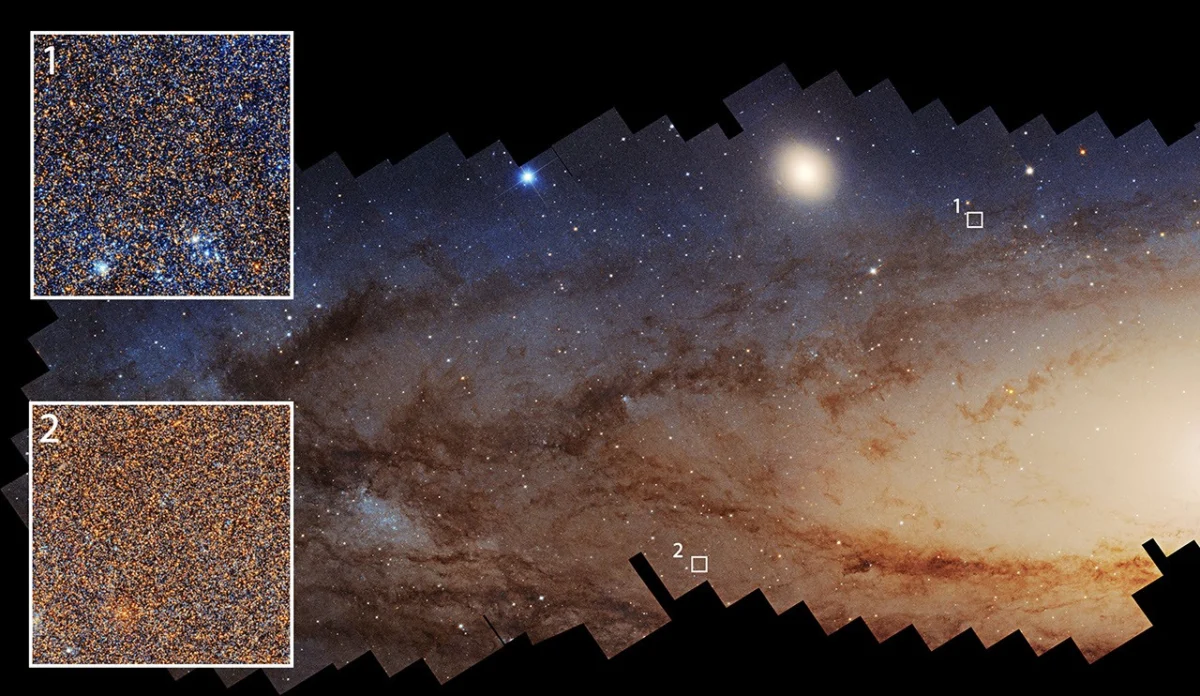
To reach their conclusions, the research team meticulously combined data from two monumental Hubble surveys: the Panchromatic Hubble Andromeda Treasury (PHAT) and the Panchromatic Hubble Andromeda Southern Treasury (PHAST). These ambitious programs, conducted over several years, systematically mapped an astounding two-thirds of Andromeda’s galactic disk in ultra-sharp detail across a broad range of wavelengths, from ultraviolet to near-infrared. The sheer scale and resolution of these surveys are unprecedented, allowing astronomers to scrutinize individual stars with a clarity that remains unmatched by any other observatory for this purpose.
The PHAT survey, for instance, involved over 800 orbits of the Hubble Space Telescope, collecting more than 11,000 images and producing a dataset that has been instrumental in mapping Andromeda’s stellar populations, dust, and gas. The subsequent PHAST survey extended this coverage to the southern regions of Andromeda’s disk, completing the comprehensive picture. Together, these surveys enabled the identification and measurement of an astonishing 200 million individual stars. This vast stellar census is the cornerstone of the study, providing the statistical power and granular detail necessary to reconstruct Andromeda’s star formation history with remarkable precision.
Ben Williams, an astronomer at the University of Washington and a co-author on the study, underscored Hubble’s critical role, stating, "We need to measure the individual stars because they are the fossil record of the galaxy’s formation. Hubble is the only telescope that can give you high enough spatial resolution over a large enough area to be able to do that in Andromeda." This statement encapsulates the unique advantage Hubble offers: its ability to resolve the distinct colors and luminosities of stars, which are direct indicators of their age and mass.
Stellar Archaeology: Decoding Andromeda’s Past Through Individual Stars
The methodology employed by the researchers is akin to stellar archaeology. By analyzing the characteristics of individual stars, particularly their color and luminosity, astronomers can infer their age. Massive stars, which are typically blue, burn through their nuclear fuel rapidly and have relatively short lifespans, often tens of millions of years. Conversely, less massive stars, which tend to be redder, live for billions of years. Consequently, regions of a galaxy that have experienced recent bursts of star formation will exhibit a higher proportion of young, blue stars, while areas where star formation has long ceased will be dominated by older, redder stellar populations.
To reconstruct Andromeda’s star formation history across its entire observed disk, the team divided the high-resolution Hubble images into thousands of discrete squares, each spanning approximately 300 light-years on a side. Within each of these "parcels" of the galaxy, they meticulously determined the distribution of stellar ages and colors. This allowed them to map out the history of star formation in granular detail, creating a comprehensive spatiotemporal view of the galaxy’s past activity. This technique is crucial for identifying localized events or trends that might be averaged out in broader, lower-resolution observations. The ability to perform such detailed stellar population synthesis across such a large galactic area is a testament to both Hubble’s capabilities and the sophisticated analytical techniques developed by the research team.
A Slowing Engine: The Chronology of Andromeda’s Star Formation Decline
The study’s findings corroborate and significantly expand upon previous research, which had already suggested a complex history for Andromeda. Earlier investigations indicated that the Andromeda galaxy experienced a dramatic and widespread burst of star formation roughly 2 billion years ago. This monumental event is widely believed to have been triggered by a significant interaction or merger with another galaxy, likely a smaller companion galaxy that has since been absorbed. Such mergers compress gas and dust clouds, igniting a furious period of star birth across the merging galaxies.
However, since that ancient burst of activity, the new Hubble data reveals a sustained and steady decline in Andromeda’s star formation rate. The researchers quantified this decline by measuring the rate at which gas and dust are converted into new stars, typically expressed in terms of solar masses per year. Their calculations paint a clear picture of a gradually slowing cosmic engine:
- 500 million years ago: Andromeda was forming stars at a respectable rate of approximately one solar mass per year. To put this in perspective, our own Milky Way galaxy currently forms stars at a rate of about 1 to 2 solar masses per year. So, 500 million years ago, Andromeda was still quite active, comparable to our galaxy today.
- 40 million years ago: This rate had significantly dropped to about half a solar mass per year. This represents a substantial decrease over a relatively short cosmic timescale, indicating a clear deceleration in stellar production.
- Current Rate: The decline has continued even more steeply, with the current star formation rate plummeting to approximately one-fifth the mass of our Sun per year, or roughly 0.2 solar masses per year. This represents a dramatic slowdown, signifying that Andromeda is now a far less prolific star-forming galaxy than it once was, and significantly less active than the Milky Way.
This chronological evidence suggests that while major mergers can induce powerful starbursts, the subsequent quiescent periods can be prolonged and lead to a substantial reduction in star formation, challenging some models that predict more sustained activity after such events.
Pinpointing the Decline: A Ring of Diminished Activity
Beyond the overall galactic trend, the research team also investigated whether the decline in star formation was uniformly distributed across Andromeda’s disk or concentrated in specific regions. Their analysis revealed that much of the recent star formation activity in Andromeda has been predominantly occurring within a distinct star-forming ring, located approximately 32,000 light-years from the galaxy’s central core. This "ring of fire," common in many spiral galaxies, is often associated with density waves that compress gas and dust, providing the necessary conditions for star birth.
Crucially, the study found that the observed decline in star formation is largely driven by a significant decrease in activity within this very ring. This suggests that the mechanisms suppressing star formation are particularly effective in these traditionally active regions, rather than being a diffuse, galaxy-wide phenomenon. This localized decline provides important clues about the specific physical processes at play, potentially pointing towards depletion of gas reservoirs in these regions or external influences disrupting the conditions for star formation.
The Marathon Breather: Explaining the Natural Slowdown
The researchers posit that the observed decline is not primarily due to a sudden reduction in the raw material (gas and dust) available for new stars. Instead, it is more likely a natural winding down process, a gradual return to a less active state after the energetic burst of star formation that occurred 2 billion years ago. Tobin Wainer, the lead author of the study from the University of Washington, eloquently captured this idea, stating, "It’s just like after running a marathon, sometimes you’ve got to take a bit of a breather."
This "marathon breather" analogy suggests that galaxies, after periods of intense star formation, may enter phases of relative quiescence as the available gas is consumed or dispersed. Mechanisms such as stellar feedback from supernovae and strong stellar winds from massive stars can heat and expel gas, making it less likely to collapse and form new stars. Additionally, if the inflow of fresh, cold gas from the intergalactic medium diminishes, a galaxy’s star formation rate will naturally decrease over time. The gradual nature of the 500-million-year decline supports this interpretation of a natural evolutionary trajectory for a massive spiral galaxy.
The M32 Enigma: A Satellite’s Potentially Disruptive Influence
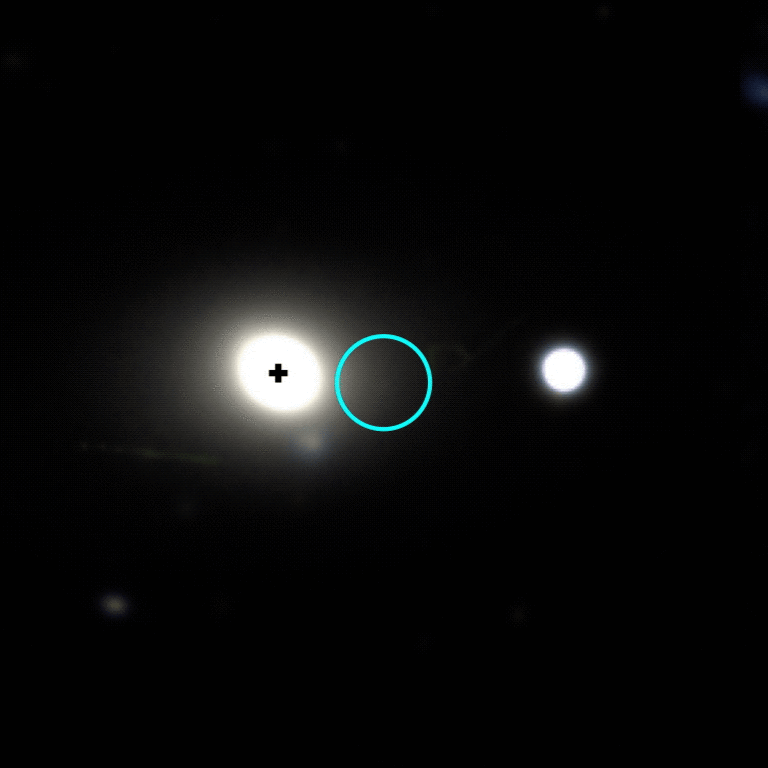
While the overall decline might be a "natural winding down," the recent, steeper drop in star formation, particularly in certain regions, prompted the team to investigate potential external triggers. Their attention turned to Andromeda’s compact satellite galaxy, M32 (Messier 32). M32 is a peculiar, compact elliptical galaxy, sometimes theorized to be the stripped-down core of a larger spiral galaxy that once interacted with Andromeda. It is currently separated from Andromeda by approximately 16,000 light-years in the plane of the sky.
However, M32’s precise three-dimensional location in space relative to Andromeda, and consequently, the timing and nature of any past interactions, remain uncertain. Zhuo Chen, a co-author from the University of Washington, highlighted this aspect: "One of the major motivations for this program was to probe potential interactions between M32 and Andromeda’s disk."
The comprehensive data from the Panchromatic Hubble Andromeda Southern Treasury (PHAST) survey allowed the team to specifically study the star formation history in the regions of Andromeda closest to M32. Their analysis revealed compelling evidence: this particular area showed signs of a more pronounced decrease in star formation compared to other regions of the galaxy. Crucially, the timing of this localized decrease, which the study estimates began roughly 60 million years ago, aligns strikingly with theoretical predictions for when M32 might have last interacted significantly with Andromeda’s disk.
Wainer acknowledged the strong circumstantial evidence, remarking, "We can’t explicitly say that we are seeing a decrease in star formation because of M32. But it’s right there, and it’s definitely the most likely suspect." A close encounter or passage of M32 through Andromeda’s disk could have had a profound impact, tidally stripping gas away, heating existing gas, or perturbing gas clouds, thereby inhibiting their collapse and subsequent star formation. This localized effect, occurring relatively recently, suggests that while the overall decline might be natural, a satellite galaxy interaction could provide the final "kick" that accelerates the slowdown in specific regions.
Broader Implications: Understanding Our Cosmic Neighborhood and Beyond
The insights gleaned from this study of Andromeda have far-reaching implications for our understanding of galaxy evolution. As our closest large spiral galaxy, Andromeda serves as an essential analogue for the Milky Way. Its detailed study allows astronomers to test theoretical models of how spiral galaxies form, evolve, and interact with their environments. The observed decline in star formation in Andromeda could mirror similar processes that have occurred or are currently occurring in the Milky Way, albeit from an external vantage point that is impossible for our own galaxy.
For instance, understanding the "natural winding down" process in Andromeda could shed light on the Milky Way’s own star formation history and future. While the Milky Way is still actively forming stars, the long-term trend for large spiral galaxies is often a gradual decrease in star formation as their gas reservoirs are consumed or expelled. This study provides empirical data to refine these evolutionary models, especially concerning the impact of satellite interactions on star formation rates. It also informs our understanding of how galaxy mergers, like the one Andromeda experienced 2 billion years ago, can initially fuel starbursts but then lead to prolonged periods of reduced activity.
The detailed chronology established by this research offers a valuable benchmark for cosmological simulations, allowing scientists to fine-tune parameters related to gas dynamics, stellar feedback, and galactic interactions. Furthermore, given the impending collision between Andromeda and the Milky Way, comprehending Andromeda’s current state of star formation is crucial. The properties of the merging galaxies will dictate the characteristics of the future Milkomeda galaxy, including its overall star formation rate during and after the merger.
The Future of Galactic Archaeology: Roman Space Telescope and Beyond
The research team plans to continue their analysis of the vast archive of Hubble data, combining it with observations from ground-based observatories. Ground-based telescopes offer complementary capabilities, such as spectroscopy, which can provide detailed information about the chemical composition and kinematics of stars and gas, further enriching the picture of Andromeda’s past.
Raja GuhaThakurta, a co-author from the University of California Santa Cruz, emphasized the enduring value of such datasets: "There’s a strong scientific value to this archival data. Andromeda is important because it’s a neighbor that is close enough that we can see it in great detail while also getting a global perspective." The ability to combine such high-resolution, multi-wavelength data from space with detailed spectroscopic data from Earth-based facilities will undoubtedly yield further groundbreaking discoveries.
Looking to the future, the next generation of space observatories promises to revolutionize our understanding of Andromeda and galactic evolution. NASA’s Nancy Grace Roman Space Telescope, slated for launch as early as Sunday, August 30, is particularly poised to make unprecedented contributions. Roman’s colossal field of view—at least 100 times larger than Hubble’s in a single observation at near-infrared wavelengths—will allow astronomers to image the entirety of Andromeda’s disk and its expansive surrounding halo with unprecedented efficiency. A newly approved Roman observing program is already slated to perform this comprehensive imaging, enabling the measurement of hundreds of millions of stars, far exceeding the current census, and unlocking groundbreaking new science. This will provide an even more global and detailed perspective on Andromeda’s star formation history, its interactions with satellite galaxies, and its dark matter halo, pushing the boundaries of galactic archaeology even further. The James Webb Space Telescope (JWST), with its deep infrared capabilities, also offers the potential to peer through Andromeda’s dust lanes, revealing even younger, obscured stellar populations and providing additional context for the observed decline.
Hubble’s Enduring Legacy
This latest study is another testament to the extraordinary legacy of the Hubble Space Telescope. Operating for more than three decades, Hubble has consistently delivered groundbreaking discoveries that have fundamentally reshaped our understanding of the universe, from measuring its expansion rate to revealing the birth and death of stars and galaxies. A project of international cooperation between NASA and the European Space Agency (ESA), Hubble’s mission operations are managed by NASA’s Goddard Space Flight Center in Greenbelt, Maryland, with Lockheed Martin Space providing crucial support. The Space Telescope Science Institute (STScI) in Baltimore, operated by the Association of Universities for Research in Astronomy, conducts Hubble’s vital science operations for NASA. The continued productivity of Hubble, exemplified by this detailed study of Andromeda, underscores its enduring scientific value and its role as a cornerstone of modern astrophysics.