


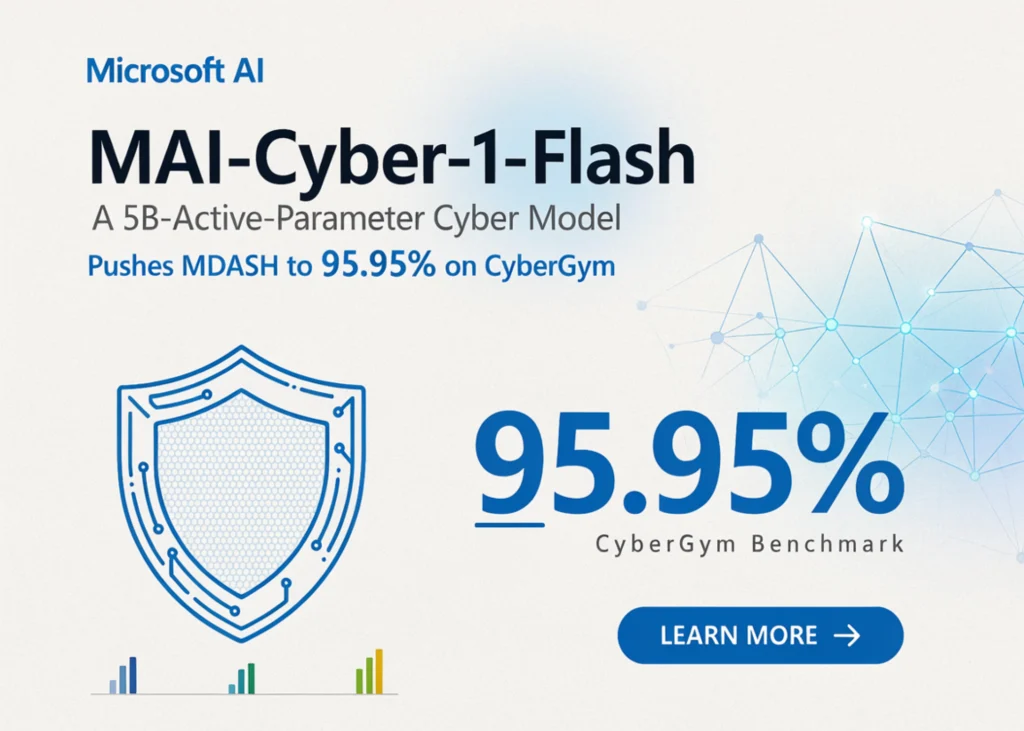
Microsoft AI has officially announced the release of MAI-Cyber-1-Flash, the company’s first large language model engineered specifically for the rigors of modern cyber defense operations. Unlike traditional generative models designed for broad consumer use, MAI-Cyber-1-Flash is not offered as a standalone API or endpoint. Instead, it serves as the primary engine within Microsoft’s Multi-Model Agentic Scanning Harness (MDASH), a sophisticated ecosystem designed to automate the detection, validation, and remediation of software vulnerabilities at a scale previously unattainable by human security researchers.
The introduction of MAI-Cyber-1-Flash marks a significant pivot in Microsoft’s artificial intelligence strategy, moving from general-purpose assistants toward highly specialized, task-oriented agents. The model is a transformer-based architecture utilizing a sparse Mixture-of-Experts (MoE) design, a configuration that allows for high-capacity reasoning with significantly reduced computational overhead. With a total of 137 billion parameters, only 5 billion of which are active during any single inference cycle, the model balances the deep "knowledge" of a massive neural network with the speed required for real-time code analysis. Furthermore, the model features a 256k-token context length, enabling it to ingest and analyze massive codebases or complex network logs in a single pass.
Technical Lineage and Architectural Foundation
MAI-Cyber-1-Flash is not an entirely new creation but rather a specialized evolution of existing Microsoft technologies. It is a fine-tuned variant of MAI-Code-1-Flash, a lightweight model already integrated into development environments like GitHub Copilot and Visual Studio Code. By building on a foundation of code-centric logic, Microsoft’s Autonomous Code Security (ACS) team has ensured that the model possesses an inherent understanding of programming syntax, logic flow, and common architectural weaknesses.
The model also draws from the MAI-Thinking-1 lineage, incorporating "chain-of-thought" reasoning capabilities that allow the agent to work through complex security problems step-by-step. This lineage is critical for defensive applications where a model must not only identify a potential bug but also reason through whether that bug is reachable, exploitable, and how it can be patched without introducing regressions.
The MDASH Framework: Orchestrating Autonomous Defense
While the MAI-Cyber-1-Flash model provides the "brainpower," the MDASH harness provides the operational structure. MDASH operates by managing over 100 specialized agents across a five-stage pipeline: Prepare, Scan, Validate, Dedupe, and Prove.
- Prepare: In this initial stage, agents ingest the target source code, mapping out dependencies and identifying high-risk areas such as authentication modules or network parsers.
- Scan: MAI-Cyber-1-Flash conducts the initial pass, flagging potential vulnerabilities. Because it is optimized for speed, it can scan millions of lines of code in a fraction of the time required by traditional static analysis tools.
- Validate: This stage utilizes a "debate" mechanism. Auditor agents review the findings, while debater agents argue the exploitability of the bug. This internal disagreement serves as a signal to the system, highlighting areas that require deeper investigation.
- Dedupe: The system identifies and merges duplicate findings, ensuring that security teams—or subsequent automated stages—are not overwhelmed by redundant data.
- Prove: Perhaps the most advanced stage, the "Prove" module executes triggering inputs against the target code. For C and C++ targets, it utilizes AddressSanitizer (ASan) to provide concrete proof of memory corruption or other flaws, effectively eliminating false positives.
Benchmarking Success and Performance Metrics
The efficacy of MAI-Cyber-1-Flash and the MDASH system has been validated through rigorous testing against industry-standard benchmarks. The primary metric for the launch was the CyberGym suite, which consists of 1,507 real-world vulnerability reproduction tasks derived from 188 OSS-Fuzz projects.
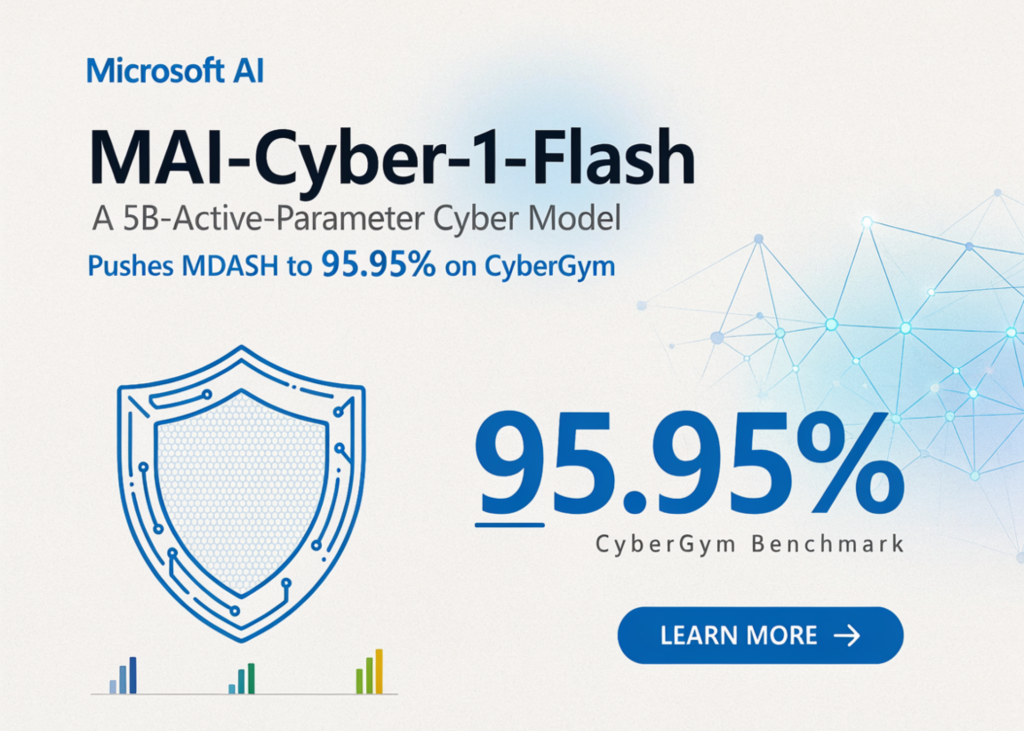
In Microsoft’s latest evaluation, MDASH—powered by MAI-Cyber-1-Flash working in tandem with GPT-5.4—achieved a record-breaking score of 95.95% on CyberGym’s Level 1 configuration. This represents a substantial leap over the 88.45% score Microsoft recorded in May 2026 when using generally available models. The research team noted that simply replacing 80% of the existing models in the harness with MAI-Cyber-1-Flash was responsible for this 7.5% increase in accuracy.
Comparatively, MDASH now sits approximately 12 points ahead of Anthropic’s "Mythos" system. Other competing autonomous security systems currently range between 83.2% and 85.6%, placing Microsoft’s solution at the top of the public leaderboard for autonomous vulnerability reproduction.
Beyond CyberGym, the model was tested on several other specialized benchmarks:
- CVEBench: 0.314
- CyberSecEval4 (Threat Intel): 0.553
- CyberSecEval4 (Malware Analysis): 0.33
- CRSBench: 0.651 (with a Point of Vulnerability score of 1200)
Notably, the model scored a perfect zero on ExploitGym across Kernel, Userspace, and Browser categories. Microsoft clarified that these zeros are intentional. The model has been strictly trained to avoid offensive tasks, such as generating malware or creating weaponized exploits. This "defensive-only" alignment is a core safety feature, ensuring the tool remains a utility for protectors rather than a weapon for attackers.
Real-World Impact and Case Studies
The practical application of MDASH has already yielded significant results within Microsoft’s own software ecosystem. The Autonomous Code Security team, which includes members from the DARPA AI Cyber Challenge-winning "Team Atlanta," deployed MDASH to analyze the Windows networking and authentication stacks.
In May 2026 alone, MDASH-assisted research led to the discovery and reporting of 16 Common Vulnerabilities and Exposures (CVEs), four of which were classified as "Critical" remote code execution (RCE) flaws. These are the types of vulnerabilities that, if left unpatched, could be used by state-sponsored actors to gain unauthorized access to millions of systems.
Retrospective analysis further highlights the system’s precision. When MDASH was tasked with finding historical bugs that had already been patched by human researchers over the last five years, it recovered 96% of 28 cases in the Windows Common Log File System (clfs.sys) and 100% of 7 cases in the TCP/IP driver (tcpip.sys). This demonstrates that the AI is now capable of matching, and in some cases exceeding, the investigative depth of elite human security researchers.
The Economic Logic: Routing as the Real Product
One of the most significant hurdles in deploying frontier AI models for security is the cost. Running a model as powerful as GPT-5.4 across an entire enterprise codebase is prohibitively expensive. Microsoft’s solution is a "routing" strategy that treats MAI-Cyber-1-Flash as the primary workhorse.
The MDASH system routes up to 90% of all scanning and validation tasks to MAI-Cyber-1-Flash. Only the most complex 10% of cases—those where the specialized model reaches a high degree of uncertainty—are escalated to GPT-5.4. This tiered approach has resulted in a 50% cost saving compared to Microsoft’s previous configuration, which relied on a mix of GPT-5.4, 5.4 mini, and 5.3 codex.
For enterprise customers, this routing logic is arguably as valuable as the model itself. it provides a blueprint for how AI can be deployed sustainably at scale without sacrificing the "peak" performance of frontier models when they are truly needed.
Broader Implications for the Cybersecurity Industry
The launch of MAI-Cyber-1-Flash signals a new era of "Defense at AI Speed." As software grows in complexity, the "attack surface" expands faster than human teams can defend it. Autonomous systems like MDASH represent the only viable path forward for securing the global digital infrastructure.
Industry analysts suggest that this release will likely trigger a response from other major AI labs, such as Google DeepMind and OpenAI, who may accelerate the development of their own security-centric models. There is also a growing conversation regarding the ethics of such models. While Microsoft has successfully "crippled" the offensive capabilities of MAI-Cyber-1-Flash, the underlying research into how an AI identifies a bug is fundamentally similar to how an attacker would find a target.
Microsoft’s commitment to a defender-only product is a strategic move to build trust with enterprise clients and government regulators. By focusing on patching, bug discovery, and internal validation, Microsoft is positioning itself as the "secure by design" leader in the AI age.
As the Autonomous Code Security team continues to refine the MDASH harness, the focus is expected to shift toward automated patching—where the AI not only finds the bug but also writes and tests the fix. For now, MAI-Cyber-1-Flash stands as a powerful testament to the efficacy of specialized AI in the ongoing battle to secure the world’s most critical software.