
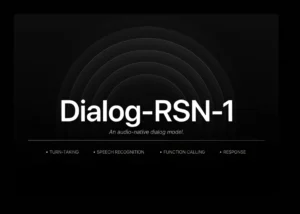

PolyAI has introduced Dialog-RSN-1, a pioneering dialog model designed to perceive a caller’s audio input directly, bypassing the traditional requirement for intermediate text transcripts. By fusing turn-taking, speech recognition, function calling, and response generation into a single audio-native architecture, the company has established a new benchmark for low-latency, high-accuracy enterprise voice interactions. This model is not merely a laboratory prototype; it is currently operational, handling live production calls for early-adopter enterprise clients. The release marks a significant departure from the "cascaded" architectures that have dominated the telecommunications and AI industries for decades, offering a more nuanced and responsive user experience.
The launch of Dialog-RSN-1 addresses a fundamental bottleneck in voice technology: the loss of information that occurs when human speech is converted into raw text. In traditional systems, when a caller hesitates, changes their tone, or speaks with a specific inflection, that data is discarded by the Automatic Speech Recognition (ASR) layer before it ever reaches the Large Language Model (LLM). PolyAI’s new model retains these acoustic cues, allowing the AI to understand the context of a conversation beyond the literal meaning of the words spoken. This advancement is particularly critical in customer service environments where understanding a caller’s frustration, urgency, or uncertainty can significantly alter the quality of the resolution.
The Shift from Cascaded to Audio-Native Architectures
To appreciate the impact of Dialog-RSN-1, it is necessary to examine the two primary architectures that have historically governed voice AI. The first is the cascaded stack, which functions as a linear pipeline. In this setup, an ASR system converts audio to text, an LLM processes the text to generate a response, and a Text-to-Speech (TTS) system converts that response back into audio. While this approach is modular and easy to debug, it is inherently "lossy." The LLM only receives the ASR’s best guess at the words, losing all non-verbal data like pitch, pace, and hesitation. Furthermore, tuning these systems often requires manual adjustment of end-pointing parameters and ASR biasing, which are difficult to scale across diverse use cases.
The second architecture involves speech-to-speech models, such as OpenAI’s GPT-4o Realtime or Google’s Gemini Live. While these models maintain audio fidelity by baking the voice directly into the model, they present their own set of challenges. These "always-on" full-duplex variants often require constant GPU utilization for the duration of a call, leading to high operational costs. Additionally, because the voice is part of the model itself, developers have limited control over specific pronunciations—a vital requirement for brands that need to ensure their names or technical terms are spoken correctly.
Dialog-RSN-1 introduces a hybrid "audio-aware" approach. It is audio-native on the input side, meaning the model reasons over raw audio data. However, it hands the generation of the response to a separate, promptable TTS system. This allows for the nuanced understanding of a multimodal model while retaining the precise control over output voice characteristics that enterprises demand. Unlike always-on models, Dialog-RSN-1 is probed on demand. A high-recall Voice Activity Detection (VAD) system combined with specialized timers determines when the model should run, ensuring that GPU resources are used efficiently without sacrificing the speed of the interaction.
Technical Foundations and Development Process
The development of Dialog-RSN-1 involved a rigorous post-training process of open-weight multimodal models. PolyAI utilized both supervised fine-tuning (SFT) and reinforcement fine-tuning (RFT) on extensive in-house datasets specifically curated from real-world conversational data. The training pipeline was designed to be base-model agnostic, allowing the research team to evaluate various architectures including Gemma, GPT-OSS, Qwen, and Mistral.
A primary engineering objective was to achieve sub-300ms latency on NVIDIA A100 GPUs. To reach this goal, the team targeted models in the 8B dense to 30B sparse parameter range. Achieving real-time responsiveness required several layers of optimization. First, the team implemented a system to prefill the attention cache while the user is still speaking. By processing the audio in chunks, the model is prepared to generate a response the moment the user finishes their sentence.
Second, PolyAI developed an append-only prompt template to minimize cache invalidation. In standard LLM setups, changing a prompt can require the system to re-process large amounts of data; the append-only approach ensures that the "memory" of the conversation remains stable. Third, the system routes each caller to the same GPU throughout the duration of the call, maximizing the utility of the local cache.
Finally, the model utilizes a fine-tuned speculative drafter. This smaller, faster model predicts the most likely next tokens, which the larger model then verifies. PolyAI reports a mean acceptance rate of 3.9 tokens per step, significantly accelerating the generation process. Interestingly, transcription—the process of turning the audio into text for record-keeping—is the last step in the pipeline. It runs in parallel with speech generation, ensuring that the user never waits for a transcript to be created before hearing a response.
Benchmarking and Performance Metrics
To quantify the capabilities of Dialog-RSN-1, PolyAI utilized Dialog-Eval, an internal benchmark that the company plans to release as an open-source tool for the wider AI community. Unlike traditional benchmarks that evaluate a full conversation, Dialog-Eval truncates calls at specific decision points. It scores the model on a single, atomic next step, such as whether it correctly identified a tool to call or whether it accurately detected that the user had finished speaking.
According to PolyAI’s reports, Dialog-RSN-1 emerged as the highest-scoring real-time capable model currently available. In comparative testing, traditional cascaded systems reached an "Audio-score" ceiling of approximately 77. In contrast, Dialog-RSN-1 demonstrated superior performance in audio-aware scenarios where tone and hesitation were key factors. When compared to OpenAI’s GPT-4o-transcribe, Dialog-RSN-1 showed marked improvements in Word Error Rate (WER). Specifically, GPT-4o’s WER improved from 7.8% to 6.9% when provided with full conversational context, but Dialog-RSN-1 achieved even lower error rates, proving its efficacy in accurately capturing speech in complex, noisy, or high-stakes environments.
Deployment and Enterprise Accessibility
Currently, Dialog-RSN-1 is available exclusively through the PolyAI platform. There are no immediate plans to release open weights or a public API, as the company is focusing on delivering the technology to its enterprise client base. Existing PolyAI customers can enable the model immediately to enhance their current voice assistants. New organizations interested in the technology can request early access through the company’s official channels.
For the initial release, PolyAI has focused heavily on the English language. For clients requiring non-English support or rich web chat capabilities, the company continues to recommend its Raven 3.5 model. However, the success of the Dialog-RSN-1 architecture suggests that expansion into other languages and modalities is a logical next step in the company’s roadmap. A full technical report and a formal paper detailing the Dialog-Eval benchmark are expected to be published in the coming months.
Implications for the Future of Enterprise Communication
The introduction of Dialog-RSN-1 has significant implications for the Business Process Outsourcing (BPO) and customer service sectors. For years, the "uncanny valley" of voice AI—where bots sound almost human but fail to grasp the rhythm of natural conversation—has been a barrier to full-scale automation. By solving the turn-taking problem and reducing latency to sub-human levels (typically, human response time in conversation is around 200ms), PolyAI is bridging this gap.
From an operational perspective, the efficiency of Dialog-RSN-1 allows enterprises to handle higher call volumes without a linear increase in GPU costs. Because the model uses a "probed on demand" mechanism rather than constant streaming, it maximizes the throughput of existing hardware. This makes sophisticated AI voice agents economically viable for a broader range of applications beyond high-value sales or complex technical support.
Furthermore, the ability of the model to perform "auto-reasoning" learned during reinforcement fine-tuning means that the AI can handle ambiguous situations more gracefully. If a caller mumbles or interrupts themselves, the model’s audio-native perception allows it to decide—based on acoustic cues—whether to wait for more input or to provide a clarifying response. This level of "conversational intelligence" was previously unattainable in text-based cascaded systems.
As PolyAI prepares to release its technical documentation, the industry will be watching closely to see how Dialog-RSN-1 influences the broader development of multimodal AI. The move toward models that "hear" rather than just "read" represents a fundamental shift in how machines interact with the world, moving closer to a seamless, human-centric interface for the digital age. For now, Dialog-RSN-1 stands as a potent example of how specialized, fine-tuned models can outperform general-purpose AI in the demanding arena of real-time enterprise communications.