

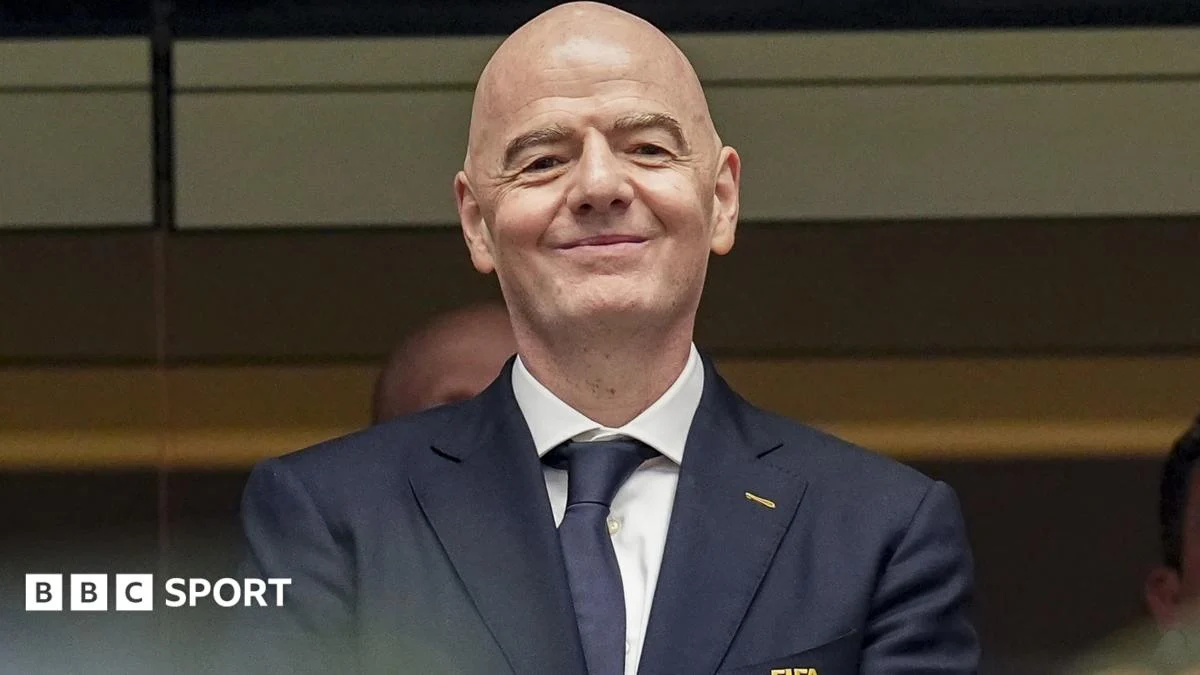
The future of global football governance hangs in the balance as a bold proposal by FIFA President Gianni Infantino to sell stakes in its premier competitions to private investors faces widespread opposition, prompting calls for his resignation and raising critical questions about the sport’s direction. The plan, which aims to inject significant capital into FIFA by allowing external entities to acquire minority, non-controlling investments in a newly formed commercial subsidiary, has ignited a firestorm of controversy, culminating in the resignation of a senior presidential advisor and a united front of opposition from major continental confederations.
Andy Burnham, the Prime Minister of the United Kingdom, has become one of the most prominent political figures to voice his disapproval, directly stating that Gianni Infantino is "the wrong man" to lead FIFA. Burnham’s scathing assessment came hours after the Asian Football Confederation (AFC) declared its solidarity with Uefa (Europe) and Concacaf (North, Central America, and the Caribbean), all of which have publicly denounced Infantino’s ambitious strategy.
"This was an outrageous suggestion," Burnham told reporters on Friday, amplifying the growing discontent. "The idea that it could even be brought forward shows that, in my view, [he] is the wrong man to lead the organisation." His strong words reflect a deepening concern among stakeholders that the commercialization of football’s most cherished events could undermine the sport’s integrity and universal appeal.
A Unified Front Against Commercialization
The AFC’s statement marked a significant escalation of opposition. It declared that Infantino’s plan could not "realistically achieve the necessary broad consensus and unity required to move forward." The confederation emphasized the World Cup’s status as the "pinnacle of global football," deriving its strength from the "participation of all Confederations and the world’s leading football nations." The AFC unequivocally stated, "Any proposal that risks undermining the unity and universal character of the competition must be reconsidered."
This unified stance from three of FIFA’s six confederations, representing a substantial bloc of voting power, significantly jeopardizes the passage of Infantino’s proposal. The plan requires a simple majority of FIFA’s 211 member associations to be approved, meaning 106 votes in favor. With Uefa (55 votes), Concacaf (35 votes), and the AFC (46 votes) aligning against the proposal, a potential 136 nations could be poised to reject it, should their member associations follow their governing bodies’ lead.
Resignation Amidst Growing Dissent
Adding further weight to the opposition, Carlos Cordeiro, Infantino’s senior advisor on global strategy and governance, resigned from his post, labelling the proposal "a bad deal for football" and warning that it would "mortgage football’s future." Cordeiro, a former investment banker with Goldman Sachs and a significant figure in FIFA for nearly five years, articulated his strong disapproval in a lengthy statement. He stated he "unequivocally" opposed the plans and did not accept the premise that FIFA needed outside investors to "unlock greater value."
"The proposal has become a defining question for FIFA’s future," Cordeiro wrote. "Fifa’s responsibility is not to maximise commercial returns at any cost. It is to protect and strengthen football for future generations. When those principles come into conflict, football must come first." He expressed deep concern over the lack of transparency and unanswered questions surrounding the proposal, including "Why this deal? Why now? What oversight exists? Who benefits?" Cordeiro lamented that member associations were being asked to make a decision of "enormous consequence in barely 50 days or risk being left behind," deeming it "not a responsible way to determine the future of the world’s game." His resignation marks the first high-profile departure directly linked to the investor plan.
The Genesis of the Proposal and its Mechanics
FIFA’s ambition, as outlined in a 25-page document prepared by investment bank JP Morgan, is to establish a commercial subsidiary, tentatively named FIFA Forward Enterprise (FFE). This entity would be responsible for the commercial operations of FIFA’s main events, including the World Cups, with the intention of attracting external investors to purchase minority, non-controlling stakes. The proposal projects a significant increase in revenue, with an estimated enhanced payout of 24 million euros per member association during the 2035-2039 cycle. The document identifies "new business initiatives" and "attracting top talent with incentive-driven compensation" as key components. Notably, the World Cup is described as the "most widely viewed" sporting event, while FIFA itself is characterized as "under-monetised." The document reportedly makes no mention of the women’s game, a point of concern for many observers.
Should the proposal gain approval, the American venture capital firm Thrive Eternal, founded by Joshua Kushner (brother of former President Donald Trump’s son-in-law Jared Kushner), is expected to lead the proposed investor group for FFE.
A Timeline of Opposition and FIFA’s Response
The timeline of events leading to the current crisis highlights a rapid escalation of dissent:
- Early June 2024 (approximate): Initial reports emerge regarding FIFA’s plans to sell stakes in its major competitions to private investors.
- June 2024 (specific dates vary): Uefa and Concacaf publicly announce their opposition to the proposal. Uefa even votes to boycott World Cups if the plan proceeds, stating, "The World Cup cannot be treated as an investment product. It is one of football’s greatest sporting legacies… No part of it should ever be surrendered to private investors. The World Cup is not for sale." Concacaf echoes these sentiments, expressing concerns about the consultation process.
- June 21, 2024 (Friday): The Asian Football Confederation (AFC) releases its statement of solidarity with Uefa and Concacaf, formally rejecting Infantino’s plan and deeming it unlikely to gain the necessary consensus.
- June 21, 2024 (following AFC statement): Carlos Cordeiro resigns as senior advisor to FIFA President Gianni Infantino, citing fundamental objections to the proposal.
- June 21, 2024 (early Friday): FIFA issues a statement vowing to continue with its plan, asserting that "nobody is selling football" and attributing the disruption of the consultation process to "incorrect media reports." The governing body insists the plan "will not come at the cost of either the spirit or the governance of FIFA or football itself."
FIFA’s assertion that consultation has been disrupted by incorrect media reports contrasts sharply with the detailed concerns raised by the confederations and Cordeiro, who specifically cited a lack of answers to fundamental questions. Uefa has directly accused FIFA of using football "to enrich themselves and their friends," a sentiment echoed by the broader concerns regarding consultation processes voiced by Concacaf and the AFC.
Governance Concerns and Calls for Reform
Beyond the financial implications, the AFC’s statement sharply criticizes FIFA’s approach to consultation and decision-making. The confederation accused FIFA of once again setting the "direction of travel" for a "significant initiative" without adequate stakeholder engagement. The failure to consult member associations, the AFC argues, has "exposed fundamental weaknesses in FIFA’s consultation and decision-making processes that must now be addressed." The AFC further criticized FIFA for leaving "confederations, member associations and even FIFA’s own governing bodies, including the FIFA Council, feeling sidelined."
The AFC’s call for an "urgent review of its governance and decision-making framework" underscores a broader demand for greater transparency and inclusivity in FIFA’s operations. The confederation insists that "The Fifa World Cup, and the game itself, belong to the entire global football family. Their future must always be shaped collectively, through institutions that reflect the voices of all Confederations and member associations."
The Divide: Developed vs. Developing Football Nations
While Uefa, representing some of the wealthiest football nations, has taken a strong stance against the proposal, the perspectives from other confederations reveal a more nuanced landscape. The South American confederation, Conmebol, has yet to issue a public statement. The African (CAF) and Oceania (OFC) confederations have indicated they will discuss FIFA’s plan in August.
Rogers Byamukama, representing the Ugandan Football Federation, offered a contrasting viewpoint, arguing that any avenue that could lead to increased resources for nations like his should be explored. "Football is a very expensive venture, especially on the African continent where the resources are not easy to come by," he told BBC World Service. He highlighted the crucial role FIFA funding plays in supporting infrastructure projects and grassroots programs in Uganda and across Africa. "From my perspective, any avenue that brings in more resources is good because those resources would be distributed and given to federations, especially on the African continent and that would inspire growth."
Byamukama acknowledged Uefa’s right to express its concerns but suggested that many associations worldwide remain reliant on FIFA funding, where Infantino continues to enjoy considerable popularity. FIFA’s development programs, such as FIFA Forward, have allocated substantial funds for member associations. For instance, between 2019 and 2022, $2.8 billion was made available across the 211 member associations. The subsequent cycle, FIFA Forward 3.0 (2023-2026), saw a 30% increase in funding, with an additional $5 million provided to each member association and $60 million to each confederation for their projects.
Furthermore, FIFA’s plans extend to the expansion of the men’s World Cup, with proposals for a 64-team tournament for the 2030 edition under consideration. FIFA is seeking an independent agency to assess this expansion, with key decision dates in August and September, suggesting a rapid progression of FIFA’s strategic initiatives.
Implications for the Future of Football
The current standoff presents a critical juncture for FIFA and the global football landscape. Infantino’s vision of increased commercialization, aimed at generating substantial revenue for development and growth, is met with deep-seated concerns about the potential erosion of the sport’s intrinsic values and universal character. The unified opposition from key confederations, coupled with the resignation of a senior advisor, signals a significant challenge to Infantino’s authority and his ambitious reform agenda.
The core of the dispute lies in the fundamental question of how football’s most prized assets should be managed and exploited. While some see an opportunity for much-needed financial injection, particularly for developing nations, others fear a commodification that could disenfranchise fans and compromise the sport’s integrity for private gain. The coming weeks will likely see intense diplomatic maneuvering and debate as FIFA navigates this unprecedented crisis, with the ultimate outcome poised to redefine the governance and commercial future of the world’s most popular sport. The integrity of the World Cup, and indeed the very soul of football, hangs in the balance.