

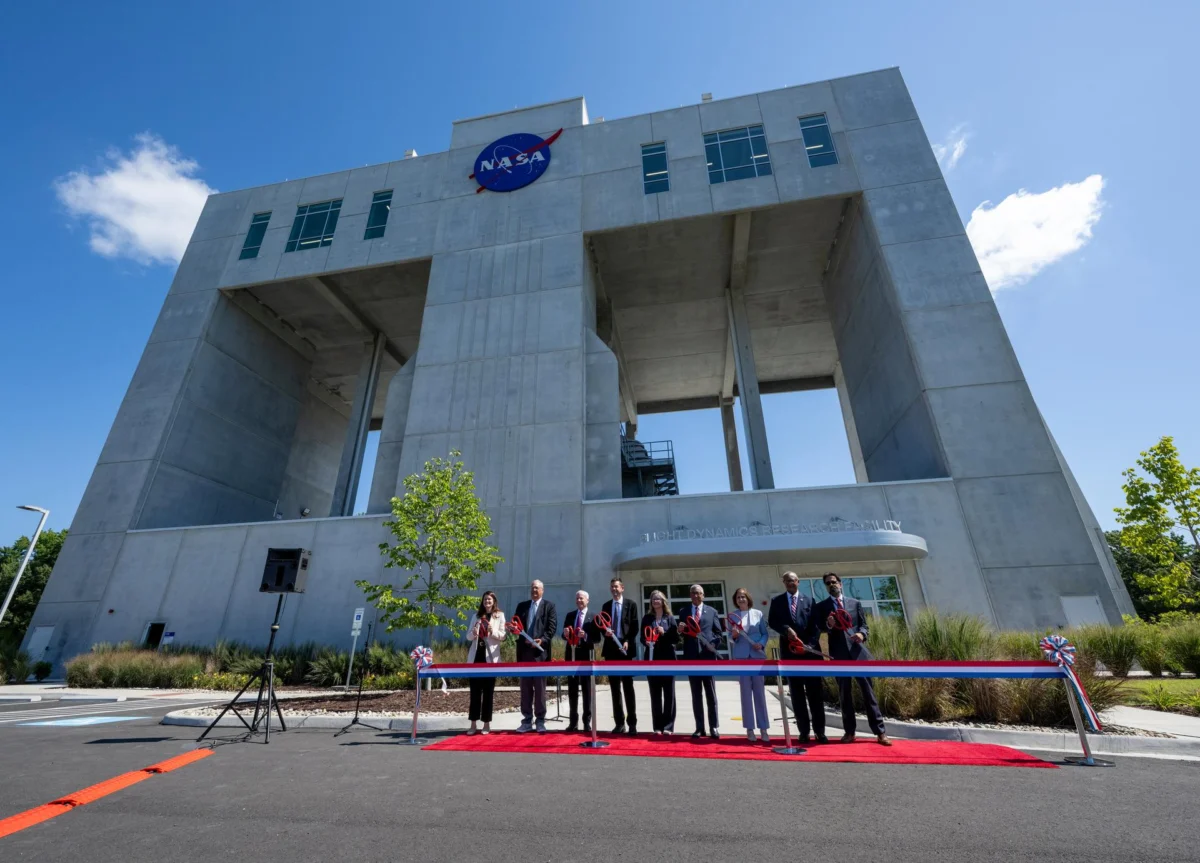
Hampton, Virginia – NASA officially opened its newest and most advanced wind tunnel, the Flight Dynamics Research Facility (FDRF), on Friday, establishing a pivotal new resource for the agency and its extensive network of partners. This state-of-the-art facility is poised to revolutionize the testing and validation processes for future generations of aircraft, rockets, and ambitious space exploration vehicles, solidifying America’s leadership in aeronautics and astronautics for decades to come.
Located at the historic NASA Langley Research Center in Hampton, Virginia, the FDRF represents a significant leap forward in aerospace engineering capabilities. The facility is specifically designed to support groundbreaking advancements across a spectrum of critical areas, including enhanced aircraft safety, the development of experimental X-planes, sophisticated drone research, and cutting-edge spacecraft technology. Its unique design allows for both free-flight and mounted testing of a diverse array of scale-model vehicles engineered to traverse an atmosphere, encompassing everything from conventional airplanes to advanced space capsules undergoing Earth re-entry simulations.
A Monumental Leap After Four Decades
The inauguration of the Flight Dynamics Research Facility holds particular significance as it marks NASA’s first major new wind tunnel in over 40 years. This substantial investment underscores the agency’s commitment to maintaining its pioneering edge in an increasingly dynamic aerospace landscape. NASA Administrator Jared Isaacman articulated the profound impact of this new asset, stating, “The Flight Dynamics Research Facility is NASA’s first major new wind tunnel in more than 40 years and gives us a powerful new platform to test the ideas and technologies that will shape the future of aviation and exploration. America has led in air and space because we were willing to take on hard problems, challenge assumptions, and build what didn’t exist before. This facility gives the talented team at Langley, and our partners across government, industry, and universities, the tools to keep pushing the boundaries of what’s possible and ensure America remains the world leader in air and space.” This statement encapsulates the forward-looking vision behind the FDRF, emphasizing innovation, problem-solving, and collaborative efforts.
The ribbon-cutting ceremony at NASA Langley was more than a mere formality; it symbolized the commencement of an entirely new chapter in flight research. Agency leaders, representatives from collaborating partners, and distinguished Virginia officials converged to underscore how the FDRF’s advanced capabilities are set to profoundly influence the trajectory of future flight and exploration endeavors. Dr. Trina Dyal, Center Director for NASA Langley, further elaborated on this transformative potential: “The opening of the Flight Dynamics Research Facility represents a significant advancement for NASA and for the nation. By bringing modernized testing capabilities under one roof, we are enabling transformative research that will ensure the United States remains at the forefront of aeronautics and exploration.”
Strategic Partnership and Campus Revitalization
The realization of the Flight Dynamics Research Facility is a testament to a robust and ongoing partnership with the U.S. General Services Administration (GSA). This collaboration has been instrumental in replacing outdated infrastructure with a new, energy-efficient facility. The design not only promises reduced maintenance costs but also provides the critical flexibility essential for evolving research requirements. The FDRF is a key component of a broader, long-term collaboration between NASA and GSA, representing the fourth new building delivered by GSA under Langley’s ambitious 20-year campus revitalization plan. This strategic initiative aims to modernize the entire research campus, ensuring it remains at the vanguard of aerospace innovation.
Edward C. Forst, Administrator of the GSA, expressed immense pride in this joint achievement: “GSA is proud to partner with NASA in delivering the Flight Dynamics Research Facility, a state-of-the-art asset that will power the next generation of American dominance in aeronautics and space exploration. This facility reflects what we do best: provide the advanced, expertly designed installations that federal agencies need to carry out their missions. With these new capabilities, NASA will be better equipped to test bold ideas, validate new designs, and advance technologies that will serve the nation for decades to come.” His comments highlight the GSA’s role in providing the essential physical infrastructure that underpins critical national missions.
Building on a Rich Legacy: Technical Advancements and Capabilities
The FDRF ingeniously combines and significantly enhances the capabilities previously offered by two venerable NASA Langley wind tunnels: the 20-Foot Vertical Spin Tunnel and the 12-Foot Low-Speed Tunnel. Spanning an impressive 25,000 square feet, the new facility features a vertical wind tunnel engineered with superior airflow characteristics, integrated with modern digital control systems, and boasting highly flexible testing configurations. These advancements will enable researchers to conduct meticulous studies on the aerodynamic behavior of aircraft, spacecraft, parachutes, and various other vehicles throughout their flight profiles.
A standout feature of the FDRF is its expansive 20-foot diameter test chamber, which is substantially larger than those of its NASA Langley predecessors. This increased volume allows for a greater quantity of air to flow unimpeded around test models, drastically improving the accuracy and reliability of collected data. Furthermore, the enlarged chamber accommodates the use of larger, more intricately detailed models during testing, providing researchers with unprecedented fidelity in their simulations. This is particularly crucial for understanding complex aerodynamic phenomena and validating advanced designs.
The facility also boasts a remarkable top airspeed of 117 miles per hour, doubling the capacity of the older facilities. This enhanced speed is critical for conducting free-flight tests with heavier scale models, enabling simulations of full-scale vehicles operating at higher altitudes. Such a capability is indispensable for crucial operations like analyzing the stability of next-generation aircraft or accurately predicting the re-entry characteristics of space capsules returning from orbit. The ability to simulate these conditions with greater precision directly contributes to mission success and crew safety.
The formidable wind power within the FDRF is generated by four 750-horsepower motors, each seamlessly integrated with a 14-foot diameter, eight-bladed fan. These fan blades are meticulously crafted from lightweight carbon fiber, a material choice that allows for rapid and remarkably precise adjustments to airspeed during free-flight tests. This level of control is paramount for capturing transient aerodynamic effects and ensuring that test conditions perfectly match the specific parameters required for each research objective. The integration of advanced materials and digital control systems represents a paradigm shift from previous generations of wind tunnel technology, offering unparalleled experimental versatility and data quality.
Historical Context: Langley’s Enduring Legacy in Flight Research
NASA Langley Research Center, established in 1917 as the nation’s first civilian aeronautical laboratory, holds an unparalleled place in the history of aerospace. For over a century, Langley has been at the forefront of aviation and space exploration, pioneering critical research that shaped everything from the design of early aircraft to the Apollo missions and the Space Shuttle program. Its wind tunnels, including the legendary 8-Foot Transonic Pressure Tunnel and the Unitary Plan Wind Tunnel, have been instrumental in breakthroughs like understanding supersonic flight, developing swept-wing designs, and validating the aerodynamic profiles of every major U.S. aircraft and spacecraft.
The 20-Foot Vertical Spin Tunnel, one of the FDRF’s predecessors, was particularly vital for studying aircraft spin characteristics, significantly enhancing flight safety. The 12-Foot Low-Speed Tunnel provided crucial data for aircraft performance at takeoff and landing. The construction of the FDRF, therefore, is not merely the addition of a new facility but a continuation and modernization of this profound legacy. It acknowledges the fundamental importance of empirical testing in physical facilities, even in an age dominated by computational fluid dynamics (CFD). While CFD offers powerful simulation capabilities, physical wind tunnels remain indispensable for validating models, exploring complex flow phenomena that defy simulation, and providing real-world data crucial for certification and design refinement. The four-decade gap between major new wind tunnels highlights the significant advancements in materials science, digital instrumentation, and control systems that make the FDRF a truly next-generation asset, far surpassing the capabilities of its predecessors.
Broadening the Horizon: Applications and Implications
The Flight Dynamics Research Facility powerfully illustrates the intrinsic synergy between NASA’s aeronautics and space exploration endeavors, with each domain continuously driving innovation in the other. The facility is poised to propel experimental research across an expansive range of flight systems, significantly advancing the development of autonomous flight vehicles, sophisticated drones, next-generation commercial and military aircraft, and groundbreaking X-planes like the X-59 QueSST, designed to achieve quiet supersonic flight.
Beyond Earth’s atmosphere, the FDRF will play an indispensable role in NASA’s ambitious Artemis program, which aims to establish a sustained human presence on the lunar surface and develop a Moon Base. The facility will be critical for testing vehicle designs specifically for entry, descent, and landing on the Moon, a complex phase fraught with risk. By rigorously testing these designs, NASA can significantly reduce mission risk and ensure the safe return of crews to Earth. Looking further afield, the wind tunnel will also be instrumental in designing innovative aircraft for Mars and other celestial bodies within our solar system where atmospheric flight is feasible. This includes potential future Mars rotorcraft or fixed-wing aircraft designed to explore the Martian atmosphere with greater payload capacity and range than current capabilities.
The implications of the FDRF extend beyond direct research. Industry leaders anticipate that access to such advanced testing capabilities will accelerate product development cycles, reduce costs for private aerospace companies, and foster greater collaboration between government, industry, and academic institutions. University researchers will gain unparalleled opportunities for cutting-edge studies, attracting and training the next generation of aerospace engineers and scientists. Virginia officials also recognize the facility’s role in bolstering the region’s reputation as a hub for aerospace innovation, potentially attracting further investment and creating high-tech job opportunities.
Charting the Future of Aerospace
With the Flight Dynamics Research Facility now fully operational, NASA embarks on a new and exciting era in flight research. This era is characterized by an intensified focus on shaping the aircraft and spacecraft of tomorrow, fostering deeper and more robust industry partnerships, and extending the agency’s unparalleled legacy of pioneering aerospace leadership. The facility is strategically managed under the Aerosciences Evaluation and Test Capabilities portfolio within the Aeronautics Division of NASA’s Research and Technology Mission Directorate, ensuring its alignment with national strategic goals for both aviation and space.
The FDRF is not just a building with advanced equipment; it is a declaration of intent. It signifies America’s unwavering commitment to pushing the boundaries of what is possible in air and space, ensuring that the nation remains at the forefront of scientific discovery, technological innovation, and global leadership in aerospace. As humanity looks towards a future of sustainable lunar habitation and eventual Martian exploration, the data and insights gleaned from this facility will be fundamental to transforming ambitious visions into tangible realities. The wind tunnel’s advanced capabilities, coupled with NASA’s enduring spirit of exploration, promise to unlock new frontiers of understanding and enable the next generation of aerospace marvels.
For more detailed information about the Flight Dynamics Research Facility, interested parties can visit: https://go.nasa.gov/4yzKEGQ