AMD has officially announced the release of Instella-MoE-16B-A3B, a high-performance Mixture-of-Experts (MoE) large language model designed to push the boundaries of open-source artificial intelligence. This release marks a significant milestone for the semiconductor giant, as the model was trained entirely from scratch using AMD’s proprietary hardware ecosystem, specifically the Instinct MI300X and MI325X accelerators. By releasing not only the final weights but also the intermediate training checkpoints, data mixtures, and comprehensive configurations, AMD is positioning itself as a primary advocate for transparency and reproducibility in the rapidly evolving AI landscape.
The Instella-MoE model utilizes a sophisticated architecture that balances massive parameter capacity with computational efficiency. While the model contains a total of 16 billion parameters, its sparse activation mechanism ensures that only 2.8 billion parameters are utilized per token during inference. This approach allows the model to deliver the reasoning capabilities associated with larger architectures while maintaining the speed and lower latency of much smaller models. The release includes the training codebase under a permissive MIT license, though the model weights themselves are governed by a ResearchRAIL license, restricting their use to academic and non-commercial research purposes.
The Evolution of AMD’s AI Strategy
The development and release of Instella-MoE-16B-A3B represent the culmination of AMD’s multi-year effort to challenge the dominance of rival Nvidia in the data center AI market. For years, the industry has relied heavily on Nvidia’s CUDA platform. AMD’s response has been the ROCm (Radeon Open Compute) software stack, which has seen aggressive updates to support the latest machine learning frameworks like PyTorch and JAX.
The timeline for this release follows the successful rollout of the Instinct MI300X in late 2023 and the subsequent introduction of the MI325X. These GPUs feature industry-leading memory bandwidth and capacity, which are critical for training and serving large-scale MoE models. By releasing a model optimized specifically for this hardware, AMD is demonstrating that its "end-to-end" AI strategy—combining high-performance silicon with optimized software and open-source models—is a viable alternative for enterprise and academic researchers.
Architectural Innovations: Gated MLA and FarSkip-Collective
At the heart of Instella-MoE-16B-A3B are two primary technical innovations that distinguish it from existing MoE models like Mixtral or OLMoE. These architectural choices were specifically designed to maximize the throughput of AMD’s hardware while improving the model’s ability to handle complex contexts.
The first major innovation is Gated Multi-head Latent Attention (Gated MLA). Multi-head Latent Attention is an evolution of traditional attention mechanisms that reduces the memory footprint of the Key-Value (KV) cache, a common bottleneck in long-context processing. AMD has enhanced this by adding a lightweight, learned output gate. A dedicated linear projection derives an input-conditioned gate that is applied multiplicatively before the final output projection. This allows the model to more effectively filter and prioritize information during the attention phase, leading to sharper reasoning and better performance on instruction-following tasks.
The second innovation, FarSkip-Collective, addresses the communication overhead inherent in MoE architectures. In a standard MoE setup, "expert-parallel" communication can create significant idle time as the system waits for activations to be transferred between different GPUs. FarSkip-Collective allows the model to pass outdated and partial activations into the MoE and attention layers. By overlapping this communication with actual computation, AMD has achieved a 12.7% increase in pre-training speed. More importantly for end-users, this technique reduces the "Time to First Token" (TTFT) by up to 39.2% when serving the model in a distributed environment, making it exceptionally responsive.

Comprehensive Training Pipeline and Data Strategy
The training of Instella-MoE-16B-A3B was conducted in four distinct stages, each designed to instill specific capabilities into the model. AMD’s decision to publish the weights from every stage provides an unprecedented look into the "life cycle" of a modern LLM.
Pre-training and Mid-training
The initial pre-training phase involved a massive corpus of 7.1 trillion tokens sourced from high-quality open datasets. These included Nemotron-CC-v2, MegaMath, FineMath, RefineCode, and TxT360. This stage established the model’s foundational knowledge across general language, mathematics, and programming. Following this, a "mid-training" phase utilized 100 billion tokens from the Dolma3 Dolmino dataset. AMD experimented with three different data variants during this phase, eventually merging the resulting models through weight averaging to create a more robust base checkpoint.
Long-Context Extension
To meet the modern demand for processing extensive documents and codebases, AMD implemented a dedicated long-context training stage. The model’s context window was expanded from an initial 4,000 tokens to 64,000 tokens. This was achieved using the YaRN (Yet another RoPE extensioN) method, which scales the Rotary Positional Embeddings (RoPE). During this stage, AMD increased the RoPE theta value and utilized document masking to ensure the model could maintain coherence over long distances.
Post-training and Reinforcement Learning
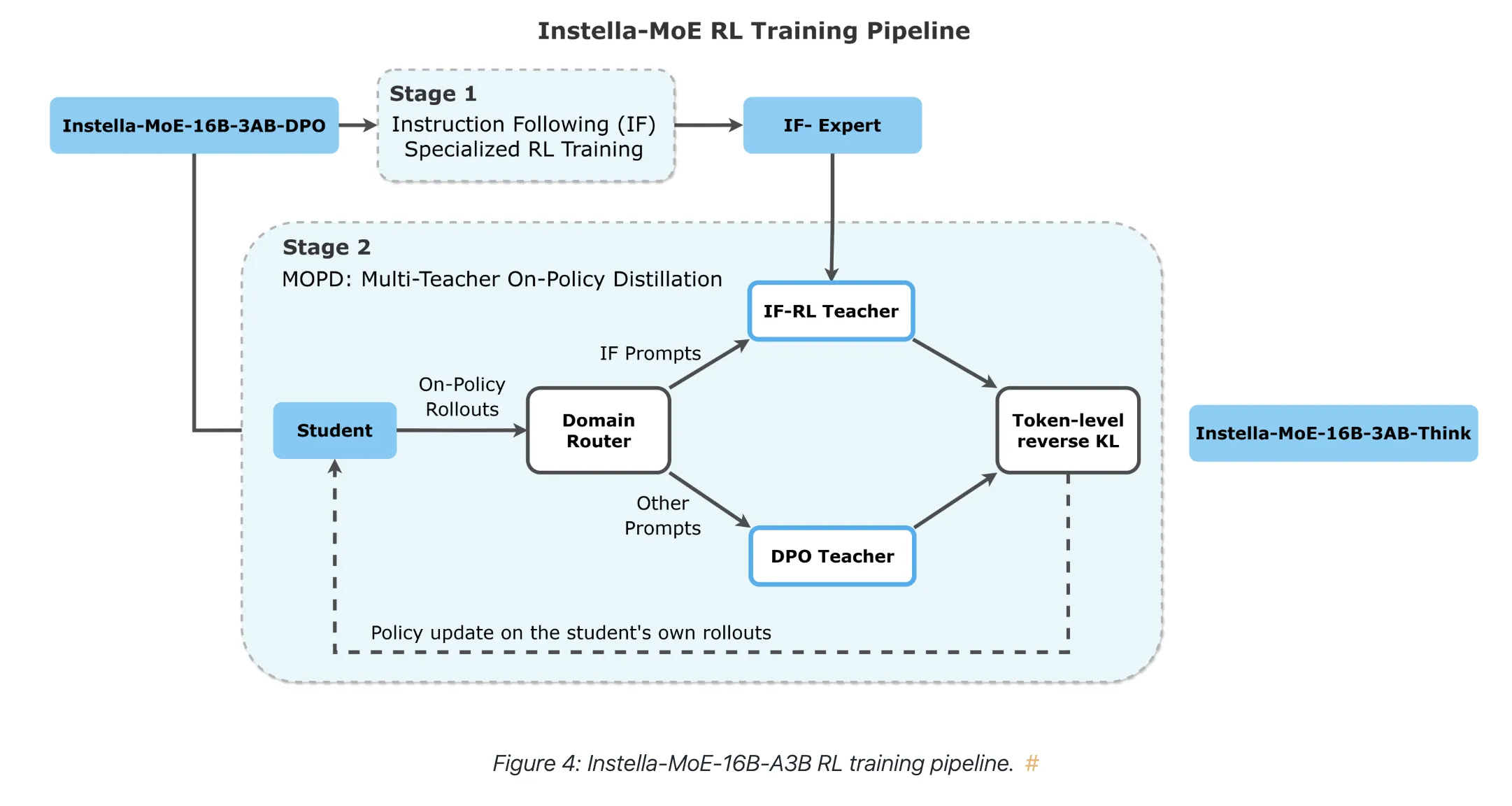
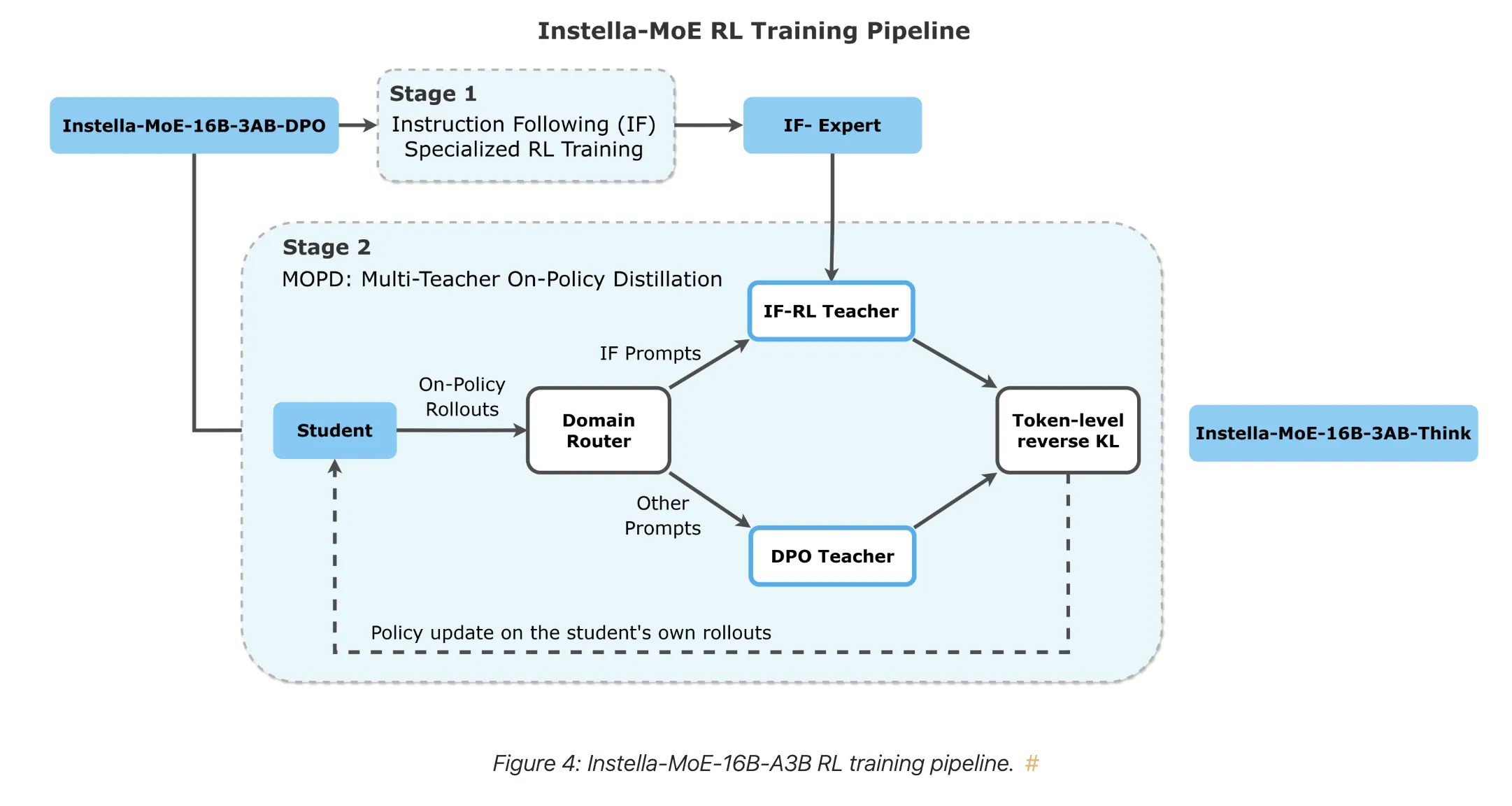
The final refinement of the model involved Supervised Fine-Tuning (SFT) and Direct Preference Optimization (DPO). The SFT stage used a combination of the Dolci-Think-SFT-7B dataset and Nemotron mixtures. This was followed by a feedback-driven dataset of 512,000 examples specifically designed to target the model’s measured weaknesses.
To prevent the common issue of "model collapse" or degradation during optimization, AMD disabled router bias updates and the auxiliary load-balancing loss during the DPO phase. The final polish was applied using the Miles framework, involving 1,400 steps of instruction-following Reinforcement Learning from Verifiable Rewards (RLVR). Finally, a Multi-Teacher On-Policy Distillation process was used to integrate these gains without sacrificing the model’s core proficiency in math and coding.
Performance Benchmarking and Results
In rigorous testing, Instella-MoE-16B-A3B has emerged as a leader among "fully open" models—those that provide complete transparency regarding their training data and methodology. The base checkpoint achieved an average score of 76.7 across standard benchmarks, outperforming several notable competitors:
- Instella-MoE-16B-A3B: 76.7
- Moonlight-16B-A3B: 76.2
- SmolLM3-3B-Base: 70.5
- OLMo-3-7B: 70.1
- OLMoE-1B-7B: 61.9
While the model trails slightly behind the closed-data Qwen3.5-4B-Base (79.5), its performance on specific tasks is highly competitive. It achieved a score of 86.5 on WinoGrande (commonsense reasoning) and 65.7 on HumanEval+ (programming). In long-context evaluations, it maintained solid performance with an average of 41.5 on HELMET and 79.4 on the RULER benchmark.
The post-training refinements showed clear incremental gains. The model’s performance climbed from SFT (71.58) to DPO (72.67) and finally to the "Think" variant (73.22). This final score puts it ahead of other prominent "thinking" or reasoning-optimized models such as Olmo3-7B-Think (71.97) and Gemma-4-E4B (70.47). Instruction following also saw a significant boost, with IFEval scores rising from 77.08 to 83.70.
Industry Implications and Future Outlook
The release of Instella-MoE-16B-A3B has broader implications for the AI industry beyond just the availability of a new model.
Strengthening the ROCm Ecosystem
By proving that a world-class MoE model can be trained and served efficiently on Instinct GPUs, AMD is providing a powerful incentive for developers to adopt the ROCm ecosystem. The inclusion of the FarSkip-Collective code in the public repository provides a blueprint for other developers to optimize their own models for AMD hardware, potentially reducing the industry’s reliance on Nvidia’s proprietary stack.
The Value of Intermediate Weights
AMD’s decision to publish weights from every training stage is a rarity in the corporate AI world. This level of transparency allows researchers to study how models learn, how specific datasets impact performance, and where "forgetting" occurs during fine-tuning. This "open science" approach is likely to earn AMD significant goodwill within the research community.
Strategic Competition
As enterprises look to diversify their hardware providers to mitigate supply chain risks and costs, AMD’s demonstration of software-hardware parity is crucial. Instella-MoE serves as a "proof of concept" that AMD hardware is not just for generic compute, but is a first-class citizen for the most advanced AI architectures currently in use.
Licensing and Accessibility
It is important for potential users to note the distinction in licensing for this release. The training codebase is released under the MIT license, making it highly reusable for developers who wish to train their own models using AMD’s optimizations. However, the model weights themselves are released under a ResearchRAIL license. This means that while the model is "open" in terms of visibility and research access, it cannot be used in commercial products or for-profit services without further negotiation or different licensing terms.
AMD has made the model accessible through several channels, including a dedicated Hugging Face collection and a comprehensive technical write-up on the ROCm blog. By providing the inference code alongside the weights, AMD ensures that researchers can begin experimenting with the model immediately on compatible hardware.
In conclusion, Instella-MoE-16B-A3B is more than just a new entry in the crowded field of large language models. It is a technical showcase of AMD’s ability to integrate cutting-edge architecture with specialized hardware. As the AI community continues to shift toward more efficient, sparse architectures like Mixture-of-Experts, AMD’s contributions to both the software and the hardware required to run them will be a critical factor in the democratization of high-performance artificial intelligence.