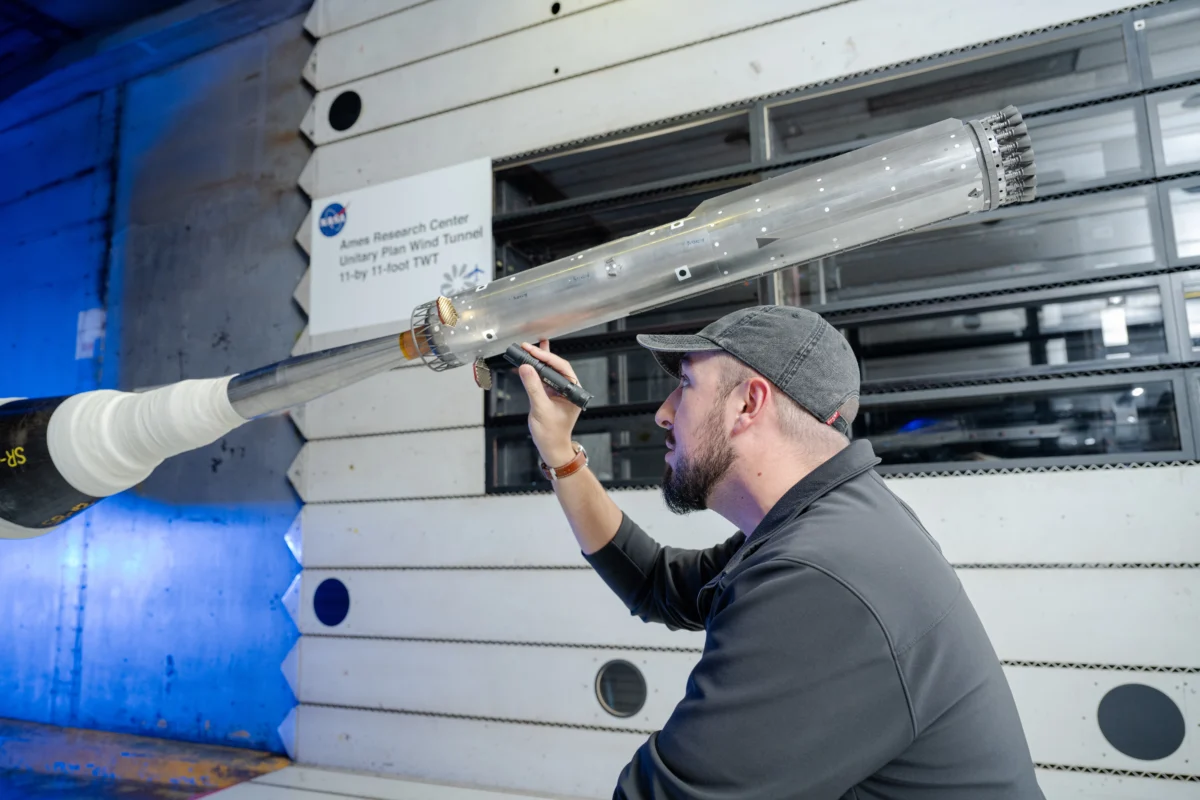
NASA, in close collaboration with its commercial partner SpaceX, has completed a crucial series of wind tunnel tests on the Super Heavy Version 3 rocket booster, a pivotal component of the Starship Human Landing System (HLS) destined for the Artemis III demonstration mission. These comprehensive tests, conducted at NASA’s Ames Research Center nestled within California’s Silicon Valley, represent a significant stride in ensuring the safety and operational reliability of the next generation of lunar transportation. The primary focus of this extensive test campaign was to meticulously characterize and understand the extreme aerodynamic forces that the massive booster will encounter during its atmospheric re-entry, a critical phase for its planned reusability. This recent test series builds upon earlier, foundational aerodynamic assessments performed at NASA Ames throughout 2024, demonstrating a continuous and iterative approach to validating the Starship HLS design. The successful execution of these tests underscores the deep technical collaboration between NASA and SpaceX, leveraging specialized agency facilities and decades of cumulative expertise to push the boundaries of human space exploration.
The Artemis Program: Paving the Way for Lunar Return and Beyond
The overarching context for these advanced aerodynamic tests is NASA’s ambitious Artemis program, an initiative designed not merely to return humans to the Moon, but to establish a sustainable, long-term human presence on its surface. Artemis envisions a future where lunar exploration serves as a proving ground for even more distant destinations, primarily Mars. The program is structured around several key objectives: fostering scientific discovery through unprecedented access to lunar resources and environments, unlocking new economic opportunities in space, and building the foundational capabilities for the first crewed missions to the Red Planet. Artemis III, currently slated for 2027, stands as a landmark mission within this ambitious framework. It is intended to be the first crewed lunar landing since Apollo 17 in 1972, marking humanity’s triumphant return to the lunar south pole – a region of immense scientific interest due to the potential presence of water ice. This mission will utilize the Starship HLS to transport astronauts from lunar orbit to the surface, where they will conduct pioneering research and lay the groundwork for future lunar outposts. A subsequent crewed lunar landing is anticipated in 2028, further solidifying humanity’s enduring presence beyond Earth.
Starship HLS: A Critical Component for Lunar Access
At the heart of NASA’s strategy for lunar access under Artemis is the innovative Starship Human Landing System (HLS), developed by SpaceX. This unique vehicle is designed to be fully reusable, a paradigm shift in space transportation that promises to dramatically reduce the cost and increase the cadence of deep-space missions. The Starship HLS is not just a lander; it’s an integrated system comprising the second-stage Starship vehicle and the powerful Super Heavy first-stage booster. While SpaceX is the designer and builder of Starship HLS, NASA plays an indispensable role through its commercial partnership model. This collaboration provides SpaceX with unparalleled access to critical national assets, such as the state-of-the-art wind tunnels at NASA Ames, alongside the invaluable technical expertise of agency engineers and scientists. This synergy ensures that the Starship HLS meets the stringent safety and performance requirements necessary for crewed spaceflight, a testament to the effectiveness of public-private collaboration in accelerating technological advancement.
Unveiling Super Heavy Version 3: Evolution for Enhanced Performance
The Super Heavy Version 3 rocket booster represents the latest iteration in SpaceX’s rapidly evolving Starship launch system. This specific version is expected to form the bedrock of the Starship HLS for the critical Artemis III mission in 2027 and subsequent lunar landings. SpaceX’s Starship system, in its entirety, consists of a colossal 33-engine first-stage Super Heavy rocket and the second-stage Starship vehicle. Version 3 of the Super Heavy booster incorporates numerous significant enhancements and upgraded systems compared to its predecessors. While specific details of every improvement are proprietary, these changes typically encompass advancements in engine design, structural integrity, flight control systems, and potentially aerodynamic surfaces. Such significant modifications necessitate rigorous testing to validate their performance and safety. The primary reason for these upgrades is to optimize the booster for repeated, reliable re-entry and landing, which are crucial for achieving the full reusability vision that underpins the Starship architecture and is fundamental to the economic viability of sustained lunar operations. With these substantial changes to Super Heavy, both NASA and SpaceX engineers recognized the imperative for more detailed information regarding the steady and, critically, unsteady aerodynamic forces the rocket will experience during its atmospheric re-entry as it maneuvers back to the launch site for refurbishment and reuse. This data is vital for refining flight control algorithms, predicting structural loads, and ultimately ensuring mission success and astronaut safety.
The Science of Aerodynamics: Wind Tunnel Testing Explained
To meticulously gather the necessary data, NASA and SpaceX deployed a precisely engineered 1.2% scale model of the Super Heavy Version 3 for testing within the specialized facilities at NASA Ames Research Center. The tests were conducted across two distinct wind tunnels: the transonic wind tunnel and the supersonic wind tunnel. These facilities are instrumental in simulating the extreme atmospheric conditions a rocket encounters during various flight regimes.
Jayanta Panda, an unsteady aerodynamics subject matter expert at NASA Ames and a key member of the Human Landing System Plume and Aero Environments team, elaborated on the nuances of aerodynamic forces. "When a rocket, or an airplane, flies through air at high speed, it’s subjected to steady aerodynamic forces and moments, and unsteady aerodynamic forces and moments," Panda explained. He further clarified, "An example of a steady aerodynamic force would be when air smoothly flows over the surface of the rocket as it ascends. An unsteady aerodynamic force would be air ‘buffeting,’ or hitting, certain areas the rocket at less predictable times and potentially causing vibrations."
The transonic wind tunnel at Ames is a marvel of engineering, capable of blasting scale models with air at speeds ranging from Mach 0.2 to Mach 1.4. To put this in perspective, Mach 1 represents the speed of sound, approximately 761 miles per hour at sea level. This range is particularly critical for re-entry, as vehicles transition through transonic speeds, where shockwaves form and aerodynamic behavior becomes complex and unpredictable. The smaller, yet equally vital, supersonic wind tunnel at Ames is designed to test models at even higher velocities, from Mach 1.55 to Mach 2.5. The wind tunnel tests on Super Heavy Version 3, which took place in late 2025, strategically utilized both tunnels to comprehensively measure both steady and unsteady airflow patterns and the resultant forces on the surfaces of the Super Heavy booster. These measurements provide engineers with a granular understanding of the pressure distributions, lift, drag, and moments experienced by the booster throughout its re-entry trajectory, from high supersonic speeds down to subsonic atmospheric flight. The fidelity of these scale models, coupled with advanced instrumentation within the wind tunnels, allows for precise data acquisition that is then scaled up to predict the behavior of the full-sized rocket.
NASA’s Legacy and Expertise: A Foundation for Future Exploration
The extensive experience of NASA in the field of aerodynamics and wind tunnel testing proved invaluable in this collaborative effort. Manish Mehta, discipline lead engineer for the HLS Plume and Aero Environments team at NASA’s Marshall Space Flight Center in Huntsville, Alabama, highlighted this institutional knowledge. "NASA has a lot of experience with unsteady aerodynamics," Mehta stated. "We used the agency’s broad experience base of conducting wind tunnel tests for the Space Shuttle, the SLS (Space Launch System) rocket, and Orion spacecraft to efficiently set up and analyze the wind tunnel testing for the Super Heavy Version 3." This deep well of historical data and procedural expertise ensures that the testing protocols are robust, the instrumentation is precise, and the analysis methodologies are sound.
Indeed, the agency’s past experiences directly inform current endeavors. Mehta provided a compelling example: "In fact, similar testing at the Ames Unitary Plan Wind Tunnel resulted in adding strakes to SLS for Artemis II, so what we learned for Artemis II is helping us get to Artemis III and beyond." This demonstrates a crucial feedback loop within NASA’s engineering practices, where lessons learned from one program are directly applied to enhance the safety and performance of subsequent missions. The addition of strakes (small aerodynamic fins) to the Space Launch System for the Artemis II mission was a direct outcome of understanding complex aerodynamic interactions, specifically to mitigate unforeseen buffetting or stability issues during ascent. This institutional memory and the continuous refinement of aerodynamic understanding are critical assets that NASA brings to its commercial partnerships, ensuring that even the most innovative designs are rigorously vetted against decades of flight experience.
Data Analysis and Flight Software Integration
The raw data collected from these wind tunnel tests forms the bedrock for critical engineering analyses and subsequent design refinements. As Mehta further explained, "Resulting wind tunnel data on steady forces and moments helps predict how the rocket will react to forces in the atmosphere during re-entry so the flight software can effectively guide the rocket during flight." This is paramount for an autonomous, reusable booster. The flight control software relies on accurate aerodynamic models to execute precise maneuvers, maintain stability, and guide the Super Heavy back to its landing pad. Any inaccuracies in these models could lead to inefficient flight paths, excessive fuel consumption, or, in extreme cases, loss of control.
Beyond steady forces, the measurement of unsteady pressure data is equally vital. "The unsteady pressure data helps engineers understand the environment around the rocket as it re-enters Earth’s atmosphere," Mehta noted. "Engineers use that information as one input into software that analyzes loads on the rocket." Unsteady aerodynamic phenomena, such as buffetting, can induce significant vibrations and dynamic loads on the rocket’s structure. Understanding these forces is crucial for assessing the structural integrity of the Super Heavy, identifying potential fatigue points, and ensuring that the booster can withstand the repeated stresses of re-entry and landing throughout its operational life. This data directly informs structural engineers, allowing them to optimize material choices, reinforce critical sections, and ensure the longevity and safety of the vehicle.
Implications for Future Lunar and Mars Missions
The successful completion and analysis of these wind tunnel tests carry profound implications for the future of space exploration. Firstly, for Artemis III, the validated aerodynamic models enhance the confidence in the Super Heavy’s re-entry and landing capabilities, which is directly linked to the overall safety and success of the crewed mission. A reliable booster means a reliable launch and, crucially for reusability, a reliable return. Secondly, the emphasis on reusability, enabled by a thorough understanding of re-entry dynamics, is a game-changer for the economics of spaceflight. By making the Super Heavy booster rapidly and reliably reusable, SpaceX aims to drastically reduce the cost per launch, thereby enabling a much higher flight rate necessary for establishing a sustained human presence on the Moon and eventually Mars. This economic efficiency is fundamental to NASA’s long-term vision for deep-space exploration.
Furthermore, the data gathered on Super Heavy Version 3 will contribute to a broader understanding of large-scale rocket aerodynamics, particularly for vehicles designed for atmospheric re-entry and precision landing. This knowledge base will be invaluable for future iterations of Starship, as well as for the design of entry, descent, and landing systems for Mars missions, which present an even more complex aerodynamic environment due to the thinner Martian atmosphere. The rigorous testing and validation process for Artemis III sets a precedent for the meticulous engineering required for crewed missions beyond Earth orbit.
The Power of Public-Private Partnerships
The collaboration between NASA and SpaceX on the Starship HLS and the associated testing exemplifies a highly effective model of public-private partnership. NASA provides its unparalleled expertise, its world-class facilities, and its rigorous safety oversight, while commercial partners like SpaceX bring innovative designs, agile development processes, and a drive for rapid technological advancement. This symbiotic relationship allows both entities to achieve goals that would be far more challenging, if not impossible, to accomplish alone. NASA benefits from cutting-edge technology developed by the private sector, and SpaceX benefits from the agency’s deep institutional knowledge and testing infrastructure. This model is central to NASA’s strategy for achieving its Artemis goals and is expected to be a blueprint for future endeavors in space exploration.
Looking Ahead: Artemis III and Beyond
With these critical wind tunnel tests concluded, the path towards the Artemis III demonstration mission in 2027 becomes clearer. The data gleaned from the Ames facilities will be meticulously integrated into the Starship HLS design, informing final structural analyses, refining flight control software, and ensuring that the Super Heavy Version 3 is robustly prepared for its demanding mission profile. As humanity stands on the cusp of returning to the Moon, the intricate details of aerodynamics, validated through rigorous testing, play an unsung yet absolutely vital role in making these ambitious dreams a reality. Through the Artemis program, NASA and its partners are not just preparing for another mission; they are building the foundation for an enduring human presence on the lunar surface and charting a course for the ultimate human journey to Mars, for the benefit of all humanity. The ongoing collaboration and technical diligence underscore a collective commitment to pushing the boundaries of what is possible in space.