




The global digital asset market is currently navigating a period of extreme turbulence as Bitcoin, the world’s largest cryptocurrency by market capitalization, demonstrates signs of a massive impending "short squeeze." Following a sharp decline to the $63,000 level in the early hours of February 28, 2026, Bitcoin has begun a tentative recovery toward $64,000. This price action comes on the heels of significant geopolitical escalations in the Middle East, specifically involving coordinated military strikes by the United States and Israel against targets in Iran. The resulting market volatility has driven perpetual futures funding rates to a staggering -6%, a level that historically signals an overextended bearish sentiment and the potential for a violent reversal to the upside.
Geopolitical Instability and the Immediate Market Reaction
The catalyst for the current market instability was a series of kinetic military operations. Reports surfaced early on February 28 regarding U.S. and Israeli strikes on Iranian infrastructure, which were followed by a swift retaliatory response from Tehran. The Iranian military launched waves of missiles and drones targeting Israeli territory, U.S. regional bases, and Gulf allies. Explosions were reported in major regional hubs including Dubai, Kuwait, and Bahrain, sending shockwaves through both traditional and digital finance sectors.
Initially, Bitcoin reacted as a high-risk asset, selling off alongside global equities as investors fled toward the perceived safety of the U.S. dollar and gold. The price of Bitcoin plummeted from its stable range above $65,000 to a local low of $63,000. This "risk-off" move triggered a massive wave of liquidations, flushing out overleveraged buyers and setting the stage for the current derivatives-driven market structure.
The Mechanics of the -6% Funding Rate
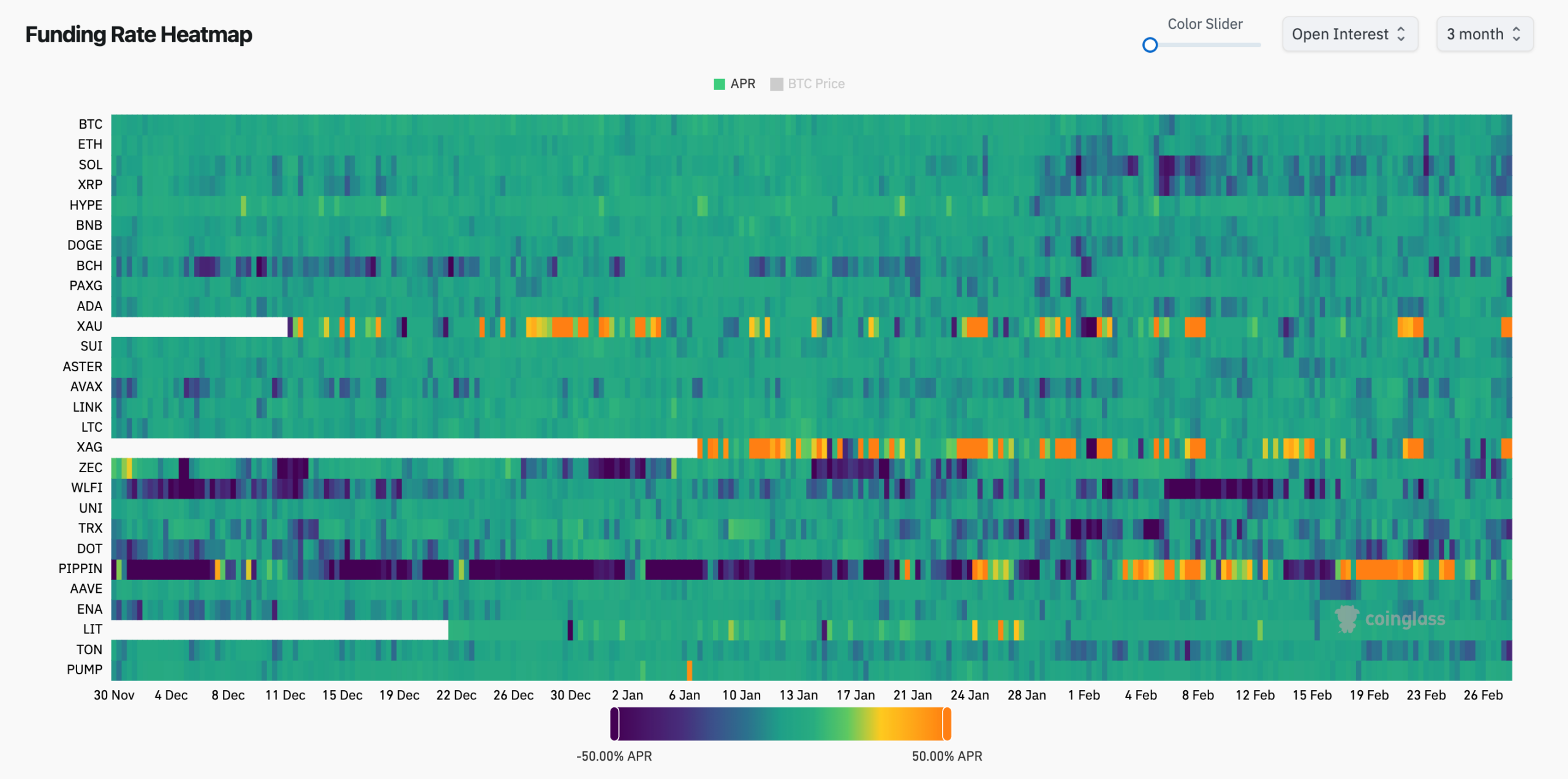
As the price of Bitcoin dipped, the derivatives market saw an unprecedented surge in bearish activity. According to data from the analytics platform CoinGlass, perpetual futures funding rates dropped to -6%. This figure represents the second-lowest funding level recorded in the past three months, trailing only the extreme bearishness seen on February 6, when Bitcoin bottomed near the $60,000 psychological support level.
To understand the significance of this metric, one must look at the mechanics of perpetual swap contracts. Unlike traditional futures, perpetuals do not have an expiration date. To ensure the contract price stays anchored to the spot price, a "funding rate" mechanism is used. When the rate is positive, traders holding long positions pay a fee to those holding short positions. Conversely, when the rate turns deeply negative, as it has now, short sellers are forced to pay long holders to keep their positions open.
A funding rate of -6% indicates that the market is overwhelmingly "crowded" with short positions. It suggests that traders are so desperate to bet on further downside that they are willing to pay an exorbitant premium to do so. Historically, such extreme negative funding is a contrarian indicator; it often marks a local price floor because the cost of maintaining a short position becomes unsustainable if the price fails to drop further immediately.
Rising Open Interest Amidst a Liquidation Cascade
The volatility of the last 24 hours has been characterized by a significant shift in market participation. Coin-margined open interest—the total number of outstanding derivative contracts settled in Bitcoin rather than stablecoins—rose from 668,000 BTC to 687,000 BTC within a single day.
Market analysts often look at open interest in BTC terms rather than USD terms to strip away the "noise" caused by price fluctuations. The rise in BTC-denominated open interest, coupled with the plummeting funding rates, confirms that new capital is entering the market specifically to take short positions. This creates a "coiled spring" effect. If Bitcoin’s price begins to move upward, these new short sellers will be forced to buy back their positions to prevent further losses, providing the "fuel" for a rapid price increase.
The path to this current state was paved by a massive "long flush." CoinGlass data indicates that more than $500 million in crypto positions were liquidated over the past 24 hours. Of that total, over $420 million were long positions. This suggests that the majority of the "weak hands" on the bullish side have already been removed from the market, leaving the floor clear for a potential recovery if the short-sellers are forced into a corner.
Chronology of Market Events: February 28, 2026
To understand the current positioning, a timeline of the day’s events provides necessary context:
- 02:00 UTC: Reports of U.S. and Israeli airstrikes on Iranian soil begin to circulate. Bitcoin price sits at $65,200.
- 04:30 UTC: Iran confirms retaliatory drone and missile strikes. Risk assets globally begin to decline. Bitcoin drops to $64,000.
- 06:00 UTC: Reports of explosions in Dubai and Bahrain. Panic selling intensifies. Bitcoin hits a 24-hour low of $63,000. Long liquidations hit the $300 million mark.
- 08:00 UTC: Funding rates on major exchanges (Binance, Bybit, OKX) begin to dive into negative territory. Short-selling volume reaches a peak.
- 10:00 UTC: Coin-margined open interest reaches 687,000 BTC. Funding rates hit the -6% threshold.
- 11:00 UTC: Bitcoin begins a slow grind back toward $64,000 as spot buying emerges to absorb the selling pressure from the derivatives market.
Analysis of the Potential Short Squeeze
A short squeeze occurs when a heavily shorted asset suddenly increases in price, forcing short sellers to close their positions. Because closing a short position requires buying the asset, this creates a feedback loop: rising prices force shorts to buy, which causes prices to rise even further, forcing more shorts to buy.
Given the current funding rate of -6%, the "pain threshold" for short sellers is remarkably low. Every hour that Bitcoin remains stable or moves slightly upward, short sellers are losing capital via the funding fee. If Bitcoin manages to reclaim and hold the $64,500 to $65,000 range, it could trigger a cascade of buy orders from short sellers who are either "stopped out" or forced to liquidate.
Industry observers note that the current setup bears a striking resemblance to the market structure of early February. During that period, similar geopolitical tensions caused a dip to $60,000 with deeply negative funding. The subsequent short squeeze propelled Bitcoin back toward $68,000 in a matter of days.
Institutional and Expert Reactions
While institutional desks have remained largely silent regarding the specific military actions, the data from CME Group (Chicago Mercantile Exchange) suggests that institutional traders are taking a more cautious approach than retail-heavy offshore exchanges. While offshore funding is at -6%, CME basis remains slightly positive, indicating a divergence between retail sentiment (extremely bearish) and institutional sentiment (neutral to cautiously optimistic).
Market analysts suggest that the "sell the news" event regarding the Middle East conflict may have already reached its local peak. "The initial shock of the strikes has been priced in," noted one senior derivatives strategist. "What we are seeing now is a derivatives market that has overshot the fundamental reality. When you have $420 million in longs liquidated and a -6% funding rate, the market is effectively ’empty’ of sellers who aren’t already positioned. This is the textbook definition of a contrarian buy signal."
Broader Implications and Market Outlook
The current situation highlights Bitcoin’s complex role in the modern financial ecosystem. While it is often touted as "digital gold" and a hedge against geopolitical instability, its immediate reaction to conflict remains tied to its status as a high-liquidity risk asset. However, the speed at which the derivatives market reaches these extreme "oversold" levels suggests that Bitcoin remains the primary vehicle for price discovery during global crises.
Looking forward, the $64,000 level remains the immediate battleground. A sustained move above this mark would likely confirm the start of the short squeeze. On the downside, if geopolitical tensions escalate further—specifically if oil infrastructure in the Gulf is severely damaged—the broader "risk-off" sentiment could overwhelm the technical setup for a squeeze, potentially pushing Bitcoin toward the $60,000 support floor.
Investors are also closely watching the U.S. Federal Reserve’s reaction to the conflict. Escalating tensions in the Middle East typically lead to higher energy prices, which can complicate the inflation outlook and influence interest rate decisions. Should the dollar continue to strengthen on the back of "safe haven" flows, Bitcoin may face persistent headwinds despite the favorable technical setup in the futures market.
As of midday on February 28, the market remains in a state of high tension. The "crowded" short trade has created a precarious environment where any positive news—or even a lack of further negative news—could serve as the spark for a significant upward move. For now, the -6% funding rate stands as a stark reminder of the current market’s extreme imbalance and the potential for a volatile correction of the recent downward trend.