



A harrowing incident unfolded off the Cuban coast on Wednesday, leading to a deadly confrontation between Cuban border guards and individuals aboard a Florida-registered speedboat. At least one American citizen was confirmed dead and another injured, according to a U.S. official, in an event that has sharply exacerbated already strained relations between Washington and Havana. Cuban authorities reported four fatalities and six injuries among the speedboat’s occupants, accusing the group of orchestrating an "infiltration with terrorist aims" and initiating hostilities. This volatile encounter has triggered urgent investigations on both sides, with officials grappling to piece together the full narrative amidst conflicting accounts and profound geopolitical implications.
The Deadly Encounter Unfolds: A Chronology of Events
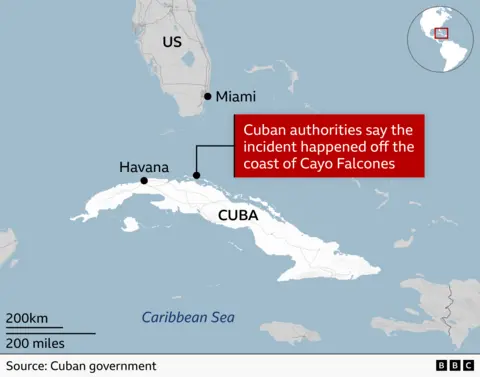
The incident, occurring Wednesday morning, began when a speedboat, identified by Cuban authorities as Florida-registered with the tag FL7726SH, was intercepted by Cuban border patrols. According to Cuba’s Interior Ministry, the vessel had penetrated its territorial waters, reaching approximately one nautical mile off Cayo Falcones on the country’s northern coast. This area is a known sensitive zone, historically associated with various illicit activities including drug trafficking and human smuggling.
Cuban officials assert that upon interception, the individuals on board the speedboat opened fire, prompting a retaliatory response from the Cuban patrol boat. The ensuing firefight reportedly resulted in the death of four people aboard the speedboat and injuries to six others. Crucially, the commander of the Cuban patrol boat was also reported injured in the exchange, underscoring the intensity of the confrontation. Following the cessation of hostilities, Cuban forces reportedly recovered an arsenal from the speedboat, including handguns, assault rifles, improvised explosive devices (IEDs), and other tactical gear, which they presented as evidence supporting their claim of a premeditated hostile incursion. An eleventh person, allegedly part of the plot, was later arrested on Cuban soil and reportedly confessed to involvement.
Conversely, U.S. officials provided a more fragmented but equally concerning account. A U.S. official confirmed that at least one American citizen was killed and another injured. Furthermore, it was revealed that a third individual on the boat held a U.S. K-1 visa, designated for fiancées of American citizens, adding a layer of personal tragedy and complexity to the incident. The owner of the Florida-registered vessel, whose identity was not immediately disclosed, alleged that the speedboat had been stolen by an employee, further clouding the operational intent and chain of command behind the ill-fated voyage. U.S. Secretary of State Marco Rubio, a prominent voice on U.S.-Cuba policy, swiftly labeled the incident "highly unusual" and confirmed that Washington was actively investigating, while unequivocally stating that no U.S. government personnel or operations were involved.
Conflicting Narratives and Identities
The core of the diplomatic tension emanating from this incident lies in the starkly divergent narratives regarding the identities and intentions of those aboard the speedboat. Cuban authorities maintained that all ten individuals on the boat were Cuban nationals residing in the United States, further alleging that "most of the passengers on the US-registered boat had prior records involving criminal and violent activity." This framing immediately positioned the incident within Cuba’s long-standing accusations of U.S.-based groups attempting to destabilize the island.
The U.S. official’s confirmation of at least one American fatality and a K-1 visa holder introduces a critical element that challenges the Cuban narrative of an exclusively Cuban-national group with a uniform "terrorist" agenda. While a U.S. citizen could indeed be of Cuban origin, the presence of an American national and a fiancée visa holder complicates the simplistic "terrorist infiltration" label, suggesting potentially diverse motivations among the passengers, which could range from illicit activities to attempts at irregular migration, or even a blend of both. The claim by the boat’s owner that the vessel was stolen also raises questions about command and control, and whether the individuals on board were acting independently or under a larger organized directive. These discrepancies underscore the urgent need for a thorough, transparent, and possibly joint investigation, though the history of distrust between the two nations makes such cooperation challenging.
Allegations of "Terrorist Infiltration" and Cuba’s Defensive Stance
Cuba’s immediate and forceful response, accusing the speedboat occupants of "an infiltration with terrorist aims," resonates deeply within the island’s historical narrative of external aggression and attempts at destabilization. The recovery of handguns, assault rifles, improvised explosive devices, and other tactical gear from the vessel, if verified, would lend credence to Havana’s claim of a well-armed and potentially hostile incursion. For the Cuban government, such an event is not merely a border violation but a direct challenge to its sovereignty and national security, evoking memories of past U.S.-backed attempts to undermine the socialist state.
Cuban President Miguel Díaz-Canel, utilizing social media platform X, swiftly condemned the incident as an act of aggression, vowing to defend the Caribbean nation against any "terrorist and mercenary aggression that seeks to affect its sovereignty and national stability." His statement, "Cuba does not attack, nor threaten," sought to portray Cuba as a victim of external aggression rather than an aggressor, reinforcing the government’s long-held position against what it perceives as ongoing hostile U.S. policies. This rhetoric is standard for Havana in the face of perceived external threats and serves to galvanize domestic support while appealing to international solidarity.
A History of High Tensions: US-Cuba Relations Context
The deadly speedboat incident cannot be understood in isolation but must be viewed through the prism of nearly six decades of deeply entrenched animosity, political embargo, and intermittent periods of cautious rapprochement between the United States and Cuba. Since the 1959 Cuban Revolution, U.S.-Cuba relations have been characterized by ideological conflict, proxy battles during the Cold War, and a comprehensive economic embargo imposed by Washington.
Migration has consistently been a flashpoint in this contentious relationship. The allure of economic opportunity and political freedom in the U.S. has driven waves of Cuban migration, often through perilous sea journeys. For decades, the "wet foot, dry foot" policy, which granted Cubans who reached U.S. soil a path to residency, incentivized dangerous maritime crossings. Although this policy was repealed in 2017, the underlying drivers of irregular migration persist, fueled by Cuba’s severe economic hardships, including persistent shortages of basic goods, food, and fuel. These conditions create a fertile ground for human smuggling operations, which often involve high-speed boats navigating the treacherous waters of the Florida Straits and beyond. The Cuban Interior Ministry’s past denunciations of incursions by privately owned U.S. boats engaged in smuggling activities highlight the routine nature of these illicit crossings, even if the "terrorist aims" accusation marks a significant escalation.
Echoes of the Past: The "Brothers to the Rescue" Incident (1996)
The recent shootout bears an unsettling resemblance to a particularly infamous incident that occurred almost 30 years ago: the 1996 downing of two civilian planes belonging to Brothers to the Rescue. This U.S.-based exile group regularly flew small aircraft over the Florida Straits to search for Cuban rafters attempting to reach the U.S. and provide humanitarian aid. On February 24, 1996, Cuban MiG fighter jets intercepted and shot down two of these unarmed Cessna aircraft in international airspace, killing all four people aboard, three U.S. citizens and one Cuban resident of the U.S.
The 1996 incident triggered widespread international outrage and significantly tightened the U.S. embargo against Cuba through the Helms-Burton Act. It exemplified the dangers inherent in the volatile waters separating the two nations, where humanitarian efforts, surveillance, and illicit activities can blur lines and lead to catastrophic miscalculations. The current speedboat incident, while different in scale and nature, evokes similar fears of a rapid escalation stemming from a border confrontation, particularly given the Cuban accusation of "terrorist aims" and the reported presence of sophisticated weaponry. The memory of "Brothers to the Rescue" serves as a stark reminder of how quickly seemingly isolated incidents can spiral into major international crises between Washington and Havana.
Escalating Regional Dynamics and Economic Pressures
The deadly shooting occurs against a backdrop of renewed U.S. pressure on Cuba, particularly under the previous U.S. administration, which reversed many of the Obama-era rapprochement policies. Sanctions were tightened, and Cuba was re-designated as a State Sponsor of Terrorism. This pressure has been exacerbated by U.S. policy towards Venezuela, Cuba’s primary political ally and historical supplier of subsidized oil. The original article’s reference to the "seizure of Venezuela’s Maduro in a US military operation" appears to be a misstatement; however, U.S. pressure campaigns against the Maduro regime in Venezuela have indeed severely impacted Cuba by disrupting oil supplies and exacerbating the island’s already crippling fuel and economic crises. This economic distress, characterized by chronic shortages, inflation, and a struggling infrastructure, acts as a significant push factor for outward migration and potentially, desperate or illicit ventures.
In a seemingly contradictory move, the U.S. Treasury Department announced on the same Wednesday of the incident that it would ease some small private sector transactions with Cuba, including oil sales, to "support the Cuban people, for commercial and humanitarian use." This policy adjustment, ostensibly aimed at bolstering Cuba’s nascent private sector and alleviating humanitarian suffering, highlights the complex and often contradictory nature of U.S. policy toward the island. While welcomed by some as a step towards engagement, its timing amidst a deadly confrontation adds another layer of complexity to an already tense diplomatic landscape. The efficacy of such limited measures in fundamentally altering Cuba’s economic trajectory or political calculus remains a subject of ongoing debate.
Diplomatic Reactions and Calls for Clarity
In the immediate aftermath, diplomatic channels have been activated, albeit cautiously. Cuba’s deputy foreign minister, Carlos Fernández de Cossío, indicated that the U.S. had shown a "willingness" to cooperate on "clarifying these regrettable events." Such a statement, even if carefully worded, suggests a mutual recognition of the gravity of the situation and the potential for unintended escalation if not handled diplomatically. However, the depth and nature of this cooperation remain to be seen, given the profound mistrust that permeates U.S.-Cuba relations.
U.S. Secretary of State Marco Rubio, a staunch critic of the Cuban government, reaffirmed that the incident was not a U.S. operation and that no U.S. government personnel were involved. His quick denial aimed to prevent any mischaracterization of the incident as a state-sponsored action, which could have far-reaching international consequences. The U.S. government’s focus will likely be on confirming the identities and motivations of the American citizen and K-1 visa holder involved, as well as investigating the claims of the boat being stolen.
The Elusive Vessel: Investigation Challenges and Broader Implications
The investigation into the speedboat itself presents significant challenges. BBC Verify’s attempt to cross-reference the Florida registration details (FL7726SH) provided by the Cuban embassy yielded no ownership details or tracking history on standard platforms. This lack of verifiable information is not uncommon for vessels involved in illicit activities, which are often registered under shell corporations, false identities, or are simply not properly tracked to evade law enforcement. The ambiguity surrounding the vessel’s true ownership and operational history further complicates efforts to ascertain the precise nature of the mission and the identities of those involved.
The incident carries significant implications for the future of U.S.-Cuba relations. It underscores the inherent dangers of the maritime border, where the convergence of economic desperation, illicit smuggling, and political animosity can quickly turn lethal. For Cuba, it reinforces the narrative of constant external threat, potentially justifying further tightening of internal security measures. For the U.S., it highlights the complex challenges of managing migration, combating organized crime, and navigating a relationship with a geopolitical adversary, especially when U.S. citizens are involved.
The immediate priority for both nations will be to prevent further escalation and to conduct thorough investigations. However, the historical baggage, the lack of robust diplomatic trust, and the conflicting initial accounts make this a formidable task. The tragic loss of life serves as a stark reminder of the human cost of unresolved political tensions and the volatile environment that persists in the waters between the United States and Cuba. How this incident is ultimately clarified and addressed will be a critical test for the already strained diplomatic channels between Washington and Havana, with potential ramifications for regional stability and the trajectory of U.S.-Cuba engagement.