



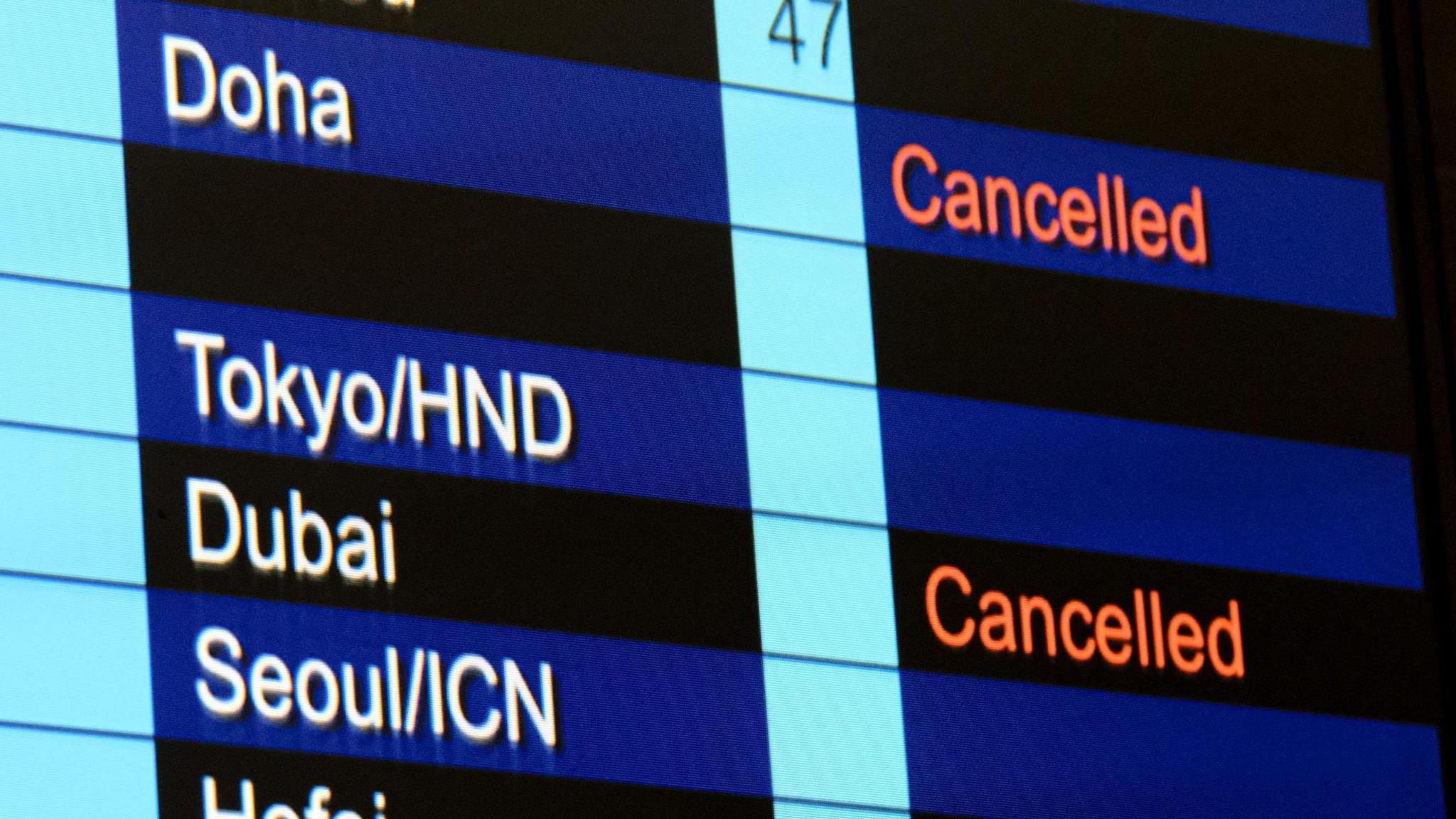
The escalating geopolitical tensions in the Middle East have triggered a significant disruption to international travel, with thousands of flights cancelled and sporting stars among those finding themselves grounded in Gulf countries. The crisis, which began with Iran’s response to an alleged attack on Saturday, has seen retaliatory actions targeting Israel, Bahrain, Kuwait, Qatar, the United Arab Emirates, and Jordan. This widespread airspace closure represents one of the most severe global travel disruptions since the COVID-19 pandemic, impacting not only commercial passengers but also the logistics of major international sporting competitions.
The UK Foreign Office has issued urgent advice to British nationals, over 100,000 of whom have registered their presence in the Middle East, recommending they adhere to local guidance, which in many affected nations involves sheltering in place. The ramifications of the escalating conflict extend beyond immediate travel concerns, casting a shadow over upcoming sporting events, including the highly anticipated 2026 FIFA World Cup, co-hosted by the United States.
Formula 1 Gears Up Amidst Travel Chaos
Despite the widespread travel disruptions, organisers of the Australian Grand Prix have expressed strong confidence that this weekend’s season-opening Formula 1 race will proceed as scheduled. The event, set to take place in Melbourne, has encountered logistical challenges with close to 1,000 Formula 1 personnel requiring rearranged travel plans. Reports indicate that approximately 500 individuals are being rerouted via charter flights from Europe to ensure their timely arrival.
Travis Auld, the chief of Australian F1 operations, conveyed optimism on Monday, stating, "Everyone will be here ready for the race." He acknowledged the necessity of "reshuffling flights" to facilitate the transport of essential personnel, including the sport’s star drivers. Formula 1 itself has confirmed it is "closely monitoring" the evolving situation, a sentiment echoed by stakeholders as the sport looks ahead to subsequent races scheduled in Bahrain and Saudi Arabia on April 12th and 19th, respectively. The proximity of these events to the current conflict zone heightens concerns about potential further disruptions.
Cricket’s Contingency Plans Amidst Uncertainty
In the realm of cricket, the England Lions squad, the nation’s development team, is adhering to official advisories from security experts and the British government as they remain unable to depart the United Arab Emirates (UAE). The squad, comprising around 30 players and staff and led by coaches Andrew Flintoff and Test captain Ben Stokes, had travelled to the UAE for a series of matches against Pakistan Shaheens. The second fixture, scheduled for Abu Dhabi on Sunday, was consequently cancelled. While no official announcement has been made regarding the remaining matches, it is widely anticipated that they will also be called off due to the prevailing circumstances.
England’s prominent cricketer Jonny Bairstow, currently in Abu Dhabi but not part of the Lions squad, publicly voiced concerns by responding to a statement from UK Prime Minister Sir Keir Starmer on X (formerly Twitter) with the plea, "Can you get us home?"
The impact extends to other cricketing nations as well. Following their exit from the T20 World Cup on Sunday, the West Indies squad is reportedly unable to return to their home country from India and remains in Kolkata. Zimbabwe is understood to be facing a similar predicament. Furthermore, the England women’s cricket team has had to postpone their planned one-month training camp in Abu Dhabi, which was scheduled to commence this week.
Iran’s World Cup Participation Hangs in the Balance
Iran’s qualification for the upcoming FIFA World Cup, co-hosted by the United States, has been cast into doubt amidst the escalating regional tensions. Mehdi Taj, the head of the Iranian football federation, expressed a somber outlook in a television interview, stating that it is "far from our expectations that we can look at the World Cup with hope." However, he also indicated that the country’s sports officials would convene to determine if any action was necessary.
FIFA’s General Secretary, Mattias Grafstrom, addressed the situation on Saturday, emphasizing the organization’s priority: "Our focus is to have a safe World Cup with everybody participating." This statement suggests a commitment from FIFA to explore all avenues to ensure Iran’s participation, contingent on safety assurances.
Meanwhile, Lionesses manager Sarina Wiegman has received assurances regarding the safety of their Women’s World Cup qualifier against Ukraine, scheduled to be held in Turkey on Tuesday. Despite Turkey’s geographical proximity to Iran and Iraq, and its closeness to Cyprus, where an Iranian drone reportedly crashed into a British RAF base on Sunday, the England team has been provided with reassurances that there are no safety concerns for the match. The ongoing exchanges of fire between Israel and Hezbollah in Lebanon further underscore the volatile nature of the region.
Adding to the uncertainty, the Finalissima match, a fixture between European champions Spain and Copa America winners Argentina, scheduled for March 27th at Qatar’s Lusail Stadium, is now in doubt. This uncertainty arises after the Qatar Football Association announced the indefinite suspension of all football matches within the country.
Tennis Stars Face Travel Nightmares
The Dubai Tennis Championships, which concluded recently, has left several prominent tennis players, including winner Daniil Medvedev, facing significant travel disruptions. Medvedev’s representative is reportedly working to ascertain how the Russian player can travel to California for the upcoming Indian Wells tournament, given the UAE’s decision to "partially and temporarily" close its airspace.
Harri Heliovaara, the Finnish player who won the men’s doubles title alongside Britain’s Henry Patten, described his travel plans as "still uncertain." He elaborated on the situation in his blog, detailing how "all of us players, the finalists and a few other doubles players, are stuck in Dubai. [Plus] all of the ATP staff, the umpires, physiotherapists, coaches and other team and family members – a total of about 30 people."
Heliovaara also noted that alternative travel routes by road had been explored. However, these options present their own challenges. A five-hour drive to Muscat in Oman is complicated by reports of significant traffic jams at the border crossing. Alternatively, a journey to Riyadh, Saudi Arabia, would exceed 10 hours, presenting another arduous and time-consuming option.
Badminton and Hockey Face Rescheduling
The ripple effects of the airspace closures are also being felt in other sports. India’s celebrated badminton player, PV Sindhu, an Olympic and World Championship medallist, remains stranded in Dubai. Her participation in the All England Championships, which are set to commence on Tuesday, is now in considerable doubt.
In hockey, the Welsh women’s team has been compelled to reschedule their flights. They were due to travel to Hyderabad, India, via Dubai for a series of matches against Scotland, Uruguay, and India, scheduled between March 8th and 14th. The current travel restrictions have necessitated a significant alteration to their travel arrangements.
The 2026 Winter Paralympics, scheduled to commence in Milan and Cortina on Friday, faces an unknown impact on athlete and staff travel. As of now, there is no confirmed information regarding whether any participants have experienced disruptions to their travel plans.
Background and Broader Implications
The current crisis stems from Iran’s direct military response to an alleged Israeli strike on its consulate in Damascus, Syria, earlier in the week, which resulted in the deaths of senior Iranian military officials. Iran’s subsequent missile and drone attacks targeted Israel directly, as well as allied military installations in neighbouring countries. This escalation marks a significant departure from Iran’s previous reliance on proxy forces for regional military actions, signalling a potentially new phase in the protracted conflict.
The closure of airspace over multiple Gulf nations, including key hubs like Dubai and Doha, has had a cascading effect on global aviation. Airlines have been forced to reroute flights, leading to increased flight times, fuel consumption, and operational costs. The economic impact on the aviation industry and related sectors, such as tourism and logistics, is expected to be substantial.
For the sporting world, the implications are far-reaching. The reliance on seamless global travel for athletes, officials, equipment, and fans makes major international competitions particularly vulnerable to geopolitical instability. The current situation underscores the need for robust contingency planning and communication protocols between sporting federations, national governments, and aviation authorities to mitigate the impact of such unforeseen events. The long-term effects could include a greater emphasis on regional sporting events or the development of more resilient logistical strategies for global tournaments. The ongoing developments in the Middle East will continue to be closely monitored by the international community, with particular attention paid to their impact on global stability and interconnected sectors like international sport.