



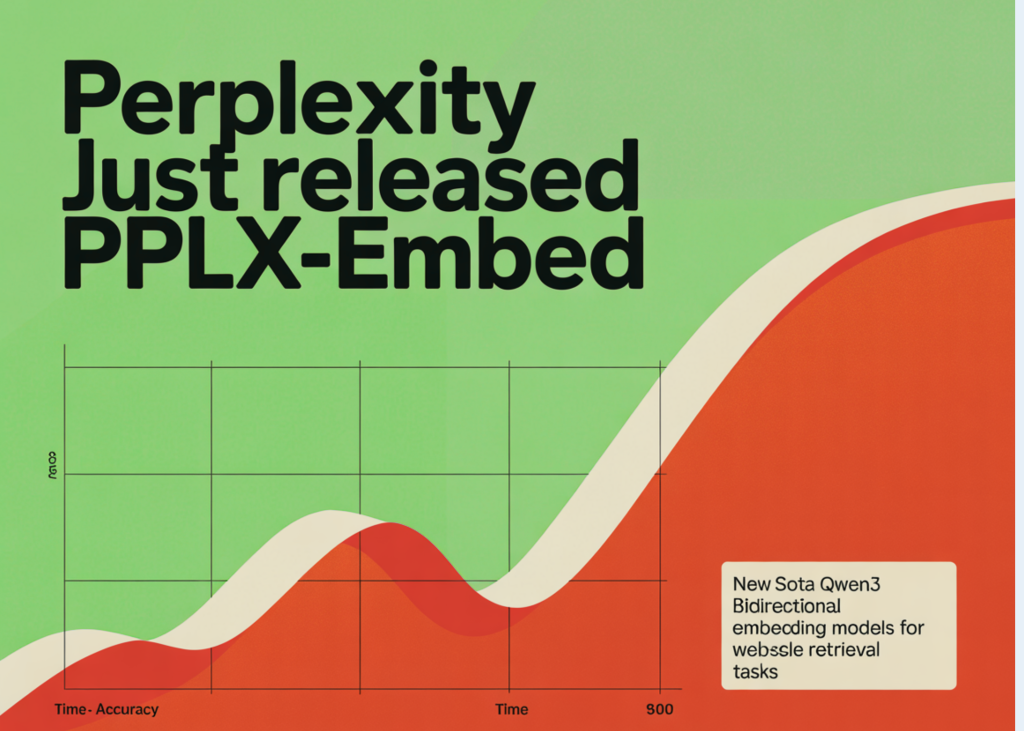
Perplexity, the artificial intelligence-driven search engine company, has officially announced the release of pplx-embed, a sophisticated suite of multilingual embedding models specifically engineered to excel in large-scale information retrieval and Retrieval-Augmented Generation (RAG) workflows. This release marks a significant milestone in the evolution of vector-based search, as the models are built to address the inherent challenges of processing "noisy" web-scale data while offering a high-performance, open-weight alternative to established proprietary embedding APIs. By introducing these models, Perplexity aims to provide developers and enterprises with a production-ready solution that balances computational efficiency with deep semantic understanding, particularly in environments where information is fragmented, unformatted, or spread across multiple languages.
The launch of pplx-embed comes at a pivotal moment in the artificial intelligence landscape, where the demand for accurate and efficient retrieval systems has surged alongside the adoption of large language models (LLMs). As enterprises increasingly rely on RAG to ground AI responses in proprietary or real-time data, the quality of the underlying embedding model—the component responsible for converting text into numerical vectors—has become a primary bottleneck. Perplexity’s new models, available in 0.6 billion (0.6B) and 4 billion (4B) parameter scales, leverage architectural innovations such as bidirectional attention and diffusion-based pretraining to set a new benchmark for web-scale retrieval tasks.
Architectural Paradigm Shift: Bidirectional Attention and Diffusion
The technical foundation of pplx-embed represents a departure from the prevailing trends in LLM architecture. Most contemporary generative models, including the GPT series, utilize causal, decoder-only architectures designed for next-token prediction. While this approach is highly effective for text generation, it is often sub-optimal for embeddings, which require a holistic understanding of a sentence or document’s entire context. To overcome this, the Perplexity research team implemented bidirectional attention within the pplx-embed framework. Unlike causal models that only look at previous tokens, bidirectional attention allows the model to process all tokens in a sequence simultaneously. This ensures that the resulting hidden state representation captures the nuances of every word in relation to every other word, leading to more precise semantic vectors.
Furthermore, Perplexity has integrated diffusion-based pretraining into the development cycle of these models. While diffusion processes are most commonly associated with generative image models like Stable Diffusion, their application to text embeddings serves a specific diagnostic and restorative purpose. During the pretraining phase, the model is trained to reconstruct clean, coherent semantic signals from noisy or corrupted input data. This is particularly relevant for web-scale retrieval, where source material often includes HTML boilerplate, social media shorthand, or poorly structured text. By learning to "denoise" information at the embedding level, pplx-embed remains resilient when encountering the complexities of the open web, ensuring that the semantic essence of a document is preserved even if the formatting is suboptimal.
Solving the Asymmetry Problem in Retrieval-Augmented Generation
One of the most persistent hurdles in RAG systems is the "asymmetry" between the user’s input and the stored data. In a typical search scenario, a user might provide a short, conversational query, such as "What is the impact of inflation on tech stocks?" This query must then be matched against a massive database of long-form articles, financial reports, or whitepapers. Standard embedding models often struggle to align these two disparate formats in the same vector space.
Perplexity addresses this challenge by offering specialized model versions tailored for different roles in the retrieval pipeline. The pplx-embed suite distinguishes between "Query" models and "Context" models. The query-specific models are optimized to understand the intent and brevity of user questions, while the context-specific models are designed to summarize and represent the core information within large document chunks. By separating these roles, Perplexity ensures that the vector space alignment is more accurate, significantly reducing the "noise" that often leads to irrelevant search results. This methodology has been validated through rigorous testing against real-world search scenarios involving tens of millions of documents, proving that specialized embeddings can outperform general-purpose models in high-stakes retrieval environments.
Technical Specifications and Deployment Efficiency
The pplx-embed collection is structured to provide flexibility for a wide range of industrial applications. The models are built upon the Qwen3 architecture, benefiting from the latest advancements in transformer efficiency and multilingual capabilities.
The 0.6B model is positioned as the primary choice for high-throughput, low-latency tasks. It is ideal for applications where speed is paramount, such as real-time search suggestions or large-scale document indexing where cost-per-token is a critical factor. Conversely, the 4B model is designed for complex semantic reasoning. It is capable of capturing deeper relationships within the data, making it suitable for legal analysis, medical research, or technical documentation where precision is non-negotiable.
A standout feature of both models is the inclusion of native INT8 quantization support. Traditionally, deploying large embedding models required significant GPU memory and computational overhead. By supporting INT8 quantization out of the box, Perplexity allows engineers to run these models with a drastically reduced memory footprint and accelerated inference speeds. This makes the 4B model viable for production environments that previously could only support much smaller, less capable models. The ability to maintain high accuracy while utilizing lower-precision arithmetic represents a significant win for enterprises looking to optimize their AI infrastructure costs.
Evolution of Embeddings: A Brief Chronology
The release of pplx-embed is the latest chapter in a decade-long evolution of natural language processing (NLP). The journey began with Word2Vec and GloVe, which provided static word representations but failed to account for context (e.g., the word "bank" having different meanings in "river bank" vs. "investment bank"). The field shifted dramatically with the introduction of BERT (Bidirectional Encoder Representations from Transformers) in 2018, which popularized bidirectional attention and contextual embeddings.
In recent years, the industry moved toward LLM-based embeddings, often relying on proprietary APIs from companies like OpenAI or Cohere. While these APIs offer ease of use, they often function as "black boxes" with hidden costs and data privacy concerns. Perplexity’s move to release pplx-embed as an open-weight collection represents a return to the transparency of the BERT era but with the power and scale of modern LLMs. It signals a shift toward vertical integration, where companies that provide search services (like Perplexity) also develop the foundational tools required to power those services at scale.
Market Implications and Industry Reaction
The introduction of pplx-embed is expected to have a ripple effect across the AI developer community. Industry observers suggest that this release directly challenges the dominance of closed-source embedding providers. By providing a multilingual, high-performance model that can be self-hosted, Perplexity is empowering organizations to maintain greater control over their data pipelines.
Initial reactions from the machine learning community have highlighted the importance of the multilingual aspect. As businesses expand globally, the ability to retrieve information across different languages—without losing semantic fidelity—is a critical requirement. The pplx-embed models have been trained on diverse datasets, ensuring they perform consistently across various linguistic structures and cultural contexts. This makes them particularly attractive for multinational corporations and global content aggregators.

Furthermore, the focus on "web-scale" retrieval aligns with the current trend toward "Agentic RAG," where AI agents are tasked with browsing the live web to find answers. Since Perplexity’s core product is a search engine, the pplx-embed models are effectively "battle-tested" on the most chaotic data source available: the internet. This provides a level of practical reliability that theoretical models often lack.
Analysis of Broader Impact
The long-term implications of pplx-embed extend beyond simple search improvements. By lowering the barrier to entry for high-quality embeddings through INT8 quantization and open weights, Perplexity is accelerating the democratization of advanced RAG systems. Small to medium-sized enterprises (SMEs) can now deploy state-of-the-art retrieval systems that were previously the exclusive domain of tech giants with massive R&D budgets.
Additionally, the emphasis on bidirectional attention and diffusion-based pretraining may encourage other model developers to revisit these architectures for specialized tasks. While the industry has been focused on making models larger, Perplexity has demonstrated that architectural refinement and targeted pretraining can yield superior results for specific use cases like embeddings.
As the AI industry moves toward more specialized and efficient models, pplx-embed stands as a testament to the value of purpose-built architecture. It provides a robust framework for the next generation of intelligent search and discovery tools, ensuring that as the volume of digital information continues to explode, the ability to find and utilize that information remains precise, fast, and accessible.
The Perplexity research team has made the model weights available on Hugging Face, accompanied by a comprehensive technical paper detailing the training methodology and performance benchmarks. This transparency is likely to foster further innovation as researchers and developers build upon the pplx-embed foundation to create even more specialized retrieval solutions.