



The Renault Megane Coupé represents a pivotal chapter in European automotive history, marking the moment when Renault successfully transitioned from a manufacturer of utilitarian transport to a leader in design-centric consumer vehicles. Launched in the mid-1990s as part of the ambitious "Project X64," the Megane Coupé was a vehicle defined by strategic compromise. It offered the aesthetic allure of a dedicated sports car while retaining the affordable running costs and mechanical simplicity of a standard family hatchback. While its practicality was notably limited—characterized by a diminutive rear seating area and a trunk space often compared to a small cupboard—its commercial success proved that a significant segment of the market was willing to sacrifice utility for stylistic distinction.
The Genesis of Project X64 and the Le Quément Revolution
To understand the Megane Coupé’s impact, one must examine the state of Renault in the late 1980s. The company was largely associated with conservative, boxy designs such as the Renault 19, the 21, and the Safrane. While these vehicles were competent, they lacked the emotional resonance required to compete with increasingly sophisticated Japanese imports and the rising dominance of German prestige brands.
The appointment of Patrick Le Quément as Senior Vice President of Corporate Design in 1987 served as the catalyst for change. Le Quément joined the firm under the strict condition that design would no longer be subservient to engineering. He reported directly to the Chairman and CEO, Louis Schweitzer, ensuring that aesthetic innovation was integrated into the earliest stages of product development. This structural shift allowed Renault to move away from the "dull" reputation of its predecessor models and embrace a philosophy Le Quément described as "Design as a Strategic Tool."
The Megane family, which debuted in 1995, was the ultimate expression of this philosophy. Rather than producing a single car, Renault developed an entire ecosystem of body styles—hatchback, sedan (Classic), station wagon (Grandtour), multi-purpose vehicle (Scenic), and the Coupé. This modular approach allowed Renault to maximize the utility of a single platform while targeting niche markets that were previously underserved.
Design Philosophy: Style Over Absolute Utility
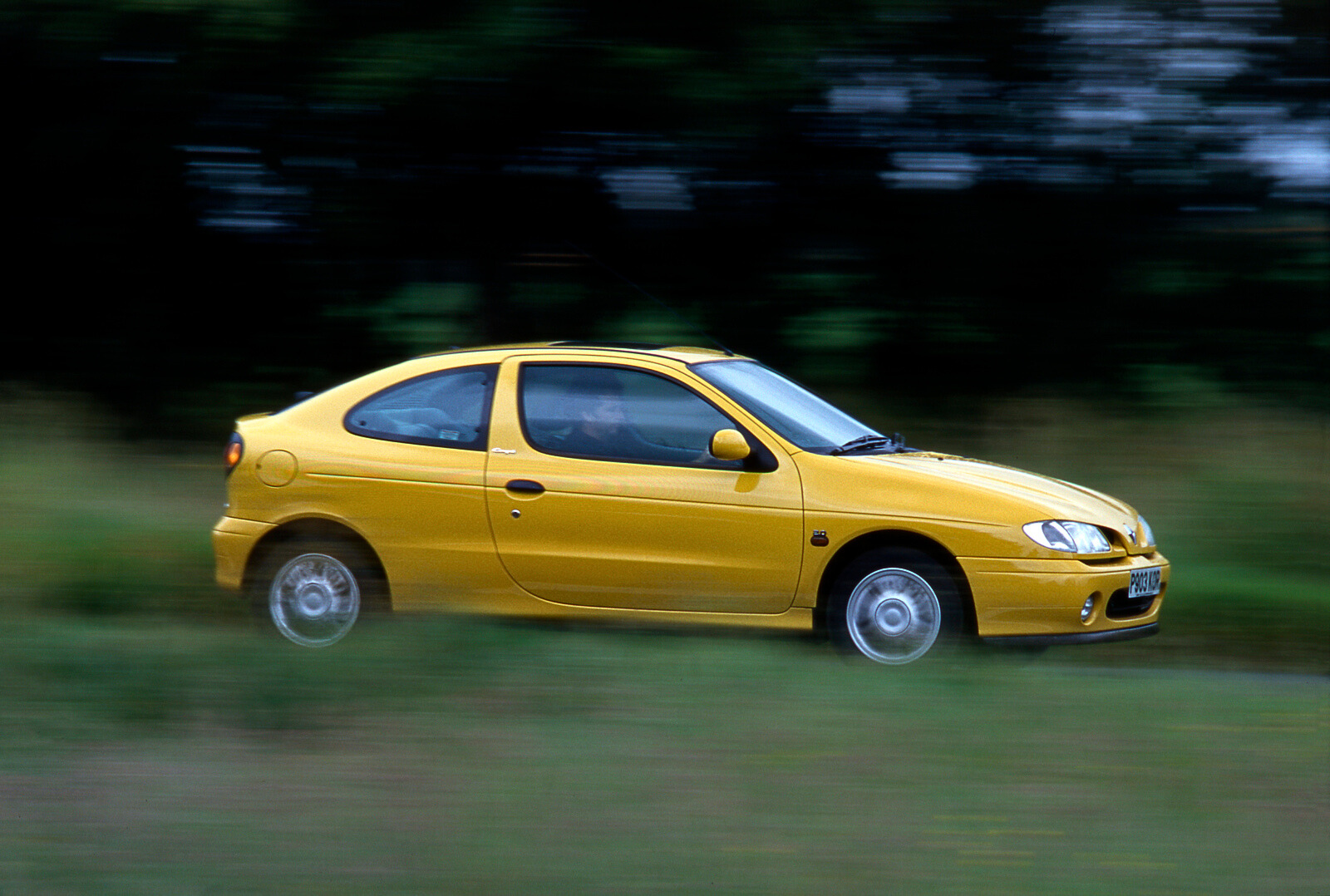
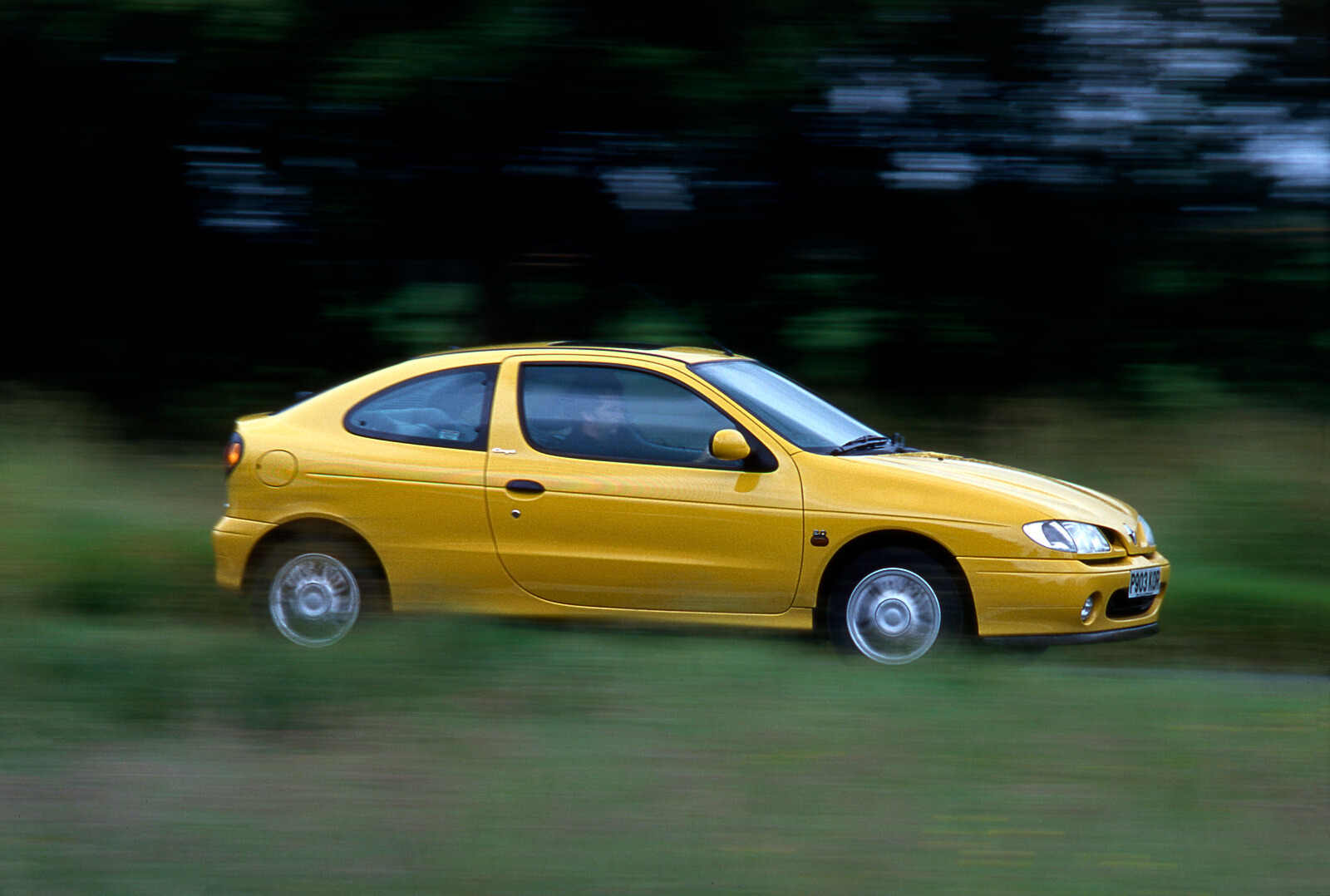
The Megane Coupé was not merely a three-door version of the Megane hatchback; it featured a shortened wheelbase and a completely distinct silhouette. Measuring 3.93 meters in length—roughly 20 centimeters shorter than the five-door variant—it prioritized a "rakish" profile. The design utilized a sweeping roofline and a high-waisted rear end, creating a visual dynamism that was rare in the affordable segment.
However, this design-first approach necessitated significant compromises. The rear interior space was cramped, making it unsuitable for adult passengers over long distances. The boot aperture was notoriously small, and the high loading lip made it difficult to accommodate large items. Despite these drawbacks, the Coupé found a massive audience. Market data from the late 1990s indicated that for many buyers, the car served as a "statement piece" for young professionals or a second vehicle for style-conscious households.
In the UK market specifically, the Megane Coupé became a common sight, often finished in vibrant "Sunflower Yellow" or "Monaco Blue." Its popularity was bolstered by its pricing strategy; it cost only marginally more than the standard five-door hatchback, making the "upgrade" to a sporty aesthetic an easy financial decision for consumers.
Mechanical Specifications and the "Croque Monsieur" Performance
Underneath the Patrick Le Quément-designed exterior, the Megane Coupé utilized what critics often called "Croque Monsieur" mechanicals—reliable, straightforward, and decidedly un-exotic. By sharing engines, transmissions, and suspension components with the mass-market Megane, Renault ensured that the Coupé was inexpensive to insure and maintain.
The engine lineup included:
- 1.6-liter 8-valve and 16-valve units: These were the volume sellers, providing adequate performance (approx. 90-110 hp) with excellent fuel economy.
- 2.0-liter 16-valve (F7R): Borrowed from the legendary Clio Williams, this engine powered the top-tier "16V" models, producing 150 hp and giving the car genuine performance credentials.
- 2.0-liter IDE (Instant Direct Injection): An early attempt at gasoline direct injection, focusing on torque and efficiency, though it was later criticized for its complexity compared to simpler units.
While the 2.0-liter models were capable of a 0-60 mph sprint in under 8.5 seconds, the standard versions were more sedate. Unlike the Ford Puma, which featured a chassis tuned for surgical precision, the Megane Coupé’s handling was safe and predictable rather than exhilarating. It utilized a MacPherson strut front suspension and a programmed-deflection torsion beam at the rear, a setup that prioritized ride comfort over cornering flat-out.
Chronology of the Megane Coupé (1995–2003)
The lifespan of the first-generation Megane Coupé can be divided into two distinct phases:
- Phase 1 (1995–1999): The initial launch featured the iconic "bird-beak" front grille and a range of E-series and F-series engines. During this period, the car established its dominance in the affordable coupé sector, competing against the aging Vauxhall Calibra and the entry-level Toyota Celica.
- Phase 2 (1999–2003): A significant facelift introduced a more modern front-end design with integrated clear-lens headlights and a refined interior. Renault also updated the engine range to include more efficient 16-valve "K-Type" engines. Safety was also enhanced, with the introduction of more advanced airbag systems and electronic brakeforce distribution.
By the time the first-generation Megane Coupé was phased out in 2003 to make way for the more radical, "shaking-that-ass" design of the Megane II, it had firmly established Renault as a brand capable of delivering "attainable glamour."
Competitive Landscape and Market Positioning
The Megane Coupé existed during the "Golden Age" of the affordable European coupé. Its primary competitors included:
- Ford Puma: Based on the Fiesta, the Puma was widely considered the better driver’s car. However, it was smaller and often more expensive than the entry-level Megane.
- Vauxhall/Opel Calibra: A larger, sleeker car based on the Vectra. While it offered more space, it was positioned in a slightly higher price bracket.
- Hyundai Coupe: Often referred to as the "Tiburon," the Hyundai offered a similar value proposition but lacked the European brand prestige that Renault enjoyed at the time.
- Toyota Celica: A more sophisticated and reliable alternative, but with higher insurance premiums and a higher entry price.
Renault’s advantage was its massive dealer network and the "halo effect" created by its involvement in Formula 1. The association with racing technology, however tenuous in the base 1.6-liter Coupé, provided a marketing edge that resonated with consumers.
The Role of Safety and Reliability
In the early 2000s, consumer priorities began to shift toward vehicle safety. Renault capitalized on this by making the Megane one of the safest cars in its class. The Megane was among the first small family cars to achieve a four-star rating in the Euro NCAP crash tests. For the Coupé buyer, this meant that the pursuit of style did not require a compromise in occupant protection—a major selling point for younger drivers and their families.
Reliability was another key factor. By using tried-and-tested components from the Renault 19 and the contemporary Clio, the Megane Coupé avoided the "fragile" reputation that had plagued French cars in previous decades. For freelance professionals and commuters who required a vehicle that was "unlikely to go wrong," the Megane Coupé offered a peace of mind that older, more temperamental sports cars could not match.
Broader Impact and Industry Implications
The success of the Megane Coupé forced other manufacturers to reconsider their small-car strategies. It proved that a "lifestyle" derivative could generate significant profit margins by using existing platforms. This paved the way for the modern trend of platform-sharing, where a single chassis might support a hatchback, an SUV, and a coupé-style crossover.
Furthermore, the Megane Coupé served as the foundation for Renault’s future performance divisions. The lessons learned in the 2.0-16V Coupé eventually led to the development of the Megane Renaultsport (RS) models, which would go on to set Nürburgring records and define the front-wheel-drive performance category for two decades.
In hindsight, the Megane Coupé was a masterclass in market segmentation. It identified a gap between the boring hatchback and the unattainable supercar, filling it with a product that was "just enough" in every category: stylish enough to turn heads, fast enough to be respectable, and cheap enough to be practical.
Conclusion: A Legacy of Accessible Style
While the first-generation Renault Megane Coupé may not be remembered as a pinnacle of automotive engineering, its legacy as a design icon is secure. It validated Patrick Le Quément’s belief that design should lead engineering and proved that the general public valued aesthetics as much as, if not more than, technical specifications.
Today, as the automotive industry pivots toward electrification and SUVs, the era of the affordable, mass-market coupé has largely come to an end. However, the Megane Coupé remains a reminder of a time when a simple French hatchback could be transformed into something glamorous, desirable, and ubiquitous on European roads. It was a car that didn’t need to be perfect to be successful; it just needed to look the part.