



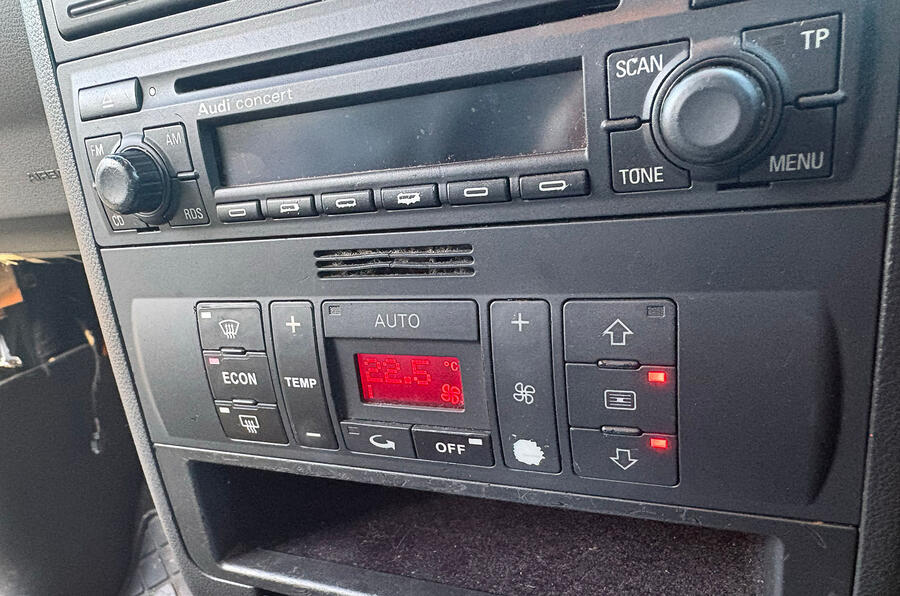
The physical degradation of a single control interface within a vehicle cabin often serves as a primary indicator of repeated user intervention, highlighting a disconnect between the manufacturer’s automated logic and the operator’s practical requirements. In the case of the 2004 Audi A2, a premium compact vehicle noted for its pioneering use of aluminum and advanced electronics, the visible wear on the fan-speed-reduction button provides a significant case study in human-machine interface (HMI) friction. While the vehicle was marketed as a pinnacle of efficiency and automated comfort, the necessity for constant manual override of its climate control system reveals a broader conflict in automotive design: the struggle between algorithmic cabin management and individual sensory preference.
The Audi A2 and the Evolution of Automated Cabin Environments
To understand the significance of this specific mechanical wear, one must first examine the context of the Audi A2’s production. Launched at the turn of the millennium, the A2 was an ambitious project that sought to bring luxury-brand sophistication to the small car segment. It featured the Audi Space Frame (ASF), a lightweight aluminum construction that was previously reserved for the flagship A8 sedan. Beyond its structural innovations, the A2 was equipped with an electronic climate control system that was, for its time, remarkably advanced for a vehicle of its dimensions.
The system in question utilizes a central Electronic Control Unit (ECU) to manage the Heating, Ventilation, and Air Conditioning (HVAC) parameters. In its default "Auto" mode, the system monitors interior temperature via thermistors, external ambient temperature, and even solar load through a dash-mounted sensor. The objective of the programming is to reach and maintain a pre-set temperature as efficiently as possible. However, the logic governing this efficiency often prioritizes thermal equilibrium over the acoustic comfort or tactile preferences of the occupants.
The Mechanism of Conflict: Manual Override vs. Algorithmic Persistence
The primary source of user frustration in the 2004 Audi A2 climate control module stems from the fan speed’s lack of "memory" or "adherence" when manual adjustments are made within certain parameters. In a standard journalistic observation of the vehicle’s operation, it is noted that while temperature and air distribution settings remain static once selected, the fan speed behaves with a degree of programmed autonomy that frequently contradicts the driver’s intent.
When a driver manually reduces the fan speed to a lower setting—perhaps to reduce ambient noise or to minimize the sensation of forced air—the system’s logic loop often interprets this as a temporary deviation from the most efficient path to the target temperature. Consequently, after a brief interval, the ECU frequently triggers an increase in blower motor voltage, raising the fan speed back to a level it deems optimal for thermal regulation. This results in a repetitive cycle: the driver lowers the fan speed, the car increases it, and the driver is forced to intervene again. Over two decades of ownership, this cycle translates into thousands of additional depressions of the "fan-down" button, eventually eroding the protective coating and exposing the white plastic substrate beneath.
Material Science and the Vulnerability of Early 2000s Interiors
The visual evidence of this conflict—the peeling button—is also a result of specific material choices made by European manufacturers during the late 1990s and early 2000s. During this era, Audi, along with competitors like Volkswagen and BMW, utilized "soft-touch" plastics. These components were coated in a thin layer of polyurethane-based paint intended to provide a premium, matte feel and a cushioned tactile response.
While aesthetically pleasing when new, these coatings have proven vulnerable to several factors:
- Sebum and Skin Oils: The chemical composition of human oils can break down the polymer chains in the soft-touch coating over time.
- Mechanical Friction: Repeated physical contact accelerates the thinning of the layer.
- UV Exposure: Ultraviolet radiation from the windshield can embrittle the coating, making it more prone to flaking.
In the case of the Audi A2, the disproportionate wear on the fan-down button compared to the fan-up or temperature buttons confirms that the driver’s primary interaction with the HVAC system was one of corrective action rather than initial setting.

Technical Analysis of HVAC Control Logic
From an engineering perspective, the behavior of the A2’s climate control is governed by a Proportional-Integral-Derivative (PID) controller. This mathematical formula is designed to minimize the "error" between the measured temperature and the setpoint.
In the Audi A2’s software architecture, the "Auto" function is often integrated into the fan speed logic even when the "Auto" light is not illuminated. If the interior temperature sensor detects a significant delta (difference) between the actual and desired temperature, the PID controller will increase the blower speed to maximize heat exchange across the heater core or evaporator. The "conflict" arises because the software is programmed to prioritize the "Integral" component—the accumulation of error over time—above the manual override input. If the temperature does not reach the setpoint quickly enough at a low fan speed, the system overrides the user to "fix" the thermal lag.
A Chronology of Climate Control Sophistication
The evolution of these systems provides context for why the 2004 Audi A2 was caught in a transitional phase of automotive HMI:
- 1970s–1980s: Most vehicles used purely mechanical sliders and cable-actuated flaps. The driver had absolute control over fan speed via a simple resistor block.
- 1990s: The introduction of "Climate Control" brought early digital interfaces. These systems were often binary: either fully automatic or fully manual.
- Early 2000s (The A2 Era): Manufacturers began implementing "intelligent" overrides. Systems were designed to be "smarter" than the driver, leading to the persistent fan-speed adjustments observed in the A2.
- 2010s–Present: Modern systems have largely solved this by offering "Auto Intensive," "Auto Medium," and "Auto Soft" profiles, allowing the user to set the bounds of the automation’s aggressiveness.
Broader Implications for Human-Machine Interaction
The worn button on the Audi A2 climate control panel is more than a cosmetic defect; it is a physical manifestation of a failure in user-centric design. In the realm of ergonomics and UX (User Experience) research, this is known as "automation surprise" or "control struggle." When a machine takes an action that the user has specifically tried to prevent, it leads to a breakdown in trust between the operator and the vehicle.
This phenomenon is not limited to climate control. It can be seen in modern Lane Keeping Assist (LKA) systems that "tug" at the steering wheel or in automated start-stop systems that some drivers find intrusive. The lesson provided by the Audi A2 is that if an automated system is too rigid in its logic, the human user will be forced into a state of constant correction, leading to premature wear of both the hardware and the user’s patience.
Market Impact and Manufacturer Responses
While Audi has not issued formal statements regarding the specific fan-logic of a twenty-year-old model, the automotive industry’s shift in the years following the A2’s production suggests an industry-wide realization of these issues. Internal documents from various Tier-1 suppliers (such as Denso and Behr-Helle) have historically noted that "subjective thermal comfort" varies so wildly between individuals that a single algorithmic "Auto" mode is often insufficient.
The secondary market for the Audi A2 now sees these worn buttons as a common "fault" or "character trait" of the model. Restoration kits, including vinyl overlays and replacement button sets, have become a niche industry for enthusiasts of the A2. This secondary economy highlights the enduring nature of the vehicle’s mechanicals (particularly the 1.4 TDI engine) contrasted against the failure of its interior touchpoints.
Conclusion: The Legacy of the Overactive Fan
The 2004 Audi A2 remains a landmark of automotive engineering, a vehicle that was ahead of its time in terms of aerodynamics and lightweighting. However, its climate control interface serves as a cautionary tale for the limits of automation. The worn-away coating on the fan-down button is a testament to 23 years of a driver asserting their will over a computer that believed it knew better.
As the industry moves toward even higher levels of automation, including autonomous driving and AI-driven cabin assistants, the case of the Audi A2 button reminds designers that the ultimate goal of technology should be to serve the user’s preference, not just the system’s internal logic. In the balance between efficiency and comfort, the human hand will always seek to correct the machine—even if it takes twenty years of persistent pushing to make the point.