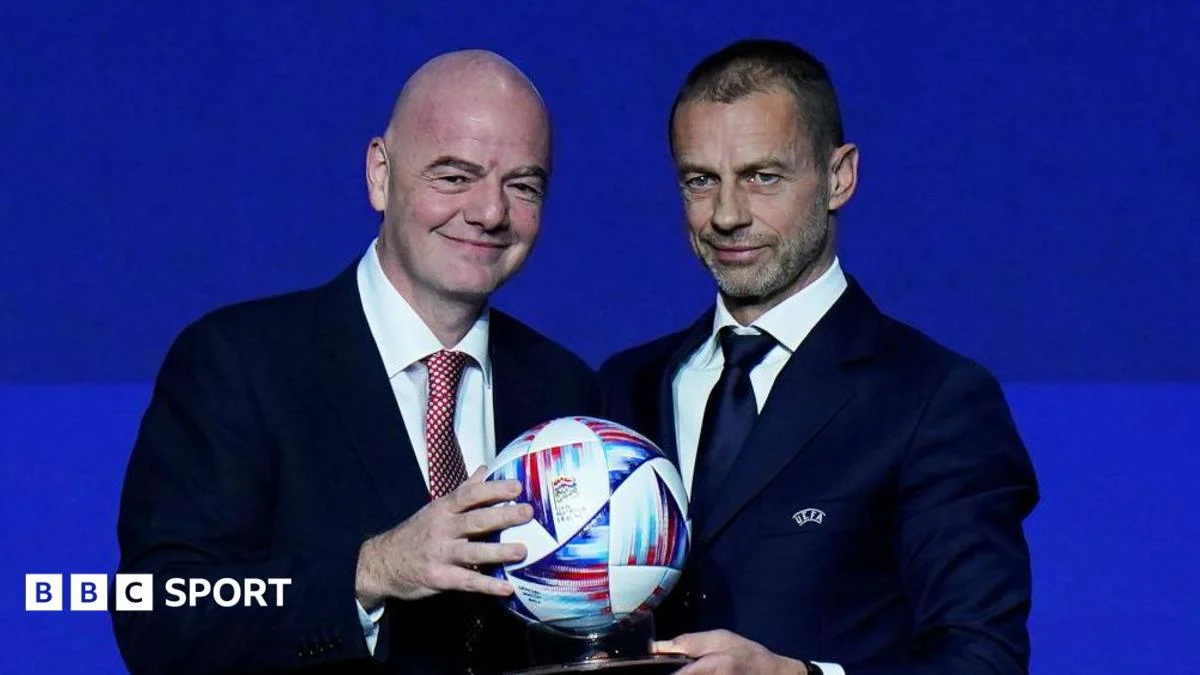
Uefa President Aleksander Ceferin has definitively stated he will not pursue the position of Fifa president, aiming to succeed Gianni Infantino. However, Ceferin anticipates that a challenger will emerge to contest Infantino’s leadership at the Fifa Congress scheduled for March 2027. This announcement comes amidst significant controversy surrounding Infantino’s leadership, particularly following the abrupt cancellation of a contentious plan to sell stakes in Fifa competitions to private investors.
The proposed venture, which Uefa vehemently opposed, would have seen the creation of a new entity, Fifa Forward Enterprise (FFE), tasked with managing the commercial and ticketing rights of all Fifa tournaments. A significant 21% stake in this company was slated for sale to a private investment firm. The plan ignited widespread opposition across the global football community, prompting Uefa to lead the charge against it. European football’s governing body, alongside its member associations, had threatened to boycott World Cups if the proposal was not scrapped, ultimately declaring a loss of confidence in Infantino.
Ceferin’s Stance: Focus on Uefa and Credibility
Ceferin, a 57-year-old Slovenian lawyer, has long been considered a potential frontrunner to challenge Infantino. His explicit withdrawal from contention, however, offers a clear indication of his priorities. Speaking on the "Rest is Politics" podcast, Ceferin articulated his reasons for declining to stand for the Fifa presidency.
"I’m not interested because of two reasons," Ceferin explained. "One reason is that I love Uefa and I love working here, and I think that at a certain point, it’s time to also enjoy life a bit." This sentiment underscores his commitment to his current role and a desire for a balanced professional life.
His second rationale focused on the strategic advantage of maintaining his current position. "The second point is, my credibility is much, much higher if I’m not interested in the position," he stated. This suggests a belief that by remaining outside the direct presidential race, he can exert greater influence and maintain a more objective stance in criticising Fifa’s direction.
Anticipating a Challenge to Infantino’s Leadership
Despite his personal non-candidacy, Ceferin remains convinced that Infantino’s tenure will not go uncontested. He presented two likely scenarios: either Infantino will voluntarily step down due to a perceived lack of support, or he will face a direct challenge from another candidate during the March elections.
"One option is that he realises that he doesn’t have the support, and that’s not only a political support of the ones who vote, but the political support of football community, the political support of fans, the political support of the players, former players, coaches," Ceferin elaborated. This highlights a broad spectrum of support that Infantino may be struggling to maintain beyond the immediate voting blocs.
The alternative, according to Ceferin, is that Infantino proceeds to the elections, but in such a scenario, "I think he will have a candidate against him. I don’t know yet who." This prediction suggests ongoing behind-the-scenes discussions and potential candidacies within the Fifa ecosystem.
The Controversial Fifa Forward Enterprise (FFE) Proposal
The aborted FFE plan represented a significant shift in Fifa’s operational and financial strategy. The proposal envisioned a substantial commercialisation of Fifa’s assets, with the sale of a 21% stake to a private equity firm. This move was widely interpreted as an attempt to secure substantial capital for Fifa’s projects, but it raised profound concerns about the potential loss of control over the sport’s most lucrative competitions and the ethical implications of prioritizing private profit over the collective interests of football.
Uefa’s open letter, issued in conjunction with Concacaf and the Asian Football Confederation, accused Infantino of a breach of trust "through deception." This strongly worded statement reflected a deep-seated disillusionment with Infantino’s leadership and decision-making processes.
Shifting Alliances and Infantino’s Global Outreach
The fallout from the FFE proposal has led to a recalibration of support for Infantino. Notably, the football associations of all the home nations – England, Scotland, Wales, and Northern Ireland – have publicly withdrawn their support. This signifies a significant blow to Infantino’s standing within European football, a region that traditionally holds considerable influence within Fifa.
Conversely, Infantino has maintained the backing of key continental confederations, including Conmebol (South America) and Caf (Africa). This regional support is crucial for his electoral prospects, demonstrating the continued division within the global football governance landscape.
In response to the mounting pressure, Infantino has embarked on an extensive global tour to shore up his support base. This month alone, he has met with Caribbean Football Union members in the Dominican Republic and attended the E-Sports World Cup in Paris. The latter event was a high-profile gathering attended by prominent figures such as French President Emmanuel Macron, Saudi Crown Prince Mohammed bin Salman, and Portuguese football superstar Cristiano Ronaldo, underscoring Infantino’s efforts to leverage global visibility and personal relationships.
Voices of Support for Infantino
Despite the widespread criticism, some figures within the football community have publicly defended Infantino. Samuel Eto’o, president of the Cameroonian Football Association and a former Barcelona striker, has expressed his conviction that Infantino has not erred.
"I don’t think that President Gianni Infantino has done anything wrong," Eto’o told CNN. He argued that the FFE project, had it proceeded, could have been "incredible" for African nations, potentially rebalancing the power dynamics in football and preventing African talent from emigrating to play for other countries.
Eto’o further lauded Infantino’s impact on global football, stating, "Infantino has changed football. He’s given opportunities to nations that didn’t have those opportunities to take part in the most beautiful tournament, the World Cup." He highlighted Infantino’s role in enabling smaller nations to participate in major competitions and fostering rapid development within African federations, urging for acknowledgement of these achievements.
Ceferin’s Scathing Critique: "Worse Than the Super League"
Ceferin’s criticism of Infantino’s plan extended beyond its commercial implications, drawing a stark comparison to the failed European Super League project. He described the FFE proposal as "even worse than the Super League."
The Super League, a proposed breakaway competition involving 20 elite European clubs that threatened to undermine Uefa’s Champions League, collapsed in April 2021 after facing overwhelming backlash. Ceferin contrasted the two, noting that while the Super League aimed to create a private league for top clubs, the FFE plan involved the literal sale of football itself.
"Super important clubs wanted to do their own league, which is wrong, and would destroy football. But in this case, football would be literally sold," Ceferin asserted. He conveyed absolute certainty that the FFE plan was "dead" and expressed disbelief that anyone would consider selling a sport that belongs to everyone. "We will not allow that to happen," he vowed.
A significant point of contention for Uefa was the lack of prior notification regarding Infantino’s FFE proposal. Ceferin revealed that he learned about the plan through media reports while on holiday with his family, highlighting a breakdown in communication and consultation between Fifa and its continental confederations.
Ceferin also alluded to a potential tactic by Fifa, suggesting they might portray European opposition as arrogance. "’They play on, you know, ‘[how] arrogant Europe is against us: They have enough money, but I help the small and the poor’," he stated. He used this to emphasize his point that Infantino, as a European, should remember his origins and the support he received from Uefa, which he allegedly overlooked.
The Shadow of Political Interference: The Balogun Incident
Infantino’s presidency has also been shadowed by concerns over his relationship with political figures. A particular incident involving US striker Folarin Balogun, whose red card suspension was overturned to allow him to play in a World Cup match, drew significant attention. Former US President Donald Trump revealed he had personally called Infantino to request the sanction be lifted. This revelation led to Ceferin expressing shock and dismay, calling the situation "more than shocking."
"We have rules, and if you don’t respect your own rules, then the game doesn’t make any sense," Ceferin commented on the incident. He found it deeply concerning that the president of a country would publicly admit to intervening in a Fifa disciplinary matter, while Infantino’s subsequent claim that the decision was independent appeared disingenuous.
"The president of a country says: ‘I called him, and I told him to look at it.’ And then the Fifa president says it was an independent decision. I mean, for us as football fans, or for us as a governing body, that’s shocking. That’s shocking, and – trust me – almost everybody was shocked. Just not everybody dared to speak," Ceferin concluded, highlighting a perceived culture of fear or reluctance to speak out against Fifa under Infantino.
Earlier this month, Donald Trump had publicly stated that removing Infantino as Fifa president would be a "terrible mistake," suggesting a continued political alliance or endorsement. This adds another layer of complexity to the internal politics of Fifa and the external pressures influencing its leadership.
Broader Implications for Global Football Governance
The ongoing power struggles and controversies within Fifa have significant implications for the future of global football governance. The FFE proposal and the subsequent backlash underscore the delicate balance between commercial interests and the integrity of the sport. Uefa’s strong stance reflects a desire to protect the traditional structures of football and prevent undue influence from private equity.
Ceferin’s decision to step aside from a potential Fifa presidency, while predicting a challenge for Infantino, suggests a strategic long-term approach. By remaining at the helm of Uefa, he can continue to be a powerful advocate for European football interests and a vocal critic of policies he deems detrimental to the sport.
The coming months will be critical in determining the direction of Fifa. Whether Infantino can consolidate his support and navigate the anticipated challenges, or if a viable candidate will emerge to offer a credible alternative, remains to be seen. The controversies highlight the persistent need for transparency, accountability, and a commitment to the core values of football in its highest governing body. The division between major confederations and the influence of political figures suggest a landscape ripe for further debate and potential upheaval as the sport grapples with its evolving economic and political realities.