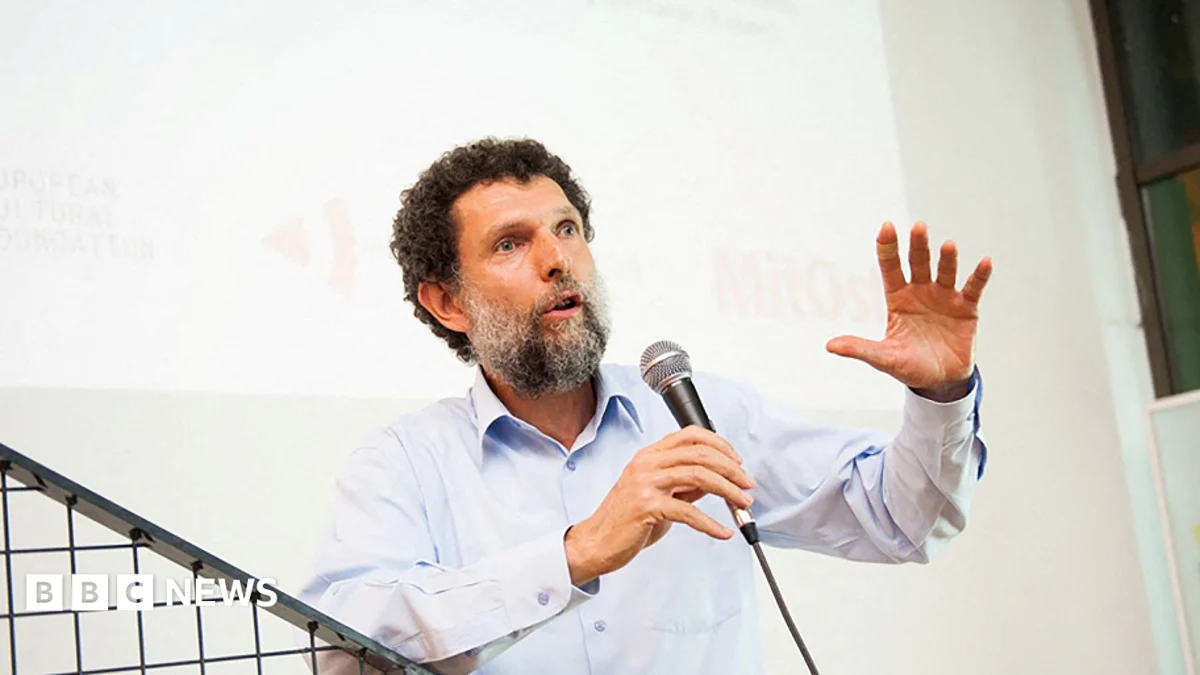
The European Court of Human Rights (ECHR) has issued a landmark ruling, ordering Turkey to immediately release prominent activist and philanthropist Osman Kavala, who has endured detention for nearly seven years. This decisive judgment on Tuesday marks the third time the Strasbourg-based court has demanded Kavala’s freedom, intensifying scrutiny on Turkey’s adherence to international human rights standards and the rule of law. Kavala, 68, was initially arrested in October 2017 and subsequently sentenced to an aggravated life term in 2022 on charges related to nationwide protests in 2013 and a failed coup attempt three years later. Rights groups, international bodies, and Kavala himself have consistently maintained that the accusations against him are politically motivated, designed to silence a critical voice within Turkish civil society.
The ECHR’s ruling unequivocally declared Kavala’s continued detention unlawful, asserting that his fundamental rights to a fair trial, freedom of expression, and freedom of association had been severely violated. In a strongly worded statement, the court highlighted that "the measures taken against the applicant… had been predominantly motivated by an ulterior purpose, namely, to punish him for his role in the Gezi Park demonstrations and for expressing his opinions as a human rights defender, and to silence him." Furthermore, the court found that Kavala’s aggravated life sentence amounted to "inhuman and degrading treatment," underscoring the severity of the rights abuses he has suffered. This latest judgment elevates the Kavala case from an individual grievance to a critical indicator of broader systemic issues within Turkey’s judiciary and its commitment to democratic principles.
Osman Kavala: A Symbol of Civil Society Under Pressure
Osman Kavala’s journey from a prominent figure in Turkish arts and culture to a symbol of government crackdown on civil society is a poignant narrative of contemporary Turkey. Born in Paris and educated in the United Kingdom, Kavala cultivated a career dedicated to fostering dialogue, cultural exchange, and human rights through various initiatives. Before his arrest, he managed Anadolu Kültür, a non-profit organization promoting cultural and artistic projects across Turkey, often in collaboration with European partners. His work focused on reconciliation, minority rights, and democratic values, positioning him as a respected, albeit often critical, voice in Turkish public life.
His philanthropic endeavors and advocacy for human rights, however, made him a target for the government of President Recep Tayyip Erdogan, particularly in the wake of significant political challenges. Kavala became the face of what human rights organizations describe as a systematic effort to stifle dissent, imprison critics, and erode the independence of civil society organizations. His detention, coming nearly four years after the Gezi Park protests, signaled a deepening intolerance for perceived opposition, regardless of its non-violent nature. President Erdogan himself has publicly accused Kavala of being an agent of the Hungarian-born US billionaire George Soros, a common trope used by populist leaders globally to discredit civil society and foreign influence.
The Gezi Park Protests and the Failed Coup: Twin Charges
Kavala’s legal ordeal is inextricably linked to two pivotal events in recent Turkish history: the 2013 Gezi Park protests and the 2016 failed military coup attempt. The Gezi Park demonstrations, which began as a local environmental protest against the planned destruction of a public park in Istanbul, rapidly escalated into nationwide anti-government rallies. Millions took to the streets across Turkey, expressing discontent over issues ranging from urban development plans to restrictions on freedom of expression and perceived authoritarian tendencies of the then-Prime Minister Erdogan’s government. These protests represented the first major challenge to Erdogan’s dominant political rule, shaking the foundations of his power and prompting a robust government response that saw thousands injured and several killed.
Prosecutors later alleged that these protests were not spontaneous civic action but a deliberate attempt to overthrow the government, orchestrated and financed by figures like Kavala. Human rights groups, including Amnesty International, have consistently refuted these claims, asserting that the Gezi Park protests were a legitimate expression of public grievances.
The second set of charges against Kavala emerged after the traumatic events of July 15, 2016, when a faction within the Turkish military attempted a coup. The failed putsch led to a sweeping government crackdown, with tens of thousands of people arrested, including military personnel, civil servants, academics, and journalists, on suspicion of links to the Gülen movement, which the government blames for orchestrating the coup. Kavala was accused of being involved in the coup attempt, a charge that appeared to many observers as a convenient pretext to prolong his detention after initial attempts to prosecute him for the Gezi Park events had faltered. The juxtaposition of these two disparate events in the charges against Kavala further highlighted the perceived political nature of his prosecution.
A Decade of Detention: A Chronology of Legal Persecution
Osman Kavala’s legal battle has unfolded over nearly a decade, marked by a pattern of arrests, acquittals, and re-arrests that have drawn international condemnation:
- October 18, 2017: Osman Kavala is arrested at Istanbul Atatürk Airport upon his return from a cultural exchange trip to Gaziantep. He is formally charged with "attempting to overthrow the constitutional order" and "attempting to overthrow the government" in connection with the Gezi Park protests.
- December 10, 2019: The ECHR issues its first ruling on Kavala’s case, finding that his detention was arbitrary, politically motivated, and violated his rights to liberty and security. The court demands his immediate release, stating that his detention was intended to silence him and deter other human rights defenders. Turkey, however, does not implement this binding ruling.
- February 18, 2020: In a surprising turn, a Turkish court acquits Kavala and eight other defendants of all charges related to the Gezi Park protests. Hopes for his release are short-lived.
- February 19, 2020: Just hours after his acquittal, Kavala is rearrested on new charges, this time related to the 2016 failed coup attempt, accused of "attempting to overthrow the constitutional order" and "espionage." This immediate re-arrest, before he could even leave the prison premises, sparked widespread outrage and confirmed fears that his detention was politically orchestrated.
- January 22, 2021: A higher appeals court overturns Kavala’s acquittal in the Gezi Park case, reopening the possibility of conviction on those charges. This move is seen as another setback for judicial independence.
- April 25, 2022: A Turkish court sentences Osman Kavala to aggravated life imprisonment without parole for "attempting to overthrow the government" through his alleged financing of the Gezi Park protests. Seven other co-defendants receive 18-year sentences for "aiding" the attempt. The verdict is widely denounced by international human rights organizations and Western governments.
- September 2022: Turkey’s Court of Cassation upholds the life sentence, further cementing his imprisonment despite international calls for his release.
- June 2024 (Latest Ruling Date): The ECHR issues its third and most comprehensive ruling, reiterating the unlawful nature of his detention, identifying multiple rights violations, declaring the life sentence as "inhuman and degrading treatment," and demanding his immediate and unconditional release. The court explicitly states that his prosecution was motivated by an "ulterior purpose" to silence him.
Reactions and Broader Implications
The latest ECHR ruling has elicited strong reactions from international human rights organizations and placed renewed pressure on Turkey. Eve Geddie, Director of Amnesty International’s European Institutions Office, emphasized the urgency of the situation, stating: "This obstruction of justice must end. Turkey’s authorities, including judicial and prosecutorial, must act to free Osman Kavala immediately and unconditionally." This sentiment is echoed by numerous other rights advocates and opposition groups within Turkey, who contend that President Erdogan’s government has increasingly weaponized the judiciary to silence critics, neutralize political rivals, and stifle independent voices.
In contrast, the Turkish government has consistently maintained that its courts are independent and that Kavala’s prosecution is a matter of domestic law. This stance, however, is increasingly at odds with the findings of the ECHR and other international bodies. The ECHR’s ruling explicitly highlighted a "systemic problem" in Turkey, characterized by the "detention and prosecution of political opponents, human rights defenders and journalists," and pointed to "structural shortcomings which affected the guarantees of independence and impartiality of the judiciary." This constitutes a damning indictment of the state of the rule of law in Turkey, suggesting that Kavala’s case is not an isolated incident but symptomatic of a broader trend.
The Kavala case remains one of the most serious recent flashpoints between Ankara and Strasbourg, testing the very foundations of Turkey’s membership in the Council of Europe. As a founding member of the Council of Europe, Turkey is bound by its conventions, including the European Convention on Human Rights, and is obligated to implement ECHR rulings. Despite this, Turkey has a troubling record of non-compliance with ECHR judgments, particularly concerning high-profile cases deemed politically sensitive.
The Council of Europe’s Committee of Ministers, responsible for overseeing the execution of ECHR judgments by its 46 member states, will now face a critical decision. A meeting scheduled for mid-September is highly likely to prioritize the Kavala case. The Committee possesses the power to initiate infringement proceedings, which could ultimately lead to severe punitive measures, including the suspension of a country’s voting rights or even the freezing of its membership. While Turkey has maintained its engagement with the Council of Europe system despite previous non-compliance, the cumulative weight of this third, emphatic ruling on Kavala could push the relationship to a breaking point.
The Future of the Rule of Law in Turkey
The ECHR’s latest ruling on Osman Kavala serves as a crucial barometer for the state of democracy and human rights in Turkey. It not only reaffirms the international community’s concern over Kavala’s unjust detention but also exposes the deep-seated issues within the Turkish judicial system. The court’s explicit mention of an "ulterior purpose" behind his prosecution resonates with the criticisms leveled by numerous observers who view the judiciary as a tool for political repression rather than an independent arbiter of justice.
The implications for Turkey are significant. Continued non-compliance with the ECHR’s binding ruling risks further isolating Turkey on the international stage, damaging its reputation, and straining its relations with European institutions. It also sends a chilling message to civil society within Turkey, signaling that even the highest European court’s intervention may not be enough to protect those who challenge the status quo. The Kavala case has become a litmus test for Turkey’s commitment to the fundamental principles of human rights and the rule of law, and the world watches to see if Ankara will finally heed the call for justice. The upcoming Committee of Ministers meeting will be a pivotal moment, determining not only Osman Kavala’s fate but also the future trajectory of Turkey’s relationship with the core institutions upholding European human rights standards.