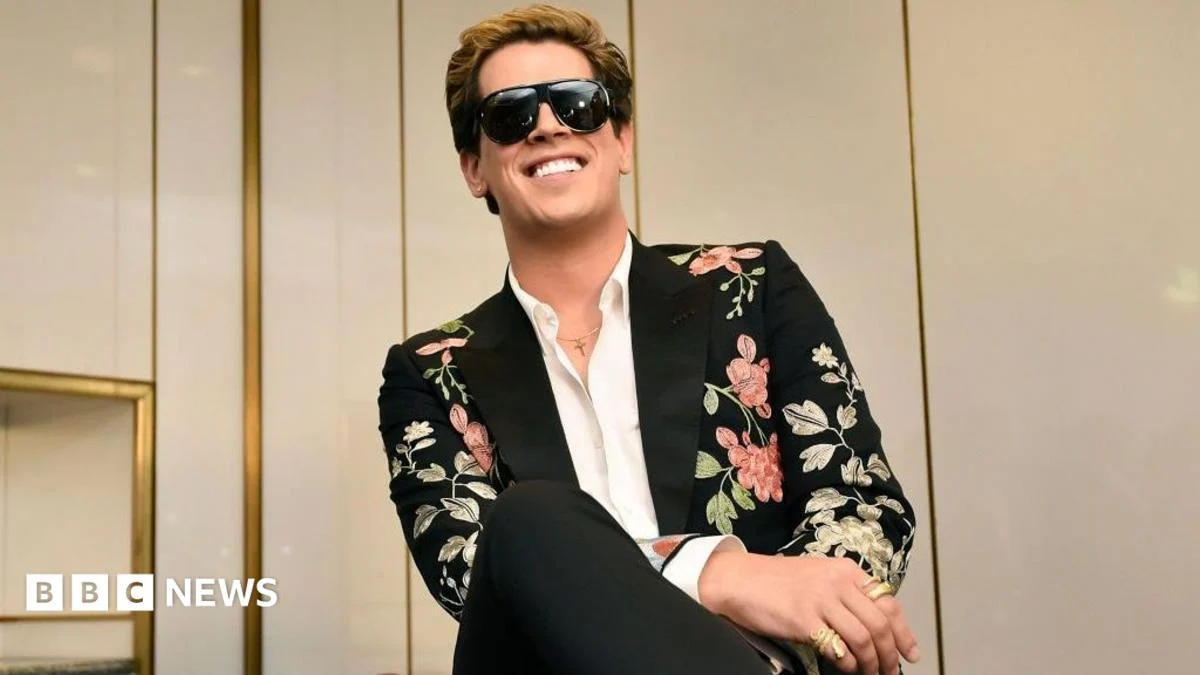
British political commentator Milo Yiannopoulos, a figure widely recognized for his provocative right-wing views and vocal support for former U.S. President Donald Trump, appears to have been detained by U.S. Immigration and Customs Enforcement (ICE). Records from the agency’s inmate registry indicate that Yiannopoulos, aged 41, is currently held in Louisiana. The precise circumstances surrounding his apparent detention remain undisclosed, and both ICE and Yiannopoulos have yet to respond to requests for official comment regarding the situation.
The Apparent Detention: Details from ICE Records
According to a search of the federal government’s online inmate locator for ICE detainees, Milo Yiannopoulos, identified by his full name and British nationality, is listed as being held. The registry provides limited information, typically confirming an individual’s presence in ICE custody and their location. In Yiannopoulos’s case, the records point to a facility in Louisiana, a state that houses several significant immigration detention centers. The lack of immediate official statements from either Yiannopoulos’s representatives or ICE leaves a void of information regarding the reason for his detention, the specific charges or immigration violations he may be facing, or his current legal status. This opacity is not uncommon in the initial stages of immigration enforcement actions, where information is often restricted for privacy or operational reasons.
For individuals like Yiannopoulos who are not U.S. citizens but reside in the United States, detention by ICE typically occurs if there are questions about their visa status, if they have overstayed a permitted period, or if they are deemed to have violated other immigration laws. It can also arise if an individual has committed certain crimes that make them deportable under U.S. law, even if they possess a valid visa. Without official confirmation, speculation regarding the cause of his apparent detention remains rife among observers, ranging from potential visa irregularities to more serious allegations.
Who is Milo Yiannopoulos? A Profile in Provocation
Milo Yiannopoulos rose to prominence in the mid-2010s as a leading figure on the American far-right, cultivating a persona as a self-styled "internet supervillain" and "provocateur." Born in Kent, England, Yiannopoulos gained significant traction as a technology editor at Breitbart News, a right-wing news and opinion website. His tenure at Breitbart, under the leadership of Steve Bannon, saw him become a highly visible and controversial figure, known for his inflammatory rhetoric, often directed at what he termed "political correctness."
His public image was meticulously crafted, characterized by flamboyant appearances, unapologetic defiance, and a penchant for generating outrage. He became a darling of certain segments of the conservative movement, particularly during the 2016 U.S. presidential election cycle, where he positioned himself as an ardent and unconventional supporter of Donald Trump. Despite identifying as gay, Yiannopoulos frequently attacked LGBTQ+ rights activists, feminists, Muslims, and the Black Lives Matter movement, often using humor and shock tactics to disseminate his views. His columns bore titles such as "Birth Control Makes Women Unattractive and Crazy" and "Would You Rather Your Child Had Feminism or Cancer?", deliberately designed to provoke and polarize.
A Provocateur’s Trajectory: From Breitbart to Blacklist
Yiannopoulos’s career trajectory is marked by rapid ascent, widespread influence, and an equally swift and dramatic fall from grace.
- Early Career and Rise to Prominence (Pre-2016): Prior to his Breitbart fame, Yiannopoulos was involved in various media ventures, including founding "The Kernel," a technology news site. However, it was his move to Breitbart News in 2014 that truly launched him into the American political consciousness. He became known for his "Dangerous Faggot Tour" on college campuses, where he often clashed with student protesters and delivered highly controversial speeches. These events cemented his image as a free speech absolutist challenging liberal orthodoxies.
- The 2016 Election Cycle and "Gays for Trump": The 2016 U.S. presidential election proved to be Yiannopoulos’s peak moment of influence. He leveraged his platform at Breitbart and his campus tours to champion Donald Trump, becoming a prominent voice within the "alt-right" movement that coalesced around Trump’s candidacy. He notably headlined a "Gays for Trump" event during the Republican National Convention, an ironic position given his often-derogatory comments about the LGBTQ+ community. His unique blend of identity (gay, British, self-proclaimed conservative) and extreme views made him an unusual, yet compelling, figure for many who felt alienated by mainstream media and politics.
- The CPAC Scandal and Breitbart Resignation (2017): Yiannopoulos’s career suffered a catastrophic blow in February 2017. Footage surfaced in which he appeared to condone paedophilia, making comments about older men and younger boys that were widely interpreted as an endorsement of child sexual abuse. The ensuing public outcry was immediate and severe. Despite his claims that his comments were taken out of context and referred to his own past experiences, the backlash was overwhelming. He was swiftly uninvited from speaking at the Conservative Political Action Conference (CPAC), a major annual gathering of conservatives that also hosted then-President Trump. Days later, he resigned from Breitbart News, effectively ending his mainstream platform and beginning a period of significantly diminished public visibility. This incident served as a stark reminder that even within the fringes of political commentary, certain lines cannot be crossed without severe consequences.
- Post-Breitbart and Continued Controversies (2017-Present): Following his departure from Breitbart, Yiannopoulos struggled to regain his previous level of influence. He attempted to launch new ventures, including a media company called MILO Inc., but these largely failed to materialize. He continued to be active on social media, albeit with reduced reach due to numerous bans from platforms like Twitter (now X) and Facebook for violating their terms of service, often related to hate speech or harassment. In recent years, he briefly worked for rapper Kanye West (now known as Ye), an association that itself drew considerable media attention given Ye’s own controversial statements and public struggles. More recently, Yiannopoulos has adopted the label "ex-gay," stating he no longer identifies as gay, adding another layer of complexity and controversy to his public persona.
The Alt-Right and Ideological Alignment
Yiannopoulos has been consistently associated with the alt-right, a disparate, loosely defined far-right movement that emerged in the mid-2010s, primarily online. Characterized by its opposition to mainstream conservative politics, "political correctness," and multiculturalism, the alt-right embraces various ideologies, including white nationalism, neo-Nazism, anti-feminism, and nativism. While Yiannopoulos has publicly stated he does not consider himself part of the alt-right, he has also described it as "energising and exciting" and played a significant role in popularizing its themes and figures, often acting as a bridge between the fringes and a broader, albeit still niche, audience. His rhetoric often mirrored alt-right talking points, particularly his critiques of immigration, feminism, and identity politics. This association, regardless of his self-identification, further cemented his reputation as a figure on the extreme right of the political spectrum.
Vocal Support for Trump and Immigration Policies
Throughout his career, Yiannopoulos has been an unwavering and vociferous supporter of Donald Trump, particularly endorsing the former president’s stringent immigration policies. He consistently advocated for tighter border controls, increased deportations, and a more nationalistic approach to immigration. His stance was exemplified by a post on X (formerly Twitter) last year, where he explicitly called for "Total legal immunity for ICE agents when they’re on duty." This public endorsement of aggressive immigration enforcement makes his current apparent detention by ICE particularly noteworthy and, for some, ironic.
Trump’s "America First" agenda placed a heavy emphasis on immigration restriction, including the construction of a border wall, increased ICE enforcement, and limitations on legal immigration pathways. Yiannopoulos’s rhetoric often aligned perfectly with these policies, portraying immigrants, especially those from non-European backgrounds, as a threat to Western culture and national identity. His past statements and calls for expanded powers for immigration enforcement agencies now stand in stark contrast to his own predicament, where he is seemingly subject to the very system he so enthusiastically championed.
Legal Framework and Unanswered Questions
The detention of non-citizens by ICE falls under a complex legal framework governed by U.S. immigration law. When an individual is taken into custody, they are typically processed, and an immigration judge determines whether they can be released on bond or must remain detained pending a resolution of their immigration case. The process can involve hearings to determine deportability, eligibility for relief from removal, or asylum claims. The lack of specific information regarding Yiannopoulos’s case means that critical questions remain unanswered:
- Grounds for Detention: What specific immigration violation or alleged offense led to his apprehension?
- Visa Status: Does he possess a valid U.S. visa, and if so, what type? Has it expired or been revoked?
- Legal Representation: Is he being represented by an attorney, and what legal strategies might be pursued?
- Future Proceedings: Will he face deportation proceedings, or is there a pathway for him to resolve any issues and remain in the U.S.?
Given his high profile, any official proceedings would likely attract significant public and media attention, though immigration court proceedings are often less transparent than criminal trials.
Broader Implications and Public Reaction
The news of Milo Yiannopoulos’s apparent detention has sparked a predictable range of reactions across the political spectrum. For his critics, it may be seen as a form of poetic justice, an ironic turn of events for a figure who vocally supported the very enforcement mechanisms that now appear to be affecting him. His history of advocating for strict immigration policies, including "total legal immunity for ICE agents," creates a narrative of comeuppance for those who view his past rhetoric as harmful.
For his diminishing base of supporters, the detention might be framed as another instance of persecution against a right-wing commentator, a perceived attack by the "deep state" or liberal establishment. This narrative aligns with the broader grievance culture often cultivated by figures like Yiannopoulos, where any adverse event can be spun as evidence of a systemic conspiracy against conservative voices.
Beyond the immediate reactions, Yiannopoulos’s apparent detention carries several broader implications:
- Impact on His Career: While his public profile has waned since 2017, this incident could further complicate any attempts at a resurgence. Immigration issues can be lengthy and costly, diverting resources and attention away from any potential media projects.
- Symbolic Weight: The detention of a prominent right-wing, anti-immigrant figure by immigration authorities carries significant symbolic weight, highlighting that immigration laws apply to all non-citizens, regardless of their political affiliations or public platform.
- Media Scrutiny: The event will undoubtedly reignite discussions about Yiannopoulos’s past controversies, the nature of right-wing media, and the role of provocative figures in political discourse.
- The Power of Immigration Enforcement: It serves as a stark reminder of the broad powers vested in ICE and the potential consequences for non-citizens who run afoul of U.S. immigration laws, even those who have previously championed those very laws.
As of now, the full story behind Milo Yiannopoulos’s apparent detention remains largely unconfirmed by official sources. The coming days and weeks are expected to shed more light on the circumstances, potential charges, and the legal path forward for the controversial commentator. Until then, his situation stands as a potent, if opaque, footnote in the ongoing saga of a figure who built his career on challenging norms and provoking reactions.