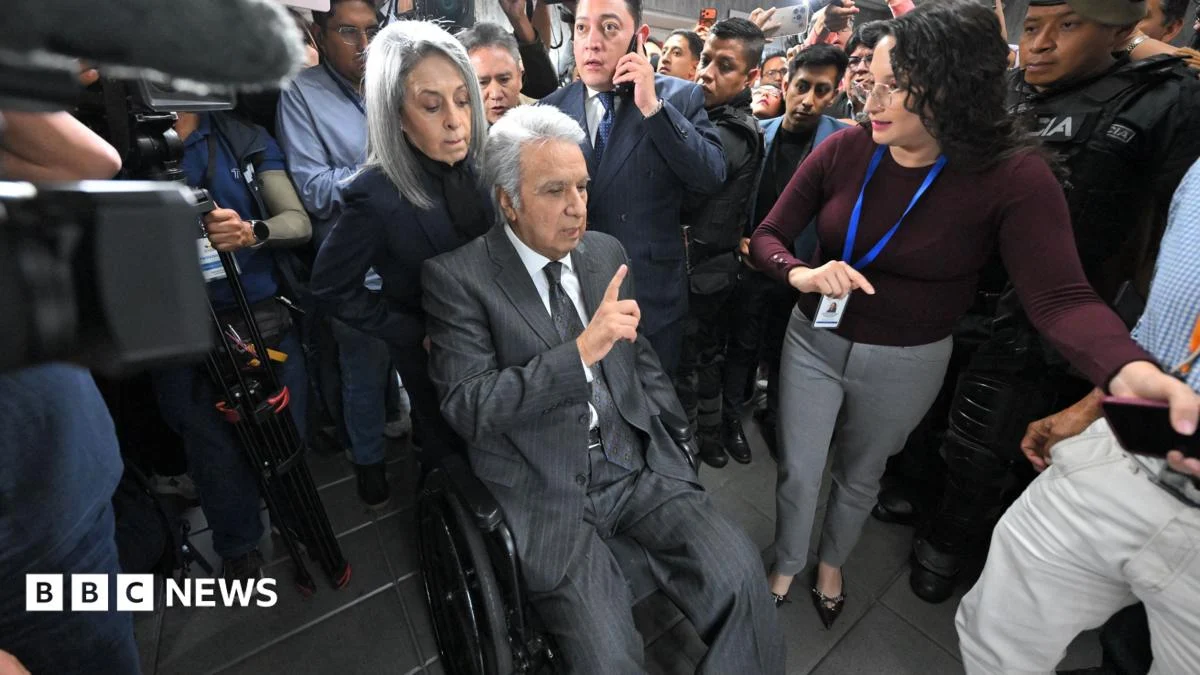
A landmark ruling in Ecuador has seen former President Lenín Moreno sentenced to five years in prison after being found guilty of taking bribes related to a significant national infrastructure project. The verdict, delivered by a court in the capital, Quito, marks a pivotal moment in Ecuador’s ongoing struggle against systemic corruption, as Moreno becomes the third former head of state in the Andean nation to face conviction for illicit activities. Due to his age of 73 and a disability, the former president will serve his sentence under house arrest, a provision often made for elderly or infirm individuals in the Ecuadorian legal system. Moreno has promptly indicated his intention to appeal the verdict, asserting his innocence against the charges.
The case, known as "Sinohydro" or "INA Papers," revolved around allegations that Moreno and a network of associates received illicit payments from Sinohydro, a Chinese state-owned firm, in exchange for securing the lucrative contract to construct the Coca Codo Sinclair hydroelectric plant. This monumental project, envisioned as a cornerstone of Ecuador’s energy independence, has been plagued by controversy since its inception. Prosecutors alleged that a staggering $76.1 million (approximately £56.2 million) was funneled through an intricate web of shell companies to individuals involved in the deal. The beneficiaries included not only Moreno himself, albeit a smaller portion, but significantly, his immediate family members – his wife, daughter, and brother – who were alleged to have received tens of thousands of dollars.
The conviction extended beyond Moreno, encompassing 19 other individuals implicated in the extensive corruption scheme. Among those handed prison sentences were Moreno’s wife, Rocío Gonzáles; his daughter, Cristina Moreno; and his brother, Edwin Moreno. Also convicted were former plant managers, representatives of Sinohydro, and even a former Chinese ambassador to Ecuador, further highlighting the far-reaching nature and international dimensions of the alleged bribery ring. The court’s decision stipulated that all those convicted of bribery would be required to repay three times the amount they illicitly received, a measure designed to deter future corruption and recover stolen public funds. Additionally, Lenín Moreno has been barred from holding public office, effectively ending his political career.
The Coca Codo Sinclair Project: A Saga of Ambition and Allegations
The Coca Codo Sinclair hydroelectric dam project, at the heart of the scandal, was conceived during the administration of former President Rafael Correa (2007-2017) and was touted as Ecuador’s largest energy project, designed to provide a substantial portion of the nation’s electricity needs. Construction began in 2010, with Sinohydro awarded the contract, and the plant was inaugurated in 2016. The initial cost was estimated at approximately $2.2 billion, primarily financed by a loan from the Export-Import Bank of China.
However, almost from the outset, the project was mired in controversy. Technical reports, including some from the Comptroller General’s Office of Ecuador, later revealed significant structural flaws, particularly thousands of cracks in the dam’s distributor, raising serious concerns about its long-term viability and safety. Environmental critics also pointed to potential ecological damage from its construction. These issues led the Ecuadorian government to launch legal proceedings against Sinohydro in 2021, seeking reparations for the defects. This year, after protracted negotiations, the government reached a $400 million settlement with Sinohydro’s owner, the Chinese state, to address the construction failures and ensure necessary repairs.
The bribery allegations surrounding Coca Codo Sinclair specifically pointed to the period when Moreno served as Vice President under Correa (2007-2013), and subsequently during his own presidency (2017-2021). Prosecutors detailed how the alleged bribes were structured through shell companies, many of which were reportedly registered in offshore jurisdictions. These companies acted as intermediaries, obscuring the true recipients of the funds and making the trail of money exceedingly difficult to follow. The prosecution successfully argued that these payments were directly linked to the awarding and execution of the hydroelectric plant contract, ensuring that Sinohydro maintained its favored position despite mounting concerns about the project’s quality and cost.
Moreno’s Defense and the Shadow of Rafael Correa
Throughout the legal proceedings, Lenín Moreno vehemently denied any involvement in the alleged bribery scheme. His defense strategy largely focused on shifting blame to his predecessor and former political ally, Rafael Correa. Moreno argued that the Coca Codo Sinclair project, including the contract with Sinohydro, was initiated and largely overseen during Correa’s presidency, under whom Moreno served as Vice President. He contended that he had inherited a problematic project and, upon assuming the presidency in 2017, had in fact launched investigations into the construction issues and potential irregularities.
The complex relationship between Moreno and Correa forms a critical backdrop to this case. Moreno, a long-time ally of Correa, was hand-picked by him to succeed him in the presidency. However, shortly after taking office, Moreno dramatically distanced himself from Correa’s populist policies, initiating a process of de-Correafication that included reversing many of his predecessor’s reforms and launching anti-corruption probes that targeted figures from the Correa era. This political rupture led to a bitter and public feud between the two men.
Rafael Correa himself is no stranger to corruption charges. In 2020, he was sentenced in absentia to eight years in prison in a separate bribery case, known as the "Sobornos 2012-2016" (Bribes 2012-2016) case. That case involved allegations that his Alianza PAIS party received illicit contributions from businesses in exchange for state contracts. Correa, who currently resides in Belgium, where he has been granted political asylum, maintains his innocence and claims to be a victim of political persecution orchestrated by Moreno’s government. The current conviction of Moreno, therefore, adds another layer to the intricate and often acrimonious political landscape of Ecuador, where allegations of corruption frequently intertwine with political rivalries.
A Chronology of Key Events in the Coca Codo Sinclair Saga and Related Cases:
- 2007-2017: Rafael Correa serves as President of Ecuador. Lenín Moreno serves as Vice President from 2007-2013.
- 2009: Ecuadorian government, under Correa, signs agreement with Sinohydro for the construction of the Coca Codo Sinclair hydroelectric plant.
- 2010: Construction of Coca Codo Sinclair begins, financed largely by a Chinese loan.
- April 2016: Coca Codo Sinclair hydroelectric plant is inaugurated.
- May 2017: Lenín Moreno is inaugurated as President of Ecuador. He begins to distance himself from Correa’s policies.
- 2018-2019: Reports emerge of structural flaws, including thousands of cracks, in the Coca Codo Sinclair dam.
- February 2019: The "INA Papers" scandal breaks, alleging that an offshore company linked to Moreno’s family received illicit payments. This triggers initial investigations.
- April 2020: Rafael Correa is sentenced in absentia to eight years in prison for bribery in the "Sobornos 2012-2016" case.
- May 2021: Ecuadorian government, under Moreno, files a lawsuit against Sinohydro for $77 million due to technical failures and cracks in the dam.
- March 2023: Prosecutors formally accuse Lenín Moreno and 36 others of bribery in the "Sinohydro" case.
- Early 2024: The Ecuadorian government reaches a $400 million settlement with Sinohydro’s owner (the Chinese state) to address the dam’s technical issues.
- April 2024: Lenín Moreno and 19 co-defendants are found guilty of bribery in the "Sinohydro" case, with Moreno sentenced to five years under house arrest.
Ecuador’s Enduring Battle Against Corruption
The conviction of Lenín Moreno underscores Ecuador’s persistent struggle with corruption, a systemic issue that has plagued its political and economic development for decades. Moreno’s case follows that of not only Rafael Correa but also Abdalá Bucaram (president 1996-1997), who was sentenced to prison in 2020 for organizing crime, though later acquitted of other charges. This pattern of high-level convictions reflects a growing, albeit challenging, effort by the Ecuadorian judiciary and anti-corruption bodies to hold powerful figures accountable.
According to Transparency International’s Corruption Perception Index, Ecuador consistently ranks poorly, indicating a high perceived level of corruption within its public sector. The country’s score has fluctuated, reflecting periods of intensified anti-corruption efforts alongside ongoing challenges. Such high-profile cases, while demonstrating judicial independence and a commitment to justice, also highlight the deep-seated nature of the problem, often involving complex international networks and significant financial flows.
The implications for Ecuador’s institutional stability and public trust are substantial. Each major corruption scandal erodes faith in governance, discourages foreign investment, and diverts crucial resources from public services. However, successful prosecutions like Moreno’s can also serve as a deterrent, signaling that impunity for high-ranking officials is no longer guaranteed.
Reactions and Broader Implications
Following the verdict, Lenín Moreno’s legal team immediately confirmed their intention to appeal, reiterating their client’s claim of innocence and alleging political motivations behind the prosecution. They are expected to challenge the legal basis of the conviction and the evidence presented.
The Ecuadorian Attorney General’s Office, responsible for the prosecution, has not yet issued a detailed public statement following the conviction, but previous comments have consistently emphasized the office’s commitment to upholding the rule of law and combating corruption at all levels. This verdict is likely to be hailed by the prosecution as a significant victory in their ongoing efforts.
The current Ecuadorian government, led by President Daniel Noboa, is expected to reaffirm its commitment to transparency and good governance. While specific official statements regarding Moreno’s conviction are pending, the general stance of recent administrations has been to support judicial independence and anti-corruption initiatives. This case also has implications for future large-scale infrastructure projects, particularly those involving foreign investment. It is likely to lead to increased scrutiny, more rigorous due diligence, and enhanced transparency requirements for government contracts, especially those financed by international entities.
Internationally, the conviction could prompt further examination of Chinese state-owned enterprises operating in Latin America and other developing regions. While Sinohydro and the Chinese embassy in Ecuador were approached for comment by the BBC during the initial reporting and have not publicly responded, such cases can raise questions about the governance and ethical practices associated with large-scale foreign investments, particularly under China’s Belt and Road Initiative. Governments and international organizations are increasingly scrutinizing the transparency and accountability mechanisms in major development projects to prevent similar illicit activities.
Ultimately, the conviction of Lenín Moreno represents a complex chapter in Ecuador’s political narrative. It reflects both the deep challenges of corruption within the nation’s political elite and a burgeoning, albeit difficult, path towards greater accountability and judicial integrity. The appeal process will continue to unfold, but the initial verdict sends a clear message about the consequences of abusing public trust for personal gain, reinforcing the ongoing quest for justice in a country determined to shed its past.