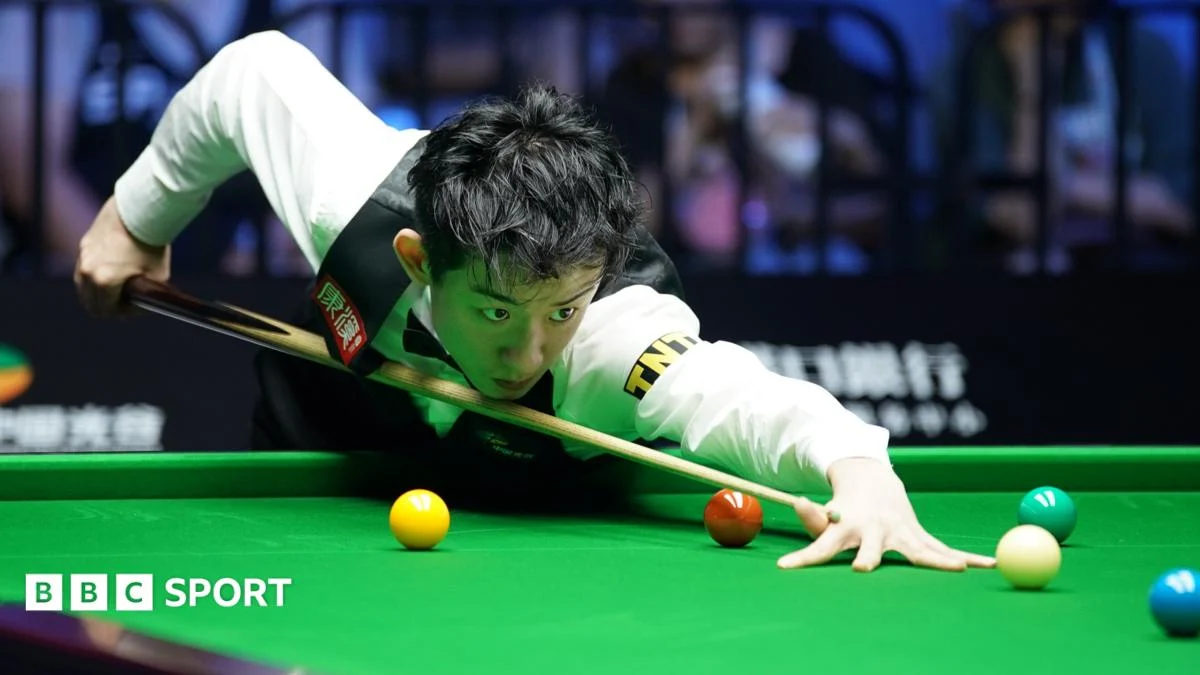
The opening day of the prestigious British Open snooker championship, held in the historic spa town of Cheltenham, has already delivered a significant talking point with the confirmation of a compelling second-round encounter between reigning world champion Wu Yize and former Crucible king Kyren Wilson. Both snooker titans successfully navigated their initial hurdles, setting the stage for a high-stakes showdown that promises to captivate fans and analysts alike.
Wu Yize, the current holder of the sport’s most coveted title, demonstrated his class by overcoming fellow Chinese compatriot Liu Hongyu in a hard-fought contest that went the full distance, concluding with a 4-3 victory. The match, played out under the intense scrutiny of the British Open arena, showcased the growing depth of talent emerging from China, a nation that has rapidly ascended to the forefront of professional snooker in recent years. Wu’s ability to maintain composure under pressure, particularly in the deciding frame, underscored his championship pedigree.
Across town, Kyren Wilson, the 2024 world champion and a seasoned campaigner with a reputation for his aggressive, attacking style, dispatched his Austrian opponent, Florian Nuessle, with relative ease. Wilson secured a convincing 4-1 win, signaling his intent to add another significant title to his already illustrious career. His performance suggested a player hitting form at the opportune moment, a prospect that will undoubtedly concern his future opponents.
The early stages of the British Open have also seen several other prominent figures advance to the second round. Last year’s British Open champion, Shaun Murphy, known for his eloquent break-building and tactical acumen, has progressed, as has the ever-consistent Ding Junhui, a multiple ranking event winner and a figurehead for Chinese snooker for over a decade. Barry Hawkins, a player renowned for his resilience and steely determination, and the explosive Judd Trump, a former world champion and one of the sport’s most popular stars, have also booked their places in the next stage. The legendary John Higgins, a four-time world champion and a veteran of the sport, continues his quest for further silverware, demonstrating that his renowned cueing ability and competitive spirit remain undimmed.
However, the tournament has not been without its significant upsets, providing a stark reminder of the unpredictable nature of professional snooker. Three-time world champion Mark Williams, a player who has achieved legendary status through sheer longevity and unparalleled skill, suffered a surprising and comprehensive 4-0 defeat at the hands of David Gilbert. This result will be a significant disappointment for Williams and his legions of fans, who have come to expect strong performances from the Welshman in major tournaments.
Adding to the list of notable casualties, world number two Neil Robertson experienced a disappointing exit, falling 4-1 to the emerging Chinese talent Pang Junxu. Robertson, a former world champion and one of the most prolific break-builders in the game, will be looking to analyze this performance and regroup for future events. The defeat for the Australian underscores the increasing threat posed by the younger generation of Chinese players who are now consistently challenging the established order.
Further compounding the sense of disruption, 2023 world champion Luca Brecel was narrowly defeated in a dramatic deciding frame, losing 4-3 to Chris Wakelin. Brecel, whose dynamic and attacking style captivated audiences during his fairytale run to the world title, was unable to replicate that magic on this occasion, highlighting the fine margins that often separate victory and defeat at this elite level.
In a story of a different kind, Mark Joyce has found himself in the spotlight after stepping in to replace seven-time world champion Ronnie O’Sullivan. O’Sullivan, a sporting icon and arguably the greatest player of all time, withdrew from the tournament citing medical reasons, a decision that undoubtedly impacted the event’s narrative. Joyce, a professional who has consistently competed on the tour, seized his opportunity by defeating Poland’s Mateusz Baranowski 4-1, securing his passage to the second round and demonstrating his capability to compete at this level.
The anticipation surrounding the British Open is further heightened by the impending opening-round match of the new world number one, Zhao Xintong. Zhao, who made history by becoming the first Chinese player to achieve the world number one ranking in 2025, is set to face England’s Oliver Brown on Tuesday. His ascent to the pinnacle of the sport is a testament to his exceptional talent and dedication, solidifying China’s dominance in the snooker world.
Zhao’s recent form has been nothing short of sensational. Last week, he reached the final of the Wuhan Open, a significant ranking event held in his homeland. This impressive run secured his coveted world number one status. However, the Wuhan Open final saw him narrowly defeated 10-7 by his compatriot Chang Bingyu in a captivating title match. This experience, while a defeat, will undoubtedly have provided Zhao with invaluable match practice and further motivation as he embarks on his British Open campaign.
The British Open, a tournament with a rich history dating back to 1985, is distinguished by its unique tournament format. Unlike many other major snooker events, the British Open employs a completely random draw for each round, with no seeding system in place. This format ensures that high-profile players, regardless of their ranking or reputation, can face each other at any stage of the competition. This approach guarantees an element of unpredictability and excitement, as established stars can be pitted against emerging talents or fellow top players from the very first round. This system, while potentially leading to early clashes of titans, fosters a meritocratic environment where every player has the opportunity to prove their mettle.
Background and Context of the British Open
The British Open, often considered one of snooker’s flagship events, has a storied past, marked by memorable moments and the crowning of numerous champions. Established in 1985, the tournament has evolved over the decades, adapting to the changing landscape of professional snooker. Its current iteration, held in Cheltenham, represents a continuation of this legacy, attracting the world’s elite players to compete for one of the sport’s most prestigious titles. The event’s significance is amplified by its placement within the snooker calendar, often serving as a crucial indicator of form and a vital opportunity for players to accumulate ranking points. The random draw system, a distinctive feature of the British Open, adds a layer of intrigue, ensuring that no match is taken for granted and that the path to the title is often fraught with unexpected challenges.
Timeline of Key Events and Performances
The initial stages of the British Open have unfolded with a blend of expected triumphs and surprising reversals. The tournament commenced with the first round of matches, setting the tone for the week ahead.
-
Opening Day Matches:
- Wu Yize defeated Liu Hongyu 4-3.
- Kyren Wilson defeated Florian Nuessle 4-1.
- Shaun Murphy, Ding Junhui, Barry Hawkins, Judd Trump, and John Higgins all secured victories to progress.
- Mark Williams lost to David Gilbert 4-0.
- Neil Robertson fell to Pang Junxu 4-1.
- Luca Brecel was defeated by Chris Wakelin 4-3.
- Mark Joyce defeated Mateusz Baranowski 4-1.
-
Upcoming Matches:
- Zhao Xintong is scheduled to play his opening-round match against Oliver Brown on Tuesday.
-
Recent Form Context:
- Zhao Xintong reached the final of the Wuhan Open the previous week, securing the world number one ranking but losing to Chang Bingyu.
- Ronnie O’Sullivan withdrew from the tournament due to medical reasons.
Supporting Data and Player Statistics
While specific match statistics such as break percentages and safety play effectiveness are not immediately available from the initial reports, the results themselves provide significant data points. The dominance of certain players, like Wu Yize and Kyren Wilson, in their opening matches, suggests strong statistical performances in terms of frames won. Conversely, the comprehensive defeat of Mark Williams indicates a potential dip in his usual statistical output or a particularly inspired performance from his opponent.
The emergence of Chinese players continues to be a significant trend. The fact that Wu Yize is the current world champion and Zhao Xintong is the new world number one highlights the sustained success of Chinese talent. Pang Junxu’s victory over Neil Robertson, a player consistently ranked in the top echelons of the sport, further reinforces this observation.
Broader Impact and Implications
The British Open, with its unique format and high-profile participants, has far-reaching implications for the snooker world. The early elimination of established stars like Mark Williams and Neil Robertson, while disappointing for their fans, opens up opportunities for other players to make their mark. The unexpected nature of these results underscores the competitive parity that has developed within professional snooker, making every match a potential upset.
The upcoming clash between Wu Yize and Kyren Wilson is particularly significant. It pits the current reigning world champion against a former world champion, a match that could easily have been a World Championship final. The outcome of this encounter will not only determine progression in the British Open but also provide valuable insights into the current form and mental fortitude of two of snooker’s biggest stars.
The continued success of Chinese players, exemplified by Wu Yize, Zhao Xintong, and Pang Junxu, signals a shift in the global power dynamics of snooker. Their consistent performances at the highest level suggest that this trend is not a temporary phenomenon but rather a fundamental evolution of the sport. This has implications for the development of snooker in other regions and the strategies employed by national federations to cultivate talent.
The withdrawal of Ronnie O’Sullivan, a global icon, inevitably impacts the tournament’s appeal and narrative. However, it also presents an opportunity for other players to step into the spotlight and gain wider recognition. The British Open, through its unpredictable nature, consistently provides such platforms for emerging talent and established players alike to showcase their skills and pursue championship glory. The random draw, while controversial for some, ensures that the tournament remains a true test of adaptability and resilience, where every opponent presents a unique challenge, and the path to victory is never guaranteed. The tournament’s continued success hinges on its ability to deliver thrilling matches and compelling narratives, and this year’s edition is already shaping up to be a memorable one.