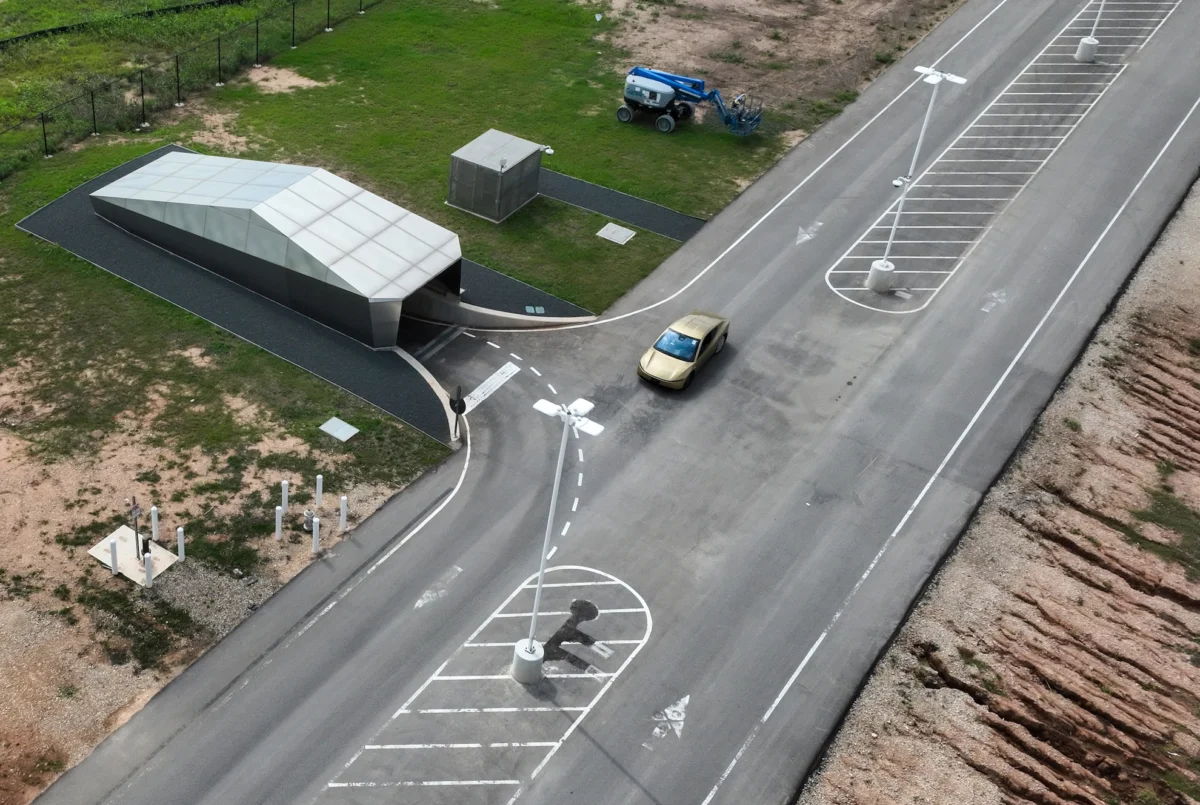
Today marks a potentially transformative day for Tesla, as the company officially "launches" its highly anticipated Cybercab in its hometown of Austin, Texas. This event is not merely the unveiling of a new vehicle; it represents a critical juncture that could redefine Tesla’s corporate identity, transitioning it from a dominant electric vehicle manufacturer to a front-runner in artificial intelligence and robotics. The Cybercab, a compact, gold-hued, two-seater sedan devoid of a steering wheel or pedals, relies entirely on an array of cameras and advanced AI to navigate its environment, embodying CEO Elon Musk’s long-held vision for fully autonomous ride-hailing.
The precise nature of the launch event remains shrouded in Tesla’s characteristic secrecy. It could range from a limited deployment of a few vehicles offering rides within a confined downtown area to a significantly grander and more expansive demonstration of its capabilities. However, Tesla’s pre-launch activities strongly suggest the latter, signaling an ambitious intent to make a substantial impact. In the weeks leading up to the event, dozens of Cybercabs were strategically positioned across Austin and other major U.S. cities, generating considerable public buzz. This aggressive rollout strategy is underpinned by a growing fleet of autonomous vehicles registered in Texas; according to the state’s automated vehicle tracker, 420 such vehicles were registered at the time of this publication, indicating a burgeoning ecosystem for self-driving technology.
The Road to Autonomy: A Decade of Promises and Pivots
The concept of fully autonomous vehicles has been a cornerstone of Elon Musk’s long-term vision for Tesla for over a decade. His pronouncements on self-driving capabilities have consistently pushed the boundaries of technological ambition, often preceding the actual readiness of the technology. As early as 2016, Musk famously declared that every Tesla vehicle being manufactured possessed the requisite hardware for full autonomy, requiring only a software update to unlock its potential. This assertion, however, proved premature. Tesla has since undergone multiple hardware revisions in its vehicles, and Musk himself has recently conceded that millions of existing Tesla cars will necessitate some form of hardware retrofit to achieve true autonomous functionality.
Despite these technical hurdles and the iterative nature of development, Tesla has relentlessly pursued its driving automation software. The company’s primary offering, Full Self-Driving (Supervised), has seen continuous releases and refinements. While increasingly capable, FSD (Supervised) remains a driver-assistance system, with the ultimate responsibility and liability resting firmly with the human driver. The Cybercab represents a fundamental departure from this paradigm. It is designed from the ground up to operate without human intervention, shifting the onus entirely to the vehicle’s AI and Tesla as its developer.
The genesis of the Cybercab is rooted in Tesla’s strategic effort to develop a next-generation EV platform that prioritized cost-effectiveness. The objective was to leverage the manufacturing lessons learned from the highly successful Model 3 and Model Y—Tesla’s mass-market stalwarts—to create a new platform that would slash production costs by half. This would ostensibly pave the way for a new generation of more affordable Tesla electric vehicles. However, historical accounts and Musk’s own biography reveal a singular focus on achieving full autonomy. Rather than developing a manually drivable car on this new platform, Musk pivoted entirely to designing a dedicated two-seater robotaxi, which ultimately materialized as the Cybercab. This strategic shift was underscored in April 2024, months before the Cybercab’s public reveal, when Musk initiated significant layoffs across Tesla, declaring an all-in commitment to autonomy, which he termed a "blindingly obvious move." He famously dismissed all other vehicle designs as "variations on a horse carriage," emphasizing his conviction that autonomy represented the definitive future of transportation.
A Storm of Cybercabs: The Pre-Launch Hype and Shifting Narrative
Tesla’s pre-launch campaign for the Cybercab has been characterized by an aggressive and highly visible marketing blitz, a stark contrast to the more cautious messaging that preceded it. In the months leading up to the event, Musk and other Tesla executives had frequently stressed a measured, safety-first approach to robotaxi development, seemingly prioritizing public perception over rapid deployment. However, this narrative has dramatically shifted, replaced by an almost defiant assertion of readiness and scale.
Ashok Elluswamy, the head of Tesla AI, ignited anticipation with a post on X, stating that the "streets won’t be the same anymore." This sentiment was amplified by Musk himself, who, in response to a user’s comment about Tesla being "about to flood Austin," simply replied, "Yes." The crescendo of pre-launch hype reached a peak with Musk’s Wednesday night post featuring a seemingly AI-generated image of Cybercabs engulfing the city amidst a massive dust storm, captioned, "A Storm of Cybercabs." These gravitas-laced posts mark a significant departure from the company’s prior "go-slow-and-safe" rhetoric, signaling a bold, unreserved push into the autonomous ride-hailing market. This change in tone suggests a company confident in its recent advancements, or perhaps one acutely aware of the high stakes involved and seeking to manage expectations through sheer force of will.
Design Philosophy: Cost, Scale, and the Cybercab’s Unique Proposition

The Cybercab’s design is intrinsically linked to Tesla’s strategy for achieving widespread robotaxi adoption: cost-efficiency and scalability. It is intentionally smaller, lighter, and equipped with a lower-capacity battery pack than any other Tesla vehicle. This minimalist approach translates directly into reduced material costs, particularly for the battery, which is often the most expensive component of an electric vehicle. By lowering the manufacturing cost, Tesla aims to accelerate its path to profitability once the Cybercab network is deployed.
This economic model has generated considerable excitement among Tesla’s most fervent supporters. They point to Tesla’s projected ability to produce dozens of Cybercabs for a similar investment that competitors like Waymo might expend on acquiring and outfitting fewer than ten of its latest "Ojai" vans. This comparison, they argue, unequivocally demonstrates Tesla’s decisive advantage in the burgeoning robotaxi market. Elon Musk appears to endorse this perspective, having replied to a graphical representation of this cost argument with, "this doesn’t even take into account the operational efficiency of Cybercab."
However, industry analysts and skeptics highlight several critical caveats. Tesla’s current robotaxi operations, initiated with modified Model Y SUVs, have so far been confined to specific geofenced areas within cities. While some of these geofences have expanded, Musk himself once famously stated, "If you need a geofenced area, you don’t have real self-driving." This apparent contradiction raises questions about the true autonomy of the Cybercab and its ability to operate seamlessly across unrestricted urban landscapes.
Operational Realities: Pilot Programs, Incidents, and the Geofencing Dilemma
Tesla’s initial foray into robotaxi services began in June 2025 in Austin, utilizing modified Model Y SUVs. During the initial months, a human safety operator was always present, either behind the wheel or in the passenger seat, ready to intervene if necessary. While no catastrophic failures have been reported, Tesla has documented several dozen incidents in Austin since the pilot’s inception. The majority of these incidents involved minor collisions with stationary objects, with a few requiring remote teleoperator intervention at low speeds.
The Model Y-based robotaxi system has since expanded to a few other cities in Texas and Florida. However, the network’s growth and performance over the past year have not fully aligned with the initial hype. A notable setback occurred in July 2026, when the company revealed that the number of paid miles facilitated by the network was actually declining. This suggests that scaling a robotaxi service presents significant operational challenges, even with existing, modified vehicles.
Tesla’s belief is that the dedicated Cybercab platform is essential for achieving the necessary scale and profitability. Its optimized design and lower production cost are intended to overcome the limitations encountered with the Model Y pilot. However, the challenge of operating a vast, driverless network at scale extends beyond mere vehicle economics. A smaller, geofenced network inherently exposes the self-driving software to fewer "edge cases"—unusual or complex scenarios that are difficult for autonomous systems to predict and navigate. This has arguably allowed Tesla to benefit from a relatively lower incident rate compared to competitors like Waymo, which operates a much larger fleet of 4,000 robotaxis across more extensive areas. Fewer trips and edge cases also mean fewer opportunities for issues to be reported on social media or to regulatory bodies.
Moreover, the distinct appearance of the Cybercab will change the dynamics of public scrutiny. Unlike the Model Y SUVs, which blend in with regular traffic, the shiny gold Cybercabs will be highly conspicuous. If the autonomous software proves inadequate for complex urban environments, its failures will be far more visible and harder to overlook.
The Broader Landscape of Autonomous Driving: Competition and Regulatory Hurdles
The autonomous vehicle industry is a fiercely contested arena, with numerous players employing diverse technological approaches. Companies like Waymo (Google’s self-driving division) and Cruise (GM’s autonomous unit) have invested heavily in sensor suites that typically combine lidar, radar, and cameras, aiming for redundancy and robust perception. Tesla, by contrast, has famously championed a camera-only, "vision-first" approach, arguing that the human brain relies primarily on vision, and therefore, AI should too. This philosophical difference underpins significant engineering challenges and has been a point of contention among experts.

Regulatory bodies across states and at the federal level are still grappling with the complexities of autonomous vehicle deployment. Issues of liability, safety standards, data privacy, and operational permits vary widely, creating a fragmented and often challenging environment for companies seeking to scale their services. The National Highway Traffic Safety Administration (NHTSA) and state DMVs closely monitor incidents and safety records, and public perception remains highly sensitive to any reported accidents or malfunctions.
The "Fork in the Road": Implications for Tesla’s Identity and Future
The Cybercab launch represents Tesla’s quintessential "fork in the road"—a metaphor frequently employed by Elon Musk to signify moments of profound strategic choice. This concept, which he applied to Twitter employees in 2022 during an ultimatum and invoked again in early 2025 in another context, is deeply embedded in his strategic thinking. Musk even commissioned a 30-foot-tall sculpture of a literal fork on a literal road for Burning Man in 2022, later relocating it to a Tesla office, underscoring the weight he places on such pivotal moments.
For Tesla, the Cybercab is precisely this kind of moment. Its success or failure will dictate whether the company truly transforms urban transportation as we know it, or if it remains, despite its many innovative endeavors, primarily an automaker. A successful robotaxi network would provide tangible evidence that Tesla has indeed evolved into a leading AI and robotics company, validating years of investment and Musk’s audacious claims. It would open up vast new revenue streams, potentially disrupting the traditional ride-hailing and taxi industries.
Conversely, significant setbacks or a failure to scale effectively could cement perceptions that Tesla’s autonomous ambitions have consistently outpaced its technological capabilities. This would raise questions about the long-term viability of its "vision-only" approach and potentially erode investor confidence in its broader AI and robotics initiatives.
Challenges Ahead: Public Perception, Safety, and Scaling
The path to widespread robotaxi adoption is fraught with challenges. Beyond the technical complexities of fully autonomous driving, Tesla must navigate public perception, which is heavily influenced by safety incidents and media coverage. Building and maintaining trust in driverless technology is paramount. Furthermore, the sheer logistical complexity of operating a large-scale robotaxi network—including charging infrastructure, maintenance, customer support, and dynamic routing—is immense.
The Cybercab’s distinct design, while potentially a marketing advantage, also means that any operational issues will be highly visible. The contrast between Musk’s bold "storm of Cybercabs" rhetoric and the reality of deployment will be under intense scrutiny. The industry, regulators, and the public will be closely watching whether Tesla can deliver on its promises and demonstrate that its AI-powered Cybercabs are not just technologically advanced, but also consistently safe, reliable, and capable of operating at scale in the real world. The coming months will undoubtedly reveal whether this "storm" is a harbinger of a new era in urban mobility or merely another chapter in Tesla’s ambitious, often controversial, journey.