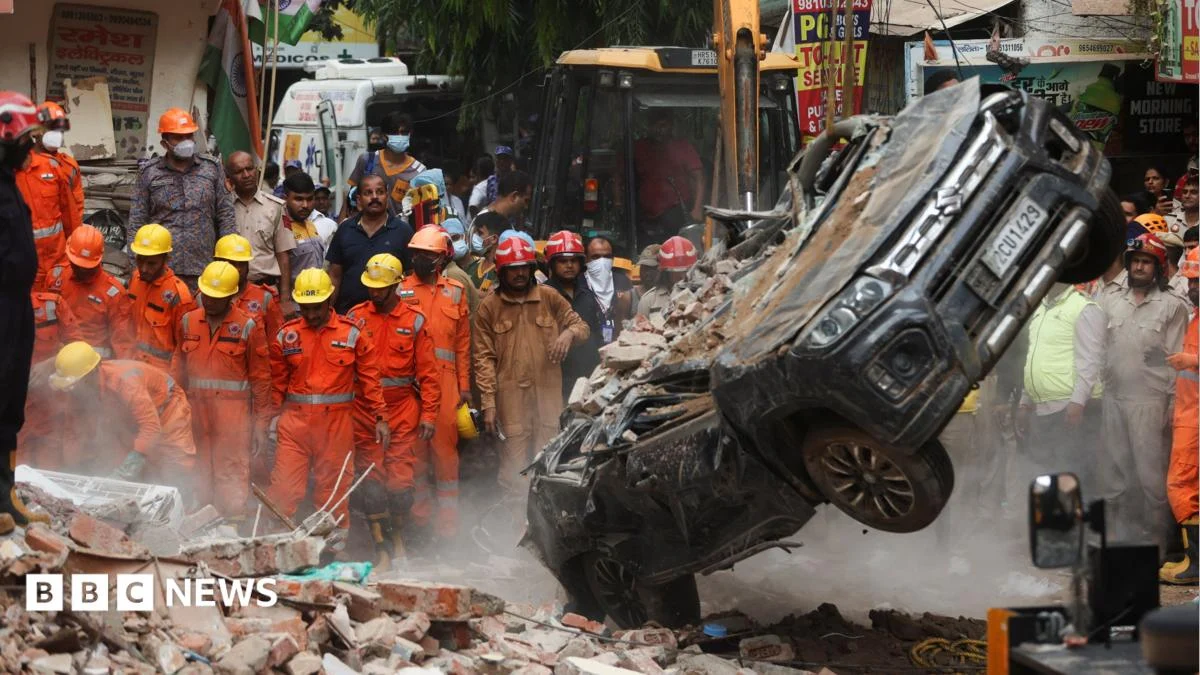
A tragic residential building collapse in Delhi’s densely populated Satya Niketan neighbourhood has claimed the lives of at least six people, with rescue operations continuing amidst fears that more students remain trapped under the rubble. The five-storey structure, identified as "Hostel Daze," crumbled around 13:30 local time (08:00 GMT) on Sunday, sending shockwaves through the area and reigniting critical discussions about urban infrastructure safety and the acute student housing crisis in the Indian capital.
Eyewitness accounts suggest that between two and four dozen individuals, primarily students, were inside the building when it gave way. Many were believed to be in their rooms, taking advantage of the Sunday holiday from lessons. The All India Institute of Medical Sciences (AIIMS) hospital confirmed the fatalities on Monday, while six other individuals rescued from the debris are currently receiving treatment and are reported to be in stable condition. The swift and devastating nature of the collapse has prompted an immediate investigation and drawn sharp criticism regarding building standards and regulatory oversight in the bustling metropolis.
Chronology of a Catastrophe and Intensive Rescue Efforts
The tragedy unfolded with startling speed. On Sunday afternoon, residents and shopkeepers in Satya Niketan were startled by a thunderous roar. "It sounded like the rumble of an earthquake," recounted an eyewitness who was at his nearby shop when the building collapsed. "We rushed out immediately; there was a lot of smoke and dust here. The entire building had collapsed." The immediate aftermath was chaotic, with locals attempting to sift through the fresh debris, desperate to reach any survivors.
Emergency services, including the National Disaster Response Force (NDRF), Delhi Fire Service, and local police, were immediately mobilised to the site. The sheer volume of concrete, twisted metal, and shattered masonry presented significant challenges to the rescue teams. Equipped with hydraulic cutters, drills, and sophisticated search equipment, personnel worked tirelessly through the day and into the night. Specialized sniffer dogs were deployed to locate potential survivors, and thermal imaging cameras were used to detect heat signatures beneath the rubble.
During the initial hours, the cries for help from trapped students were clearly audible, intensifying the urgency of the rescue operations. "Save us, save us!" students were heard calling out from beneath the debris, according to the eyewitness. This heartbreaking appeal fuelled the efforts of the first responders and volunteers. By Monday morning, Delhi Chief Minister Rekha Gupta provided an update, stating that "approximately 80% of the debris had been cleared" from the site, with only the basement rubble remaining. "So far, 12 people have been recovered; six have died, while the other six are in stable condition. We are in touch with all their parents and are making every effort to ensure they face no difficulties. The children are receiving proper medical treatment," she affirmed, highlighting the ongoing commitment to the rescue and recovery mission.
As a precautionary measure, an adjacent building was evacuated, with local media reports indicating its potential demolition on Monday to ensure the safety of the surrounding area. The structural integrity of neighbouring properties often becomes compromised after such collapses, necessitating swift action to prevent further incidents. Rescue efforts remain concentrated on the basement area, where officials fear more individuals might still be trapped.
Victims, Survivors, and the Human Toll
The human impact of the collapse is profound. The victims are predominantly students, many of whom were residing in the building due to its proximity to Delhi University’s South Campus. Sundays, typically a day off from academic schedules, meant that a higher concentration of residents would have been inside the hostel. This unfortunate timing likely contributed to the number of casualties and those trapped.
Shivam Yadav, a student from Venkateswara College, recounted the terrifying experience of his friend who lived in the collapsed building. "He was on the third floor at the time of the accident. He has been rescued and sent to hospital." Such accounts underscore the arbitrary nature of the disaster, where luck and location determined survival. Another student, Sawai Sharma, who narrowly escaped the accident as he often visited a friend in the building, shared the grim reality of student housing. The emotional distress among the student community is palpable, with friends and family members anxiously awaiting news of their loved ones. Helplines have been established to provide information and support to affected families, many of whom have travelled from distant cities to be with their children. The incident has cast a pall of grief and fear over the academic community, highlighting the vulnerabilities faced by students seeking education in the capital.
Initial Investigations and Allegations of Negligence
Early investigations have begun to shed light on the potential causes of the catastrophic failure. Delhi Chief Minister Rekha Gupta pointed to "accumulation of water, combined with ongoing repair work in the basement" as the primary suspected factors. This combination is particularly dangerous, as water seepage can significantly weaken a building’s foundation, especially when coupled with structural alterations.
Further details emerged from a nearby shop owner, who revealed that the building, estimated to be only 40 or 50 years old, was under a 100-year lease. Crucially, the leaseholder was reportedly undertaking excavation work in the basement. The motive for such work, according to the shop owner, was to expand the hostel’s capacity and thereby increase income. This allegation immediately raises questions about unauthorised construction and the potential for bypassing safety regulations. Civic officials have confirmed they are actively investigating whether any digging or structural modifications were carried out recently without proper permits or structural assessments. "Given the incessant rain, we are examining the possibility of seepage weakening the structure. Repair or other work could also have contributed to the collapse. At this stage, however, it is difficult to establish the exact cause," a civic official was quoted as saying, acknowledging the multi-faceted nature of the inquiry.
In response to these grave allegations, Delhi Police have registered a case against the building owner and have launched a search to apprehend them. The National Students’ Union of India (NSUI) has vehemently condemned the incident, calling for a thorough government investigation into the cause and demanding accountability for anyone found responsible. "Negligence with the safety of students and common people will not be tolerated at any cost," the NSUI stated, reflecting widespread public anger and a demand for justice.
Delhi’s Urban Housing Crisis and Regulatory Lapses
The tragedy in Satya Niketan is not an isolated incident but rather a stark symptom of deeper systemic issues plaguing Delhi’s urban development and housing sector. Satya Niketan itself is a microcosm of the problem: a densely populated area that has become a vital student hub due to its proximity to Delhi University’s South Campus. With five colleges in the South Campus, the demand for student accommodation far outstrips the supply of official university hostels. "There are 75 students in Sociology Honours class, but only two get a seat in the college hostel. All other students have to live here," explained Sawai Sharma, underscoring the severe shortage.
This acute lack of on-campus facilities forces thousands of students, many from outside Delhi, into cheap private hostels and paying-guest (PG) accommodations. These private facilities often operate in a grey area, with varying degrees of regulation and oversight. Sharma noted that a bed in the collapsed building cost 18,000 rupees ($190; £140) a month, making it an "affordable" option for students despite the inherent risks. However, affordability frequently comes at the cost of safety and structural integrity.
Shivam Yadav’s observation that "most of the buildings in Satya Niketan are ‘overloaded’" points to a critical issue. Overloading can refer to an excessive number of occupants, but more importantly, it often implies unauthorised vertical extensions, internal structural alterations, or inadequate maintenance for the stress placed on aging structures. His blunt assessment, "And the buildings are in a dilapidated condition. No inspections are conducted. There are no rules or guidelines here," paints a grim picture of a regulatory vacuum where profit motives often override safety concerns. The absence of regular structural audits, adherence to building codes, and strict enforcement mechanisms creates a fertile ground for such disasters. The rapid urbanisation of Delhi, often unplanned and unchecked, has exacerbated these issues, leading to a proliferation of illegal constructions and modifications that bypass safety standards.
A Recurring Nightmare: The Pattern of Building Collapses in India
Building collapses are a disturbingly common occurrence in Delhi and across India, revealing a chronic problem rooted in a combination of factors. According to fire department figures, Delhi alone has recorded more than a thousand building collapses in the past three years, resulting in dozens of deaths. Nationally, the numbers are even more alarming, with hundreds of such incidents reported annually, particularly during the monsoon season.
The underlying causes are well-documented: poor foundations, the use of inadequate or substandard construction materials, and the engagement of unqualified or untrained construction workers are perennial issues. Rampant illegal construction, often driven by a desperate need for housing or commercial space in rapidly expanding urban centres, is another major contributor. These structures frequently disregard approved building plans, structural stability, and safety norms. Furthermore, a lack of regular maintenance, unauthorised structural modifications (such as adding floors or excavating basements without expert assessment), and corruption within regulatory bodies that allows unsafe buildings to operate, collectively create a hazardous environment. The incessant rain, as mentioned by a civic official, also plays a significant role, as water seepage can erode foundations and weaken already compromised structures.
Recent incidents underscore this tragic pattern. Last April, eleven people, including three children, were killed when a residential building collapsed in north-eastern Delhi. In 2024, another devastating incident saw three students drown after getting trapped in the flooded basement of an exam coaching centre in the capital, sparking widespread anger and protests. These events serve as grim reminders of the urgent need for comprehensive reforms in urban planning, construction regulation, and enforcement.
Implications and the Path Forward: A Call for Systemic Change
The Satya Niketan tragedy is more than just a single incident; it is a critical inflection point that demands systemic change. The immediate implication is, of course, the urgent need for accountability. The police investigation must be thorough and swift, leading to the prosecution of all individuals responsible for the structural failures and regulatory negligence, from the building owner to any complicit officials. This accountability must serve as a deterrent against future malpractices.
Beyond immediate justice, the incident necessitates a comprehensive overhaul of building safety regulations and their enforcement. This includes:
- Stricter Building Codes and Permits: Reviewing and updating existing building codes to reflect modern safety standards, particularly for high-density student housing areas. The permit approval process must be transparent and rigorous, with mandatory structural audits at various stages of construction and for older buildings.
- Regular Inspections and Audits: Establishing a robust system of periodic structural inspections for all residential and commercial buildings, especially those over a certain age or in high-risk zones. Special attention must be paid to areas like Satya Niketan, known for their high concentration of private hostels.
- Digitalisation and Transparency: Implementing digital platforms for building permits, inspection reports, and complaint mechanisms to reduce human intervention and potential for corruption.
- Student Housing Policy: Developing a comprehensive policy for student accommodation that ensures safe, affordable, and regulated options. Universities, in collaboration with municipal bodies, must play a more active role in providing or accrediting off-campus housing that meets stringent safety standards. Incentives for developers to build safe student housing, and penalties for those who flout rules, could be explored.
- Public Awareness and Reporting: Educating residents and property owners about their rights and responsibilities regarding building safety, and establishing easily accessible channels for reporting suspicious construction activities or dilapidated structures.
- Disaster Preparedness and Response: Continuously improving the training, equipment, and coordination of disaster response teams to ensure efficient and effective rescue operations in future emergencies.
The Satya Niketan building collapse serves as a poignant reminder of the human cost of unchecked urban expansion, regulatory apathy, and the relentless pursuit of profit over safety. For a city that prides itself on being a global capital, ensuring the safety and well-being of its residents, particularly its vulnerable student population, must be an absolute priority. The lessons from this tragedy must translate into concrete action to prevent another such preventable loss of life.