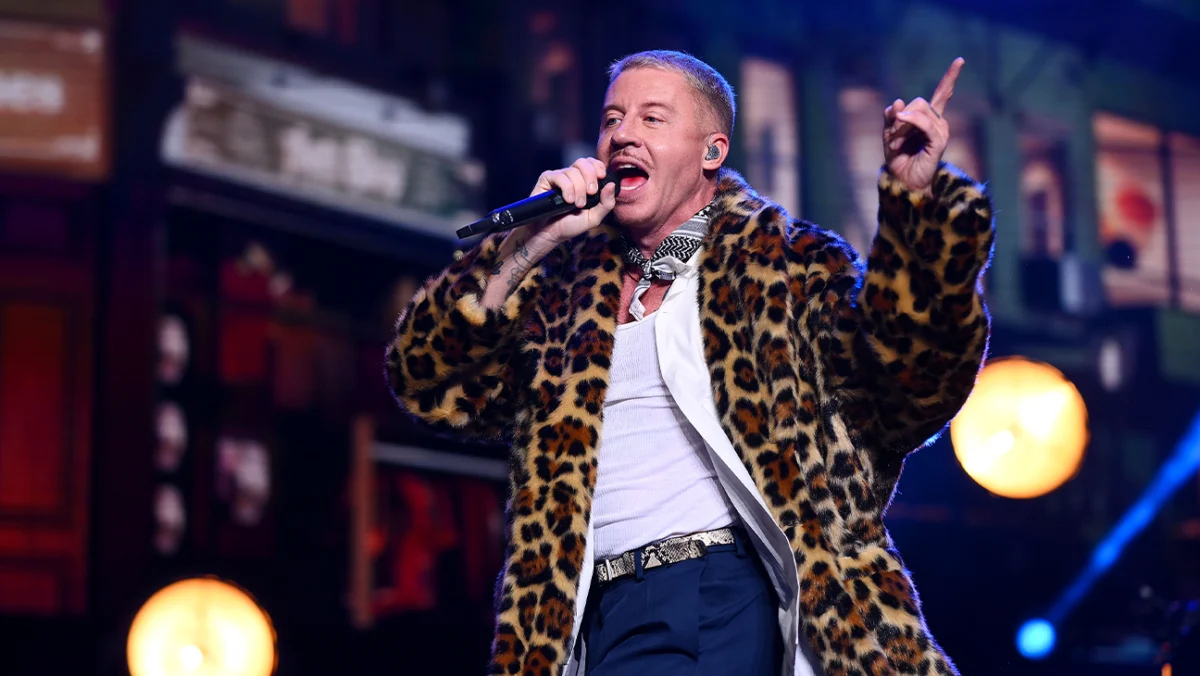
Rapper Macklemore is reaffirming his public stance and message of solidarity with Palestine, doubling down after facing significant backlash and a petition calling for his removal from Ed Sheeran’s "Mathematics Tour." The controversy ignited when Macklemore used his opening set at MetLife Stadium in New Jersey to advocate for a "Free Palestine," a move that has drawn sharp criticism from pro-Israel organizations.
Escalating Controversy and Macklemore’s Response
The Grammy-winning artist, known for his socially conscious lyrics, articulated his position further on social media Monday, stating, "Wanting all humans to be treated equal should never be controversial." This declaration accompanied a video of his speech delivered during the second night of his back-to-back performances with Ed Sheeran.
On Saturday night, after again chanting "Free Palestine" on stage, Macklemore addressed the audience directly, seeking to clarify the intent behind his message. He stated, "To all of my Jewish brothers and sisters: criticism of Israel, criticism of apartheid, being against genocide in no way is a criticism of you. My message is for peace; love for all human beings to be treated with dignity, respect, and equality."
He broadened his call for liberation, declaring, "So I say Free Palestine, I say Free Lebanon, I say Free Cuba, I say Free Congo, Free Sudan, I say Free all people in America living in fear of this terrorist organization, ICE. None of us will be free until we are all free." This comprehensive statement aimed to frame his activism within a universal human rights context, connecting various struggles for freedom and justice.
Genesis of the Backlash: The "Hind’s Hall" Performance
The current wave of controversy stems from Macklemore’s performance on Friday, the first night of his stadium appearances. During his opening set, he performed his protest song "Hind’s Hall," a track released earlier in May that directly addresses the ongoing conflict and expresses solidarity with the Palestinian cause. Following the song, he explicitly told the crowd, "A big part of the reason why I wanted to do this tour in the first place is so I could stand up in stadiums like this and say two words that are very near and dear to my heart: Free Palestine."
This direct political statement during a major musical tour, particularly while opening for a globally recognized artist like Ed Sheeran, quickly prompted a strong reaction.
The Israeli-American Council’s Petition
In response to Macklemore’s statements and the performance of "Hind’s Hall," the Israeli-American Council (IAC) initiated a petition. The organization called for Macklemore’s removal from the remaining dates of the "Mathematics Tour," arguing that the concert stage should not be used for political activism.
The petition’s text, as reported, stated, "This was an Ed Sheeran concert – not a political rally, not a protest, and not an activist event. The issue is not whether Macklemore has the right to hold political views. The question is where the line should be drawn when an opening act uses a global concert platform to advance a one-sided political agenda." The IAC’s stance highlights a perceived boundary between artistic performance and political advocacy within a commercial entertainment setting.
Broader Context: The "Mathematics Tour" and Macklemore’s Activism
Ed Sheeran’s "Mathematics Tour" is one of the highest-grossing concert tours globally, drawing massive audiences to stadiums worldwide. Macklemore’s inclusion as a supporting act provides him with a significant platform to reach a vast and diverse fanbase. His decision to leverage this platform for his political messaging, specifically concerning the Israeli-Palestinian conflict, has placed him at the center of a complex and often polarizing geopolitical discussion.
Macklemore has a history of engaging with social and political issues through his music and public platform. His song "Thrift Shop" brought him mainstream success, but he has consistently used his artistry to address topics ranging from addiction and mental health ("Can’t Hold Us") to social justice and inequality. "Hind’s Hall," named after the building at Columbia University that was occupied by pro-Palestinian protesters, represents a more direct and forceful engagement with contemporary political events compared to some of his earlier work.
The song’s lyrics have been noted for their critical stance on the actions of the Israeli government and the broader international response to the conflict. The title itself is a direct reference to the student-led occupation and renaming of Hamilton Hall at Columbia University in solidarity with Palestine, highlighting the intersection of campus activism and broader political movements.
Data and Public Sentiment
The ongoing conflict in the Middle East has generated intense debate and divided public opinion globally. Data from various sources indicates a significant level of concern and advocacy surrounding the humanitarian situation in Palestine. For instance, United Nations reports have consistently detailed the dire conditions in Gaza and the West Bank, including casualties, displacement, and destruction of infrastructure, which have fueled international calls for a ceasefire and humanitarian aid.
Public opinion polls on the Israeli-Palestinian conflict often reveal complex and varied perspectives, influenced by geographic location, political affiliation, and access to information. The online discourse surrounding Macklemore’s statements has been highly polarized, with his supporters commending his courage and conviction, while critics condemn his perceived partisanship and the disruption of the concert experience. Social media platforms have become key battlegrounds for these differing viewpoints, with hashtags related to Macklemore, Free Palestine, and Ed Sheeran trending at various times.
Implications and Potential Ramifications
The situation raises several important questions regarding the role of artists in public discourse and the boundaries of political expression within entertainment events.
- Artist’s Platform: Macklemore’s actions highlight the ongoing debate about whether artists have a responsibility to use their platforms for social and political advocacy. His supporters argue that silence in the face of perceived injustice is complicity, while critics believe that such platforms should remain apolitical to cater to a diverse audience.
- Concert Experience: The IAC petition reflects a segment of the audience that expects concerts to be a form of escapism and entertainment, free from potentially divisive political messaging. The inclusion of political statements can alienate some attendees and detract from the intended experience.
- Tour Integrity: For tour organizers and headlining artists, the actions of a supporting act can have implications for the overall tour’s reputation and audience reception. The decision to continue with or remove a controversial opener involves balancing artistic freedom with potential audience dissatisfaction and logistical challenges.
- Geopolitical Dialogue: Macklemore’s statements, however controversial, contribute to the broader public conversation surrounding the Israeli-Palestinian conflict. By bringing the issue to the forefront of a large-scale entertainment event, he ensures it remains a topic of discussion, potentially influencing public awareness and engagement.
The Hollywood Reporter has reached out to representatives for Ed Sheeran for comment regarding Macklemore’s statements and the petition. As of the time of publication, no official statement from Sheeran’s camp has been released. The response from Sheeran’s team, or the lack thereof, will likely be closely watched as it could indicate the headliner’s stance on the unfolding situation and how such controversies are managed within the music industry. The long-term impact on Macklemore’s career and his relationship with his fanbase, as well as the broader implications for artists engaging in political activism, remain to be seen.