The long-anticipated opening of the inaugural road bridge connecting Russia and North Korea marks a significant development in the burgeoning strategic alliance between the two isolated nations. Officially inaugurated to facilitate cargo and passenger traffic across the Tumen River, this new infrastructure is poised to deepen bilateral ties, with international observers closely scrutinizing its potential implications, particularly amidst the ongoing conflict in Ukraine.
A New Artery for Bilateral Exchange
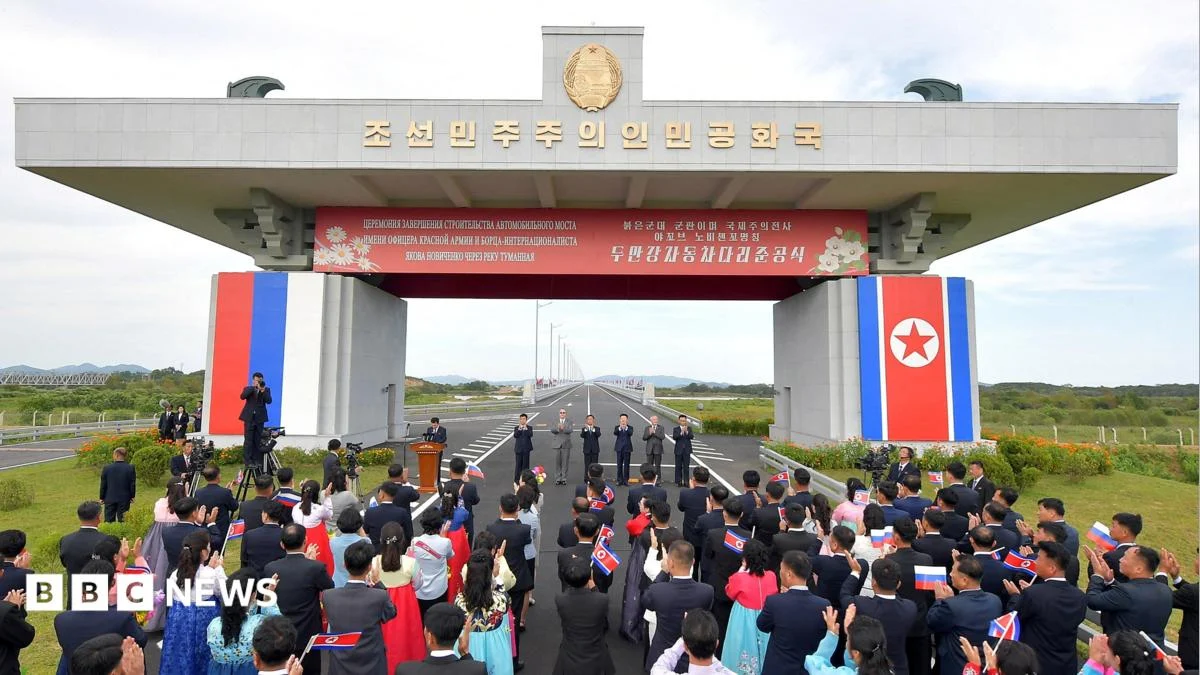
The new road bridge, a critical piece of infrastructure, was officially opened with Russian Prime Minister Mikhail Mishustin describing it as a "new symbol of friendship" and North Korea’s Prime Minister Pak Thae Song hailing it as a "historical event." The bridge is designed to accommodate up to 300 vehicles and 2,323 people daily, according to reports from Russian state news agency TASS. This capacity represents a substantial upgrade to the previously limited cross-border transit options.
For decades, connectivity between the two countries has been notably constrained. While air links and a single rail connection existed, the only previous road link was a rudimentary, makeshift solution involving wooden planks temporarily placed on the rail bridge for vehicle passage, a cumbersome arrangement reported by Reuters. This new, dedicated road bridge, stretching approximately one kilometer, significantly enhances the logistical capabilities for both nations. Satellite imagery, reported by the BBC in May of the current year, revealed the completed bridge alongside newly constructed access roads, a modern border checkpoint, and extensive support infrastructure, including parking facilities, underscoring the scale of this investment.
Initially, the bridge is designated for cargo transport, with plans to open for passenger traffic later in the year, as confirmed by the Russian government. Prime Minister Mishustin, addressing the opening ceremony via video link, emphasized that the bridge would provide a "powerful impetus for the further development of trade, economic, scientific, technological and cultural cooperation." He further underscored the current state of relations, describing ties between Moscow and Pyongyang as being "at an unprecedented high level."
Geopolitical Context and Evolving Alliance
The inauguration of this bridge arrives at a time of dramatically escalating cooperation between Russia and North Korea, largely spurred by the geopolitical shifts following Russia’s full-scale invasion of Ukraine in February 2022. This conflict has driven Moscow, increasingly isolated by Western sanctions, to seek new partners and supply chains, finding a willing and strategically aligned counterpart in Pyongyang.
The leaders of both nations, Russian President Vladimir Putin and North Korean Chairman Kim Jong Un, have publicly pledged mutual support, vowing to assist each other in the event of "aggression" against either country. This commitment was formalized and significantly strengthened during President Putin’s visit to North Korea in 2024 – his first trip to the reclusive state in 24 years – which culminated in the signing of a strategic partnership treaty. This treaty, perceived by many international analysts as a mutual defense pact, lays a robust foundation for deeper military, economic, and political collaboration.
A Bridge with a Dual Purpose: Military Logistics Concerns
While officially touted for civilian purposes, significant concerns have been raised regarding the bridge’s potential primary role as a conduit for military logistics. The Ukrainian OSINT (Open-Source Intelligence) group Truth Hounds has explicitly stated that the bridge is intended "primarily to establish a covert military logistics corridor" to bolster Russia’s war efforts in Ukraine.
This assessment is supported by the context of existing military transfers. Researchers at South Korea’s spy agency estimate that North Korea has already supplied Russia with an estimated $7 to $14 billion worth of rockets, missiles, and artillery shells, primarily transported via maritime routes. Furthermore, reports indicate that an estimated 11,000 North Korean troops are actively engaged in combat operations alongside Russian forces in Ukraine, though the precise nature and deployment of these personnel remain subject to intense scrutiny and debate.
Truth Hounds elaborated in a recent statement that, given the strategic partnership treaty of 2024, the bridge could be instrumental in facilitating the direct transport of North Korean military personnel, including combatants and construction workers, as well as senior military officials, into Russia. Conversely, it would also enable the flow of Russian military technology and critical resources in the opposite direction, potentially bolstering North Korea’s own defense capabilities and its prohibited weapons programs. This two-way exchange of military assets and personnel represents a significant challenge to the international sanctions regime against North Korea and could profoundly impact the balance of power in the region and the trajectory of the Ukraine war.
Economic Dimensions: Trade, Tourism, and Labor
Beyond military implications, the bridge is expected to stimulate a range of economic activities, albeit under the shadow of international sanctions. Pyongyang state media has highlighted its use for "personnel exchanges, tourism and trade," echoing Mishustin’s emphasis on broader cooperation.
Trade between the two countries, historically modest and severely restricted by international sanctions against North Korea’s nuclear and ballistic missile programs, is poised for expansion. The new road link offers a more efficient and less scrutinizable alternative to existing rail and sea routes, potentially enabling a wider array of goods to be exchanged.
Tourism, a sector North Korea has sporadically attempted to cultivate, has seen a small but notable uptick from Russia since limited access was permitted in 2024. Russian tourists have reportedly been hosted in the capital, Pyongyang, and at beach resorts such as Wonsan-Kalma, while visitors from most other countries remain barred. The new bridge could facilitate an increase in these tightly controlled tourist flows, offering North Korea a minor source of foreign currency.
Perhaps more significantly, the road link is anticipated to streamline the transport of North Korean laborers to Russia. South Korean estimates suggest that approximately 10,000 North Koreans are currently working in Russia, primarily in construction sites and logging camps. Despite a United Nations ban on member states employing North Korean labor, many reportedly enter Russia under the guise of student visas, exploiting loopholes in international regulations. The new bridge would provide a more direct and efficient means for this labor force to travel, offering North Korea a crucial source of remittances and a means to circumvent sanctions.
Historical Precedent and Previous Connections
The Tumen River, forming a natural boundary between North Korea, Russia, and China, has long been a region of strategic importance. Historically, the river has seen limited infrastructure development due to geopolitical tensions and North Korea’s isolationist policies. The existing rail bridge, connecting Khasan in Russia with Tumangang in North Korea, has been the primary conduit for cross-border traffic since its construction in the mid-20th century. However, its single track and the logistical challenges of sharing it with road traffic via makeshift planks underscored the dire need for dedicated road infrastructure.
Prior to the war in Ukraine, the connection between North Korea and its two neighbors, Russia and China, was characterized by Victor Cha from the Center for Strategic and International Studies (CSIS) think tank as "one of the sleepiest links." This assessment highlights the profound shift in dynamics, where geopolitical necessity has spurred rapid infrastructure development and a dramatic reorientation of priorities for both Moscow and Pyongyang.
International Reactions and Sanctions Scrutiny
The opening of this bridge is expected to draw strong condemnation and increased scrutiny from the international community, particularly from the United States, South Korea, and Japan. These nations have consistently called for the strict enforcement of UN Security Council resolutions against North Korea, which prohibit most forms of trade, military cooperation, and labor export.
The UN Security Council has imposed a comprehensive array of sanctions on North Korea since 2006, aimed at curbing its nuclear weapons and ballistic missile programs. These sanctions include restrictions on arms sales, financial transactions, and the import/export of various goods. The new road bridge, by facilitating increased trade and personnel movement, could significantly complicate efforts to enforce these sanctions, potentially leading to new enforcement measures or diplomatic pressure.
South Korea, a direct neighbor of North Korea and a key ally of the United States, is particularly sensitive to any development that could enhance North Korea’s military capabilities or economic resilience under sanctions. Increased military cooperation between Pyongyang and Moscow is viewed as a direct threat to regional stability and a violation of international norms. Japan also shares similar concerns, given its proximity and historical tensions with North Korea.
The Strategic Partnership Treaty of 2024: A Foundation
The agreement to construct the bridge was a direct outcome of President Putin’s landmark visit to North Korea in 2024. This visit, the first by a Russian head of state in 24 years, cemented a "strategic partnership treaty" that fundamentally reshaped the bilateral relationship. The treaty’s provisions, reportedly including a mutual defense clause, signify a formalization of their alliance, elevating it from transactional cooperation to a more enduring strategic bond.
This treaty provides the overarching framework within which projects like the new road bridge gain profound significance. It transforms what might otherwise be a routine infrastructure project into a symbol of a deeper, more resilient alliance, one designed to withstand international pressure and facilitate shared strategic objectives. The bridge, therefore, is not merely a physical link but a tangible manifestation of this renewed partnership, signaling a clear intent to deepen cooperation across various domains.
Construction Timeline and Engineering Feat
The construction of the bridge, though initiated in 2025 following the agreement reached during Putin’s 2024 visit, faced delays. Despite these setbacks, the project was completed in 495 days, a relatively swift timeline for such a significant undertaking. This speed of construction, as noted by Victor Cha in May of the current year, "is a reflection of the volume of trade activity between the two sides," primarily "spurred largely by North Korea’s provision of troops, weapons, munitions, and labourers for Putin’s war in Ukraine."
The engineering feat itself involved constructing a kilometer-long span over the Tumen River, a natural barrier that previously limited efficient connectivity. The accompanying infrastructure, including the new access roads, border checkpoint, and support facilities, indicates a comprehensive approach to establishing a modern, high-capacity crossing point.
Regional Dynamics and Long-Term Outlook
The opening of this bridge represents a critical juncture in the evolving geopolitical landscape of Northeast Asia and the broader international order. It solidifies a strategic corridor between two states increasingly aligned against Western dominance, creating a new axis of cooperation that challenges existing power structures and international norms.
For Russia, the bridge offers a more direct and reliable supply route for military materiel and labor, crucial for sustaining its war effort in Ukraine. For North Korea, it provides a vital lifeline, potentially easing the grip of international sanctions, offering access to Russian technology and resources, and reinforcing its strategic security through a powerful ally.
The long-term implications are manifold. The enhanced connectivity could lead to a more robust and resilient North Korean economy, albeit one operating largely outside the international financial system. It could also enable North Korea to further develop its military capabilities with Russian assistance, posing an increased threat to regional security. The bridge stands as a stark symbol of a shifting global order, where alliances are being forged and strengthened in defiance of established international frameworks, with potentially far-reaching consequences for peace and stability.