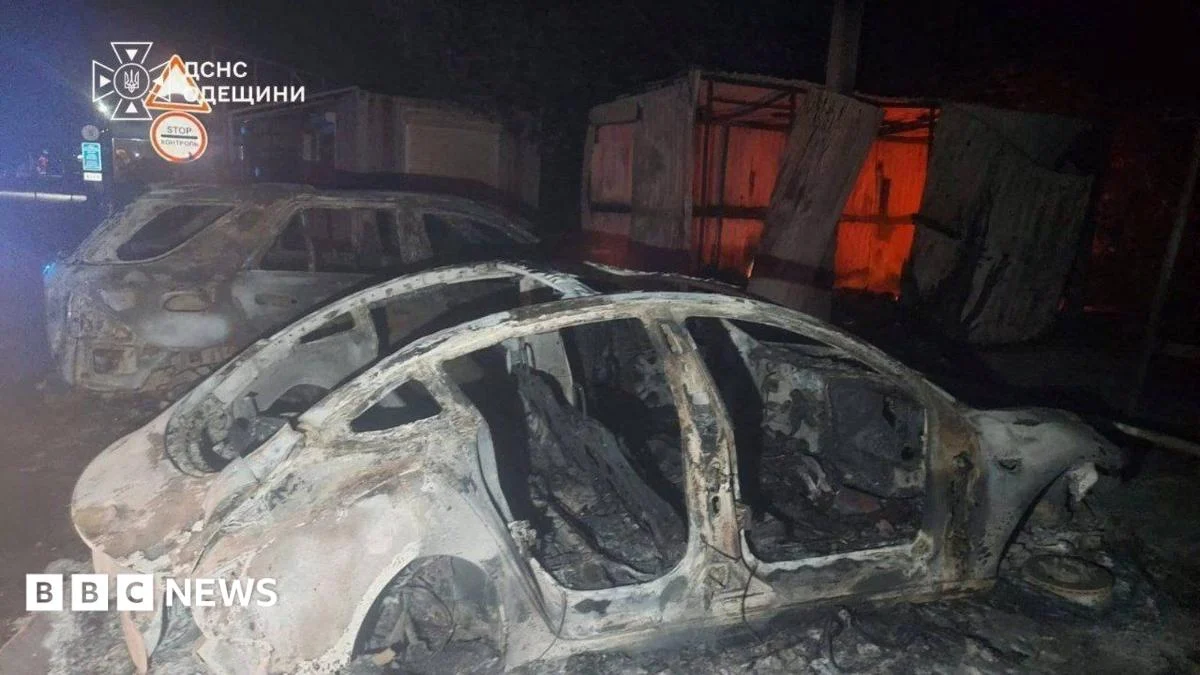
A recent surge in cross-border drone attacks has exacted a heavy human toll and inflicted significant damage on critical infrastructure across both Ukraine and Russia, even as renewed diplomatic efforts to de-escalate the conflict continue to unfold. Ukrainian President Volodymyr Zelensky confirmed the deaths of two individuals at the Starokozache border crossing between Ukraine and Moldova following a Russian drone strike, an incident that underscores the widening geographical impact of the conflict and the increasing vulnerability of civilian areas and critical transit points. The overnight assault on Starokozache led to the immediate closure of the crossing, with harrowing images from the scene depicting multiple burnt-out vehicles amidst scattered debris, a stark testament to the ferocity of the attack.
The wave of aggression extended deep into Ukrainian territory, claiming more civilian lives and causing widespread destruction. In the capital city of Kyiv, a nine-story residential building was struck by a Russian drone, resulting in the death of one woman and injuries to 14 others, including two children. Concurrently, the north-eastern city of Sumy experienced a devastating attack on a shopping centre, where three people perished and 20 others sustained injuries. Regional head Oleg Hryhorov confirmed the ongoing efforts to manage the aftermath of the Wednesday evening strike in Sumy, highlighting the relentless pressure on emergency services and local authorities.
Ukrainian Targets Bear Civilian Brunt
The Starokozache border crossing, situated approximately 500 kilometers (310 miles) south of Kyiv in the Odesa region, represents a vital artery connecting Ukraine with its southwestern neighbor, Moldova. The attack, which claimed two lives and injured three others, including a Moldovan driver, marks a significant escalation, drawing Moldova further into the conflict’s orbit. Odesa regional head Oleh Kiper provided details on the casualties, emphasizing the cross-national impact. President Zelensky, in the wake of the Starokozache assault, issued an urgent appeal for heightened international support, declaring that "the aggression must be stopped here and now before it spreads any further." This plea reflects deep concern over the potential for regional destabilization, particularly given Moldova’s increasingly precarious position.
The strike on Kyiv’s residential infrastructure is a chilling reminder of the indiscriminate nature of drone warfare and its profound impact on urban civilian populations. Such attacks, frequently targeting non-military sites, aim to erode public morale and create a climate of fear, even as Ukrainian air defense systems continue to intercept a significant proportion of incoming threats. The presence of children among the injured further underscores the tragic human cost of this protracted conflict, transforming homes and public spaces into unexpected frontlines.
Similarly, the attack on the shopping mall in Sumy highlights the vulnerability of civilian gathering places to aerial bombardment. Sumy, located relatively close to the Russian border, has been a frequent target throughout the conflict, bearing the brunt of sustained shelling and drone attacks. The incident not only resulted in immediate casualties but also caused extensive damage to commercial property, disrupting local economies and further exacerbating the humanitarian crisis in the region. The repeated targeting of civilian infrastructure underscores a broader pattern of warfare that exacts a heavy toll on non-combatants and their daily lives.
Russia’s Strategic and Industrial Facilities Targeted
The escalation was not confined to Ukrainian territory, as Russia also reported significant drone attacks on its soil, targeting both critical port infrastructure and distant industrial facilities. The Black Sea port of Novorossiysk, a crucial hub for Russian naval operations, oil exports, and trade, bore the brunt of what Governor Veniamin Kondratiev described as a "massive overnight enemy drone attack." This assault resulted in the deaths of four people, including a child, and left 29 others injured. Damage was reported across residential buildings, a church, and even a preschool, indicating the widespread impact of the strike. The targeting of Novorossiysk, a strategically vital port for Russia’s Black Sea Fleet and its economic lifeline, signifies Ukraine’s growing capability to project force deep into Russian territory, aiming to disrupt military logistics and economic output.
Further highlighting this extended reach, a drone strike hit an industrial facility in the Arctic city of Novy Urengoy, located more than 3,000 kilometers (approximately 1,860 miles) from Ukraine’s border. Regional governor Dmitry Artyukhov stated that the attack was repelled, but the falling drone wreckage triggered a fire, though no injuries were reported. Ukraine’s military later claimed responsibility, identifying the target as the Novourengoysky ZPKT, a major oil refinery. The Ukrainian military asserted that the facility’s petroleum products and gas condensate were being utilized by Russia to sustain its war efforts, thereby justifying the strategic targeting of such a distant, high-value asset. This strike, if confirmed as successfully hitting its intended target, represents one of the longest-range drone attacks of the conflict, demonstrating Ukraine’s sophisticated drone capabilities and its strategic intent to degrade Russia’s capacity to finance and prosecute the war.
Moldova’s Precarious Position
Moldova, a nation historically caught between Russian influence and European aspirations, has increasingly found itself inadvertently drawn into the conflict. The attack on the Starokozache border crossing, which injured a Moldovan driver, is merely the latest in a series of incidents that underscore the country’s growing vulnerability. Prime Minister Vasile Tofan recently confirmed a alarming trend: 17 drones struck Moldovan territory in August alone, a figure surpassing the total number of incursions recorded throughout the entirety of the previous year.
Tofan’s public statements have grown increasingly forthright, reflecting a deepening frustration and concern within the Moldovan government. "Those who ignore or downplay these threats — and refuse to name the aggressor — are denying reality," he wrote on social media, unequivocally stating, "Russia started this war. Russia alone bears responsibility." This strong rhetoric signals Moldova’s firm stance against Russian aggression and its growing alignment with Ukraine and Western powers, despite the significant internal political divisions and the ongoing challenge posed by the pro-Russian breakaway region of Transnistria, which hosts a contingent of Russian "peacekeepers." The increasing frequency of drone incursions not only poses a direct security threat but also risks further destabilizing a region already fraught with geopolitical complexities, potentially drawing Moldova into a more direct confrontation.
The Escalation of Drone Warfare
The recent wave of attacks underscores the evolving nature of the conflict, characterized by a significant escalation in the use of long-range drones by both sides. Drones have emerged as a critical component of modern warfare, offering a cost-effective means of reconnaissance, targeting, and delivering ordnance with precision, or, as seen in civilian areas, with devastating broad impact. Their ability to strike deep behind enemy lines bypasses traditional static defenses and poses new challenges for air defense systems.
Russia, for its part, claimed its forces had shot down an unprecedented 596 Ukrainian drones overnight, a figure that, if accurate, speaks to the sheer volume and intensity of Ukrainian aerial operations. While such numbers are difficult to independently verify, they highlight the scale of the drone engagements and the continuous cat-and-mouse game played out in the skies. Ukrainian forces have predominantly utilized domestically developed or modified drones, while Russia has heavily relied on Iranian-made Shahed-136 "Geran-2" suicide drones, alongside its own Lancet and Orlan-10 variants. This technological arms race in uncrewed aerial vehicles has redefined strategic targeting, allowing both belligerents to conduct attrition warfare far from the immediate front lines, disrupting supply chains, damaging economic infrastructure, and exerting psychological pressure on civilian populations.
Diplomatic Overtures Amidst Battlefield Reality
The intensifying military actions occur against a backdrop of renewed, albeit fragile, diplomatic efforts to find a pathway to peace. Notably, Russian President Vladimir Putin recently engaged in a phone conversation with former US President Donald Trump, during which discussions reportedly touched upon efforts to end the war. This high-level contact followed earlier visits to Moscow and Kyiv by US envoys Jared Kushner and Steve Witkoff, who met with Putin on Saturday before traveling to Ukraine for discussions with President Zelensky on Sunday.
The Trump administration has been actively pressing for direct talks between Russia and Ukraine, with Kyiv indicating a willingness for such discussions to potentially take place within the current month. However, the Kremlin has adopted a more cautious stance, asserting that it is "too early to discuss a date or venue" for negotiations. This stark contrast between the urgency of battlefield events and the cautious, often protracted, nature of diplomatic discourse highlights the inherent paradox of attempting to broker peace amidst an escalating conflict. The ongoing attacks, particularly those inflicting civilian casualties and targeting critical infrastructure, inevitably complicate peace efforts, hardening positions and deepening mistrust between the warring parties. The diplomatic track, while offering a glimmer of hope, appears to be consistently outpaced by the brutal realities on the ground, where the human cost continues to mount daily.
International Reactions and Future Outlook
President Zelensky’s renewed calls for international support underscore the enduring need for global solidarity and assistance for Ukraine. The international community, while condemning the aggression, faces the ongoing challenge of balancing humanitarian aid, military support, and diplomatic engagement. The targeting of civilian areas and the increasing spillover effects, as evidenced by the incidents involving Moldova, raise significant concerns about regional stability and adherence to international humanitarian law.
The immediate implications of this recent wave of attacks point towards a continuation of the attritional warfare strategy employed by both sides. Ukraine’s deep strikes into Russian territory aim to disrupt its war economy and put pressure on the Kremlin, while Russia’s intensified aerial bombardments seek to degrade Ukraine’s military capabilities, break civilian morale, and force concessions. As the conflict enters its third year, the reliance on drone warfare has fundamentally altered the strategic landscape, extending the reach of destruction and ensuring that the human cost, both on and off the traditional front lines, remains tragically high. The persistent disconnect between diplomatic overtures and the escalating violence on the ground signals a long and arduous path ahead for any meaningful resolution to the conflict.