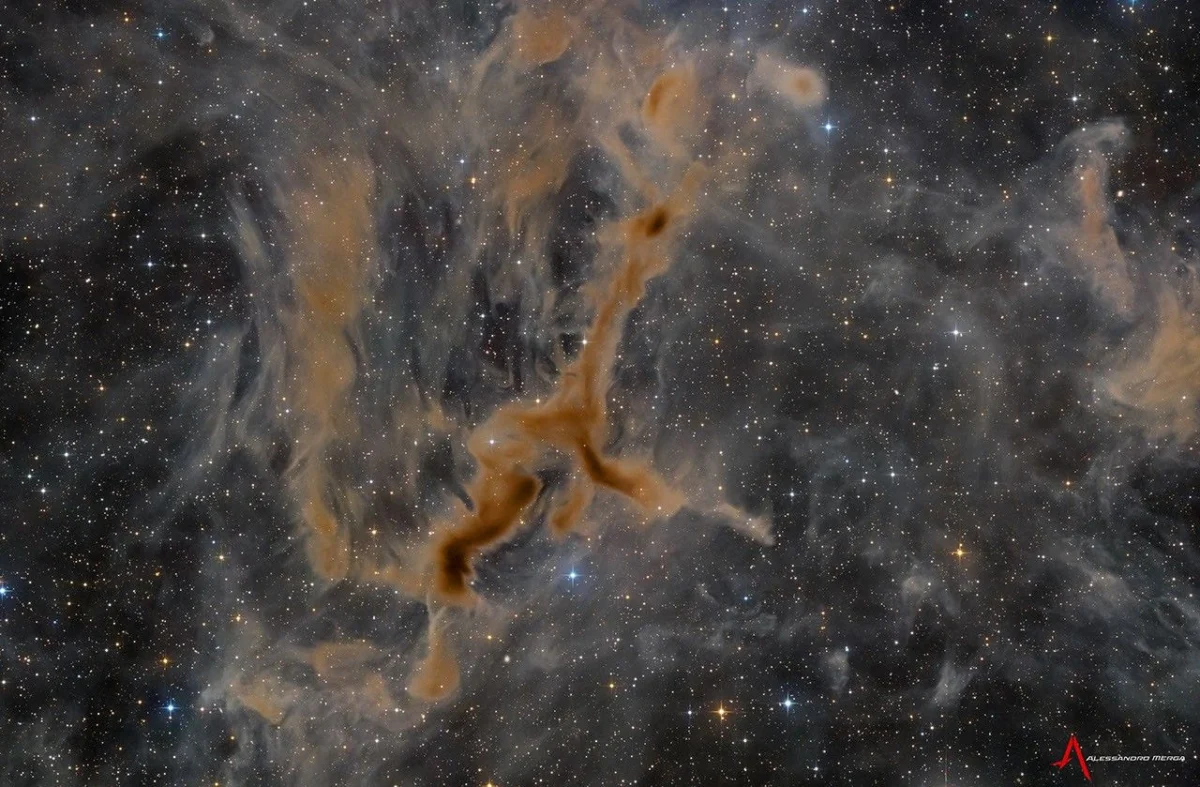
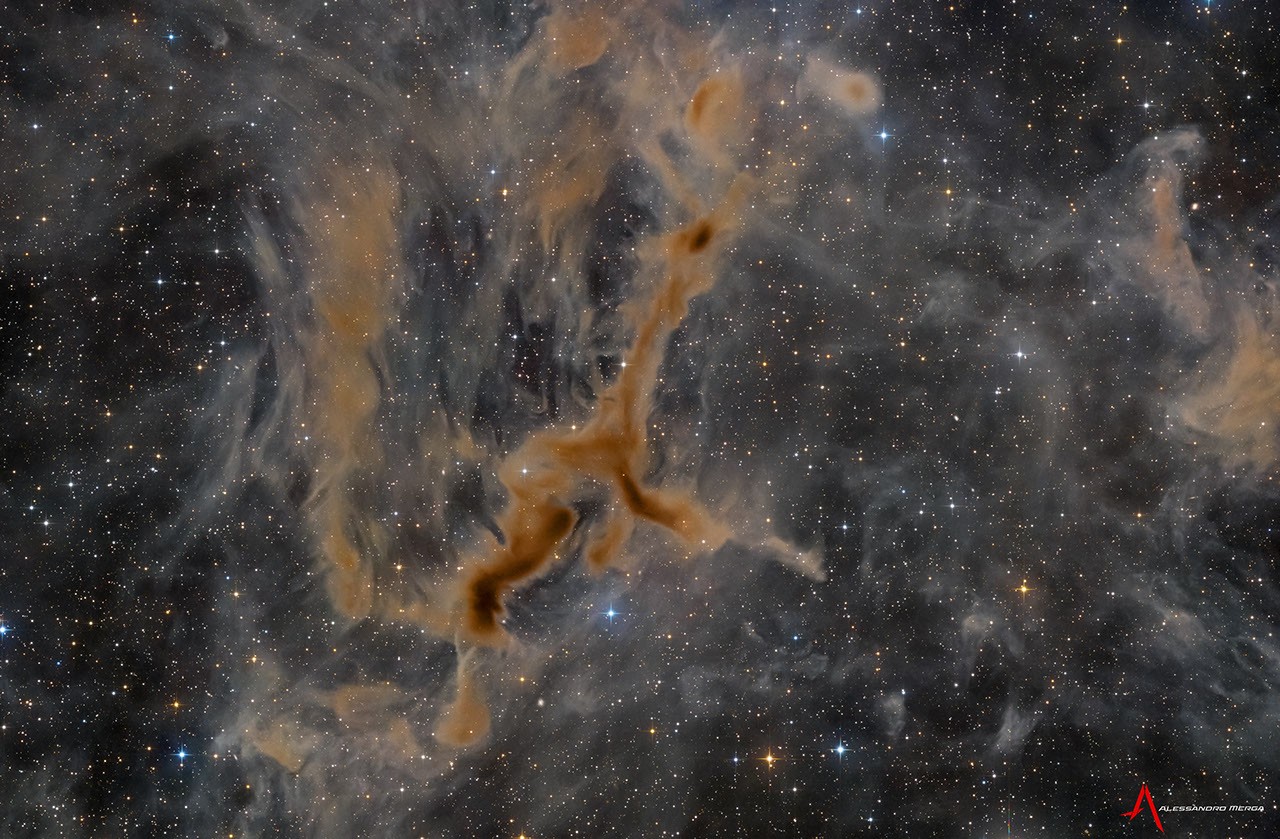
The vast and enigmatic expanse of the cosmos once again offered a moment of wonder on September 10, 2026, as NASA’s Astronomy Picture of the Day (APOD) featured an evocative image of LDN 1295, affectionately known as the Giraffe Nebula. This captivating celestial formation, captured with remarkable clarity by astrophotographer Alessandro Merga, provided a poignant reminder of both the universe’s intricate beauty and the human mind’s innate desire to find familiar patterns within the unknown. The unveiling of this particular image also coincided with a significant operational shift for the APOD program, as its primary online presence transitions from its long-standing apod.nasa.gov domain to a new home at science.nasa.gov/apod, signaling a broader integration into NASA’s evolving digital infrastructure.
LDN 1295, situated within the constellation of Cassiopeia, the mythical queen of Aethiopia, is a quintessential example of a dark nebula. These dense, cold interstellar clouds are not luminous in themselves but reveal their presence by obscuring the light from more distant stars and nebulae behind them. The image presented on APOD strikingly illustrates this characteristic, with the dark, silhouetted dust lanes forming a shape that many observers interpret as a giraffe, its long neck extended and legs seemingly mid-stride. This phenomenon, where indistinct stimuli are perceived as distinct and meaningful objects, is scientifically termed pareidolia—a testament to the human brain’s powerful pattern-recognition capabilities, often rooted in evolutionary advantages for survival.
Unveiling LDN 1295: A Portrait of Stellar Genesis
The Giraffe Nebula, officially designated LDN 1295, is a profound example of a Bok globule, a small, isolated dark nebula that is actively collapsing to form new stars. These dense pockets of gas and dust represent the initial stages of stellar evolution, where gravity begins to pull material inward, eventually leading to the ignition of protostars. The environment surrounding LDN 1295 within Cassiopeia is rich with molecular clouds, providing the raw material for such cosmic creation. While appearing as dark voids against the starry backdrop, these nebulae are far from empty; they are the fertile grounds where future suns and planetary systems are born.
Astrophotographer Alessandro Merga’s expertise is evident in the detailed rendering of LDN 1295. Capturing dark nebulae presents unique challenges, requiring long exposure times, sensitive detectors, and often specialized filters to isolate faint emissions or the absence thereof. Unlike bright emission nebulae that glow from excited gas or reflection nebulae that scatter starlight, dark nebulae absorb and block light across the visible spectrum. Merga’s work not only highlights the nebula’s intricate structure but also underscores the dedication and technical skill required to bring these elusive cosmic features into public view. The image, with its impressive 6118×4014 pixel resolution, allows for a deep dive into the nebula’s textures and surrounding star fields, offering a high-fidelity visual experience for astronomy enthusiasts worldwide.
The Enigma of Dark Nebulae: Stellar Nurseries in Shadow
Dark nebulae are fundamental components of the interstellar medium, the matter and radiation that exist in the space between star systems within a galaxy. Composed primarily of molecular hydrogen, helium, and trace amounts of heavier elements in the form of dust grains, these clouds are exceedingly cold, typically ranging from 10 to 100 Kelvin (-263 to -173 degrees Celsius). This frigid environment is crucial for their existence and function. At such low temperatures, gas molecules can clump together more easily, and the thermal pressure that would otherwise resist gravitational collapse is significantly reduced.
The significance of dark nebulae extends far beyond their visual appeal. They are the primary sites of star formation. Within their densest cores, gravitational forces overcome internal pressures, leading to the collapse of material into protostars. This process is often shielded from view by the very dust and gas that form the nebula, necessitating observations in infrared and radio wavelengths to peer into these stellar nurseries. Telescopes like NASA’s James Webb Space Telescope (JWST) are particularly adept at observing through these dusty veils, revealing the nascent stars hidden within. The study of dark nebulae like LDN 1295 provides critical insights into the initial conditions of star birth, the distribution of matter in galaxies, and the lifecycle of stars. Other famous examples include Barnard 68, known for its remarkably sharp, circular silhouette, and the vast Coalsack Nebula in the southern celestial hemisphere, both testaments to the prevalence and importance of these shadowy cosmic structures.
Beverly Lynds and the Legacy of the Dark Catalogue
The designation "LDN" in LDN 1295 refers to the Lynds Catalogue of Dark Nebulas, a foundational astronomical compendium compiled in 1962 by American astronomer Beverly T. Lynds. Her pioneering work provided a systematic classification of these visually elusive objects, significantly advancing the study of star formation and interstellar matter. Lynds meticulously identified and cataloged 1,802 dark nebulae, assigning each a number based on its position in the sky. This catalogue became an invaluable resource for astronomers, enabling consistent identification and detailed research into these previously underappreciated cosmic features.
Beverly Lynds (1929-2024) was a remarkable figure whose contributions went beyond mere cataloging. As a woman in astronomy and astrophysics during the mid-20th century, she faced significant challenges and prejudices. Despite these obstacles, Lynds earned her Ph.D. in astronomy from the University of California, Berkeley, in 1955 and went on to have a distinguished career at institutions like the National Radio Astronomy Observatory (NRAO) and the Kitt Peak National Observatory. Her work was instrumental in mapping the distribution of interstellar dust and gas, understanding its role in obscuring starlight, and identifying regions ripe for stellar birth. Lynds was a strong advocate for women in STEM fields, and her legacy continues to inspire future generations of astronomers. The fact that the Giraffe Nebula carries her catalogue designation underscores the enduring impact of her rigorous and groundbreaking scientific endeavors.
Pareidolia in the Cosmos: Finding Familiarity in the Faint
The perception of a "giraffe" or even a "squirrel" within the contours of LDN 1295 is a classic example of pareidolia, a fascinating psychological phenomenon. This cognitive bias drives humans to see faces, animals, or other meaningful patterns in random or ambiguous stimuli. From observing figures in clouds to perceiving religious icons in toast, pareidolia is a universal human experience. In astronomy, it enriches our engagement with cosmic imagery, giving rise to evocative names for nebulae such as the Horsehead Nebula, the Pelican Nebula, or the Witch Head Nebula, where cosmic dust and gas coalesce into recognizable forms.
Neuroscientific research suggests that pareidolia stems from the brain’s highly developed visual processing systems, which are constantly seeking to impose order and meaning on sensory input. This ability to quickly identify patterns, even when incomplete or ambiguous, is believed to have an evolutionary advantage. For early humans, the rapid recognition of a predator’s shape in dense foliage or a potential food source could be a matter of life or death. Thus, the brain’s tendency to "fill in the gaps" and see familiar patterns is a highly adaptive trait that, in modern times, extends to our appreciation of cosmic vistas. While the giraffe in LDN 1295 is purely a human interpretation, it serves as a powerful bridge between the scientific observation of distant phenomena and our innate psychological wiring, making the universe feel more relatable and accessible.
APOD’s Enduring Legacy: Two Decades of Cosmic Inspiration
NASA’s Astronomy Picture of the Day (APOD) has been a cornerstone of public astronomical outreach since its inception in June 1995. Founded by astronomers Robert Nemiroff and Jerry Bonnell, both from Michigan Technological University and NASA’s Goddard Space Flight Center, APOD’s mission is elegantly simple: to present a different image or photograph of the universe each day, accompanied by a concise explanation written by a professional astronomer. This daily dose of cosmic wonder has cultivated a massive global following, transforming complex astronomical concepts into digestible and inspiring content for millions.
Over its more than two-decade history, APOD has published over 11,000 unique images, covering everything from stunning planetary portraits and intricate nebulae to distant galaxies and groundbreaking scientific visualizations. Each entry is carefully selected not only for its aesthetic appeal but also for its scientific significance, ensuring that the public receives accurate and up-to-date information directly from experts. The program’s enduring success lies in its consistent delivery of high-quality content, its accessibility to a global audience, and its ability to foster a deeper appreciation for space science. The current editorial team, including Cecilia Chirenti and Keighley Rockcliffe alongside co-founders Nemiroff and Bonnell, maintains the rigorous standards that have defined APOD since its inception. The program is a collaborative effort, a service of the Astrophysics Science Division (ASD) at NASA/GSFC, NASA Science Activation, and Michigan Technological University, highlighting the broad institutional support for this vital public engagement initiative.
NASA’s Digital Evolution: The APOD Site Migration
The announcement of APOD’s main NASA site moving from apod.nasa.gov to science.nasa.gov/apod marks a significant step in the program’s evolution and NASA’s broader digital strategy. This migration is part of a larger effort by NASA to consolidate its vast online presence, streamline user experience, and enhance the security and maintainability of its digital assets. By integrating APOD directly into the science.nasa.gov domain, NASA aims to provide a more unified and coherent platform for its scientific content, allowing users to more easily navigate between various scientific disciplines and discoveries.
For long-time followers of APOD, the transition is expected to be seamless, with all historical archives and daily updates continuing uninterrupted. The new URL reflects a strategic decision to align APOD more closely with the agency’s primary science communication channels. This move likely entails several benefits, including improved website performance, enhanced search engine optimization, and potentially greater resource allocation for maintenance and future development. It also underscores NASA’s commitment to modernizing its digital infrastructure to meet the demands of an increasingly interconnected world, ensuring that its invaluable scientific data and outreach programs remain accessible and robust for decades to come. This consolidation is a common practice for large government agencies and research institutions seeking to centralize their digital footprint, improve brand consistency, and optimize content delivery.
Cassiopeia: The Celestial Queen’s Domain
LDN 1295 resides within the constellation Cassiopeia, a prominent and easily recognizable constellation in the northern sky. Known for its distinctive "W" or "M" shape, depending on the season and time of night, Cassiopeia is steeped in ancient Greek mythology. It represents Queen Cassiopeia, the vain wife of King Cepheus of Aethiopia and mother of Princess Andromeda. Her boastfulness led to divine punishment, as she was chained to her throne and placed in the heavens, condemned to circle the celestial pole, sometimes upside down.
Beyond its mythological allure, Cassiopeia is a rich astronomical region. It hosts numerous open star clusters, such as Messier 52 and Messier 103, which are relatively young groupings of stars formed from the same molecular cloud. The constellation is also home to several notable nebulae, including the Pacman Nebula (NGC 281), another stellar nursery, and the Bubble Nebula (NGC 7635). Furthermore, Cassiopeia is famous for being the site of Tycho’s Supernova (SN 1572), a Type Ia supernova observed by Tycho Brahe in 1572, which significantly challenged the Aristotelian view of an unchanging celestial sphere. The presence of LDN 1295 within such a historically and astronomically significant constellation adds another layer of depth to its observation, connecting a modern photographic marvel with millennia of celestial lore and scientific discovery.
The Art and Science of Astrophotography
The image of LDN 1295 by Alessandro Merga is a testament to the symbiotic relationship between art and science in astrophotography. Modern astrophotography combines advanced optical equipment, sensitive digital sensors, and sophisticated image processing techniques to reveal the hidden beauty of the universe. What was once the exclusive domain of professional observatories is now accessible to a global community of amateur and professional photographers, empowered by technological advancements in cameras, telescopes, and software.
Astrophotographers like Merga play a crucial role in public engagement with astronomy. Their images not only serve scientific documentation but also inspire awe and curiosity, drawing more people into the appreciation of space science. The painstaking process of capturing faint objects like dark nebulae involves careful planning, long hours under dark skies, precise tracking of celestial objects, and meticulous post-processing to bring out subtle details and colors. This dedication transforms raw light data into breathtaking visual narratives that resonate with a broad audience, making the abstract concepts of cosmic dust and star formation tangible and beautiful.
Fostering Astronomical Literacy and Public Engagement
NASA’s Astronomy Picture of the Day, through features like the Giraffe Nebula, exemplifies a highly effective model for fostering astronomical literacy and public engagement. By presenting complex scientific phenomena in an accessible and visually appealing format, APOD democratizes access to astronomical knowledge and inspires a sense of shared wonder about our place in the universe. The brief, expert-written explanations accompanying each image serve as mini-lessons, educating the public on diverse topics from stellar lifecycles to galactic dynamics.
Looking ahead, programs like APOD will continue to be vital as humanity ventures further into space. As new missions from NASA and international partners, such as the upcoming Nancy Grace Roman Space Telescope, return unprecedented images and data, platforms like APOD will be crucial for translating these discoveries for the public. They bridge the gap between cutting-edge research and everyday understanding, ensuring that the excitement of exploration and scientific advancement is shared by all. The Giraffe Nebula, LDN 1295, stands as a prime example of this ongoing endeavor—a stunning cosmic portrait that blends scientific insight with the enduring human capacity for imagination, reminding us that even in the darkest corners of space, there is always something familiar, and profoundly beautiful, to discover.